After spending the better part of three years warning about the adverse consequences of Australia’s ageing population, it’s good to see Business Spectator’s new economics writer, Callam Pickering, take up the mantle:
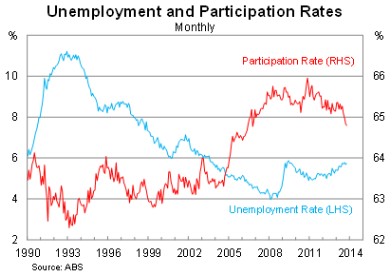
Australia’s labour market participation rate has fallen sharply over the past few months and is now at its lowest level in seven years. But that pales by comparison with the expected decline resulting from ‘baby boomers’ retiring and the population ageing.
The participation rate – the share of working age population in the workforce – is a key measure of labour market and economic health. Since peaking towards the end of 2010, the participation rate has declined by 1.2 percentage points to be at its lowest level since October 2006. Part of this is a reflection of weaker labour market conditions, transitional industries and a non-mining sector that could generously be characterised as subdued. But there is also a longer-term trend pushing the participation rate down: an ageing population…
A lower participation rate affects most aspects of an economy, including growth, health care expenditure and government revenue. An economy’s output is a function of its resources (labour, capital, land, technology etc) and how those resources are utilised. An ageing population directly reduces the share of productive labour resources in the economy. It also reduces the tax base and GST revenues, given older Australians also consume a lower share of their income/wealth. Combined with rising health costs, the result is a government less able to provide the integral services that an ageing community requires…
With the possible exception of climate change, the ageing population is the biggest economic challenge that the country faces over the next few decades. The best way to mitigate the problems of an ageing workforce is to increase the fertility rate, boost migration or raise the retirement age. But the reality is that Australians will have to accept lower growth, productivity and standard of living.
Advertisement
I agree with everything that Pickering has said, except for the suggestion that increasing immigration will help mitigate the ageing conundrum. Immigration only helps to delay population ageing by pushing the problem onto future generations (whilst creating potential problems in other areas). Indeed, when the current batch of migrants inevitably grow old and retire, Australia will find itself in exactly the same position, with policy makers once again seeking to kick-the-can down the road via more immigration.
Ultimately, the best way to alleviate pressures from an ageing population is to: 1) seek out policies that boost Australia’s productivity; and 2) expand labour force participation (e.g. by raising the retirement age). But even with concerted action in these areas, Australia’s employment-to-population ratio will continue to decline, lowering growth and living standards in the process.
Leith van Onselen is Chief Economist at the MB Fund and MB Super. He is also a co-founder of MacroBusiness.
Leith has previously worked at the Australian Treasury, Victorian Treasury and Goldman Sachs.