

The Victorian Department of Sustainability & Environment (DSE) released transfer and mortgage data for the month of February, which revealed resurgent weakness in the number of housing transfers and finance commitments.
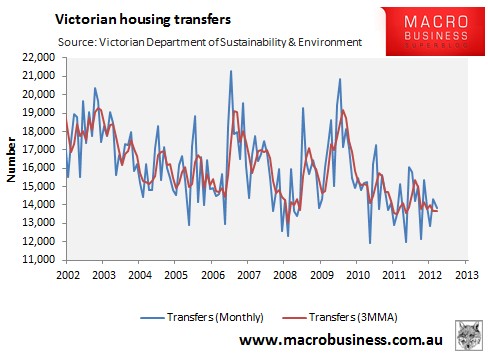
First, the below chart shows the number of housing transfers on a monthly and 3-month moving average basis (3MMA):
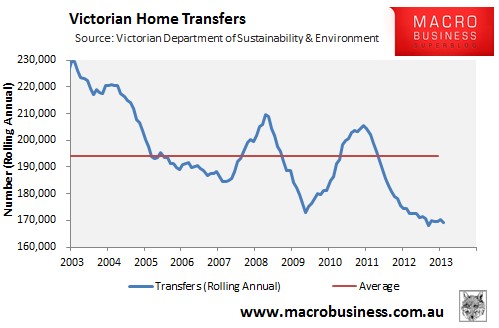
And the next chart shows the same data on a rolling annual basis from January 2003 to January 2013:
According to the DSE, it was the weakest February in the 11-year history of the data, with just 13,819 housing transfers occurring over the month, compared with a February average of 19,718.
Reflecting this weak result, the annual number of Victorian home transfers fell from 170,368 in January 2013 to just 169,025 in February – which is the second lowest level reached in the series’ history (behind October 2012) and 13% below the 11-year average level.
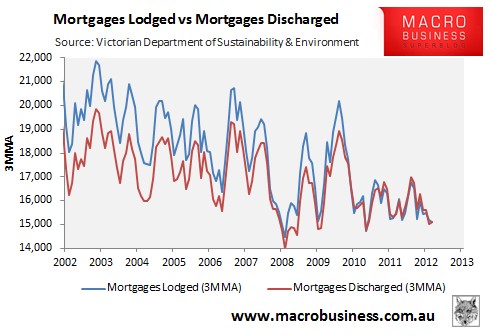
The DSE’s mortgage finance statistics are unique in that they provide data on both mortgage lodgements (i.e. new mortgages) and mortgage discharges (i.e. mortgages repaid in-full). Below is a chart showing both series on a 3MMA basis:
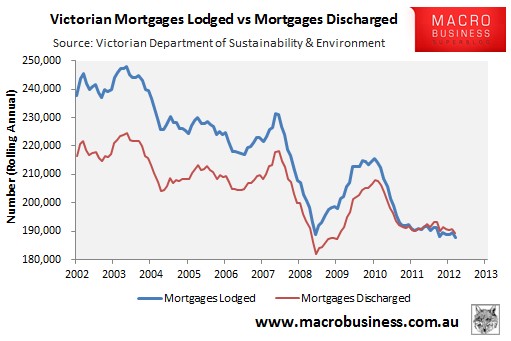
And the next chart shows the same data on a rolling annual basis:
And below is the number of net new mortgages created, calculated by subtracting mortgage discharges from mortgage lodgements:
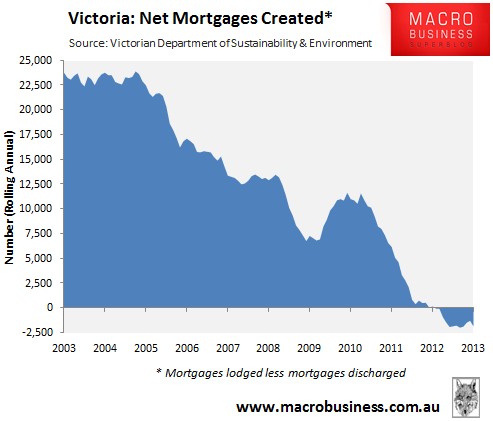
According to the DSE, the number of mortgages lodged in the month of February was -439 less than the number of discharges (i.e. 14,948 versus 15,387). On an annual basis, the number of mortgages discharged (189,483) also continued to exceed the number of mortgage lodgements (187,596), meaning that -1,887 mortgages were lost in the State of Victoria in the 12-months to February 2013, up from -1,306 mortgages lost in January. This compares to the average of around 12,560 annual net mortgage creations since the series began in 2002.
And below is a similar chart showing that the ratio of mortgages lodged to mortgages discharged, which has been below 1.0 since May 2012:
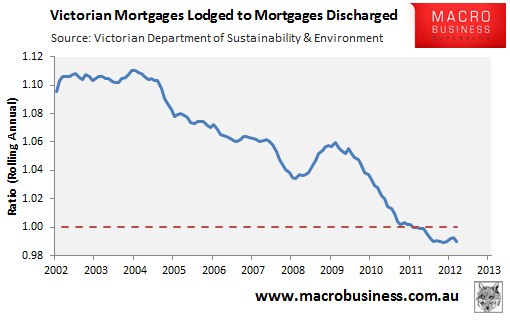
Despite the recent pick-up in Melbourne house prices, which was reflected by an improvement in net mortgage creation between November and January, the data has worsened once more and suggests that the Victorian (Melbourne) housing market remains on a fragile footing.
unconventionaleconomist@hotmail.com


This is great news for people that boycotted the market and are just sitting and waiting. But also looking at those figures I wonder just how bad unemployment really is getting and how many people are just holding off because of a worsening economy.
Already agents have pulled out all the bells and whistles to try sell a package such as throwing in a free car or gift card, doing anything accept dropping the actual price of the property.
Couple that with the possible urban boundary expansion that may happen in NZ and both these markets could implode together.
Yes investors have jumped off at the gun, but the people who buy houses to live in are not jumping.
They don’t want more debt? They don’t have job security? They don’t trust that another short-term housing bounce is not just another political trick to just pump up the construction economy?
bull-trapish.
Hopefully this is a sign that the euphoria from another hit of lower interest rates is running out and having less and less effect each time the needle goes in. Fingers crossed that it’s a sign the collapse in housing is still underway. /proud crashnik
‘Resurgent Weakness’ in the dataset that actually measures Victorian land transaction activity.
Not enough net new money from FHBs. Young adults are now habituated to renting.
The little landlords losing money every time the sun rises can stay irrational only so long. Another year? Three?
Can someone show me a metric suggesting this is a good time to go long and geared Vic property?
Don’t Buy Now!
First Vic, then *hopefully* NSW/Sydney… *fingers crossed*.
Waiting, waiting, with pixels-on-a-screen/fiat stored in a “bank”…
DC – it occurred to me that one of the tools that is under-utilised in the growing power disparity between the ‘little landlords’ and those renting is a kind of renters ‘realestate.com’ that lists houses that have been known to be for rent, who the land-lords were, what the rent was and what the experiences were with the land-lord and the property itself – and done in a kind-of user friendly map/location style like the sales/rental pages.
We see some occasional work from regulators in extreme cases:
http://www.news.com.au/realestate/investing/huge-fine-for-landlord/story-fndbarft-1226592924817?utm_source=rea&utm_medium=qld&utm_campaign=news-widget
but really nothing when it comes to managing the issues with small land-lords.
Are you aware if anyone is working on or has looked into such a project?
This may also give a much more visible representation of how much of our suburbs are locked up in the hands of rent-seekers.
And yet the daily index is showing some genuine price gains since 08/02/2013 for Melbourne, so either volumes have risen since January or we are seeing price gains with lower volumes.
http://www.rpdata.com/research/back_series.html
Could the lower volumes be a result of less people trading up, but the buyer/seller ratio remaining firm?
I watched the early stages of the US stock market recovery where commentators were sceptical of the gains because volumes were low – and yet here we are now at record levels in the Dow and close to it in the S&P500.
Is it absolutely necessary to see increasing volumes in sales to effect a price resurgence?
Grasping at straws yet again!
Or maybe just less people willing to pay the over-inflated prices still demanded by vendors. And vendors are being lead to believe, once again, that prices are booming so will continue to demand ridiculous money for their rubbish. Surely backs will eventually have to break.
The index is based on sale prices, not listing prices, although that is up as well.
Melbourne median sale prices are up 3.45% and almost all of that over the last month. Don’t you think that raises questions?
Is it the index?
Are sales volumes up?
Are prices up on low volumes?
What is the answer – seriously I don’t know, but the questions are relevant?
I agree Peter there are some serious unanswered questions about the Melbourne property market at the moment.
This type of transfer and mortgage data would suggest at best stagnating prices while in actual fact it would seem prices are off to the races yet again.
The question is can prices rises be sustained in the face of contrary data from the mortgage and transfer rates?
The potential crux of this entire argument is Melbourne’s stock on market, which is higher than it was at this point last year, if we do see it climbing to all time high’s like it did last year we may see prices trend downwards. Or at least thats my current working theory.
HIgher prices (if that’s reliable) on lower volume isn’t bullish.
“The index is based on sale prices, not listing prices, although that is up as well.”
Not according to this:
http://www.sqmresearch.com.au/graph_median_weeks.php?region=vic%3A%3AMelbourne&type=c&t=1
Sure, rich foreigners buying property, it is the only thing that could be driving that market !
Guaranteed!
.
The only clients we have buying and developing are either Asian / Indian.
.
The powers that be allowing foreign ownership should be skinned alive and thrown into a barrel of salt.
….
I hope karma comes back ten-fold on these sell-out scumbags!
The RPData price series isn’t based on prices being paid today. It’s based on sales that have occurred some time ago, so there is a lag of several months.
Just have a look at where they source their stats – the same state Gov. organisations that everyone else gets the sales data. The data only comes through sometime after settlement (i.e. at least 6-8 weeks after the sale, and generally much longer than that by the time it is published), which is why the ABS continues to revise their stats for up to 9 months after they initially release their price series.
RPdata effectively revise their index on a daily basis, but the prices aren’t for sales made today.
Nathan – the SQM data is still showing elevated list prices over the pre-Xmas period.
The RPData index – I can’t find a link but I’m sure that CJ has told us that they capture 4% of the sales on RE agents data and the rest of the data catches up, so it’s a daily index based on REA reported sale prices.
That still doesn’t mean that the index can’t be wrong, but it has been pretty right so far.
Anything reported by the REA’s should be viewed with extreme scepticism!
.
Much like your postings!
Christian there are a lot of well informed commentators asking the same questions that I asked above.
AF suggested foreign buyers, and that might be part of the answer, but could there be more to the story? Try to look past your self interest.
Hi Peter,
They’ve got their methodology document on their website for you to look. You can see for yourself exactly where they get the input data. Secondly it has a strong correlation with mortgage sales, but lagged by 6 months. Yes, the index has been pretty good, but it’s a lagging indicator.
SQM is showing an increase in listing prices prior to Christmas, but we’re now in March, and since Christmas listing prices have been trending down.
Why did you omit that?
If that is the case we are seeing the price rises that correspond to the small uptick in mortgage lodgements we saw in the later half of 2012 as is shown on the net mortgages created graph.
Now it would appear the trend has reversed and will be heading down back to mid-2012 levels.
I can’t see the price rises continuing in Victoria, however the market seems to of completely decoupled from reality, so making any sort of accurate short term prediction seems like a fools errand.
“We record all available sales and use them as the data arrives in our database. We use statistical methods to account for the timing difference between the sale date and the date we receive the information. If we receive information about a sale one week after it has occurred, we use that sale data to update our current view of the market, mathematically taking into account that the sale occurred one week ago.
http://www.propertyobserver.com.au/residential/rp-data-rismarks-defence-of-the-daily-hedonic-home-value-index/2012070555447
In order to report its monthly measure, RP Data substantially augments the sales data they receive from government agencies with ‘real-time’ information acquired directly from proprietary sources, such as Australia’s largest property portal, realestate.com.au and real estate agents. (Over 70% of Australia’s real estate agents use RP Data’s software to service their clients.) This real-time data has been tested to be highly accurate and furnishes RP Data-Rismark with up to 50% of the total population of final home sales within one month of the subject period.
http://christopherjoye.blogspot.com.au/2010/01/house-prices-for-dummies.html
I appears as if the latest figures show a deceleration in the rate of mortgages lodged.
This will lead to a drop in house prices.
For evidence of this correlation of change in the rate iof mortgages (dept) v prices refer to Steve Keen blog
http://www.debtdeflation.com/blogs/2013/02/05/mortgage-acceleration-house-price-changes-the-result/
I’ve given up on Keen. He’s missing too many variables. Prices are rising not falling like the model would lead you to expect.
I’d actually say his model has been really good, but it’s his commentary that has been rubbish. When his model was predicting a flatish result for 2012, he was out saying that prices would fall 10%!
Yeah, but what if the only things that foreign investors are buying are the more expensive houses, this will push the price up on a low volume market
Good news indeed, .ope feb will be remembered as a dead cat bounce
If one looks at a graph of the Melbourne market it does very much look like being in the classic bull trap phase of a bubble.
If that is the case then the question is how long does the bull market last before the final faceplant of the market?
Personally I can see the good times rolling for a few months but by the end of the year I can see the trend turning down.
I sacked 1/3 of my workforce yesterday.
The reasons were purely economic.
Unfortunately he was the only one in the team with a mortgage, and in a new Point Cook hotbox.