RBA drops the ball on housing supply

By Leith van Onselen

The Reserve Bank of Australia (RBA) last night released a speech (below) Christopher Kent, Assistant Governor (Economic), entitled Recent Developments in the Australian Housing Market.

The speech contains some useful data and analysis of current trends affecting the housing market, including rising prices on low transaction volumes, the recent pick-up in dwelling approvals, and the collapse of first home buyer mortgage demand (and the growth of investor demand).

My main issue with the speech is its discussion on the supply-side, which seems to insinuate that Australia’s planning system is not particularly restrictive and housing supply has been fairly responsive to increases in demand:

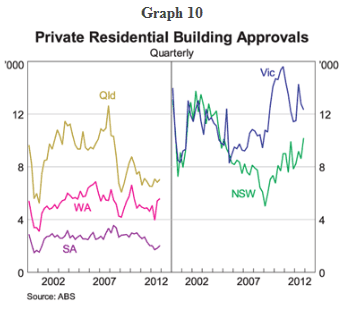
Factors affecting the supply of land for development will obviously have an important bearing on the cost of new housing, and the speed with which any increase in demand for housing can be accommodated by a rise in construction… whatever these supply-side constraints might be, they don’t seem to have prevented an increase in construction across much of the country in 2009 and 2010. At that time, a general increase in incentives for first home buyers (for both new and existing dwellings), and the support provided for a time by lower interest rates, led to a sharp run-up in construction in New South Wales, Queensland, Victoria and Western Australia (Graph 10).

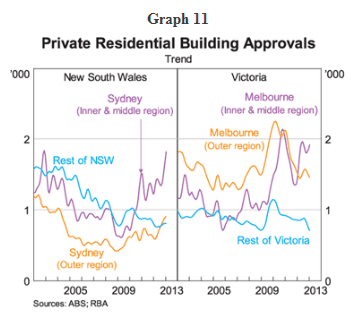
Further evidence that the supply of land is not the whole story can be found by looking across different regions within the states. If supply has been the critical constraint, we might have expected construction trends to have been very different across inner and outer parts of cities and the regional areas beyond the cities. For example, development in the outer suburbs tends to be on greenfield land, while development in the inner suburbs tends to be higher-density dwellings on brownfield land. However, for Victoria at least, the pick-up in building activity in 2009 and 2010 was relatively broad based across these different areas (Graph 11). For New South Wales, it does appear that there was a larger and more sustained pick-up in approvals in the inner and middle regions of Sydney, than in outer Sydney and the rest of the state. This may have reflected some limitations in access to land on Sydney’s fringes, but nonetheless, there was a relatively rapid pick-up in approvals in 2009.

Even so, this doesn’t mean that supply-side issues have not had an important bearing on the housing sector. This point was made in research published in one of the Bank’s Bulletin articles last year. Many public reports and the Bank’s own liaison with industry participants pointed to a range of supply-side impediments in the Australian housing market. These included the length and complexity of the planning process, the provision and funding of infrastructure, land ownership and geographical constraints, as well as the challenges for development within those city regions that are already well developed. While these factors may impose some constraints on the cost and responsiveness of new supply, it is less clear that they have been restraining the level of new construction more so now than in the past.

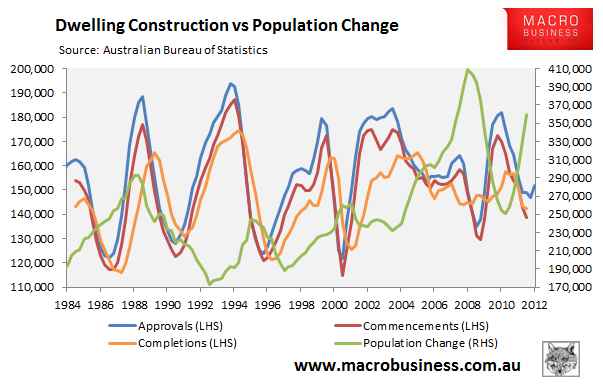
My concerns with the RBA’s analysis are two-fold. First, an examination of dwelling approvals, commencements, and completions data against population growth shows that housing construction has shown zero pick-up, despite the huge surge in house prices since the mid-1990s and the boom in population growth since the mid-2000s (see next chart). Therefore, it is wrong for the RBA to suggest that housing supply has been somewhat responsive to increasing demand – it hasn’t.

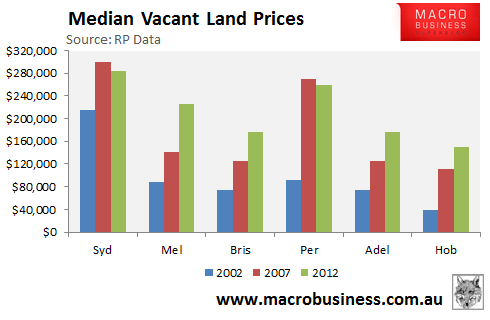
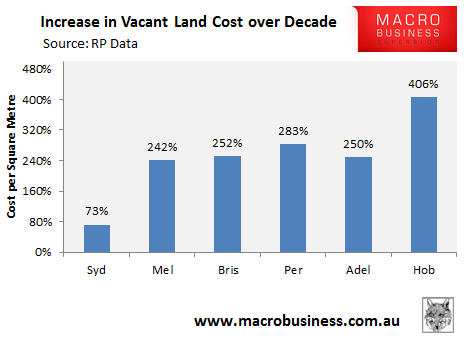
More importantly, the RBA speech does not mention the huge escalation in fringe vacant land costs over the past decade, which are bonafide proof of impediments to land supply. A 2008 speech by the RBA’s Anthony Richards explained these dynamics well:

…supply-side factors should have a much greater influence on prices towards the fringes of cities, where land is less scarce and accounts for a smaller proportion of the total dwelling price. In principle, the price of housing there should be close to its marginal cost, determined as the sum of the cost of new housing construction, land development costs, and the cost of raw land. And in the absence of any restrictions on supply, the price of raw land on the fringes should be tied reasonably closely to its value in alternative uses, such as agriculture. So unless there has been a marked increase in the value of this land when used for other purposes, the availability of additional land towards the edges of our cities should have limited increases in the cost of housing there…

So if we are looking for explanations why housing is not as affordable as we might like, it may be necessary to look at factors on the supply side as well. One obvious place to start is the cost of land for building new houses near the edges of our cities…

There are no doubt a number of factors that could be contributing to the observed level of land prices… One factor that has been widely mentioned is the existence of various constraints on land development, including growth corridors and boundaries. Another factor that has been mentioned is the existence of a range of government charges, including developer levies or infrastructure charges. More broadly, concerns have also been expressed that zoning policies and building approval processes have hampered in-fill development closer to the city centres.

Both economic theory and international evidence suggest that housing prices can be boosted by land usage policies (which can create artificial scarcity of residential-zoned land), problems with the complexity of the development process (which creates rents), and the fees and charges imposed on development. Accordingly, the fact that higher prices for housing have not resulted in a more significant supply response could be a reflection of various supply-side costs that have represented a wedge in the cost of bringing new housing to market.

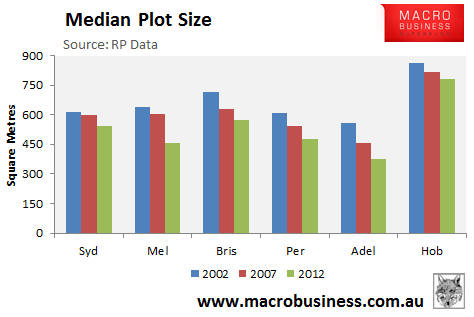
So what has happened to vacant land costs on the fringes of Australia’s cities? They have literally skyrocketed over the past decade as plot sizes have shrunk (see below charts).

If the above isn’t evidence of increasing supply-side rigidities, I don’t know what is. Anthony Richards recognised these dynamics in 2008. It’s shame that Christopher Kent has not displayed the same level of understanding.

unconventionaleconomist@hotmail.com

www.twitter.com/Leithvo

RBA Speech – Recent Developments in the Australian Housing Market (14 March 2013)


36 Responses to “ “RBA drops the ball on housing supply”

  1. The Lorax says:

    I am staying away from this today!

  2. bskerr2 says:

    This is one reason supply sucks, because large multinationals buy it all up

    http://www.theage.com.au/business/ge-to-cash-in-and-lend-out-20130314-2g3em.html

    • PhilBest says:

      So why don’t large multinationals buy it all up around the 150 odd cities in the USA where it stays affordable regardless?

      • PhilBest says:

        Considering basic urban economics: the land value curve for an urban economy slopes up from fringe to centre based, among other things, on the cost of transport saved by a more central location.

        Where there is no UGB and no bidding war for the quota’d supply of land, this curve’s slope is gentle and continuous. It actually extends miles out into the country beyond the existing fringe, and the amount of land involved is massive; like 100 years or more “supply” for urban growth.

        If some speculator “corners” all the land within the first mile or 2, which is quite some feat, then competitors can simply “leapfrog” the holding. It is only 2 minutes drive on an open road anyway, and about another $1,000 worth of real estate value versus “transport costs saved”.

        This is how it works in cities without an Urban Growth Boundary.

        “Affordable housing” is basically an issue of whether or not people can “leapfrog” land bankers holdings to build themselves houses. When there is no UGB, as in the affordable US cities, no-one bothers to land bank. The “supply” economically accessible to the urban economy via a few minutes and a couple of dollars worth of further car travel, is far too big for anyone to “corner”.

  3. Pfh007 says:

    No real surprise that the RBA struggle to get their heads around the issue of housing supply.

    Bearing in mind that central to their universe is the idea of using low interest rates to drive credit and the main outlet for that credit is housing and all the industries dependent on it, and they believe that outlet needs constantly rising prices so the punters dont run a mile, HOW ON EARTH could they simultaneously argue that the housing market is dysfunctional on the supply side with the obvious implication that if it was fixed prices would decline.

    Their heads would simply explode!

    Better to pretend all is hunky dory on the supply side.

  4. Mav says:

    Nothing to see here.. Capt Glenn admitted in parilament that he is no expert on supply, even as one Dr Kent was sitting mum next to him and dodged the question.

    Mr CRAIG THOMSON: Governor, I am going to ask questions about mortgages, too. In particular, you talked about housing prices having been on the rise since May of last year, and very soon we will get to the issue of housing affordability again, as being a strong political issue at least. In the last 20 years, we have seen the size of mortgages increase, and therefore the importance of small interest rate rises has been more profoundly felt by households. I am seeking some comment in relation to not so much the way in which the Reserve Bank has dealt with interest rate rises but other policy measures looking at supply side issues that you think policy makers should be looking at.

    Mr Stevens : It is outside my field of expertise, really, to say very much about that. There are people around, I am sure, who are more expert in the dynamics of the supply side. What you say about the rising size of mortgages is quite right. It is oversimplifying somewhat, perhaps, but not completely, to say that the rate of interest halved and we decided that we would borrow twice as much. The cynic might say—well, we borrowed a lot more as a society. It is true that any given rate rise has a bigger impact, which is why the rises tend to be smaller. We used to raise it 100 points at a time, at one stage. So that is all true.

    As to the supply side: it is complicated, because there have been preference shifts. I think it is much more prominent now for people looking for their first couple of dwellings to want to live closer to the city, particularly if they are young professionals. People I think have had some changes in preference about location. But that of course means you have to bear higher costs. So there are preference shifts going on. Beyond that you are into things like zoning rules, and costs that are loaded onto developers for various good things that regulators think new developments should have. You also have issues where new developments and the existing residents do not like certain things that are being proposed. All these things are relevant. I do not know enough about them to give an expert opinion on how important they are. I simply think that a question I cannot quite get away from is: how it is, in a country with this much land, we certainly do not have cheap dwelling prices compared to the rest of the world—and I would have thought that that might be a natural advantage for us, but we do not have that anymore.

    Mr CRAIG THOMSON: Is there a role, then, for national governments? Largely, supply issues are left to local councils. The issues in relation to the releasing of that land can be different from one council to the next, and there are legitimate issues in relation to what the local community thinks about particular releases. But surely there is some role in the supply side that a national government could play in terms of how that supply is released and where.

    Mr Stevens : I think you are trying to draw me into something I do not know enough about to really offer an opinion on. I do not think I am going to step into state versus local versus federal. If you do not mind, Madam Chair, I am going to duck that one. I just do not know enough about it.

    http://parlinfo.aph.gov.au/parlInfo/search/display/display.w3p;query=Id%3A%22committees%2Fcommrep%2Facabdfe3-97ce-4998-b908-f679e2f49be2%2F0001%22

    • Pfh007 says:

      Nice work Mav.

      That quote sums up perfectly the RBA obsfucations when it comes to the obvious fly in their low interest rate debt driving agenda.

      The prices of the prime object of all that debt – housing assets – are inflated by massive market dysfunction.

      Admit that, or god forbid bang on about the need for all levels of government to address that issue as a matter or urgency, would be to draw attention to the madness of their enthusiastic yanking on the low interest rate lever and the house prices that are its consequence.

    • PhilBest says:

      Actually, Glenn Stevens and Anthony Richards were saying such insightful things about land supply as recently as 2008, that Wendell Cox has repeatedly quoted them in his annual Demographia Reports and other papers.

      One day a history might be written that tells who and what “got to” the RBA people on this point.

      • Pfh007 says:

        I doubt anyone got to them.

        Most likely they eventually got to the point that the cognitive dissonance of driving credit/house prices AND arguing that there should be action on supply to drive house prices down became all too much.

        The push me pull you in Dr Doolittle had a similar problem.

      • PhilBest says:

        This dissonance was one reason why Don Brash quit being Governor of the RBNZ and went into politics. It is a great pity he did not make it to PM in 2005; if he had done so, NZ would have had land supply regulations reformed and the house price bubble reverting to mean instead of still ratcheting upwards for years later.

  5. bp says:

    It may be a huge surprise to many but the Australian housing market is not actually under-supplied. Using the latest census numbers we now that unoccupied housing has increased, number of persons per household has not changed, completions roughtly equal underlying demand (possibly slightly higher than demand). We also know that in Vic/ACT completions have outstripped ‘underlying demand’ for quite sometime yet neither has seen great improvements in affordability.

    The new stock that is added is only tiny compared to the 9M stock in total. Back in the early 00′s Sydney was adding a lot of completions (around 50K across the state) which was about 20K ahead of underlying demand yet we saw house prices go crazy! The link between new supply and house prices is very weak. House prices are more strongly driven by demand factors such as credit, int rates, expectations of returns (which are now very poor).

    It is amusing that we supposedly have these massive supply shortages/rigidities but as soon as we throw a few $s the way of the FHB (via up to 28K in grants in 2009) we start building like crazy and these supply issue evaporate.

    Here in my home state of the ACT we’ve been building up to twice underlying demand for the last few years (up to 5K pa) and we are now struggling to sell the vacant land or new apartments. The impact on price has been minimal with the ACT mostly following the national trend of flat prices over the past year or two.

    Supply is no doubt important but keep it in perspective! it aint everything.

    • Pfh007 says:

      The reason many would be surprised by your assertion that Australia “is not under supplied” is that they know that the vacancy rate for rental properties remains tight and the demand for new housing is low due to the high and sticky price of the housing on market rather than any lack of desire on the part of people to buy houses.

      “Vacancy Rates Australia’s national vacancy rate fell to 1.9 per cent as of January 31 from 2.3 per cent in December, figures from SQM Research show. Excluding Decembers, when vacancies see seasonal spikes, the rate has remained at or below 2 per cent since September 2009.”

      Read more: http://www.smh.com.au/money/investing/investors-scramble-as-rental-crisis-bites-20130312-2fxj1.html#ixzz2NYfevpXK

      • bp says:

        http://www.sqmresearch.com.au/graph_vacancy.php?national=1&t=1

        One needs to be careful with vacancy rate stats. I would read more into the trend or movement than the actual numbers.

        In any case, if this supply crisis was really biting then the vacancy rate would surely have declined (I would take no notice of monthly movements). Since 2005 the rates are about the same – in fact slight upward trend over the past few years.

        Certainly there is a shortage of affordable supply. The market does not supply new housing that is affordable to low income households and trickle down isnt exactly opening up the market to these households either.

        Oddly enough though rent stress and mortgage stress numbers are little changed over the past decade.

        Does anyone have numbers on proportion of sales that go to os buyers? I don’t think we do but I’d be intrigued to know. Fact remains that for Australian residents (using the ABS surveys) household size numbers have declined for a long time only increasing very modestly at the end of last decade.

      • PhilBest says:

        What I want to see a breakdown of, is the percentages of Aussie home “owners” who ACTUALLY “owned” their home – debt free, in 1960, 1970, 1980, 1990, 2000, and now. It would also be worth breaking down the percentages of people who owed 90%+, 80%+, 70%+, and so on.

        The trend has been absolutely fabulous for the mortgage lending sector.

      • Alex Heyworth says:

        Can’t give you those dates, Phil, but I can tell you that the % of households which owned their home outright fell from 41.7% in 1995 to 32.6% in 2010. Gleaned from Survey of Housing Occupancy and Costs, ABS 4130.0.

      • The Claw says:

        Fact remains that for Australian residents (using the ABS surveys) household size numbers have declined for a long time only increasing very modestly at the end of last decade.

        It is amazing how Australian family size has shrunk. In the old days mum had 8 kids. Now a mum might have 2 kids and granny lives all alone.

        Another fact is that the number of people who misinterpret statistics has been rising since the Internet and Google became available.

      • PhilBest says:

        But check this out:

        http://www.prosper.org.au/wp-content/uploads/2012/06/Philip_Soos_Speculative_Vacancies_2012_Report.pdf

        Interesting approach, using water use as a proxy to estimate the likely occupancy rates in neighbourhoods.

      • The Claw says:

        5% of dwellings appear to be unused (as defined by the method).
        If Soos could be bothered he could read a few water meters himself and ask about and find why these dwellings are unused. Instead he takes a wild guess.

    • Alex Heyworth says:

      bp, two points in response: a good deal of the new “supply” is not supply at all. It is overseas money buying property in Australia as a hedge in case things go wrong for them at home (mostly China) and they have to leave in a hurry. These properties stay empty because that’s the way the owners want it. Many properties in China are exactly the same.

      The other factor you have to take into account is the price. If new land is released at particular prices, the selling price for the house/units built on it must reflect the cost to the developer.

      Eventually developers may be forced to sell at a loss, but this takes a long time. They are very reluctant to do this because it also implies writedowns of their substantial land banks (much of which doesn’t actually have the necessary approvals to be developed as yet).

      The problem is not that supply doesn’t meet demand, the problem is that land supply is still restricted and therefore price constrained. Allow building at any density the owner likes on any land around a city and the price will plummet.

      • Right on.

        **Also, it’s worth having a think about where the population growth is coming from:

        The “demand” from families adding to the population growth from births are unlikely to wait till the day the baby is born to register as demand. Some may seek out larger homes beforehand, many will not (we should expect there to be a lag between pop growth from births & actual demand).

        As for migrants, we should consider the cultural background. Our idea of what constitutes a “normal” household size isn’t necessarily what is considered normal by the country of origin of many of those choosing to call Australia home

    • aiecquest says:

      +1 have heard all sorts of reasons for property prices, including same that were used in the UK some years ago…… know for a fact population growth has been overstated (without qualitative analysis) but that has been used by both xenophobes and property spruikers.

      Maybe it is impossoble to analyse because property ownership and mortgages are more a religious type of phenomenon as opposed to rational decision making…..

      • willynilly says:

        +2
        There are many burbs in all capitals that have population decline. Jindalee, Chelmet, Rochedale etc in Brisbane but prices went up. Population increase or decrease does not determine house prices ar demand. The absolute number of people of a particular age does.

  6. tsport100 says:

    Those RP Data sourced Vacant Land Prices don’t look right to me (for NW Sydney at least) Landcom New Land and House deals in the NW have maintained an average land price around 350k for at least the last decade.

    Sure the land size has shrunk as developers also get more ridiculous about road sizes and simply delete back yards etc.

    There’s a $100k variation in vacant land prices between North and South in Sydney today.

    • PhilBest says:

      The land cost is the crucial factor in “affordability”.

      All the affordable cities in the USA have an average section size of around half an acre or more, and these sections are well under half the price of one tenth of an acre in the UK, Aussie, or NZ.

      When you net everything else out, structures, costs of development, etc, the factor of the difference in raw land price per square foot is something like hundreds of times. SOMEONE, SOMEWHERE, is absolutely creaming it with zero-sum unearned gains of this magnitude.

  7. Muzzer018 says:

    Supply means nothing to me and many others, you could have 10 or 100,000.

    I couldn’t care less, if you don’t price them right then rent on boys, rent on.

    Just smile and wave!

    • willynilly says:

      Well when we have 23% as lone occupants, the most spare bedrooms in the world and 10% of our homes with 5 or more people, the shortage is just that, a shortage of understanding.

      • The Claw says:

        If “we” were a caring and sharing family then your comment might make a bit of sense.
        Sadly there are other countries where obese elites drive past starving people daily. I suppose that is not a shortage of food either. Cold comfort for the dying.

  8. The Claw says:

    It may be a huge surprise to many but the Australian housing market is not actually under-supplied. Using the latest census numbers we now that unoccupied housing has increased, number of persons per household has not changed, completions roughtly equal underlying demand (possibly slightly higher than demand). We also know that in Vic/ACT completions have outstripped ‘underlying demand’ for quite sometime yet neither has seen great improvements in affordability.

    Here we have a multi-point shortage-denier. First the Census indicates oversupply and if that is not enough, then some other cockamamy thing is used to deny the shortage.

    Here is another arrow for your oversupply quiver:
    “data produced by planning agencies shows around 95% of all development applications in NSW and Victoria are approved, a rate which has been more or less stable for the past five years”

    I am sure that, in your mind, this also proves there is no shortage.

    • Janet says:

      Claw. It’s Friday night. Let’s just suggest that there is a property market problem in our countries, and come back on Monday and fight from the red (shortage) and blue( deniers) corner. They, after all, are the same fight?

      • The Claw says:

        Does a fisherman go home just as the fish start biting?

      • DrBob127 says:

        Translation: Who’s that tripping over my bridge?

      • The Claw says:

        But who is the creature UNDER the bridge?

      • PhilBest says:

        Here comes big Billy Goat Gruff…..

        Claw, has China got a shortage of “housing”?

        Their empty apartments and indeed whole cities is the stuff of legend.

        But twice as many households as there are empty “homes”, are living in informal shanties and on rural plots with no title.

        But in long-since-fully-developed countries we don’t find out if there really was a shortage or not, until we see how fast the empty properties sell after the prices have come back down to “sane”. Given that there are still quite a lot of empty properties in Spain and Ireland even though the prices are “give-away”, can one conclude that they did manage to have both an unaffordability crisis, a price bubble, AND over-supply?

        But the empty homes in Arizona seem to have been bought up and the prices rising again from their sane levels; so we can conclude that there never was an “oversupply” there in spite of all the mythology. Leith gave us accurate figures recently that confirmed this. And Australia’s “build rates” over a comparable period have been higher than Arizona’s – so rationally there is even more basis for a mythology of oversupply, than there was with Arizona.

        I pick that a resumption to “sane” prices would see any overhang of houses in Australia sold, to the large number of people under about 35 who are currently “priced out”, plus a whole lot more relatively well-off young people who might buy at 22 instead of 28.

      • Alex Heyworth says:

        Phil, check above for my reply to your question about outright ownership.

      • The Claw says:

        I’m no expert on China but I am sure that such a large country would have many shortages related to housing. An expert could list at least 1000 shortages.
        If you are asking about an “overall shortage” – there is no such thing.
        Empty cities, to us they appear to be an oversupply. But who built them and why? without these answers we cannot make sensible comment.
        Regarding your last comment, in Sydney there is a severe structural shortage of housing. No financial crash will get all deserving young families into decent housing – there is not enough of it to go around. I am sure of that.

      • willynilly says:

        “Well there you have it, its official, the average Sydney home is 8x wages!

        NSW givernment through Landcom is going to self build tens of thousands, and push private enterprise to build many more homes.

        The target is 100,000 for Sydney.

        http://m.dailytelegraph.com.au/realestate/news/sydney-housing-dream-on-track/story-fncv6y42-1226598570237

        MORE than 100,000 extra homes will be built in Sydney as part of a radical overhaul to create affordable housing near public transport links.
        Planning Minister Brad Hazzard will today offer his blueprint to stop Sydney being the city that few can afford – where the average home is worth eight years’ wages, and the average Sydneysider buys their first home aged 38.
        The plan, to allow young families into home ownership and stop workers getting stuck in daily gridlock, includes more than 27,000 new homes and 50,000 jobs created around the eight new stations on the North West Rail Link.
        It could spell the end of an era of homebuyers being forced to the western fringe to afford a home, and then stuck in bumper-to-bumper traffic for hours every day…….”