Stock on market up in Melbourne, down in Sydney

By Leith van Onselen

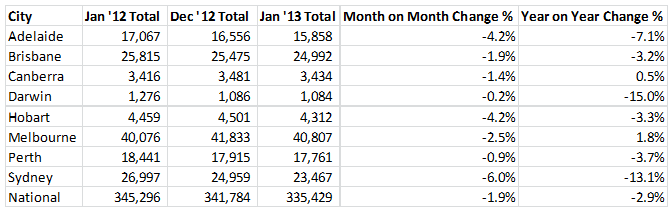
SQM Research today released stock on market figures for the month of January, which reveals an ongoing reduction in the number of homes for sale nationally. According to SQM, for sale listings fell by -1.9% over the month of January and were -2.9% lower than the same period last year (see next table).

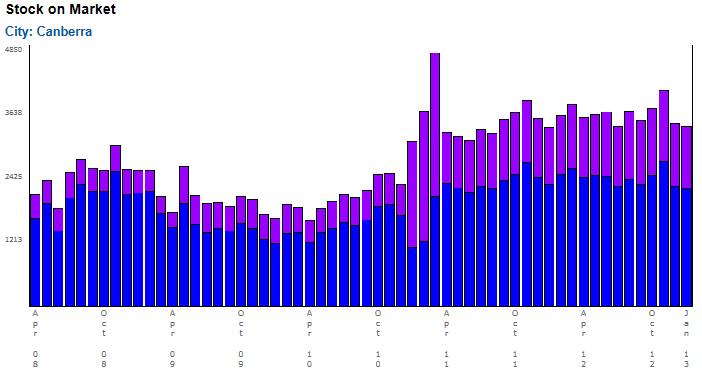
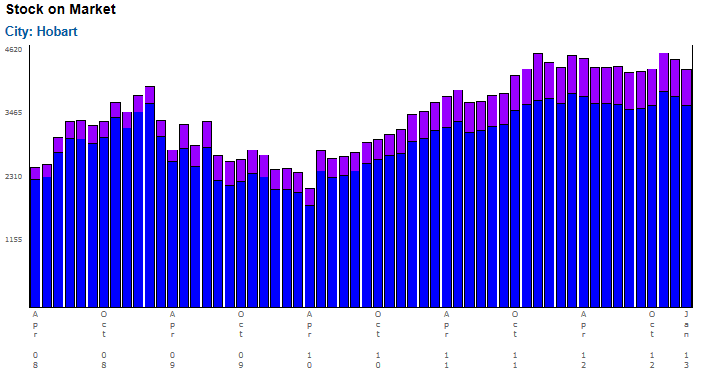
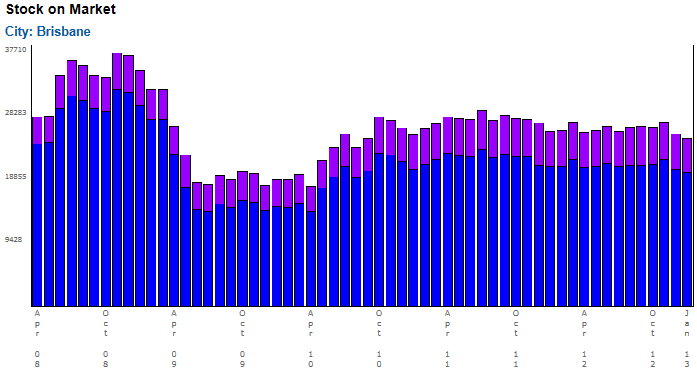
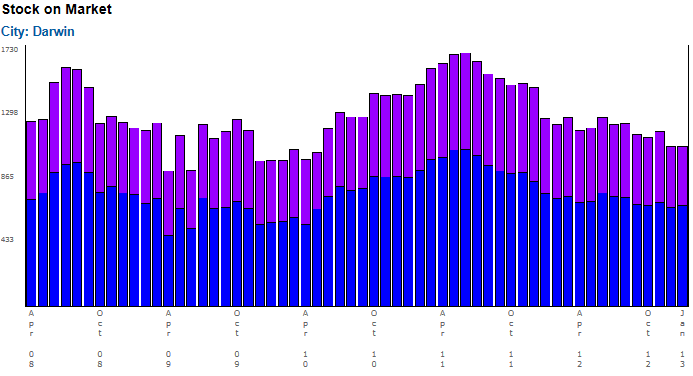
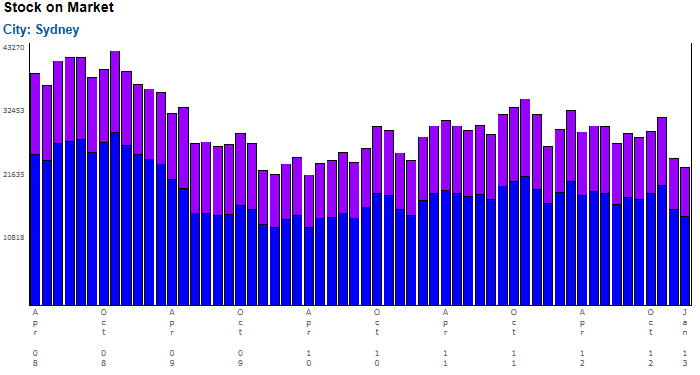
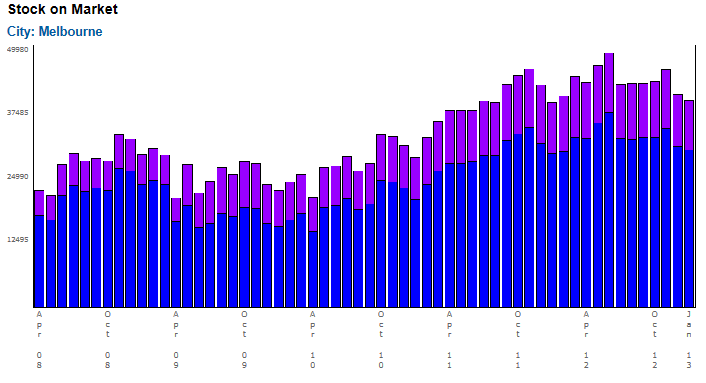
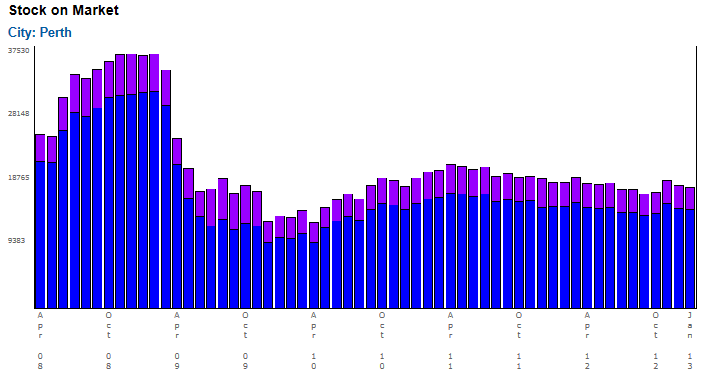
The divergence between Australia’s two largest cities – Sydney and Melbourne – continues, with Sydney stock levels falling sharply over the year (down -13.1%), whereas for sale listings in Melbourne have risen (+1.8% year-on-year). And while the overall number of listings in Sydney is well down compared with recent history, Melbourne’s listings remain highly elevated (see next charts, with houses in blue and units in purple).
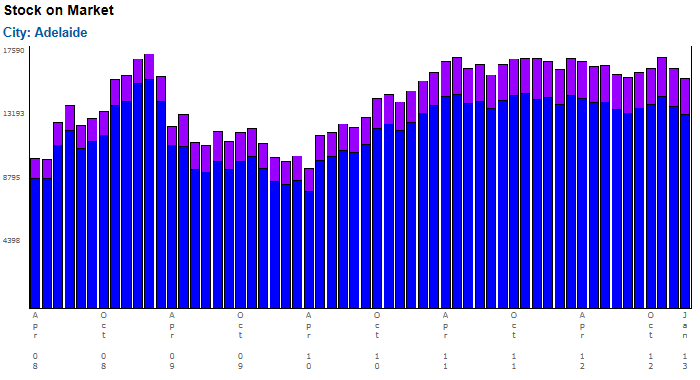
Elsewhere, listings remain fairly elevated in Adelaide, Canberra, and Hobart:
But remain fairly tight in Perth, Brisbane and Darwin:
unconventionaleconomist@hotmail.com

www.twitter.com/leithvo


66 Responses to “ “Stock on market up in Melbourne, down in Sydney”

  1. Archie says:

    Looks like Sydney is getting set for a powerful upsurge in prices.

    • General Disarray says:

      Your one-line housing spruiks provide valuable info here at MB. Do you have a newsletter I can subscribe to?

      • krazy.galah says:

        I thought MB comments were above basic trolling unless with a spray of wit added for interest.

        The Kouk must be doubling as Archie today in order to give a shot in the arm to his 2013 prophecy.

      • Archie says:

        Why is it ‘trolling’ to suggest that Sydney might be set for an upsurge? An upsurge is common after such a sharp decline in stock. It means people must bid against each other for the remaining stock. Why is it ‘trolling’ to mention this?

      • Nick says:

        If someone has removed their property from market and it has not sold, then they are not able to upgrade, therefore less buyers in the market for the remaining lower stock pie. And lower pricing expectations on failed sales.

      • Archie says:

        But Sydney prices are rising quite steadily according to RPData and APM and Residex. ABS will likely conform this tomorrow.

        And SQM says the market is recovering.

        So your theory is not borne out by what is happening in the market.

      • Nick says:

        RPData/Rismark daily index rolled over around 23rd January and has been steadily declining since.
        http://www.rpdata.com/research/back_series.html
        Sydney, Melbourne, Perth and Adelaide all down.

        And I don’t care what SQM ‘says’. The data ‘says’ houses are being removed from the market because they are not selling.

      • rich42 says:

        @Archie.

        ” It means people must bid against each other for the remaining stock.”

        It’s not just supply and demand. The demand’s there no doubt. It’s money availability that’s the limiting factor. People are maxed out, more demand cannot therefore make a difference.

      • Archie says:

        If people are maxed out, why have Sydney house prices just surged to new record highs according to Residex and APM?

      • jelmech@bigpond.com says:

        Are the record prices supported by record volumes too, Archie??

      • Mav says:

        Archie, any idea on how Northern Beaches properties are doing? I heard they are down, especially suburbs in the Pittwater council.

    • russellsmith55 says:

      Oh goody gum drops – so it appears you’re going to be a regular here now with your lazy, one-eyed, one-lined analysis-less cheerleadings.

      And won’t we all be richer for it… because what MB really needs is further FUD to obscure the genuinely insightful and balanced comments of some of its regular posters.

    • Bobby Fischer says:

      Looks like trolling is getting set for a powerful upsurge in spruiking.

    • tsport100 says:

      Yeah right… the most expensive market in Australia is going to surge upwards?? Sales are stalling due to lack of affordability so inventory is being pulled from the market?

      Sales are currently at 16 year lows, a basic ingredient for a ‘surge’ is DEMAND! At current over-inflated prices, demand is subdued!

  2. Archie says:

    Here is Louis Christopher’s view (from SQM research, who published these figures.

    ““There are a number of signals now that the market is gaining some traction,” SQM Managing Director Louis Christopher said in the statement. “The interest rate cuts are now working and that a housing recovery is now occurring.” “

    • Nick says:

      Well, he has to say SOMETHING, doesn’t he? And surprise, surprise. Interest rate cuts are FINALLY working. Must be the answer.

      • Peter Fraser says:

        Not quite, Louis can see data that we can’t. He is releasing a new index very shortly, perhaps that will give weight to the discussion.

    • russellsmith55 says:

      There you go, a little bit of evidence to back up your opinion. Wasn’t so hard now was it?

      I think it’s a big leap to go from Mr Christopher’s comments of ‘gaining some traction’ and ‘a housing recovery is now occurring’ to ‘Sydney is getting set for a powerful upsurge in prices’.

      • Archie says:

        What evidence have you posted to back up your own position?

      • russellsmith55 says:

        I’m critiquing your evidence, which does not agree with the large body of evidence actually published here. Suggesting a strong upsurge without even suggesting a percentage increase or linking it to previous patterns is a bit silly.

        I can give you an analogy if you want – ‘The recent trend of moderate rainfall is easing to light showers.’ Could I use this to conclude we’re heading for an imminent drought? Or should I perhaps restrain my optimism and suggest only clear skies in the future?

      • Archie says:

        Just giving my opinion mate, I see a strong upsurge in the making. You’re welcome to disagree, but let’s be fair, the ‘body of evidence actually published here’ hasn’t exactly ‘nailed it’ in terms of what happened to house prices.

      • Archie says:

        Also, remember what happened in 2009 when Sydney stock levels got this low. House prices jumped 20%.

      • Bobby Fischer says:

        Interest rate cuts are working ‘Arch the demarche’!? (or can I call you ‘Dam’?)

        Wrong. You obviously haven’t read LVO’s little interest rate analysis here showing that the interest rate lever is broken compared to previous easing cycles->

        http://www.macrobusiness.com.au/2013/01/housing-ignores-swan-rba/

        Here’s a little quote to show that your interest rate cuts are not working:

        “To illustrate just how muted the response to interest rate cuts is this time around, consider the below charts, which compare the growth of various housing demand indicators against previous interest rate cutting cycles, namely those starting in 1990, 1996, 2001 and 2008 (depending on data availability).

        As you can see, total outstanding housing credit has risen by only 4.6% since October 2011, versus an average 13.3% rise at the same stage of the four prior interest rate-cutting cycles.

        It’s a similar story for the ABS housing finance series, which has registered only 11.5% growth in the total value of mortgage commitments (i.e. owner-occupied excluding refinancings plus investor finance), versus an average 34.0% growth in the previous four interest rate-cutting cycles.”

        ‘Arch the Demarche’, this aint looking so good for your undisclosed property sector nong narrative.

        Seriously, next you’ll be telling us that Sydney housing values are based on ‘fundamentals’ or that we have a ‘land shortage’ in this country.

        MB, please give this muppet a guest post so that he can be excoriated for his spruiking…

      • russellsmith55 says:

        Difference of opinion is a good thing, but without evidence its just useless schoolyard tit for tat. And when you add in cheesy RE spruik like ‘strong upsurge without actual price expectation’, ‘unspecified group of people are realising my particular view of the market’ and ‘you must buy now because of threat of missing out forever’, its hard to take anything you say seriously.

        If you’re going to be pushing your opinion here, which you’re entitled to, at least try to educate us with something we haven’t heard before from every self-interest in the ponzi scheme that came before you. Otherwise, you’re just a nuisance.

      • Archie says:

        Why are you abusing me and calling me a ‘muppet’ Bobby?

        The fact is Sydney prices have risen solidly from the middle of last year.

      • Bobby Fischer says:

        Well done Archie. Straight out of the troll muppet handbook as expected:

        http://techrights.org/wiki/index.php/Common_Troll_Tactics

        “7. Keep posting non-stop. Flood the group with your idiocy and nonsense. Some readers may equate your volume with proof of quality. You will tie good Linux advocates in knots trying to refute you and they won’t have time for real advocacy.

        10. Refuse to admit your errors, no matter how blatant they are. If you find no way out and have to admit that you are wrong, phrase it so that you can accuse your opponent of being wrong and pretend to be insulted.”

        Please continue – like I said, tres amusing…

      • Archie says:

        Bobby, I simply pointed out that Sydney prices have been rising since mid-2012. This is not in dispute. RPData, Residex, APM and ABS all agree. Sydney house prices are rising. APM and Residex have Sydney house prices currently at an all time record peak.

  3. Archie says:

    All this talk of trolling is a bit silly IMHO.

    Prices are rising now, so you’re going to get a lot more people coming on here commenting about the fact that prices are rising.

    Same way as when prices were falling you had a lot of people saying prices were falling.

    Surely the comments here should be a reflection of what is happening in the market. If prices are rising then it is not ‘trolling’ to say prices are rising!

    • Nick says:

      Rp Data daily index shows prices are falling across the country in the last two weeks. If this continues prices could fall 10% in nominal terms this year.

      • Archie says:

        Two weeks? The data ‘rolls over’ like that every month or two, and then rolls back up to fresh highs. The trend is clearly up.

    • Dr Watson says:

      Can you be more specific in regards to “powerful upsurge in prices”? What rate of growth do you predict? Will this be driven by investors or FHB? If the latter, how will they be able to afford property at these prices?

      • Archie says:

        Prices aren’t very high in Sydney. Relative to wages they are lower than they were a decade ago. Relative to wages and interest rates, affordability is better than it has been for a very long time. You can get three year fixed rates for under 5.5%, fixed rates have never been that low before! No wonder so many people have decided now is the time to buy. There’s only so long FHBs are willing to wait for a ‘crash’. They now realise the promised crash just isn’t going to happen, so it’s time to buy now while they can.

      • Forrest Gump says:

        I just love the “Realator Rhetoric”.
        Prices aren’t high
        Affordability is better
        Low Interest Rates
        Lowest on Record
        Many people decided to buy

        These are typically the “one-liners” of a preamble just prior to the auctioneer commencing….another failed auction that gets passed in…

      • russellsmith55 says:

        Sydney is not affordable. Using ABS figures, dividing median house prices by median gross annual income makes it the 3rd most expensive property market in the world:
        http://www.propertyobserver.com.au/news/sydney-third-most-expensive-property-market-in-the-world-demographia/2013012158902

        FHBs are not ‘realising’ what you say.
        The Westpac quarterly survey of consumer house price expectations shows consumer expectations of price changes are relatively unchanged over the year. The proportion expecting falls increased slightly. Less than half have expected rises for quite a while now.
        http://www.macrobusiness.com.au/2013/01/first-home-buyer-price-expectations-collapse/

        ‘so it’s time to buy now while they can’
        If a property market becomes unaffordable to full-time, single or dual income middle class couples, then who keeps buying, and how does the market keep running at that price?

      • Dr Watson says:

        Prices aren’t very high in Sydney. Relative to wages they are lower than they were a decade ago

        That is not true in well-located areas. The aggregate price-to-income ratios are artificially deflated when new estates are built on the fringes. It’s not a matter of FHB waiting. They simply cannot afford to buy in well-located areas so they are forced to rent. I will venture that there will not be a “powerful upsurge” without further government/RBA incentives.

      • “Prices aren’t very high in Sydney. Relative to wages they are lower than they were a decade ago.”

        Not true according to the Australian Census and RP Data (see here).

        “…affordability is better than it has been for a very long time.”

        Yes, affordability is better than the recent past, but you can hardly argue that Sydney housing is “affordable”.

        “No wonder so many people have decided now is the time to buy.”

        Yet Sydney housing transactions remain fairly depressed and FHB demand has plummetted since the expiry of the FHB grant on pre-existing dwellings.

        It’s too early to be calling a big bounce in my view, especially given uncertainty over how the FHB changes will play out.

      • Archie says:

        “Not true according to the Australian Census and RP Data (see here).”

        I said a decade ago, that means the period from now (2013) back to 2003. Your data is from 2001 to 2011.

        “Yes, affordability is better than the recent past, but you can hardly argue that Sydney housing is “affordable”.”

        It seems to be affordable enough for the people who are currently buying and pushing up prices to new record highs (according to Residex and APM).

      • Bobby Fischer says:

        Archie said: “It seems to be affordable enough for the people who are currently buying and pushing up prices to new record highs (according to Residex and APM).”

        I hate to break it to you ‘Arch the Demarche’, but the willingness of a greater fool to leverage up to even more rarified air is hardly the sign of market ‘affordability’.

        That is, the willingness of the merchants of debt to proffer ever increasing amounts of debt to prop up the Aussie ponzi does not signify value or affordability.

        By your same reasoning, the billions lent to throw into the dot come bubble around the turn of the century, due to the willingness of chumps to buy stocks irrespective of the PE ratios (pushing values of junk shares to record new values), indicated ‘rational pricing’, due to the enough punters buying and pushing up prices to new highs.

        You remember what happened to the dot com BUBBLE right Archie?

        Keep trying bud, this is tres amusing…

      • Archie says:

        Bobby, none of what you just posted is relevant. It doesn’t matter that you think property buyers are ‘fools’. They are buying, they can afford to buy, and prices are rising.

      • Bobby Fischer says:

        “Bobby, none of what you just posted is relevant.”

        I pointed out that house prices in this country are the consequence of a grand credit bubble the likes of which we have never seen before. This can be seen in the massive increase in household sector debt to GDP here:

        http://2.money.bigpond-images.com/getattachment/d9ca6b46-bbd6-4af5-955f-334be7b8055e/plague-04.jpg

        And you are telling me this is irrelevant. I guess physical limits within systems are also irrelevant to you.

        Archie, you have been clean KO’ed in the first round, yet a bit like Anthony Mundine, you continue to have issues with hard realities.

        Data my paid on-line profesional… data is what is sorely missing from your HIA approved message…

      • Martin Place says:

        Archie is spot on. You guys can hard on about bubbles and debt levels til the cows come home, but it doesn’t change the fact that in Sydney at least, affordability is better than it has been for a very long time, and as a result, house prices are rising.

      • squirell says:

        I think we have to bear in mind that affordability has nothing to with short term int rates. Try the long term average and we how we go.

      • Tea Merchant says:

        Archie the average Australian does less research on a house purchase than buying a used car. Furthermore, you clearly have no idea about market dynamics and market theory, the ebbs and flows of bull markets and bear markets.

        Some market advice for you and your lobby group – a bull market is never finished until such a time as it has captured every last investor, speculator available. Important to note that the average Australian is financially illiterate and rely entirely on word of mouth or financial advice at the local debt peddler being one of the big four banks and/or their subsidiaries agenicies.

        The Australian real estate bull market is at its zenith and not poised at an inflection point. This is clear in the data at hand from the the last five years alone where the market (capital gain) has gone NOWHERE relative to inflation and if this factor is taken into account it has gone backwards and backwards quite significantly dependent on the inflation measure used.

        Go ahead mate and blow your $750,000 on a Sydney boat anchor (house) that has is more than likely to drag you and your debt pyramid down with it over the next 20 years. The concrete will be crumbling around you beforew you stand to make a gain. Have a nice day.

      • Archie says:

        “Have a nice day”

        You too mate, cheers!

      • Bobby Fischer says:

        Archie – too predictable mate:

        http://techrights.org/wiki/index.php/Common_Troll_Tactics

        “15. Avoid answering direct questions. Avoid answering a direct questions that you fear by claiming to not have seen the question then refuse to address it for other reasons. Keep it up along with other tactics until your opponent is distracted from the question.”

      • The Patrician says:

        Q. “.. how will they be able to afford property at these prices?”

        A. ZIRP, FHB grants and no macro prudential controls.

  4. Janet says:

    But what if interest rates globally – an by extension, here – are just about to sky-rocket ( well, that’s my view!)
    “The impossibility, as with all bubbles, lies in predicting when investors will run out of puff. What we do know is that when the fixed interest prick happens, it will be potentially very nasty because the excessive exposure of banks to government debt markets creates serious systemic risk. And when the central banks stop buying it is a safe bet that few private sector investors will be prepared to step into their shoes at anything like today’s yield levels.” Debt based speculation could prove VERY expensive if I’m right…
    http://www.ft.com/intl/cms/s/0/77778e0c-6a2d-11e2-a3db-00144feab49a.html#axzz2JrfRZH1J

    • Bob Sickle says:

      Indeed……seeing that interest are coming off a global low it aint gonna take much to double the rate. When that happens all bets are off.

      How much debt is there out in the world at the moment being supported by record low interest rates ?

      Don’t believe our current debt based monetary system is a massive Ponzi scheme. You will when interest rates double.

      • Archie says:

        If you look at the history of interest rates over the past century, current rates are about average. The mid 70s to mid 90s had unusually high rates. Before that, rates were as low as they are now for about 8 decades, from 1900 to the mid 70s.

      • davel says:

        Yes, but you’ve got to consider aggregate household debt. Can you show a time when its ever been as high as it is now in Aus? (Ok, come down off peaks maybe, but still 3-4 times higher than even 20 years ago).

        For houses to revert to their performance over the last 20 years, we will need benign monetary conditions but also a tremendous expansion of credit, more than we’ve ever seen before.

        Why would that happen?

      • Archie says:

        I haven’t argued that prices will revert to their performance over the past 20 years. I said I see a strong upsurge for Sydney. Sydney prices have declined relative to incomes over the past decade (2003-2013) so a recovery/upsurge seems likely.

      • davel says:

        Sydney has been flat-ish, perhaps. But if aggregate debt levels are still high (and they emphatically are, historically), then even rising incomes dont guarantee rising prices.

      • cangaceiro99 says:

        Arch,

        “Before that, rates were as low as they are now for about 8 decades, from 1900 to the mid 70s”

        The world was on a hard money standard (gold) up until the early 1970′s.

        Might be safer for you to compare interests rates after they came off this standard to today’s rates, as I suspect you’re conclusion may differ.

      • Archie says:

        How convenient… dismiss as ‘irrelevant’ any data that doesn’t fit. Climate change alarmists do the same thing.

      • cangaceiro99 says:

        “dismiss as ‘irrelevant’ any data that doesn’t fit.”

        Arch – Has it occurred to you that’s what you’re doing?

        Check out US Treasury bond interest rates prior to 1970s

        http://3.bp.blogspot.com/-Lg2bsmGzyDo/Tw9iZCwhMRI/AAAAAAAABO0/kpymHcbRp-w/s1600/U.S.%2BTreasury%2BBond%2BInterest%2BRate%2BHistory.jpg

        Varies from 2% to 5%.

        Check out the interest rates since moving off the gold standard in early 1970s.

        Varies from 2% to 15%.

        Do you understand cycles?

        Where do you think we are in the interest rate cycle from looking at that chart?

        Can you guess what comes next?

      • cangaceiro99 says:

        Stella – You’re saying 15% interest rates are clearly a one off so we don’t need to worry about this returning, I guess I may as well buy now. But wait, if they do go to 15%, house prices will be higher, so you’re still better off buying now? Is there an instance where it’s not a good time to buy?

        Arch says “If you look at the history of interest rates over the past century, current rates are about average.” Well interest rates on US Treasury bonds are at 2%. That is the lowest they’ve been in 100 years.

        The purpose of that chart is to make people aware that rates are at historical lows and if they do borrow to buy, they need to factor in being able to service potentially a much higher rate.

        http://www.bloomberg.com/news/2012-12-03/treasury-scarcity-to-grow-as-fed-buys-90-of-new-bonds.html

        When the Fed has to buy 90% of new bonds, it’s because they can’t sell them at the interest rates they want to offer (ie LOW). If you believe they can keep buying their own bonds forever, maybe interest rates will stay low forever. Otherwise they will have to go up to attract people who want to hold bonds. If that happens, the chart I linked to has some reference points for lows and highs.

      • Bob Sickle says:

        Debt levels around the world are at record highs, there is no denying that simple fact.

        Interest levels at generational lows……

        http://www.smh.com.au/business/interest-rates-to-hit-100year-low-anz-forecasts-20121217-2bjdt.html

        Massive debt burdens become a major problem once interest rates reverse.

        A simple doubling of interest rates will kill off any economic recovery as debt burdens will be unserviceable.

        Overseas interest rates sitting at around 0.5% are not historically representative of normal times.

        And those Aussie battlers drowning in the highest levels of household debt this country has ever seen will be the first to be well and truly screwed.

        An upsurge in house prices – all I can see is a desperate attempt to deny the obvious.

    • davel says:

      Link doesnt work, can you give the name and author of the article?

    • seanrace says:

      Hi Janet,

      This comment is by far the most interesting on the whole thread. I’m trying to understand what you think will cause CB’s to stop buying?

      As in why would the CB’s stop buying knowing full well that the house of cards would collapse.

      I’m not an expert but feel as though CB’s still have a lot of printing to do.

      Cheers,
      Sean

  5. Snagdog says:

    Forgive me if this has already been addressed or painfully obvious to everyone except me but wouldn’t a reduction in stock on the market be some what irrelevant if sales volumes haven’t increased? Therefore meaning vendors are taking their property off the market due to being unable to get their desired price. As opposed to a reduction in stock on the market meaning things are going to take off again? Please explain

  6. Goldilocks says:

    How many times did you repeat “the prices are rising” Archie? It’s time to buy while the can ( aka before it is too late” ) only got mentioned once. If you’re gonna send us to the auction with the absolute need to buy now or never, remind us and repeat, ok. Some potential buyers may have never read these lines before you know.

  7. aj. says:

    I’m no housing bull, but i have noticed a pick-up in my local area (bayside melb) and the markets i watch.

    I think a lot of comments here are (perhaps not deliberately) confusing whether high house prices are a good thing with whether house prices can go up. It may not be sustainable, but as the stock market has shown everyone resists the fed banks at their peril.

    Debt is now very cheap for investors, and might just get cheaper tomorrow. Melbourne has a lot of houses in the boon-docks that are likely to be hard to move, but the city stuff may just be on the edge of a reserve bank inspired run. If construction is to be the mining replacement then an investor led price rise might be the price we have to pay.

    None of this takes away from the fact that we have shafted a generation by turning them into renters/debt serfs and that there could not be more absurdity and stupidity in selling off our country so we can just bid up the price of each-others dwellings and treating key social infrastructure as a speculative financial asset.

    • squirell says:

      One of the more sensible posts aj. I agree, what is happening is immoral but so is slavery and empire building, this did not stop the romas or Greeks being successful. That said I do believe melbourne especially is constrained somewhat by ridiculously low yields ie 1.5 to 2.5 percent gross in inner areas for stand alone houses. This requires at least a healthy capital gain of 6 to 7 percent just to break even when you factor in stamp duty, maintenance, rates, insurance, transactional costs etc etc etc. there are also plenty of inner city flats coming on line which will depress the rental market more. Expect the govt to continue with oppressive pro property measures but its debatable how successful that Can be. I think there are limits to insanity, but I have been surprised thus far as to how far it can go.

  8. Seanm says:

    Ireland:
    End of mortgage drought in sight as loans up 30pc.

    The Irish mortgage market dropped by 90pc between 2006 and 2012. It now appears this period of extreme mortgage drought has come to an end,” said Mr Conway.

    .New figures show that 1,446 buyers got the green light from their bank for a mortgage in December, a rise of 30pc on the same month in 2011.

    Mortgage lending hit a 40-year low in 2011. The final mortgage statistics for 2012 are expected in the coming weeks and are expected to show the first annual increase since 2006, when more than 111,000 mortgages were drawn down.

    Mr Conway added: “While the ending of mortgage interest relief in December will be a contributory factor to the increase in activity, falling average mortgage amounts coupled with a rise in appetite for lending at the main banks appear to be the primary drivers.”

    The new data tracks approvals from nine major lenders – Bank of Ireland, Allied Irish Banks, EBS, KBC, Permanent TSB, Ulster Bank, Danske Bank, Haven Mortgages and ICS Building Society.
    http://www.independent.ie/business/personal-finance/property-mortgages/end-of-mortgage-drought-in-sight-as-loans-up-30pc-3371999.html

    Bank to boofhead: buddy can you spare a debt loan?

    F-wits love chasing iron crosses in Stalingrad.

  9. tsport100 says:

    Wow… MB comments section has suddenly turned into a spruikers forum!! I’m out-of-here!