
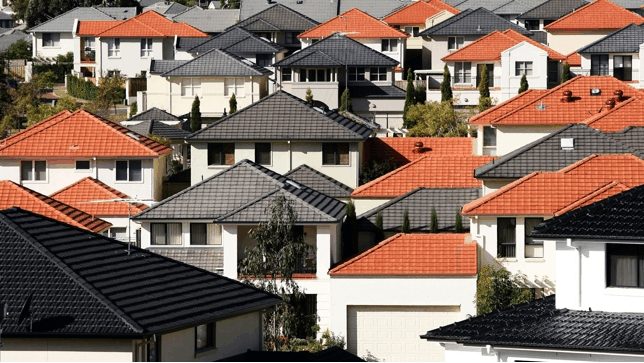
Please find below an interesting post from economist, Matt Cowgill, challenging the notion that affordable housing can be achieved amid solid population growth, restrictions on development in pre-existing areas, as well as an urban growth boundary that restricts sprawl. Be sure to also check out Matt’s blog, We Are All Dead, which examines a wide range of political and economic policy issues.
Imagine that there’s one source of carbohydrates – potatoes – and that everyone needs to eat carbs at least once a day. In this hypothetical scenario, there are three types of potatoes: kipfler, desiree, and regular. Kipflers are expensive and not that common, whereas regular potatoes are cheap and plentiful. Desirees are somewhere in the middle.
What we’d find is that high-income earners, and/or people who really value quality potatoes, would buy up all the kipflers. Low income earners would be left to the regular potatoes.
What would happen if some kind of bug struck the supply of kipflers, halving it overnight? Well, I’d guess, there would be fewer kipflers for sale, and the price of the remaining kipflers would rise. Some of the high income and/or potato-loving people who would’ve bought the lost kipflers would instead turn to desirees. This increase in demand for desirees would drive up their price; some middle income earners who would’ve bought desirees would instead settle for regular potatoes, which in turn would drive up their price. Some low income earners would be squeezed out by the process, unable to afford potatoes at the new, higher price. Even though nothing has happened to the supply of cheap or mid-priced potatoes, a reduction in the supply of expensive potatoes has cascaded its way down and harmed the poor.
Now imagine that we reversed the scenario. Through some stroke of agricultural luck, there’s a glut of desirable kipflers on the market. The price of kipflers falls. All of a sudden, desiree-eating middle-income earners who had looked on enviously as the well-to-do devoured kipflers are able to get in on the action. A number of them make the switch from desirees to kipflers, which causes the price of desirees to fall as well. A few low-income earners now find desirees within their reach, and they upgrade from regular potatoes. Even though the supply of desirees and regular potatoes hasn’t changed, they’re suddenly more affordable for everyone.
This all seems pretty straightforward. Why, then, is this logic so hard to comprehend when the good in question is not potatoes, but housing? We all need to live somewhere. If the supply of fancy, expensive apartments is restricted, the people who would’ve lived there don’t just disappear. Some of them instead settle for something a little bit less fancy and expensive. In doing so, they push up the price of these slightly-less-fancy dwellings, and take up spots that slightly-lower income households otherwise would’ve taken. This cascades its way down, so that a reduction in supply at the top end ends up meaning that prices are higher for all sorts of housing, just as with potatoes.
I had a lengthy back-and-forth on Twitter with Catherine Cashmore on this topic. She didn’t seem to accept my argument, instead suggesting that increasing supply at the top-end does nothing to make affordable housing available. I think it’s a fallacy to imagine that the housing market is parcelled off into discrete segments that have nothing to do with one another. It’s all connected, as David Simon would say.
I’ve made this point before, when I was enraged by an Adam Bandt pamphlet that seemed to promise greater restrictions on the construction of new dwellings, while also promising more affordable housing. As I said then, I don’t see how you can reconcile a desire to have:
- consistent population growth;
- affordable housing;
- an urban growth boundary that restricts sprawl; and
- strict restrictions on new development in existing areas.
If you want to say no to developments in your backyard, restricting a rise in density in established areas, then you need to compromise on one of the other points. If you want to have consistent population growth, restrictions on sprawl, and a tight lid on density, then you have to accept that your preferences will result in less affordable housing. If you want to have the NIMBYist restrictions, but keep housing affordable, then you’ll need to either reduce population growth or permit endless sprawl. Pick three of the four dot points above; you can’t have them all.


of course it is connected somehow but if low end are 50% of housing, medium 40% and premium 10% ( numbers pulled out of my ass), increasing supply of premium by 10% will only marginaly increase supply, only by 1%.You re never going to solve the supply issue by increasing the premium (which is costly to build and take lot of land).
Agree dam. It’s an interesting argument by Matt but it says nothing about proportionality – it seems to assume Kipflers, Desirees and humlble old Sebago spuds exist in more or less equal numbers. The fact is that Kipflers are only a very small percentage of the overall crop and the impact at the Kipfler end would need to be pretty big to affect the Sebago end by much.
What Matt seems to have forgotten is that demand for housing, which also determines price, (like demand for anything else) is measured in dollars, not the number of housing units that the population wants to consume.
What he says might be true, on an aggregate level, if it is assumed that all housing units are occupied, all demand is consumption demand (and not speculative demand) and when one is destroyed then a person/family becomes homeless, but this is not the world we live in, in Australia.
Take away the population’s proverbial credit cards and watch housing become affordable.
“Take away the population’s proverbial credit cards and watch housing become affordable.”
Yes, affordable in a pure price sense (i.e. lower prices). But how will FHBs be able to buy said homes if credit is severely rationed and LVR requirements are increased significantly? They will still be competing for a limited number of homes available with other cashed-up buyers with more purchasing power (made worse by high skilled immigration).
Limiting credit alone does not solve the underlying affordability problem. This can only be solved via more affordable supply.
That said, I strongly agree with implementing LVR restrictions, but more for financial stability reasons.
It is almost a no-brainer that buying something without credit is cheaper than buying something financed by credit (because you avoid the interest cost).
FHBers will still be able to buy. On one hand, it might be suggested that they might not be able to buy as quickly (because it takes longer to build savings than it does to just go get some credit from a bank), but on the other hand it is also arguable that if nil credit is available prices (for FHB-type housing) will immediately decrease to be commensurate to the average FHBer’s deposit, such that they could still buy immediately but at less cost, because housing will have depreciated in relative value to deposits.
I suspect that in the real world *some* credit will always be available, but given the depreciation of houses when measured in cash terms, FHBers will be ahead.
…then we will obviously come to some second-order effects, like the vendors slamming shut their wallets due to negative wealth effects, etc, but that is a separate discussion.
Okay, let’s assume for arguments sake that credit is severely rationed and that median house prices suddenly fell to $150k (from around $450k), but buyers could only borrow 50%, such that they had to provide a deposit of $75k. While I personally would love this situation, what’s to stop a whole bunch of cashed-up (or equity rich) boomers, immigrants, etc from buying up most of the available lower priced (FHB) housing and then renting it out (since rents would not fall nearly as much, it would be a great yield play)?
The point is, you will still be in a situation where FHBs are competing with, and being out-bid by, buyers with more means to secure a limited amount of stock available. The best way to deal with the affordability issue long-term is to create the conditions where plentiful affordable new supply is built, supplemented with abolishing stupid demand-side measures like negative gearing.
UE, boomers would be net sellers in such a situation (as they will be anyway due to demographics) the difference is that in a 50% LVR situation the boomers would no longer be (as) ‘equity rich’.
I suspect that the dynamics similar to the US would play out – all the housing won’t get snapped up because 1) there is too much of it; 2) downside risks will be painfully apparent; 3) rents will fall, so yields won’t be great (although presumably higher than SVR, which is how it should be).
I don’t quarrel with supply side components of the solution (I am all for them) nor some of the demand management components (reducing tax incentives, really regulating foreign ownership), I just have a feeling that their importance is overstated compared to the big credit pump that was on full blast for the last 15 years or so is still running reasonably well.
“Cashed up buyers”? And who might they be in any great number, if they can’t sell their existing holdings when the bottom of the ladder, the FHBer, is restricted?
There are loads of boomers, etc with over $150k in cash equivalents that could buy housing at low prices (assuming a huge credit-induced crash). There are also heaps that own their homes outright, which could presumably borrow against their equity to buy low priced housing in the event of a nasty crash, and then rent it for high yield (or positively geared), since rents would not fall nearly as much as prices. Hell, that’s what I’d do!
You should be buying in the US then!
You’d be exposed to the FX risk, but taking a long-term perspective and the concerns about the hollowing-out of Australia’s productive capacity, there is probably more upside to this FX exposure than downside…
IT’s all connected alright, China’s pollution issue will hit Australian housing, new gov policy looks like the coal boom is over which is going to hit Australia in the wallet hard as the Chinese gov looks for new forms of energy and better uses of energy. Growing anger in China is at a point that the Chinese gov can no longer ignore.
This does not look good for Australia.
All connected… but it misses the point, doesn’t it?
Putting it in potato-speak, isn’t the problem that households have been encouraged to spend any spare money they have on kipflers and desirees, to the detriment of meat, fruit and other veg, while also shifting potato production away from regular spuds (which thereby become scarcer, and less relatively cheap)?
Food for thought.
Exactly Chrism.
It also misses the point that the current tax system encourages the rich to buy up the regular potatoes and desirees, and rent them out to the poor.
The rich are not only advantaged by being richer, but also by the tax breaks they get, allowing them to effectively get their “investment potato” cheaper than the price a poor person needs to pay to buy their first one.
Arrow2
Yes, another good point.
Another aspect of this skewing of buyers’ wherewithal is when retirees outbid other buyers due to incentive to keep assessable assets (and income) low enough to qualify for part pension and/or Seniors Health Card.
Yes, because of the desire to turn tax otherwise payable into capital gain the better off crowd out others from being able to buy.
Crowding out does not only apply to government expenditure versus comparative private capacity and demand.
chrism
You’re on the money.
Quite a few upper-class ($850K – $2+ million) RE around my environs has been on the market for 1 – 3+ yrs. Lower priced RE is selling better.
A $million sale just settled after ~ 6 weeks on market. I’ll be interested to see whether price paid matched asking price (which was around $3 million).
Some time ago, one of the long-term owners called this mansion a ‘money drain’.
Only the uber-rich can continue to overlook cost of holding/owning RE (everyone else has needed to take a reality check and lower aspirations).
An example of a $million mansion that’s been on market for nearly 12 months is at 18 Duncan Road Beaumont SA.
http://www.realestate.com.au/property-house-sa-beaumont-109878416
and
http://www.smallacombe.com.au/Buying/Search/Detail.aspx?id=SM5910&wlid=8eaf4b7a-58ac-46e5-9617-0ed89cc7895f
The undeveloped blocks of land in this estate (most of which remain unsold) have been on the market for several years.
I reckon it’s an example of poor planning by Council. ‘Waterfall Estate’ would have been a perfect site to develop high-quality (three-levels of) apartments. There is access from top (Duncan Road) and bottom (Delbridge Court). For the same height of building an apartment on the top level could have been serviced by Duncan Road, while the middle and lower level apartments could be serviced by Delbridge Court.
The surrounding area has a cafe culture. Several popular eateries are within walking distance of Waterfall Estate (these businesses would probably fare better from the presence of apartment-dwellers than from mansion-dwellers).
The area is well serviced by public transport and is approx. 10 mins from the CBD.
In Adelaide we’re arguing about how many (and how high) multi-storey dwellings to impose along chogged arterial roads in Burnside and other inner-suburban Councils. An area like Waterfall Estate could enable some higher density living in a beautiful environment without adding any greater burden of built environment than the mansions will.
exactly, but even more so, it’s easier to create money (i.e. bank credit) to buy potatoes than any other activity. It’s ridiculous to believe, but it’s easier to create money to buy potatoes than it is create the money needed to farm them!
Reduce population growth.
Problem solved.
That may happen with an increase of jobs it will get harder to justify the increase in immigration numbers.
opps, increase in job losses
+ 1
+1
The world would be a better place if we could keep population levels static. Very unlikely I’m afraid
+1
What is it with this country and the almost pathological paranoia about population growth… Am I missing something???
Are Australian potatoes the same as Irish/American potatoes or are they different here?
The Sydney potatoes are in shortage, Moree ones are plentiful, Dublin shortage, Sligo abundant, San Francisco shortage, Houston abundant, Los Vegas shortage now oversupply.
Does that answer your question?
The good thing about potatoes is they can be cut many different ways, so if 1 potato feeds 2.5 people and there is a shortage then simply reducing the ration slightly will feed 3 from the one potato. Shortages not always a problem when the potatoes are big enough.
Absolutely. When a potato famine hits, rations are cut severely, as happened in the US in the wake of the global potato crisis.
The GPC resulted in a game of hot potato, no one wanted to be left holding the bag!
Shortages not always a problem when the potatoes are big enough.
I agree that a localised shortage is not a problem when government is willing to expropriate private property and divide and share it based upon need.
Do you support government expropriation to resolve shortages?
There is no need for government interference. If potato shortage occurs and prices rise, then people may choose to live with a higher person to potato ratio.
In the past we lived 3 people to a potato, but now even though the potatoes have increased in size there is less people to a potato.
Anyhow this analogy is getting confusing, but I would end on the note, eating too many potatoes will result in a belly ache.
It is certainly possible at this very moment for someone to buy a house that might otherwise be beyond their normal ability to purchase, although perhaps not for much longer.
However whilst this does allow a few adventurous souls to get their dream house, most won’t opt for the house at the more expensive end of their buying spectrum.
The theory is correct, but a low end potato eater will always eat potatoes, and it only has a marginal effect on the overall market prices.
But when low end housing becomes cheap it devestates mid range housing with a sizeable flow onto the upper end prices.
We have the 20% to 40% house price crash, it’s just in all of the wrong places and at the wrong end of the market to help the average guy.
Why Peter… I thought thats exactly what you are in business to provide..
I quote
“Today there is a growing list of commercial lenders who are happy to look at long term loans, interest only loans, low doc loans, and just about any scenario that is worthwhile”
http://www.brisbanebusinessfinance.com/propertyinvestments.htm
No job? no problem… no income? just scribble the salary you would like to be earning on the back of a fag packet… we’ll sort you out…
“To choose the best lender for your situation you really need someone experienced in this type of finance” yes… this type of finance… we all know what type you are referring to
This is an excellent analysis; I welcome Matt Cowgill to the forces of light.
Something I have been pointing out for a while is that the affordable cities in the USA (median multiple approx three) have a far HIGHER proportion of houses and sections of a size (and indeed quality and condition) that would be regarded as “luxury” in Aussie or the UK or Europe or California.
As real incomes have risen and the real price of rural land has fallen, households in any city without fringe growth constraints can get higher and higher standards of housing; whether they want a bigger or better home or a larger section is up to them.
In contrast, as Patrick Troy (Australian National University) put it so aptly 17 years ago now, “urban growth containment” is just “code” for “reduced standards for people who cannot afford to buy their way out of the market rationing mechanism”. As all amenities of housing are rationed by price, it depends heavily on people’s income levels as to how much space they will have, how efficiently located their home will be, how much local amenity they will enjoy, what condition their home will be in, and so on. Peter Hall et al pointed out this effect in England way back in 1973, in their massive report “The Containment of Urban England”.
No amount of “trading down in space per person” restores affordability, or restores the ability to lift housing quality in any way. Meanwhile, the attributes of housing that once might have been taken for granted by the great majority, become restricted to a smaller and smaller proportion of the population. I pick that only the top 5% in UK cities will have housing like 80% have in Atlanta, Georgia.
I would like to extend Matt Cowgill’s analogy. I hope he reads this.
Imagine the amount of land on which potatoes are to be grown, is rationed. The amount of land is increased by some percentage occasionally to allow for some demand growth but most of the additional supply required for the growing population, is expected to be met by “increased efficiency” in the use of the existing land.
(To make this exercise relevant to housing, there needs to be no “substitute” for potatoes, just as there is no substitute for land when it comes to housing).
Would the land on which potatoes are to be grown, become subject to bidding wars between growers every time some of it was up for sale, and would the price of potatoes rise because of this? Imagine, too, if speculators saw the rising price of this land, and got involved in the land market too, making it behave like shares or bullion, driving it an order of magnitude higher in price.
Then ironically, might not most of the potatoes actually grown, be the regular ones, only selling for the price that Kipflers used to? Less Kipflers and Desirees actually grown and sold, at astronomical prices; and some proportion of the people now unable to afford any potatoes at all, even regular ones? Maybe more young people will stay with their parents and share their potatoes. Maybe potato gruel might come to be a new source of nutrition for some hard-up people.
I find it extraordinary that, as Mason Gaffney pointed out in his 1964 essay, “Containment Policies for Urban Sprawl”, oligopolies that drive the price of any common items up are always subject to scrutiny and action from the authorities, yet the biggest cartel of the lot, in urban land supply, can operate in full view without any adverse comment. And he was writing decades before it became a major problem – except of course, in the UK, where it was in full force already.
Futhermore, in the above hypothetical example, imagine there was a public outcry against the potato growers – not the regulators and the profiteering land owners. This is what blaming “greedy housing developers” is like today. They have to engage in gladiatorial bidding wars to the death, for the available land supply, just to stay in business – or fold, because they have nowhere to build.
‘Through some stroke of agricultural luck, there’s a glut of desirable kipflers on the market. The price of kipflers falls’
Unfortunately in property, no such luck exists. Catch 22 at work again; it’s only desirable because it’s restricted/rare. Instead of bug invasions and stroke of lucks, let’s take on a more logical perspective. What if kipflers can only be harvested from an extra fertile soil located in a certain area that’s ran out of space? What if supply exceeded demand for kipflers which made them rare and desirable in the first place, not because of some make believe bug?
In Perth, there aren’t many riverside housing or prime metro housing left to go around here because not many rich folk like to live an hour away from the city. There is plenty of land to grow regular potatoes though, so take your pick before regular becomes the new kipflers.
There are several different attributes of housing, each of which is “priced”.
Size (of house)
Age and condition of house
Size (of section)
Natural amenity
Local amenity
Location efficiency
Some of these attributes are indeed exclusive and nothing can be done to “democratise” these attributes. But “planning” can have a major effect on the exclusivity or the democratisation of most of the attributes of housing.
Inflated land prices place pressures on the ability of households, to compete for all the other attributes of housing as well as for “size of section”. This is why the lowest income people in heavily planned cities like in the UK, end up with the worst housing, the most overcrowding, in the worst locations, with the least local amenity, with the worst access to everywhere else. Or they end up with no housing at all. There is simply nothing left for them to “trade off”.
I repeat what I said above; in the low land cost city of which there are some 200 in the USA, the amenity of “size” of section, and even size of home, is heavily democratised. So also, to a lesser extent, is the amenity of age and condition of the home.
Furthermore, because jobs and amenities are heavily decentralised, there is a lot less extreme “premiums” in RE prices for “location” relative to these things. Most people can afford to move closer to any particular new job they get, or closer to schools when they have children, or closer to retail centres.
“Monocentric” urban planning is just as non-democratising of the attributes of housing as rationing of land supply is.
For example, in some of the least “centralised” cities in the USA – Atlanta, for example, the most expensive “CBD” type land (cost net of “improvements”) is only about 7 times as expensive as farmland surrounding the city. But in a city with much stronger centralisation (always due to planning) and urban growth containment, the LEAST expensive land, immediately inside the UGB, is already more than 7 times more expensive than the surrounding rural land, and the MOST expensive land (found in the CBD) can be 10 times as much as THAT.
This actually gives a city like Atlanta a major competitive advantage economically, AND it makes for far greater equality of social outcomes. Gibbons, Overman and Resende, in “Real Earnings Disparities in Great Britain” (2011) state that the planning-distorted urban land market in the UK is a substantial MULTIPLIER of “inequality”; starting from initial income disparities and the “sum” being actual social outcomes.
It is already well established in the health profession, that the main connection between income disparity and health outcomes, is “housing quality”. This effect is magnified when all housing is more expensive.
Australia and NZ are going the same way as the UK.
*i meant demand > supply
I 100% agree with this article. The sad thing to me is that a lot of bears want their cake and to eat it too. They want to remain in the PC cult whilst pining for affordable housing.
To me this article is as obvious as what a 5 year old would understand, yet a lot of bears don’t want a bar of it.
This is why “bogans” don’t by default respect “smart” people. Because they shouldn’t. Because smart people all too often overlook infantile logic.
The simply fact is, if you have two decently earning people and you start early enough, housing is affordable, and you can also get yourself some ips. But to limit decent housing to this demographic is wrong.
The Greens are a joke. How do they reconcile their supposed love for the environment with overpopulation?
The Greens want population control, but they don’t want “the disadvantaged” to be deprived of anything, including the choice of having a family.
And they are hysterical about “preserving” everything possible in Australia: 0.4% urbanised, and in NZ: 0.8% urbanised; but of course they also love European and Asian mass public transport systems. The fact that Australia and NZ do not have the populations to make this fiscally sustainable is yet another contradiction among many in their belief system.
They did want population control, until the late 90s, they do not anymore. If they did why wouldn’t they say anything about it? They’d instantly get a lot of votes.
Great comment Moops. The hypocracy on this issue is mind boggling. Matt Cowgill has nailed it with this article.
Yep, cognitive dissonance is also a Green policy.
Which is profoundly disappointing.
Dont they understand we already have 2 major parties that excel in that department.
There are many city burbs in all our capitals that have seen population decline from 2001 to 2011, yet the average prices of houses in those burbs has risen just like those that did not have population decline.
Mmmm…. if decline saw prices rising, then I need to ponder.
Brisbane – Rochedale, Jindallee for exxamples.
Check your burb…
http://images.smh.com.au/file/2012/12/19/3901120/census_web/
There are many city burbs in all our capitals that have seen population decline from 2001 to 2011, yet the average prices of houses in those burbs has risen just like those that did not have population decline.
Wow genius. Big families can’t afford expensive houses, childless working couples can.
What did Churchill say about statistics?
I am shocked. I thought it would be possible to restrict supply of housing AND invite in many immigrants AND stop building railway lines AND still have affordable housing.
If we do all these things and house prices rise then surely it cannot be a SHORTAGE and must be a bubble and due to credit and soon to burst like Ireland, Spain, Greece, Japan, Pompeii and Krakatoa.
Pass me the potatoes please.
Claw, you have more insights than a lot of people. But you need to realise that building commuter rail routes NEVER reduced economic land rent and made housing affordable. Only automobile based development has ever done that. The difference in land supply introduced by each transport system is massive. Rails bring “ribbons” of supply of land into the urban economy. Automobile based development brings huge amorphous chunks of land.
You also need to realise that there have been housing bubbles with price inflation AND over-rupply; as in Spain and Ireland. But these tend to be the exception; PRICE bubbles are more often associated with UNDER-supply. But it does help to understand the exceptions.
I think there is a lot to be said (in Melbourne’s case) for having a look at how much of Melbourne was laid out originally. It didnt grow organically, with population densities pushing people out.
It was corruptly developed by a load of bent politicians (including Thomas Bent – Premier) who used public funds to build good rail transport to locations where they had landholdings. That is much of the middle to eastern suburbs of Melbourne, laid out in the 1870s -1890s. Those decisions then have affected Melbourne’s population density and liveability ever since.
If the powers that be have decided that Melbourne has to grow larger, then lets once again put the cart before the horse and use public funds to put rail and public transport out into locations where there will be housing (as well as improving public transport in outer burbs where it is woeful), look to develop sustainable employment in a range of locations (not focus on the inner city, and encourage industry/research etc to locations). And of course some sort of larger circle rail/light rail, running roughly Frankston/Mornington to Dandenong, then up through Ringwood/Mitcham, around the top to Greensborough/Thomastown and then around past Tullamarine and down towards Werribee.
I would also shove the Ferntree Gully line out further towards Dandenong (or maybe even Pakenham) and bring it back in as a sort of second loop.
Yes it would be uber expensive, and would need to be coupled with pulling people off roads (taxes or whatever) and changing the taxation basis (maybe to land tax) presumably using some sort of infrastructure bond.
But expecting ordinary punters to shell out 500K for eaveless boxes in the middle of nowhere isn’t a viable long term strategy…
The issues are credit, non-commodity pricing, and vacancies.
The fact that credit is readily available for housing, but much more restricted for any other expense means that your potato analogy is missing a component. If banks lent money to anyone wanting to buy a potato, with very little (no?) money down, then there is little incentive for farmers to drop the prices of their kipfler potatoes, even if supply increased. The extra credit made available by the banks would allow the supply to be absorbed by those able to get said credit.
Secondly, if there were to be an increase in supply of kipflers, but banks lent money to potato investors by the bucket load, then some people would end up owning multiple potatoes. Unless there is some kind of incentive for them to offload those potatoes, then it is likely that they will go unused, and there would be no flow through to the lower end of the market.
These two factors end up removing supply from the market, and you no longer have anything resembling commodity pricing. Instead, we’re left with pricing initially of cost+, and then later similar to that of superior goods – as the prices goes up, so does demand.
So, does this mean that places like Texas, which saw absolutely no run-up in house prices over the 2000s (despite rampant population growth, higher than average income growth, and ridiculously loose credit availability) has completely different potatoes than countries where supply is artificially strangled by regulation?