

The Australian Bureau of Statistics (ABS) has just released housing finance data for the month of December, which registered a seasonally-adjusted -1.5% decrease in the number of owner-occupied finance commitments over the month. Analyst’s had expected zero growth over the month:
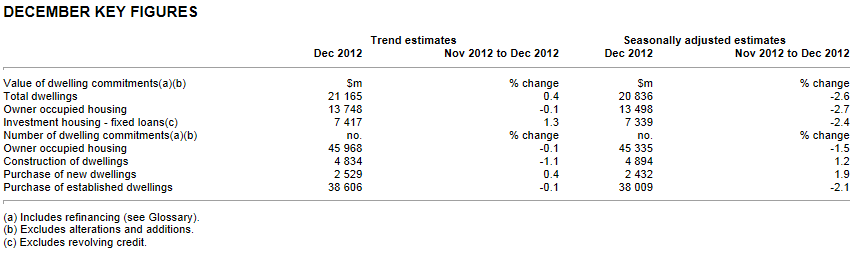
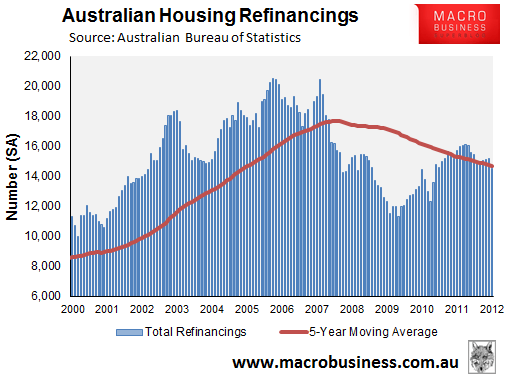
The fall in finance commitments was caused almost entirely by a -4.3% plunge in refinancings on established dwellings (see next chart).
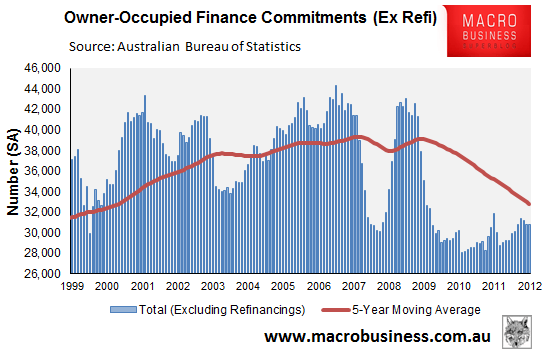
Arguably, the most important figure in the release is the number of owner-occupied housing finance commitments excluding refinancings, which registered only a seasonally-adjusted -0.1% fall over the month, but remains some -6% below the five-year moving average level.
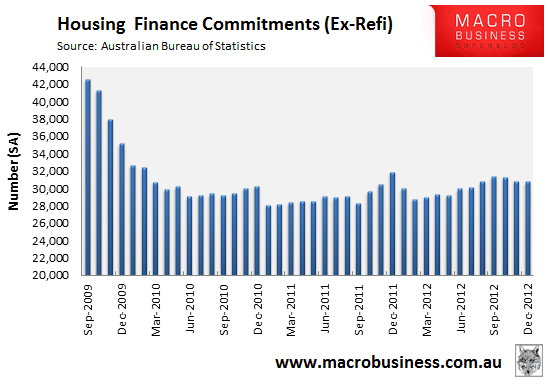
The number of owner-occupied housing finance commitments (excluding refinancings) in December were also -3.5% lower than the same time last year, although last year’s result was impacted heavily by the pull-forward of demand from New South Wales first home buyers seeking to beat the cancellation of stamp duty concessions.
The uptrend that had been aparent since February 2012 has now receded, with the series now declining for three consecutive months:
Unfortunately, the ABS only provides the value of investor finance commitments. These were down by -2% in December, the second consecutive monthly fall:
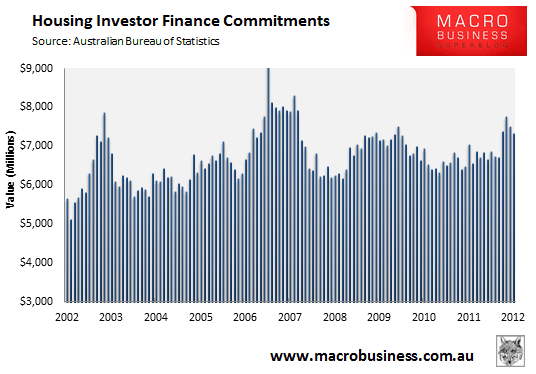
Overall, it’s a fairly weak result that suggests that the mild momentum in mortgage demand that had been building since early 2012 has lost steam.

unconventionaleconomist@hotmail.com


Didn’t they cut rates in December?
No…. they affirmed people’s negative perception of the Aus economy. Hence, news above.
What’s the current thinking on the amount of time it takes cuts to “flow through”?
6 months they reckon.
Yes, but people don’t read about a rate cut and sign a contract the next day.
I’m not sure about the fall in refinancing, perhaps the debt consolidation phase is coming to an end, or perhaps it’s just a non-conforming month.
Surely it suggests folks are waiting for lower rates to fix loans.
Are you suggesting that someone with an existing loan who decides to split and fix a portion (or all of it) with the same lender is treated as a refinance. It isn’t.
There has been a lot of household balance sheet consolidation with short term debts such as credit cards cancelled and added to the home loan.
Whilst there are negatives in converting short term debt to long term debt, it does free up a lot of disposable income. That’s one of the reasons why households here have been more resilient. If you consolidate a car loan and four credit cards into the home loan, it doesn’t reduce overall debt, but it significantly alters the structure, to the cashflow advantage of the home owner.
Peter,
But for how long is the cash flow better, from my experience (friends, family, work colleagues etc) is that those who cannot control their finances just end up with a large CC debit again and therefor no better off, unless someone is able to enforce some financial discipline on them. That’s usually why their in this position in the first place.
DNE – a certain percentage will “re-offend” but others learn. I enjoy dealing with ex-bankrupts who have learnt their lesson, but I know that I can’t help those who haven’t.
It’s now much harder to get a pocket full of credit cards, because all new credit reporting will contain much more information, but it wasn’t so before. No one knew for certain what loans or cards people had before – act of parliament to protect privacy – good thought gone wrong but now corrected.
But how much of a nanny state do we want to build? Do we stop the 95% of responsible people from doing what they want to do because 5% of people are idiots?
Where does it end?
..and it technically improves the quality of the underlying asset – the mortgage – for the bank.
Convert a “risky” unsecured, high interest but low maturity loan into a “risk-free”, secured, low interest – but much much long maturity loan.
More interest paid (hence more cashflow and profits, less B&DD charges, more capital to loan against, circle of life continues…) and the risk status of loans goes down…
What could go wrong?
Well lots could still go wrong, but for that household, to convert debts that would probably never be repaid or well managed into manageable debts that will eventually be repaid, it’s a logical choice. To reneg on debts would only mean legal action that would ultimately put the house at risk anyway.
Usually the mortgagee is refinancing other institutions debts, so they are quite fussy. LMI providers are even fussier still, so the worst cases of credit card abuse can’t be saved.
Eight cards worth about $110K is the worst that I have seen, but I’m sure there is worse. Part of the problem has been the lack of information collected by reporting agencies, which is a legislative failure – that is changing as we speak – look up “comprehensive reporting” http://www.veda.com.au/insights/comprehensive-reporting.dot
With that and the introduction of recent NCCP guidelines, aggressive borrowers won’t be able to “fake” the system in the future, so we will see less of this in a few years.
peter, those people who have 100k+ on CCs most likely used CCs to pay mortgage (maybe not directly but used CCs to cover difference between income and cost of living). School example of sub-prime mortgage.
Now they have higher mortgage and the same problem of not being able to service debt and you think they will not “re-offend”? All of that is happening while economy is still doing well (low unemployment, high income …)
What will happen if unemployment jumps or if rates go up?
Rav – the point is that those people are not being refinanced. If you have a pattern of undisciplined spending on multiple cards, you may as well have “Do Not Lend to Me” tattoed on your forehead and a flashing red light up your rear end, because banks won’t touch you, especially if you don’t have a big security margin for safety.
It’s no longer a case of “ask and ye shall receive”
Refinancings tank. We’ve long argued refinancing was a symptom of a weak economy where people needed it to keep their head above water. Is this suggesting the pressure’s off a little?
It suggests people think the RBA will cut more. Bloody misanthropes.
True, many mortgagees would think like that. But perhaps for some the refi ATM is empty, and the final and complete de-leveraging begins.
I’d be amazed if the average punter was that thoughtful re rate forecasting.
I think either the well has dried as per Mr X’s sentiment or the rate cuts have loosened the noose somewhat.
And you have to buy now before the price goes up!
Sorry…off topic!
It locks in a rate cut for next month.
What you chaps need is for the RBA to do some more talking, just like the RBNZ is doing. “New Zealand property values continued to rise in January, though those gains are extending beyond Auckland and Christchurch…(RBNZ)Governor Graeme Wheeler has been under increasing pressure to take the heat out of the property market through the use of macro-prudential tools….” Yawn….
http://nz.finance.yahoo.com/news
Glenny was muzzled after the infamous Sunrise episode. I think he’d like another contract if 7 figures per annum are at stake. Those who sign off on it most certainly won’t want him spooking the market.
Maybe Kochie can fill us in?!
Please tell us more. I have often asked, who and what got to Stevens and Richards at the RBA, when up to mid 2008 they were making some of the world’s most sensible comments about house price volatility, especially the role of “supply” constraints.
It is also striking that Chris Joye was very sound on these issues back in 2003, and something got to him not long after that. Bernard Salt is another one who has possibly been lost to the Dark Side. There are probably others.
I wonder if some of the “sound” Aussie commentators like Leith Van O, Alan Moran, Bob Day, Ross Elliott, Joe Flood, Ray Brindle, and John Muscat, could tell us any stories of being approached by “men in black” trying to coerce/bribe them over to the Dark Side?
You all need to focus on the “five-year moving average” curve in the “owner-occupied housing finance commitments excluding refinancings” Graph!
It looks like the first hill on the Big Dipper!
Now that all State/Fed retail subsidies have been pulled on established home sales, expect that downward trend of new money coming into the ponzi scheme to continue to dwindle!
Your Owner-Occupied Finance Commitments (Ex Refi) No. graph speaks loudly to me. The GFC trough has become the new normal, with Commitments around or below that depressed number since 2009 and no December peak in 2012.
Record low i rates are scaring people, not enabling home ownership. They figure, if the RBA is panicky, we need to be too.
If government and the housing industry want to maintain property prices, major policy initiatives are urgently needed. But what?
Don’t Buy Now!
Good to see you deeply concerned about FTB’s entering the market David – and there I was thinking that you were a bear.
I think that policy changes for Qld and NSW will happen via changes to FHOG policy. Could be wrong, but in an election year political deals get done very quickly when it suits them.
Ha Ha. My analysis and belief we are in the midst of a giant land bubble – which will destroy the lifetime savings and personal finances of many citizens when it collapses – remains unchanged.
If governments introduce a new first home scheme, the media will be knocking on Steve Keen’s door in a heartbeat. His stance will be simple and direct: FHOG’s inflate property prices, to the benefit of vendors and not buyers.
My concern is they may introduce an even more exotic instrument to keep land prices inflated.
Don’t Buy Now!
In the ACT we have a land rent scheme on new blocks. I’d love to hear your thoughts on it as it seems like a reasonable hedge on land prices dropping to me and something I am considering. In terms of enticing fhb it allows you to rent the land from the ACT government and pay your mortgage on the house only. (much cheaper) the cost is 4% of the market value annually + mortgage on home. As I said i’d love to hear people’s thoughts on this.
Actually, I think a lot of FHBs see the current low rates as – long term – an aberration. “They are bound to go up again”.
In a world where a drop in interest rates is claimed to equate to “increasing affordability”, a future rise in interest rates is effectively a sentence to pay more money than you expected.
It means that the cost you think you’re paying today will GO UP, and you will be liable for the difference.
Weird I know. But I think fear of future interest rate rises is a factor. And for once, people are not just looking at the next couple of years.