Data worsens for house-and-land developers

By Leith van Onselen

The AFR has a piece today aiming to look at the bright side of what appears to be a structural shift away from detached houses for consumers:

Australia’s commitment to detached housing is waning, with apartments and townhouses comprising a record 41 per cent of all private dwelling approvals in 2012.

Overall Australian dwelling approvals rose just 1 per cent in 2012, to 152,000 homes. But apartment and townhouse approvals rose 9 per cent in the year whilst traditional detached housing approvals declined by 4 per cent.

MacroPlan chief economist Jason Anderson said a long-term structural change to higher density living was under way. “The positive momentum for medium- and high-density housing reflects the greater influence of Asian businesses and households on residential markets,” he said.

It’s certainly true that the recent data flow has not been kind to Australia’s house-and-land developers.

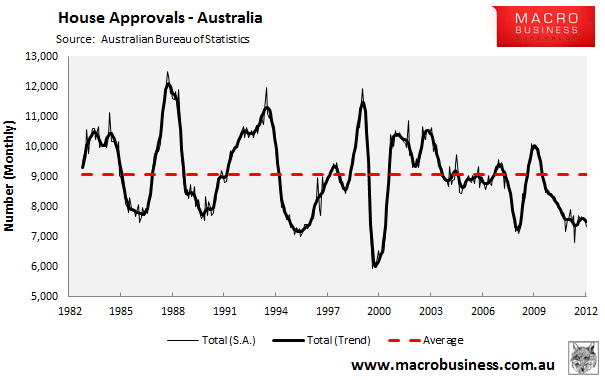
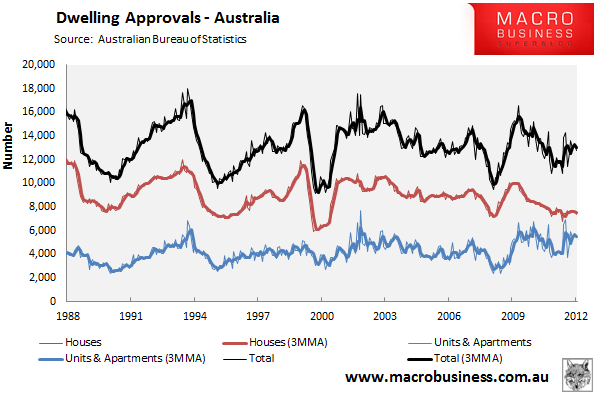
Yesterday’s dwelling approvals data, released by the Australian Bureau of Statistics, revealed that detached house approvals fell by a seasonally-adjusted -3.3% in the month of December and were -3.8% lower over the year. Moreover, house approvals are now running at levels not seen since the Global Financial Crisis, some -17% below the 30-year average in trend terms (see next chart).
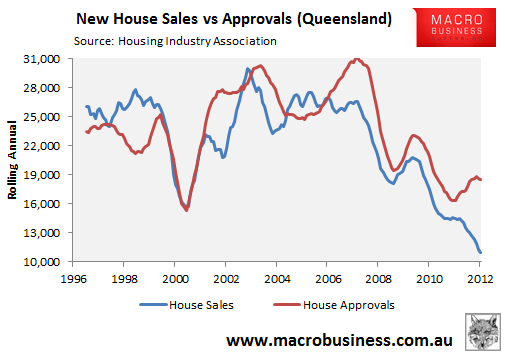
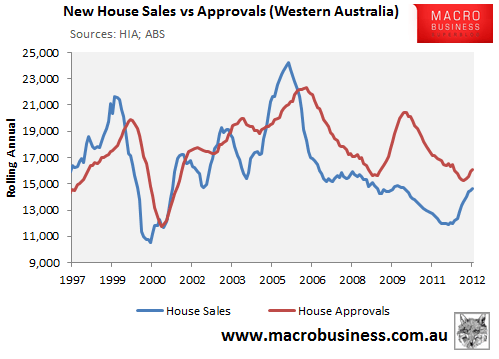
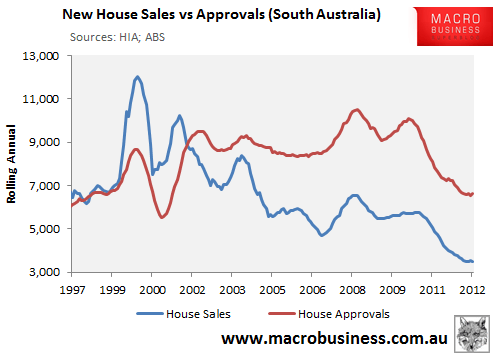
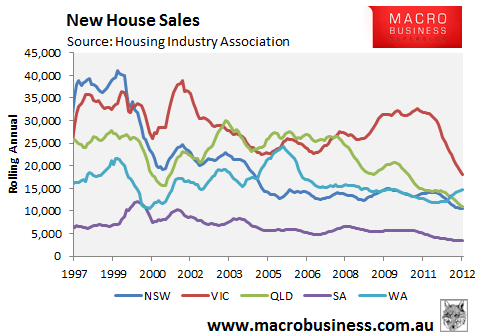
And the bad news doesn’t stop there. Last week’s new home sales data, released by the Housing Industry Association, showed that new detached house sales hit fresh 16-year lows in annual terms in all mainland states, except Western Australia (see next chart).
Finally, the gap between house approvals and new house sales appears to have widened in all mainland states, except Western Australia, suggesting that a glut might be developing in some of Australia’s new house-and-land markets (see below charts).
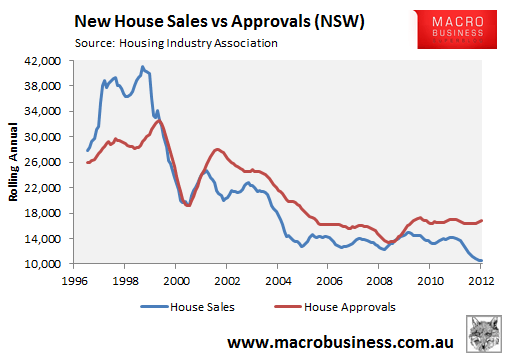
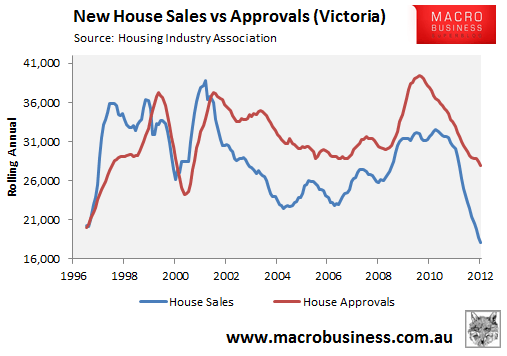
While the apartment sector is booming currently, the detached housing segment remains in the gutter, which is a worrying sign for construction employment as the mining investment boom reaches its peak later this year.
unconventionaleconomist@hotmail.com

www.twitter.com/leithvo


85 Responses to “ “Data worsens for house-and-land developers”

  1. csfn says:

    Interesting conclusion by the macroplan economist that the trend for medium and high density dwellings is being driven by Asian businesses and people.

    Given that there are some other explanations for the trend it would be helpful to see what evidence they have for that view.

  2. Archie says:

    Australia will head the way of major European cities, where only the very very rich own freestanding houses, and the masses rent or live in units. This is the inevitable path for large cities as populations grow and prices rise. And let’s face it, Australia is a collection of large cities, one of the most urbanised countries in the world.

    • Revert2Mean says:

      Australia will head the way of major European cities, where only the very very rich own freestanding houses

      Pfft! :roll: With one of the lowest population density in the world, and plenty of vacant land lying about “landbanked” (at least in Perth, where every second street has vacant blocks), and the NBN promising a future of decentralisation and telecommuting, and peak energy shifting people towards regional communities where food can be grown locally and there is a good community spirit, your scenario is extremely unlikely.

      • George Locust says:

        Unfortunately, I believe the “Peak Energy” argument has been debunked.

        The Shale revolution has extended available fossil fuels for at least a century.

        I say “unfortunately” because arguably the world needs pricing signals to support a move away from fossil fuel to non-carbon emitting alternatives.

        The “glass half full” alternative argument is that Shale energy may replace dirty coal burning power generation. But that might not be such a great result for Australia’s coal/iron reliant economy either.

      • Revert2Mean says:

        The Shale revolution has extended available fossil fuels for at least a century.

        Ha! Have you ever seen shale? It’s solid. You need (1) heat and (2) water, lots of it.

        Please read and absorb
        http://www.theoildrum.com/node/9753

      • Revert2Mean says:

        The Twilight of Petroleum

        Read that if you dare! :shock:

    • The Claw says:

      Australia will head the way of major European cities, where only the very very rich own freestanding houses, and the masses rent or live in units.

      Yes. This does seem to be the trend. It is all so unnecessary since Australia has so much land per person. If only govt policy supported many smaller cities.

      • PhilBest says:

        “…..It is all so unnecessary since Australia has so much land per person. If only govt policy supported many smaller cities…..”

        If only government policy did not enable a racket in land for urban development, that makes it hundreds of percent too expensive.

        If a massive quota scheme pushed the price of cars up, would an increased demand for bicycles be interpreted as a change in actual consumer preferences?

        Actually what happens when you let it, is “many smaller cities” developing contiguously. The famous “sprawled” low density cities in the USA do NOT have long average trip times, for the simple reason that most people regard their immediate area as their “city”, and do not bother to criss-cross the whole metropolitan area for work, shopping, entertainment, etc.

        AND these cities have median-multiple-3 affordable housing, regardless of how much larger sections have got on average over the years.

        There is no rational reason for Australia to be emulating the UK, with its urban hell-holes and gross social injustice, rather than leafy, spacious, democratised-home-ownership affordable-city USA.

      • tayser says:

        The rational reason is building an inordinate amount of sprawler cities would involve reducing the government’s bang for the public purse’s buck.

        Road/Freeway projects benefit far fewer people than increasing densities around mas movement existing infrastructure (rail improvements, road improvements to allow Bus Rapid Transit networks, tram right of way improvements on existing roads in Melbourne): 50 years of garden city growth has shown how to create two cities within one city creating a perceived divide among people who live in the have (inner city closer to all amenities) and have not areas (outer suburban/frontier areas where distance and time to the same amenities is longer and making people more susceptible to energy shocks).

        Build rail lines to low-rise suburbia? No – same concept of building more freeways to benefit a lower amount of people – we need to get more out of the overall “good” (good because planning revolves around the most popular mode of transport from the outset: private cars) road networks out in those areas first through significant bus improvements to connect with other public transport modes and these areas need to diversify housing stock and create employment nodes to make investment in transport more attractive.

        That’s the rational response to growing cities – maximise existing infrastructure first, build shiny new stuff on when it truly warrants it.

      • reusachtige says:

        Said by a true scraper fan. ;)

      • PhilBest says:

        Tayser: You are a classic case of a little knowledge being a dangerous thing; you know nothing about the effects of each alternative; “containment” versus “dispersion”, on economic land rent and economic cyclical volatility. House price median multiples bear a remarkable similarity in both “pre-automobile” urban economies and modern “growth containment planned” ones. That is, they are 6 and over regardless of how much space per person is sacrificed. The difference is entirely economic land rent; and the difference in economic land rent is literally hundreds of percent (concealed by the median multiples only being “double” or “triple”, when space per person is in fact much lower).

        It was well understood nearly 100 years ago by economists, “urban planners” (such as Ebenezer Howard), and even social reformers, that “democratised” improvements in social conditions were not possible unless the level of economic rent associated with urban land could be diminished by a dramatic increase in its “supply”. (Karl Marx’s famous solution was nationalisation – but no-one disputed that the problem existed, of economic land rent enriching the land owners and impoverishing everyone else as productivity rose and incomes rose; this insight was not in the least original to Marx).

        The frantic building of streetcar suburbs and commuter rail based suburbs was as much an effort along these lines as anything else. But it failed because the narrow ribbons of land supply were always captured by the same rentier interests as who owned most of the existing urban land area. Ebenezer Howard spent his entire career trying to break this impasse – it is a shame that he is not remembered for this (however much he is remembered for his “new towns” proposals).

        But the amount of land brought into “supply” in the urban economy by automobile based development is massive and unable to be cornered by the rentiers. This is the only way median multiples of 3 have become a norm in the cities where they have become a norm. This is in spite of the increased consumption of land per person as incomes have risen.

        The cost of “economic rent” (zero sum wealth transfers to initial land owners) that households and businesses are spared from, is many times as great as the costs of infrastructure provision, maintenance and renewal under conditions of urban dispersal. In any case there is little conclusive proof that the cost of maintaining infrastructure of all kinds under conditions of higher urban density, is lower at all.

      • PhilBest says:

        Furthermore, Tayser, These problems are entirely political; the solution is that people ultimately have to pay for the infrastructure. The “smart” solution is NOT making them pay vastly GREATER sums for absolutely NOTHING in the form of wealth transfers to the recipients of economic land rent.

        “Smart growth” is NOT “smart”; it involves forcing people to pay a whole lot MORE for NOTHING, just because people were unwilling to pay a whole lot LESS to get “something”; i.e. more infrastructure. And the “whole lot MORE” paid out in economic land rent, is paid out by first home buyers and new business start-ups; a gross social inequity. But persisted in for long enough (as in the UK), every generation ends up paying, the economy is slowly strangled by the costs, and a major social injustice is maximised in the form of generations of wealth transfers to the rentier class.

        Growth containment advocates need to be made to face the working example of the UK’s cities, as outcomes of the same sort of policies they are advocating. The world’s WORST average trip to work times, along with grossly unaffordable housing of the smallest size and poorest quality and the oldest average age and poorest average condition, is NOT something for the UK’s policy makers to be proud of or something for other countries advocates to be working towards, and it is certainly NOT “smart”.

      • Rusty Penny says:

        There is no rational reason for Australia to be emulating the UK,

        Rational for whom?

        This is what I point out with boomerism.

        They are at the end of their working life, a life that has been propped up by the largese of older and now younger generations for their entire life, as well as exercising policy hegemony.

        Their chronology has them at maximum wealth accrural.. what’s more rational than becoming a rentier.. of being petty bourgouise?

      • PhilBest says:

        At the expense of the following generation? Have these people no shame whatsoever? Of course, it does not help that next to nobody whose opinion is aired in any mainstream forums, is even trying to needle their consciences. All the chatter in the mainstream is that “this is normal, stop grizzling, boomers had it tough in their day too, yadda, yadda, yadda”

      • Rusty Penny says:

        At the expense of the following generation?

        Yep.

        Have these people no shame whatsoever?

        baby boomers, nope.

        Of course, it does not help that next to nobody whose opinion is aired in any mainstream forums, is even trying to needle their consciences.

        The party is too big, everybody is on board the gravy chain being dragged by a diminishing number of predominately young male workers.

        I try to encourage men from now on to opt out, live a minimalist lifestyle. Let it collapse.

        In the horrors of lawless anarchy, who will bring product to market, who will protect weaker people from violence? Who will create, who will repair?

        From the cinders can those who produce, protect and innovate be looked at in high esteem. not taken for granted.

        All the chatter in the mainstream is that “this is normal, stop grizzling, boomers had it tough in their day too, yadda, yadda, yadda”

        Show them the normal outcome of a disenfranchised youth. See how tough it can be when they are infirm and their financial assets are worthless.

        Their financial assets only have value because we assign trust (rules) to them.

        Change the game.. change the rules.

      • LandDeveloper says:

        Hi Phil- the Center for Housing Policy in the US debunks your idyllic Houston story by showing that when transportation costs are included for “sprawl” cities, Houston is actually more expensive than San Francisco (for example). Whilst I agree that Australia’s house and land prices are outrageous, I do think that your views (whilst clearly widely read) and those of UE and Demographia a bit myopic when it comes to “affordability.” There is a broader range of ingredients that affect affordability than just “planners gaming the system”.

      • Care to explain how Texas and Georgia have amongst the lowest cost of living in the US (including transportation costs)?

      • LandDeveloper says:

        Not according to the Center for Housing Policy. So which institution is right? I can’t declare that any particular fact that has been googled is more right than another fact. But it’s important to understand that Houston’s model is not the panacea that it is held up to be.

      • Care to provide a link to this outfit so that I can read the report for myself?

        It’s interesting to also note that Texas experienced 27% growth in median household incomes between 2000 and 2011 according to the Census, compared to only 19% growth nationally (and only 14% income growth in California). Pretty amazing that its house prices have remained stable given it also experienced rapid population growth over this period, wouldn’t you say?

      • Alex Heyworth says:

        I assume LandDeveloper is referring to this report: http://www.nhc.org/media/files/LosingGround_10_2012.pdf

        I personally think its methodology is highly suspect.

      • LandDeveloper says:

        “Pretty amazing that its house prices have remained stable given it also experienced rapid population growth over this period, wouldn’t you say.”
        Yes, and it’s crime rate followed. Along with transportation costs. I don’t disagree with what you say on this blog, what I disagree with is the emphasis placed on Houston and other sprawl cities without taking into account the “costs” that affect affordability. Did you know that Houston is in the worst 5% of US cities in terms of crime? Worse than Los Angeles, San Fran, Portland, and all those other awful planning constrained cities.

      • So by inference you argue that if Australia freed-up land supply, its crime rate would rise substantially (guns and all)? Sorry, this is a straw man argument. Freeing-up land supply and providing more affordable housing would not significantly change Australia’s social make-up.

        You also fail to recognise that Texas’ lower housing costs have encouraged lower income groups to move to Texas simply because they cannot afford to live in the Elitist supply-restricted cities. If the whole of the US adopted California-style planning, chances are there would be more poverty and more crime overall.

      • LandDeveloper says:

        “lower housing costs have encouraged lower income groups ”
        So by inference, poor people are all criminals?

      • PhilBest says:

        Land Developer: That Centre for Housing Policy study is nonsense. Saying San Fran’s “housing plus transport” costs are lower than Houston’s does not pass a basic smell test, given that their travel times are roughly similar and San Fran’s housing costs are 3 times Houston’s. They are obviously having to massively cherry-pick data to come up with such an absurd conclusion.

        The single best insight in the famous “Costs of Sprawl 2000″ report, was that the higher the median price of a home is pushed up, the FURTHER people have an incentive to commute to get a home they can afford. “Drive to qualify” is real. Anthony Downs discusses this phenomenon very helpfully in his 2004 book, “Still Stuck in Traffic”. Downs was one of the contributors to the “Costs of Sprawl 2000″ paper. There is a chapter entitled:

        “The Effect of Lower-Cost, Outlying Land on Housing Costs”:

        Page 448 onwards of the following PDF is highly relevant:

        http://onlinepubs.trb.org/onlinepubs/tcrp/tcrp_rpt_74-c.pdf

        Dr Kara Kockelman of the University of Texas, some of whose research is referenced in the “Costs of Sprawl” study, has done further research since with the same outcomes.

        There are studies which purport to prove otherwise. These studies all suffer from the fatal flaw that they compare the actual current “housing” cost of incumbent households – including people whose mortgages are already paid off, or nearly so, and whose “housing” costs are next to nothing. This misses the point that a new buyer of the same inevitably high-current-value homes would certainly achieve much lower “housing plus transport” costs by buying further away. In fact, even the incumbents with mortgages paid off, would improve their financial position by cashing up their high value property and moving further away.

      • PhilBest says:

        Thanks to Alex Heyworth for providing a link to the CHP paper that “Land Developer” is referring to. Alex is correct, the methodology is highly dodgy. This is typical of housing policy advocacy funded by the Rockefeller Foundation, which has a vested interest in maximising economic “rent” on the substantial property portfolios of their obvious connections.

        There are several clever dodges the paper uses, probably in pursuit of the “right” conclusion for those funding it. Firstly, as I already suggested, it uses “actual” housing costs from surveys, which includes households with mortgages already paid off or partly so. So obviously the proportion of people in each area who have recently bought their first home, or who are long since housing-ladder incumbents, will massively skew the figures.

        Obviously a city like Houston or Atlanta with massive recent growth (20% plus in ten years) will have a lot more first home buyers in the data.

        One of their findings is: “…..Despite the major housing market downturn that began in 2006, housing expenses in the 2006 to 2010 period were 52 percent higher for the typical household living in the 25 largest U.S. metro areas than they had been in 2000….”

        Well of course….! There are obviously more recent buyers at the new “normal” higher prices and fewer “incumbents” who bought at low prices long ago, now included in the data.

        Secondly, it specifically studies households earning between 50 and 100 percent of each metro area’s median income.
        Why such a specific quartile? What is the split of elderly reduced-income “households” with paid-off-housing, versus young with new large mortgages, by region? And was this income quartile selected because it gave the “best” results?

        Thirdly, though it uses “actual” costs from surveys, for housing costs, and for incomes, it uses “estimates” for transport costs, which are “adjusted” for all sorts of stuff like “housing type”…..! I kid you not. They say:

        “….The methods for the cost model draw from peer-reviewed research findings on the factors that drive household transportation costs……Specifically, the transportation cost model incorporates seven neighborhood
        variables (residential density, gross density, average block size, intersection density, transit connectivity index, transit access shed, and job density) and four household variables (median household income, per capita income, household size, and commuters per household) as independent variables. These variables are used to PREDICT, at a neighborhood level (census tract), three dependent variables — auto
        ownership, auto use, and public transit usage — that determine the total
        transportation costs….”

        !!!!!!!!!!!!!!!!!!!!!!!!!!!!!!!!!!!!!!!!

        So the findings were always going to be biased against the cities with the urban form disliked by the study’s authors, given that the transportation costs were derived endogenously from non-transportation data, in a way that reflected the author’s biases.

        This paper is a CLASSIC example of “how to manipulate statistics to produce something worse than damned lies”.

        What is actually needed, is an analysis of the ACTUAL “housing plus transport” costs presented by each OPTION that is available to a young first-home-buying household.

      • Nice work Phil. I note also that Texas has a lower than average commute time whereas California’s is above average, according to the US Census.

      • LandDeveloper says:

        PhilB, there’s quite a few flaws in your response. But your response is so long (and so blinkered) that it will be difficult to articulate why you are wrong. But here’s a couple: You complain that the CHP “predicts” transport costs. Phil, this is precisely how it should be done. Traffic modelling (including trip distributions, cost patterning, etc etc) is a proven science. Incidentally, the model they used was peer-reviewed as a robust technique. Sophisticated transport & cost modelling is done in many countries using a variety input predictors.
        Also, why are you suspicious of the 50%-100% median income being used? These are the people buying the affordable homes. Why would you want the authors to model affordability for the highest income earners? I could go on, but I accept that you have a different view and that transportation costs are an inconvenient reality for many people.

      • PhilBest says:

        Land Developer:

        I obviously need to spell out a bit more, what is wrong with using “estimates” for transport costs; quite apart from the fact that this is not the only thing that makes the Rockefeller property capital gains lobby “study” completely worthless.

        Aggregate cost data for automobiles, on which ALL of the anti-automobile “studies” produced by urban containment “experts” are based, INCLUDES: new vehicles with their rapid depreciation; ultra luxury and high performance vehicles; and huge V8′s of all types and ages. Most such choices are discretionary, and dependent on the discretionary income of those making the choices. The aggregate cost data for cars is completely irrelevant to the choices of car made by recent first home buyers under mortgage cost stress, especially those of the quartile immediately below the median income.

        The “study” results probably will not represent a single REAL LIFE household; or if one can be found, they will be an outlier. The real life households who have bought their first home recently will most likely be making choices of cars that are typically well under half the cost level that this “study” uses to determine the “housing plus transport” costs that these mythical households are allegedly suffering.

        You obviously have difficulty following the issues of analytical methodology that are involved here. Don’t blame me for making arguments that are “too difficult” for you to engage with.

        Surely you can see my basic point, with which I concluded my earlier comment?

        “…..What is actually needed, is an analysis of the ACTUAL “housing plus transport” costs presented by each OPTION that is available to a young first-home-buying household…..” (Or indeed to any household making a relocation decision).

        Why would you and the Rockefellers be running scared of getting such an essential analysis done, and why would you be frantically trying not to understand that it is the only relevant analysis on which to base urban policy?

      • The Study’s conclusions also seem highly odd given the rapid emigration of Americans from smart growth states to affordable states like Texas. Surely if costs were so bad, these people would not be moving?

        Also, given the median house price in Houston is only $167,500 versus $568,000 in San Francisco, the study’s conclusions don’t pass the most basic of laugh tests.

      • LandDeveloper says:

        Oh dear, your best response is to attack the integrity of the researchers by suggesting their work has been bought and then fill your argument with “probably” this and “probably” that. Whilst there’s lots of good information presented on this blog, pretending you know more from your armchair and google screen than researchers in the united states carrying out peer reviewed research is the laugh Test. And this from guys who hold Demographia as good research (which uses estimates to derive their median income measure) is worrying.

      • Mav says:

        PhilBest, we know what LandDeveloper does for a living. Perhaps a full disclosure from you is in order?

      • PhilBest says:

        I’ll leave it to people who check what I am saying on the topic, to work out whether I am “pretending” to know stuff or not. By far the greatest “vested interests” in this issue, emanates from the property investors who stand to make very substantial total sums of completely unearned capital gain through distortions to urban land markets.

        The so called “vested interests” of “suburban property developers” is derisory by comparison. The profits made on actually building a new subdivision under competitive conditions, with no unearned capital gain at all, are modest and honest.

        The only “vested interest” I have in this issue, is that I do not yet own my own home. No-one has paid me a cent for anything other than the completely unrelated work I do in my day job. I have got involved in this issue primarily because my daily life brings me into contact with many struggling young people, and I deeply resent what is being done to them, the conditions in which many of them live relative to what used to be the norm back in my parents generation and for some years after. I am appalled at the sheer lack of insight displayed by the so called wise men of our time, on such a wide range of aspects of this issue – such as the difference between “small loan, high interest rate” and “big loan, low interest rate”.

        I have ended up reading quite widely and discovering who are the lonely experts in academia talking sense, because I can see an unfilled need for someone to do it. There are thousands of well paid bureaucrats who should be doing it and making policy recommendations in the public interest. The realisation that bureaucrats “work for themselves”, not the public interest at all, has explained a lot to me. That, and the fact that the fattest “vested interests” by far are behind “growth containment”, not “freedom to build”.

        Literally ALL the ADVOCACY of “freedom to build” is being done by lonely, underfunded or totally unfunded, moral crusaders. Wendell Cox, for example, works himself half to death crunching all the data he does, and struggles to get financial support. Owen McShane in NZ, now deceased, one of the best crusaders, was constantly strapped for research funding. But “smart growth” celebrity advocates jet around the world to bureaucratically-sponsored junkets, getting paid fat speaking fees.

        Superb academic work has been done by senior urban economists around the world, all of which is totally ignored by the bureaucratic empire builders and the smart growth “industry”. Peter Hall, Alan W. Evans, Steven Malpezzi, Alain Bertaud, Peter Gordon, Alex Anas, Paul Cheshire, Richard Morrill, Theo Eicher, Edwin S. Mills…. There is virtually NO advocates or bureaucratic policy-advisory agencies picking up on any of this stuff.

        “Planning” schools and qualifications are actually a cunning tactical ploy by which environmental activists have more recently done an end run around the requirement for genuine academic standards, as were required in the departments of architecture, engineering, and urban economics which USED to supply all the staff of “planning” departments.

  3. aj. says:

    The fact that the new house and land product is so bad – a poorly built dog box miles from anywhere with a yard the size of a postage stamp – probably has something to do with this.

    • Eagle says:

      The size of the lots has slowly decreased as the buyers are ‘willing to accept’ a smaller lot due to the price point. The price point stays similar (per sqm) while the lot shrinks…

      Agree with the build quality. Half the time these guys don’t even really read the plans!

      • Snagdog says:

        This is one my pet hate when the selling agent / developer assures the prospective buyers that the small block size suits them in these current times where everyone is so busy. Now it could just be me but I could spare a 20 min a weekend to mow the lawn instead of having a concrete fence that bunts up to the neighbours house and you can hear them sneeze.

      • Peter Fraser says:

        +1

      • PhilBest says:

        “….The size of the lots has slowly decreased as the buyers are ‘willing to accept’ a smaller lot due to the price point. The price point stays similar (per sqm) while the lot shrinks……”

        +1 for that. That is the crux of the problem. Urban planners are liars. Ask them for proof of one single city in the world where “density” has restored “affordability” as the land prices have been forced up by growth containment policies. There isn’t one.

        Lots in affordable cities in the USA cost $30,000 to $80,000 for a quarter acre to 1 acre. There is no middle ground between that and any city where growth is “contained”; lots are always more than $200,000 regardless of how much smaller they get – one tenth of an acre is now typical in Aussie and one twentieth of an acre is now typical in the UK.

  4. Mitch says:

    Not so sure this surge in apartments is going so well. I notice that Southbank in Melbourne is awash with apartments many with the reduced to sell tag, same goes for Chatswood Sydney.
    Seems to me that the apartment market is going to get severely tested in the coming year especially in Melbourne they are going up everywhere, rental vacancy rates are also increasing.

    • PhilBest says:

      When the price of land crashes (I do not say “if”) the demand for apartments will evaporate, because detached houses will suddenly be within buyers price reach – as they should be – again.

    • Greconomics says:

      Thanks Mitch, I want to buy a couple distressed sale apartments in Southbank (1 bedders please, < $350k) but I'm having real trouble find any decent ones…. can you please post the links of the apartments you've found.

      • Stomper says:

        EASY… Greconomics – just search for $400k – $450k ones and offer them market value of $300k

        There are 4 pages of them (100 apartments) if you search realestate.com using that criteria.

  5. Muzzer018 says:

    Agreed aj

    Clearly a huge disconnect between builders and thier market.

    Contrary to popular belief we won’t just buy any old shite.

    I’m renting a McMansion and there’s not a straight edge in the place. Bathroom needs resealing as there’s water damage showing outside through the thin render.

    Aircon drains that head up before running away. Light fittings are falling and the fans are noisy as.

    House is under 7 years old.why would anyone buy these homes,?

    Has the home building world taken a leaf from GM and gone down the road of obsoletisum, where by the time the asset is paid off its a ruin worth little or nothing.

  6. The Patrician says:

    One thing that puzzles me with this data is that in all states we are building significantly more houses than we are selling. In NSW, Vic and SA for more than 10yrs!

    and yet stock on market is falling.

    Where is all this unsold stock?

    • reusachtige says:

      Strange isn’t it. This one probably deserves the wearing of a tin hat.

    • Denis88 says:

      I am assuming that just because developers get planning approval doesn’t necessarily mean that the approved lots will be sold to home owners and eventually built. I read a while ago on here that people are walking away from their house and land package at a rate of 1 in 3. This could explain it but, again I’m just as puzzled as you.

      • The Patrician says:

        I understand your first point but even then we would have a growing stockpile of building-approved shovel-ready lots, burning a hole in the developers pockets.

      • gregcheryl says:

        Seems to be a few townhouse developers in Brisbane who are securing planning approvals at lower than desired densities. They are sitting on them for 6-12 months then trying again for a higher density. Wonder if this explains the “shift” to townhouses as well as the gap between approvals and sales?

    • Virus says:

      I have some anecdotal evidence not statistical though….

      In the suburb where I am renting, during Dec 2012, there were just 80 places to rent however a quick walk about revealed more than 80 for-rent places with many having a ‘hand written board’ hung on the gate/door advertising the place as “for rent”, these were missing in the internet listing.

      Suddenly, after the last week’s release of “House prices to the moon in every city” report, the internet listing have risen to 120-approx and all those ‘missing’ have been put on market with ‘elevated prices’.. of course.. they would not move at those prices..

      Now to ‘for-sale’ homes, if you visit my suburb, you would think the economy is thriving with no upper limit. i.e. they are building like there is no tomorrow! However, internet listing shows around 320 homes for sale for the past ONE YEAR, constant!.. again a simple walk-about reveals a different picture. Homes/townhouses having a “for-sale” sign, with things like “enquire for freebies” slapped on the sticker, these are missing from the internet listing. Last year, a 2-Br unit right across the road sold for 310K, within hundred meters, currently the same builder (i think) is offering a off-the-plan 2-Br units for 249K, thats like a 20% deposit DOWN THE DRAIN for the 310K owner!

      • The Patrician says:

        2-Br units for 249K!

        Wow, where are you?

      • Virus says:

        15 Kms out of RAdelaide!

        I consider it pricey for this location!

      • PhilBest says:

        Do more walk-arounds picking which places are empty AND do NOT have a “to let” sign on them.

        Just because a property is owned by a speculator does not mean they will be bothering to get tenants. With an expected 10% p.a. capital gain, who needs stinkin’ tenants?

    • The Claw says:

      we are building significantly more houses than we are selling … for more than 10yrs! Where is all this unsold stock?
      Firstly “we” are not doing these things. You are refering to an aggregation of data.
      Perhaps one person builds a house and lives in it. Whereas a 2nd person builds a house and sells it to a 3rd person. Would that explain the missing surplus?

      • The Patrician says:

        Thanks Claw.

        Any explanation as to why this phenomenon has only emerged in the last 10 years?

      • Peter Fraser says:

        It has been a problem for more than 10 years in Sydney, which I think is what Claw is referring to.

        Elevated prices is the result, and it’s the only market evidence any sane observer needs.

      • The Claw says:

        Any explanation as to why this phenomenon has only emerged in the last 10 years?

        No. I find much of the data related to housing to be useless. It is better to understand principles.

        How will supply choking effect the price of housing? Up, less affordable for ordinary people.

        Is supply choked? Yes
        Is price up and housing less affordable? Yes.

        Therefore there is no need to seek obscure data.

      • PhilBest says:

        “Any explanation as to why this phenomenon has only emerged in the last 10 years?”

        Definitely because urban planners have “got religion” about saving the planet. The price of land has inflated, “supply” has failed to meet demand, and speculative demand has been triggered that was absent before.

      • The Patrician says:

        Ok, let’s take NSW as an example. We are currently building/approving 18,000 new houses per year. 10,000 new houses are being sold per year.
        So 8,000 (or 40% of the) new homes are being built and occupied by the “builders” i.e “not sold”
        Yet prior to 2001, 100% of the houses built were “sold”. Why is it so?

      • Peter Fraser says:

        Pat your data can’t be correct – prior to 2001 people still built houses for their own occupation and those homes never went to market.

        I suggest that you check your data, or see if the collection method altered.

      • The Patrician says:

        see above

      • The Claw says:

        We are currently building/approving 18,000 new houses per year. 10,000 new houses are being sold per year.
        So 8,000 (or 40% of the) new homes are being built and occupied by the “builders” i.e “not sold”
        Yet prior to 2001, 100% of the houses built were “sold”. Why is it so?

        The is clearly bad data. Time for a sanity check. Post 100 actual addresses from your data and we will see if we can check the build/approve/sell status of some of them. We should be able to find the error.

      • Peter Fraser says:

        Pat – there is no satisfactory explanation above.

      • The Patrician says:

        The data (HIA/ABS) I refer to is extracted from chart #3. If there has been some change in the methodology over the time series I presume it would be noted.

      • PETER_W says:

        Retiree empty nester subdivisions of large block family home = build more than sell

        Probably gives a ratio 2:1 or 3:1

        http://economics.hia.com.au/media/Housing%20Finance%20National%20release%20November%202012.pdf

        Large block inner urban houses are unaffordable

      • nuff nuff says:

        The Patrician.I think it relates to gst only being paid by the developer/builder when the unit or townhouse gets sold.Many builders build 3 units for example but only sell 2 and rent the third property out.Other people will be better placed to know of the capital gains implications and whether the third property is able to be held in a SMSF.I am a nuff nuff after all

    • PETER_W says:

      Owned by the banks

      • PETER_W says:

        Also Dual Occupancy

        Retirement planning BB Owner Occupiers, destroy old family house, build two units, sell one unit & live in one unit.

    • Alex Heyworth says:

      Partly accounted for by the demolition of old housing.

  7. Muzzer018 says:

    That’s right Pat its a mystery

    Scooby Do where are you?

    Heading for China’s ghost cities maybe.

  8. reusachtige says:

    People are waking up to the fact that new estates are rubbish, absolute and total rubbish. Wow, you get a square metre backyard and by “detached” it means awning are not quite touching, if you’re lucky to have awnings. Why pay top dollar for that crap when you can pay the same for similar crap that is, at least, well located. Everything sells at a price though. In the case of new estates, a much much lower price.

    • Kateged says:

      For the former, see Aberglassyn/Oakhampton near Maitland, NSW. Neighbours pass the toothpaste between bathromms in detached houses.

  9. The Patrician says:

    The upcoming reporting period of the listed developers will be interesting.
    Gunna has previously listed their reporting dates. Starts soon and runs for a week or 2 from memory.

  10. emess says:

    As population ages you would expect baby boomers to increase demand for units relative to houses. That might explain Patrician’s excess stock to some extent if the BBoomers were to be letting their kids stay in the houses, while they themselves moved to the closer in units.

    Similarly, as the yard size and house spacing of ‘McMansions’ decreases, the attractiveness of a McMansion compared to a unit decreases. In that case, you could expect to see a trend where more people purchase units in preference to houses.

    From the two perspectives above, it would be interesting to see on the same graph the comparative figures for units as well.

  11. Gunnamatta says:

    And the mainstream media (not Australian) is surely starting to catch a whiff of something unpleasant

    http://www.bloomberg.com/news/2013-02-04/australian-homebuilders-can-t-give-them-away-mortgages.html

  12. LandDeveloper says:

    The “structural shift” mentioned is in part attributed to planning policy where state governments are typically encouraging urban consolidation. Whilst decentralisation is a better approach, unfortunately we have a monocentric urban environment. So the planners are trying to address that reality, whilst working on the harder challenge of decentralisation (cue commentary by PhiBest).

    • Alex Heyworth says:

      Strip development decentralisation is gradually taking place along the east coast, although at a far below optimal rate to contain house prices. The main problem with it seems to be that most of the newly developed areas lack real industries. All employment is service industry based. While to some extent this is expected, it’s not doing much for our long-suffering, hollowed-out economy.

      • LandDeveloper says:

        Agree with you Alex. We see this problem at all of our proejcts (all our projects are large enough to include significant employment nodes). We can provide the land (often free for smaller businesses starting out) but businesses find it very hard with today’s employment costs.

      • The Patrician says:

        Where are your projects LD?

      • LandDeveloper says:

        Both coasts of AU.

      • LandDeveloper says:

        Actually, my response is pretty silly on reflection. I mean east coast and west coast.

      • The Patrician says:

        Are we talking large house and land developments?