

Annual mortgage growth plumbs fresh lows

By Leith van Onselen

The Reserve Bank of Australia (RBA) has just released the private sector credit aggregates data for the month of January:

Total credit provided to the private sector by financial intermediaries rose by 0.2 per cent over January 2013, after increasing by 0.4 per cent over December. Over the year to January, total credit rose by 3.6 per cent.

Housing credit increased by 0.4 per cent over January, following an increase of 0.3 per cent over December. Over the year to January, housing credit rose by 4.4 per cent.

Other personal credit decreased by 0.1 per cent over January, after increasing by 0.2 per cent over December. Over the year to January, other personal credit decreased by 0.3 per cent.

Business credit was unchanged over January, after increasing by 0.7 per cent over December. Over the year to January, business credit increased by 2.8 per cent.

A chart showing the long-run breakdown in the components is provided below:
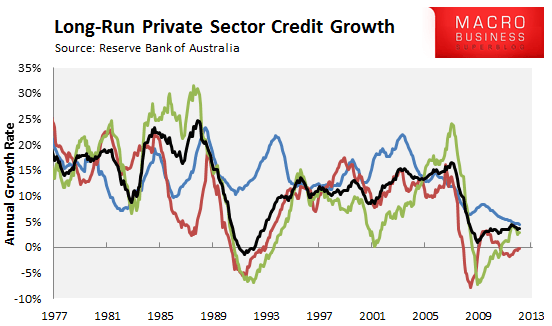
As you can see, personal credit growth (-0.1% MoM; -0.1% QoQ; -0.3% YoY) continues to deleverage, whereas business credit growth (0.0% MoM; 0.1% QoQ; 2.8% YoY) and housing credit growth (0.4% MoM; 1.1% QoQ; 4.4% YoY) remains postive in annual terms, but are at subdued levels relative to their long-run average growth rates.

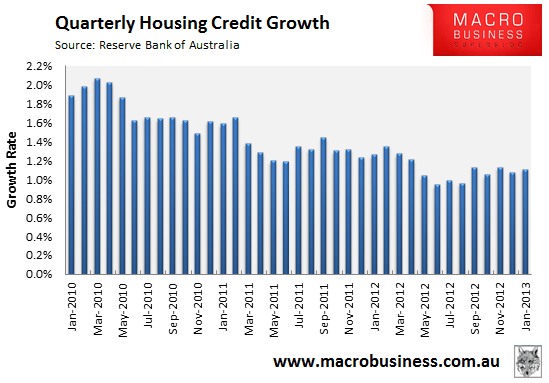
Focusing on the housing market, annual credit growth has now hit a fresh all time (36-year) low of 4.4%. However, as shown by the below chart,  housing credit growth looks like it might have bottomed (at least for the time being):
Finally, a breakdown of owner-occupied credit (0.3% MoM; 1.0% QoQ; 3.9% YoY) and investor credit (0.5% MoM; 1.3% QoQ; 5.6% YoY) is provided below:
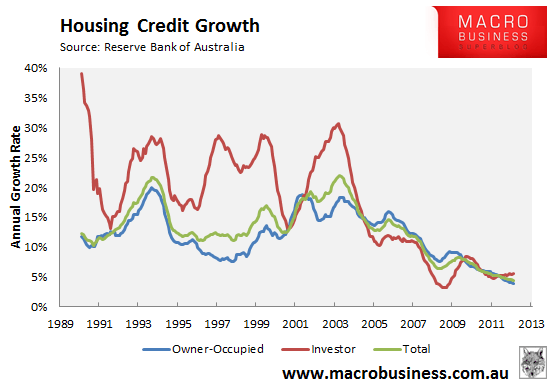
As you can see, much of the current mortgage demand is being driven by investors, which has also been reflected in recent housing finance data from the Australian Bureau of Statistics.

unconventionaleconomist@hotmail.com

www.twitter.com/leithvo


33 Responses to “ “Annual mortgage growth plumbs fresh lows”

  1. reusachtige says:

    Rising house prices on deflating credit – Keen, where are you? Another let-down.

  2. The Patrician says:

    So, fuelled by record low interest rates, mortgage debt (which has never stopped growing) is now accelarating.

    Mission accomplished RBA.

  3. PhilBest says:

    http://finance.townhall.com/columnists/markcalabria/2013/02/12/the-long-run-decline-in-actual-homeownership-n1510358?utm

    “…..It would be far more accurate to label U.S. federal homeownership policy, U.S. mortgage policy. For the primary means of “extending” homeownership, via federal policy, has been the massive increase in mortgage debt. Sadly the actual trend increase in homeownership has been close to nothing since 1960.

    If the ultimate intent of housing policy is to help build wealth and enable families to have something to pass along to future generations, then the right measure should be home equity. Even better measure would be the percent of homeowners who own their homes free and clear, that is without any mortgage. As long as there is any mortgage, even a small one, the bank has some ability to foreclose if you are in default……it’s hard to say you really “own” it unless it’s all yours.

    Currently the percentage of homeowners that own without any mortgage is just under 30 percent. Prior to 1960, an actual majority of owners held their homes with no mortgage at all. For most of American history, the typical homeowner did not have any mortgage, not having to answer to a bank and also having some wealth to pass along to future generations.

    The primary impact of US homeownership policy has not been to increase homeownership, but to increase debt along with driving up house prices. Not a bad outcome if you’re a mortgage banker or a real estate agent. But not exactly a good deal for home buyers. Yes this has also helped increase the average size of homes, but helping everyone live in a McMansion hardly seems like a compelling public policy goal. And yes, reducing our reliance on debt for purchasing a home would result in lower prices, a huge win for renters….”

    • Pfh007 says:

      As someone in debt will have some fear of the consequences of a loss of income the presence of debt is likely to make them more risk averse and less confident generally.

      Somewhat ironic that the lack of confidence to borrow and invest that Mr Swan finds so disturbing is likely due to the enormous household debts that the RBA are still desperately trying to encourage with near ZIRP policies.

    • willynilly says:

      And so it is the case fornOZ, 47% to the current 32%. So much for that property boom hey.

  4. Explorer says:

    What amazes me about the long term chart is that RBA and govt thought that the extremely high rates of growth outside of the recession periods of 82/3, 91/2, 2001 and 2008/9 were OK.

    With say 1.5% population growth and 3% inflation, credit growth over 5% ought be ringing alarm bells.

    To me the long term graph and the housing credit growth both show a total failure of policy by government and the RBA.

    4 to 5% credit growth ought be thought of as a normal range other than from 6 months before a recession to 12 months after it and is an appropriate average across the cycle for stability.

    • PhilBest says:

      “…..the long term graph and the housing credit growth both show a total failure of policy by government and the RBA….”

      Absolutely. And if you threw in graphs of what was happening to productivity, and what was happening to the tradables sector of the economy, the absoluteness of the failure should be glaringly evident to all.

      As I keep saying, a property market with distorted “supply” that does not keep up with natural short run demand “shocks” renders monetary policy impotent. You cannot kill the bubble without killing the productive sector, and the productive sector is killed anyway when “easing” merely results in the credit growth all going to the property bubble, not to productive capital. The costs to the productive sector are increased either way.

      It is like a cancer that can only be killed by chemotherapy that would kill the patient anyway. Housing supply reform is like the surgery that is really needed.

    • willynilly says:

      1.7 million temp visa holders and approx 600,000 of those as international students who are counted in our pop growth rates. Dumb as….

      • willynilly says:

        Many burbs in all capital cities have had a declining population and yet prices still went up. The end game is when these burbs with lone occupants die. Who can afford to buy their homes in Jindallee, Rochedale etc for Brisbane.

    • mirage says:

      You surely must know by now that the RBA are debt merchants. Therefore any supersized growth in debt is in fact the name of the game regardless of the consequences. More debt = more profit for commercial banks who the RBA seems soley to represent.

      Anyone with half a brain would figure that double digit debt growth (aka our housing debt bubble)is not going to end well for an economy, but with million dollar wages and bank data available on request, the RBA seems to simply ignore what they are meant to observe to create financial stability. Moving right along. Their function in the economy to me seems completely mispresented to the point where their stated and real objectives are the complete opposite.

  5. Al says:

    How come this has no effect on banks profits? Can they just offset by reducing costs, or something to look out for in 2013?

    • PhilBest says:

      They are already making profits from all the existing debt slaves they have captured; a slowing in the rate of increase of capture of debt slaves would not not lead to a fall in profits.

      The graphs are graphs of the rate of growth, not the level of debt. If the level of debt were graphed, it would merely be rising a lot less steeply now than what it used to be.

  6. The Patrician says:

    Alternative headline:

    Aus mortgage debt reaches record highs.

  7. fgh says:

    “housing credit growth looks like it might have bottomed”

    Since February, March & April 2012 were the strongest months for housing growth over the last 12 months, the 12 month growth figures may drop for a few more months, depending on how strong the growth is in the next 3 months.

    I would put my money on a bottom in February, not this month.

  8. With the winding back of FHB grants and no income tax cuts / middle class welfare handouts on the horizon its going to be interesting how low, and for how long Owner Occupied Mortgage growth will struggle. It’s going to be a long grind.