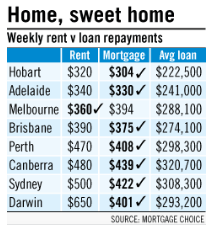
Mortgage Choice has released some highly questionable “research” claiming that it is now cheaper to buy than rent in all of Australia’s capital cities, except Melbourne. From the AFR:
It’s cheaper to buy a home than rent in almost every Australian capital city…
Thanks to cheaper loan repayments as interest rates have come down, mortgage broker Mortgage Choice points out that based on the average loan size for each state it costs less to make a mortgage repayment than pay the rent in every city apart from Melbourne…
The figures are based on house prices rather than units, and assume a basic variable interest rate of 5.9 per cent…
“The small difference between rent and loan repayments within some areas is encouraging for many potential buyers,” said Belinda Williamson of Mortgage Choice. “Of course, home-ownership costs such as land tax, strata fees, council rates, water consumption, insurances and maintenance need to be factored in.”
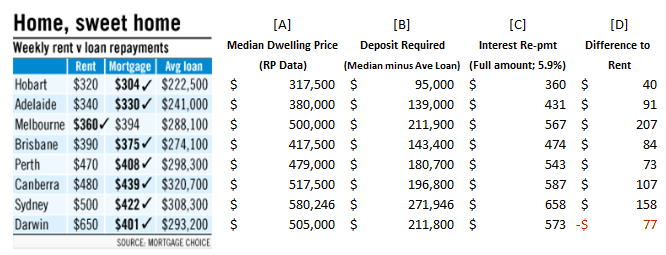
There is a lot that is wrong with Mortgage Choice’s analysis. First, it has chosen to compare the average first home buyer (FHB) loan size against rental payments, and conveniently chosen to ignore the buyer’s deposit, which represents a true opportunity cost. The below table, which adds to Mortgage Choice’s data, illustrates this point:
Column [A] shows RP Data’s median dwelling values as at December 2012, whereas column [B] shows the difference between the median dwelling value and the average loan size. Obviously, the figures added above are for illustrative purposes only, since your typical first home buyer would not buy a median priced dwelling and would instead opt for a cheaper house or apartment.
Nevertheless, in Sydney, the $271,946 difference between the median dwelling price and the average loan size could buy 543 week’s rent at the prevailing rental rate ($500 per week). It could also earn the buyer $11,286 a year in interest (pre-tax) if placed in a one-year term deposit account (at 4.15% interest), which could then also be put towards rent or other consumption. The key point is that a housing deposit represents a true cost to the buyer as the funds tied-up could be used for other purposes. As such, these costs cannot simply be ignored.
Second, if we ignore the required deposit and instead calculate the required weekly interest-only mortgage repayment on a 30-year loan at 5.9% interest, you see that it is more expensive to buy a median priced dwelling in all of Australia’s capitals, except Darwin, than it is to rent (see columns [C] and [D] above).
Finally, Mortgage Choice’s analysis does not take into consideration the many costs associated with owning a home: rates, maintenance etc, though these might be offset by capital growth, if it occurred.
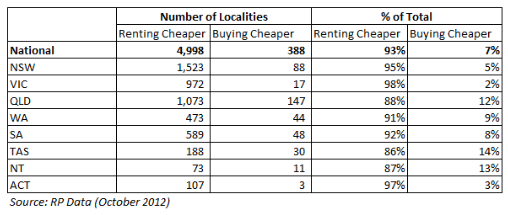
In any event, RP Data’s October Buy versus Rent report, which assumed a 10% housing deposit and also ignored the costs associated with home ownership, found that it was cheaper to rent than buy in 93% of locations across Australia (see next table).
unconventionaleconomist@hotmail.com


“Finally, Mortgage Choice’s analysis does not take into consideration the many costs associated with owning a home: rates, maintenance etc, though these might be offset by capital growth, if it occurred.”
That may be so, but you can’t exactly pay your rates with “capital growth” now can you? I’ve found that the council expects actual money rather than the illusion of weath.
The misinformation campaign from vested interests continues & is thwarted by Leith once again. Good effort.
What is worse – Mortgage Choice ‘analysis’, or that the AFR has published it with little/no analysis?
Yes, it is disappointing that Australia’s flagship finance/business paper uncritically recycles this stuff.
Well, it isn’t really a flagship finance/business paper. It is an entertainment outlet telling a niche market what they want to hear. Fair enough, and good for them if they can make money out of the entertainment business. But calling it a finance/business paper is a bit of a stretch imo.
No surprises that “research” is coming out of the Mortgage Choice PR dept. What is disturbing is that the AFR choose to publish it unchallenged.
Another editorial fail for the AFR.
I could be wrong but I am wondering if Fairfax has slaughtered all of their editors. There seems to be an increasing amount of utter bilge being pumped out of the SMH and Age, and the AFR has long had a propensity to be analytically shy of company press releases. They arent journalists so much as second wave marketing communications promotions people
+1 The arrival of Michael Stuchbury at the AFR has coincided with a rise in churnalism.
as a 27yo FHB striker what should I be reading? besides MB?
I really enjoy reading Gunnamatta & The Patricians comments, always interesting and useful.
Mate, I wouldnt recommend you read any one thing. I would recommend you cross reference every last thing you ever read.
When I was at high school we did this thing called ‘clear thinking’ which was about looking at arguments (would you accept the opinion of Ron Barassi on global busines or footy? that sort of stuff. Would you accept facts presented by people with a direct pecuniary interest in things? under what circumstances?).
A few years later I bumped into my old English teacher and was told they had pulled it from the curriculum – I attribute the decline of contemporary civilisation from about that point.
I spend much of every day reading news wires – they spout plenty of bull too, but they usually make cross referencing easy. Beyond that every time you read an article ask yourself in what ways it could be bull. Find someone arguing against it. Find balance, and maybe accept that you will never get certainty.
One thing for sure is you should never ever accept a company release at face value – I have written hundreds of them, and examined countless more, they are always an embodiment of a collective value maximising managerial/political process
My thoughts.
Dave, re the Aus housing market, if you could only read one piece per day I would make it LVO beyond that the MB daily links are probably the best guide. There are some decent analysts out there in the MSM chaff but the trick is to learn to sort industry spruik from objective data-based analysis. Maybe Gunna could publish a “spruikers to avoid” list to save time for the newbies. Although if you are reading this you probably know who they are.
Gunna –
There was a Latin phrase for describing that way of thinking.
It was called “cui bono” or “who benefits”.
I’m sure they were vested interests in Rome 2000 years ago just as we have them today.
And if MB ever gets a forum (please, please!), make that list a “sticky” (a thread permanently at the top of the forum).
On top of Gunna’s advice, get yourself a copy of the book “How to lie with statistics” and read it thoroughly.
Also learn about the exponential function. Sounds complicated but there is a great video (8 parts each of about 12 minutes) at:
http://www.youtube.com/watch?v=F-QA2rkpBSY
Some points are:
* 7% means something doubles every 10 years (just divide the interest or growth rate into 72)
* growth cannot be infinite in a finite world
* When looking at the life of resource, remember that if usage is growing, the life is shrinking every year
* during the next doubling time (eg 10 years at 7%, 24 years at 3%) we will use more of the resource (eg coal, oil) than has ever been used in the whole of preceding history (assuming growth has been constant). So in the next 24 years, at 3% growth in usage per annum global average we will use more oil than has ever been used in all recorded history to date.
Explorer, it’s mostly falling on deaf ears here. But keep trying, as I am. Maybe some are seeing the light
Yes re sentiments above.
But also be aware of a think called ‘group think’ -> which is expressed in abundance on the net.
Yes, even on beloved sites such as this one – where everyone is eventually singing from the same song sheet.
You might even find that ever more beatific poems are written acclaiming one’s own true and unique brilliance in seeing through the gloomy veil of darkness permeating the economic lands…
lol those are so not average/median first home owner loans.
‘Mortgage Choice has released…’ says it all.
Another affordability analysis that completely ignores variation. Is everyone doing housing affordability calculations out there a one trick pony?
The easiest and most accurate calculation is to look at 1) average rental yields AFTER stamp duty and puchase costs is included in cost to purchase
2) deduct yearly cost ie maintenance (.5% to 1% of property at least), rates (.1 to .2% of property), insurance etc.
3) compare 1) minus 2) to LONG TERM AVERAGE int rates (ie 7.5%).
For simplicity I’d leave out the deposit and assume 100% purchase as interest foregone can be interest /gains earned elsewhere.
I think a) for a stand alone house ranges from 3% (Melbourne, or 2.5% for the place I rent!) to maybe 4.5% in hobart.
So lets say 4% average.
4% minus 1% (b) for costs = 3%. Long term cost of interest = 7.5%. So on average it is more than twice as expensive to buy than rent in Australia. Some areas are better, othere like the place I rent in Melbourne is 3.5 times as expensive to buy v rent.
Dont buy now, its a no brainer!
I think we are all missing the point. “Rent money is dead money”
And interest payments aren’t?
But they are calculating repayments, not interest. You always get some equity in a repayment. You don’t usually get equity when you pay rent.
That’s a good point. I’ll adjust the figures above.
another point to make is that early in the loan period the amount of equity vs. the interest in the repayment is low. this changes as you get later in the loan but valid if we’re looking at a decision such as “should i rent for the next 5 years and save a bigger deposit vs. go for 95% LVR now?”
The equity you build in the first 5 years of a loan is almost zero, assuming you are making the minimum repayments.
In 5 years on the median size loan, you will pay around $140,000 in repayments and ONLY $23,000 OF THAT IS EQUITY.
All the rest is interest – lost money. $117,000 of lost money. Bye bye.
If you rent for longer and save for longer, building a bigger deposit, you need a smaller loan in the future.
You will be thousands of dollars better off almost instantly.
Save now. Don’t buy.
15% is 0%?
Seems like a crude approximation.
Yeah true, to be fair a bit oversimplified.
Paying out $140,000 and being left with $23,000 isn’t quite zero.
‘Yeah true, to be fair a bit oversimplified.
Paying out $140,000 and being left with $23,000 isn’t quite zero.’
Of course it isn’t. It’s a “solid investment in your family’s future!”
But at the end of the mortgage you own the house.
You also need to take out the cost of converting the house back to cash at the end of the comparison period.
You can do a lot of house maintenance yourself but in units you have to pay the levy in cash (but could get a part time job but should pay tax at marginal rates).
The repayments in the first few years are virtually all interest in a standard variable mortgage and you build up very little additional equity except in capital appreciation, if any.
These rent vs buy comparisons are hellishly complex to do accurately compared to the drivel published by MSM and depends on holding periods.
Interest on your saved deposit would be taxable at your maximum marginal rate of taxation, so for top marginal rate taxpayers your after tax interest is probably negative in real terms.
Buying a run down house you (and your partner) can have a tax free second job renovating if you (and friends/family) are handy and willing which you can’t do if renting. Painting, landscaping can be done by almost anyone with a work ethic and some guidance, even if you have to pay for the basic building work.
You do raise a good point with the part time job. and I don’t mean to be cynical, but you can have a tax free job not getting paid also, irrelevant? Not when getting paid for your time on a reno is not assured, I’m not convinced the sale price increase would be enough to cover your time and the cost of material invested in many basic renos in the current market. At least I can quantify how much i’ll get paid for my time in a job, the return on your time for a reno is vague but that doesn’t mean you can assume it will be profitable.
That said completely agree these are complex things, hence my statement it is relevant when considering should I buy at higher LVR vs. saving more deposit, these can only be assessed case by case.
Rent is dead money but it costs far less than a mortgage. How can a mortgage be better when you’re going backwards faster than a renter? The cliche is from the era when it actually was better to buy. Much better if you could get the loan. As you’ll very wisely read and digest in this forum it clearly no longer applies.
I think people should head over here :
http://www.accc.gov.au/content/index.phtml/itemId/142
and here:
http://www.choice.com.au/
And let their concerns be known.
Dont expect the ACCC or any state or federal agency to do anything. They sat by as the NSW Govermment made changes to new unit development warranty legislation that favoured developers over owners. They’re part of the problem.
Governments can legislate what they want, companies and private businesses can not deliberately mislead and collude for benefit.
Remember you’re dealing with the real estate industry here.
It’s what they do.
Look into Big-Pharma, or the Drug Industry. No need to look too far at all to see who calls the shots.
Um , yeh. I’ll add fuel retailers to that list.
“Regulatory capture occurs when a regulatory agency, created to act in the public interest, instead advances the commercial or special concerns of interest groups that dominate the industry or sector it is charged with regulating.”
https://en.wikipedia.org/wiki/Regulatory_capture
Is there a study comparing AFR subscription rates to MB versus the value delivered ?
Leith, need to fix your first sentence – it should read that Mortgage Choice is claiming that it is cheaper to buy then rent – you have it written the other way
Fixed. Thanks for the pick-up.
No…It should read “Mortgage Choice has issued an advertorial alleging its cheaper to buy than to rent… “
It’s amazing that something like this has a market value (clearly it doesn’t have any economic value).
Nobody needs “study” to show him whether is better to rent or buy. The true examples of non-existence of the “rent vs. buy cost dilemma” are everywhere.
This one for example:
http://www.onthehouse.com.au/buy/property/51595793?PageNr=3
House bought in Nov 2012 for $1.075m, listed for lease for $550 in Dec, re-listed in mid Jan for $520, and this week for $500 pw. Previous owner bought it in 2010 for $1.008m.
Speculator (PI) who bought it 2010 lost between $80k and $120k in just 2 years. Current speculator is losing more than $1000 pw.
Raveswei – It’s not that bad – $1m for that particular property reflects current land values in Strathfield, NSW – which at 565sqm is a pretty decent block.
The rental return reflects the dilapidated nature of the premise – it’s a knock down.
I suspect the landlord will rent it for a while and rebuild – meanwhile rent it out while he goes through the planning process to at least earn some income.
Strathfield seems to be one of those burbs sailing against the tide at the moment – there has been some modest growth (not real growth) since 2007.
Rental yields are probably closer 3.2% – 3.5%
for example
http://www.realestate.com.au/property-house-nsw-strathfield-409351951
renting for $1,200 per week purchased last year for $2m – return 3.2%
Or this one
http://www.realestate.com.au/property-house-nsw-north+strathfield-409559135
renting for $800 per week purchased Dec 2012 for $1.115m – return 3.7%
The interesting thing about Strathfield is the demographic profile – lots of Baby Boomers who will be looking to cash out in the next 5 – 10 years AND the cloud of the Aust Catholic Uni expansion hanging over the area.
Not much medium to long term growth to be expected as far as I am concerned.
Those examples of yours are as good as it gets in Strathfield. I’ve highlighted the area before and there are many more like Rav has shown where returns are more around the 2-3% mark at best! Houses selling for 1.6mil being rented for $800/wk is not uncommon.
Maybe new buyer has plan to make profit (I doubt) but I was more referring to the previous one who bought in 2010 and than managed to lose $100k+ in just 2 years before selling. What’s his story?
BTW. Most of houses worth around $1.5 mil cannot be rented out for much more than $750. Average gross rental yield for houses in Strathfield is close to 2.5%
http://www.propertyobserver.com.au/data/suburb/strathfield-nsw
After stamp duty, legals and disbursements both ways, agent’s commission, advertising and other expenses of sale that loss could be about 125,000 then add two years mortgage at $600,000 at 7% less rent alternative at say 3% of $1.1m to add another $24,000 lets say $150,000 loss on say $500,000 of equity means almost 30% loss of equity.
But if they got a similar discount on a place worth $2M because they were upgrading then maybe it was all worth it, but you only know the ultimate outcome if you can follow the chain of transactions over a very long time.
Judging lost opportunities would be hard on most people.
One thing though, if you compare the actual outcome after say 30 years for everyone who bought since 1945 I’d wager that 90% of those who bought were better off than those who didn’t.
Businesses go bad, most share traders lose money compared to the index, much savings were dramatically reduced in real value by inflation, some people lack discipline to save but do whatever it takes to pay their debts.
Plus there is the security (psychological) for a family if that is the way you go.
I’d think that buying for a 30 year hold has worked about 90% of the time.
There is a danger to being out of the market at those odds because you also have to get the timing right and that is bloody difficult. Look at the bears who would have lost a lot of money/capital gain if they had sold in fear 4 years ago and now wanted to rebuy in Sydney. It’s a dangerous game to be able to buy and not to, although I can certainly see the arguments.
The big argument not discussed is that governments take extraordinary measures to ensure that we don’t get into/stay in a depression, including a house price depression that effects voters view of their progress towards being comfortably off.
Raveswei – The RPData doesn’t reflect the current rental market for Strathfield which is returning yields of 3.7% to 4%
I suspect the difference is the data arises from the quality of housing where rental accommodation is in the lower quartile of properties meaning an apples to oranges comparison.
From personal experience the current rental is $1,000 for a property valued at the mean $1.3m = 4%
Happy to supply a list of data to support.
BTW that’s still a poor return and I’m not a fanboy for the current property bubble.
From personal experience the current rental is $1,000 for a property valued at the mean $1.3m = 4%
Only if you have no operating expenses – mortgage interest, rates, etc.
agreed drsmithy – my 4% was just spruiking the returns touted by real estate agents!
Net returns will be somewhat less!
I am completely and utterly stunned at that price – I can not begin to tell you how ridiculous that is.
For $70k less I can live in New York in absolute luxury- I mean what the hell ??!!
http://www.realestate.com/detail/137-2512656-86-41-Dunton-St-Holliswood-NY-11423/
http://www.realestate.com/detail/137-2552652-14-86-Utopia-Pky-Beechhurst-NY-11357/
………..”I am completely and utterly stunned at that price “……..
Yes it is ridiculous. Though I’m no longer stunned I just refuse to buy. I’ve been out of the market for five years thinking at the time, it cannot possibly go up further but it has. Some see this as a sign of strength in the market, I am sticking with my conviction that has only gotten further from reality and a major correction is certain. If I’m wrong, no big deal unless it sky rockets again and that’s simply not going to happen. While the market sorts itself out, I’m investing elsewhere and will/am much better off than those in the market. If I’m wrong I win, If I’m right I win. That’s the theory anyway… The real long term value is obviously a multiple of the rental return. Rent being a true market driven reality..(though supported by a population at maximum debt I also think there will be wage deflation as mining subsides; maybe rents will be coming down a bit)…
That is New York State, not New York Manhattan.
They look quite expensive to me, I can do better in Brisbane.
Strathfield is not even bordering City of Sydney so … what point you wanted to make?
It’s not New York State.
See address on Google maps:
https://maps.google.com/maps?q=86-41+Dunton+St,+Holliswood,+NY+11423&hl=en&ll=40.651471,-73.78418&spn=0.554289,1.330719&sll=37.0625,-95.677068&sspn=36.999937,85.166016&hnear=86-41+Dunton+St,+Queens,+New+York+11423&t=m&z=10
https://maps.google.com/maps?q=14-86+Utopia+Pky,+Beechhurst,+NY+11357&hl=en&ll=40.773782,-73.832932&spn=0.276636,0.665359&sll=40.651471,-73.78418&sspn=0.554289,1.330719&hnear=14-86+Utopia+Pkwy,+Queens,+New+York+11357&t=m&z=11
Over a 50 year time frame of buying a house when you are 30 and dying in it when you are 80, in an era of low interest rates at least for some years, I have yet to see any convincing maths that prove that renting is a better financial option, even if is is in the short term.
When the non repayment period on the back end is factored in, it’s a no brainer. In fact it’s usually a no brainer well before the loan is repaid.
That depends on what a renter does with their surplus cash. If they blow it on consumption instead of reinvest it elsewhere, then you might be correct.
Also, if the person moves frequently, say every 10 years (five times in your example), then they will have to pay a hell of a lot in stamp duties, which they are obviously not liable for when they rent.
It’s all horses for courses. What I don’t like, however, is the way that Mortgage Choice has produced questionable analysis presumably to scare FHBs into the market.
I didn’t read the Mortgage Choice verbage, I know what to expect from them – they are trying to make a sale. I accept your revulsion at their tactics.
However the fact remains that for the home buyer who isn’t inflicted with every bad financial habit that could be attributed to them, they come out better than those who wait, with the short term exception perhaps of those who get their timing all wrong.
If I was to compare two financially responsible couples – one that buys and pays off their extra income into their mortgage, against another who rent for life but save every spare dollar, then history tells me that the home owner will win hands down all other things being equal.
I’ve done the math a thousand times.
Peter, you set up a deceptive straw man by comparing BUYING NOW with RENTING FOREVER.
No-one is proposing that.
The real argument is between buying now, and saving longer and buying later.
Buying later wins.
Not really, I made a comparison between two polar opposites.
If you think that renting for now is your best option then you should do exactly that.
In truth no one knows what house prices will do until after the event, and no one knows what interest rates will do, or what the unemployment figure will be in 3 years.
Who knows anything for sure – just do the best you can and accept the consequences.
Archie – if you buy now, with a smaller deposit, you pay more for the house. Much more. Because you’re paying for a bigger loan. Your interest repayments will be hundreds of thousands of dollars of dollars more over the life of the loan.
The maths is actually simple. Here’s how to do it.
1. Renting is cheaper. Do it for five years and save the difference.
2. Buy later with more saved up. Your repayments will be far less.
3. You will be ahead within 1-2 years (of buying later with a bigger deposit).
4. You will be more ahead each year – those lower repayments really help.
5. You will be hundreds of thousands of dollars ahead by the time the loan is paid off. You will have exactly the same house at the end of it – and a lot more money.
But Arrow2, you pay rent every year that you don’t buy, and that rent increases every year. And most renters don’t save much because they see all this extra money and just spend it. If you’re going to buy sometime, then it makes sense to buy as soon as possible, to minimise the total cost of ownership. Remember, mortgage repayments reduce every year until the loan is paid off and then free accommodation forever. Rent goes up every year.
Your analysis contains too many incorrect assumptions and is far too simplistic Archie. In any case, many of your points (if they can be called that) have already been refuted in earlier posts.
Repeating them again can only be interpreted as a lack of reading comprehension ability or it is simply a deliberate attempt to be deceptive.
Ok Archie, I’ll take your troll bait.
1. Rent does not always increase every year. In many parts of Melbourne its flat or falling.
2. Not all renters waste the difference between rent cost and mortgage cost. Many put it in high interest savings accounts, balanced portfolios etc.
3. Its not free rent forever. Even with 100% ownership, you still have to pay for the council rates, structural insurance, maintenance when things break etc. Renters don’t pay these things.
Additional point 1: A lifetime renter would never have to pay stamp duty.
Additional point 2: as a home owner, you have great exposure to house price movements – both good and bad. If shares take off and property does nothing (like what happened in the last half of 2012) then you are worse off than people whose wealth was heavier in the stock market. This is called opportunity cost and is vital to any calculation of ‘better off’. The illiquidity and large transaction costs of houses make them incur a lot of opportunity loss.
Now are you actually interested in whether buying now or later is a good idea, or are you just here to spruik and smudge the facts?
Just spruik’n'smudge I think Russell. I don’t think the ‘turfer army here is pad to do anything else. Maybe a little smearing too, but that’s all.
If I was to compare two financially responsible couples – one that buys and pays off their extra income into their mortgage, against another who rent for life but save every spare dollar, then history tells me that the home owner will win hands down all other things being equal.
Well, that is big assumption to make and history does not always mean it will be repeated in the future. At the end of the day, as mentioned by UE above, the question about who’s getting ahead between the 2 scenarios will be mostly determined by the rate of return from the non-buying couple’s investment compared to possible capital gain to be have by the buying couple.
And, that is big assumption from you if think that you always know the answer. I admit I don’t but looking at current overpricing esp in SYD housing, I still bet my money on the non-buying couple (on probability basis, not fairy-tale assumption basis like yours).
“I’ve done one math a thousand times ”
Just for the sake of argument. Did you do your math with 10% interest rates? Did you do it with no capital growth? Did you do it with the abolition of negative gearing incentives? Does your math work out in an economy like Japan’s over the past 20 years?
Doing the one calculation a thousand times will always give you only one answer.
Peter Fraser says ‘…other things being equal’.
The great trouble is that other things are not equal. Particularly tax. The renter/saver gets taxed at the marginal rate on the income their savings make, and (depending on what they’ve put their savings into) taxed at half the marginal rate on capital gain. The homeowner pays nothing on the valuable service (shelter) their asset produces (ie no tax on imputed rent), and no tax on capital gain at the end.
Result: those with money spend it on housing, so higher prices, so less equal access to wealth and security.
That’s not a knock on PF or those individuals who see their advantage that way lies; it’s a knock on the system.
“The homeowner pays nothing on the valuable service (shelter) their asset produces (ie no tax on imputed rent), and no tax on capital gain at the end.”
Of course, but they were not able to deduct the cost of their debt on the way to home ownership.
your problem Peter is you are comparing history (where for the most part house prices were sensibly aligned with income levels, affordability and rents) with the present. The point everyone here is making is that the present is an anomoly. Yields are pitifully low, and thats before taking into account all costs / stamp duty taxes etc etc etc. Therefore gains need to be even higher than in the past to afford the same results. Yet higher than average gains over the past 10-15 years are what got us to this situation in the first place. Dont you see the problem??
It will cost near double to buy a similar house than to rent for the next five years (every five years). The buyer has almost zero equity after that five years. The renter has saved tens of thousands of dollars after that five years. How can it possibly be better to buy when after the five years the buyer has accumulated next to nothing? It makes no sense.
Peter,
Was there a specific point in LVO’s piece that you are disputing?
I don’t believe I was arguing with anyone Pat, I made a statement.
I’ll take that as a “no”.
Yes and that statement was to the effect that you are immune to cold hard logic and math.
Just admit you will never change your mind & will continue to play devil’s advocate for as long as you draw breath.
This idea that you are some sort of impartial skeptic just waiting to be convinced with the correct economic variables or prose is disingenuous.
you have no justification for your claims whatsoever.
Look at the example above and show me how it’s better to buy than rent.
If price of that home stays flat for few years and than grows with inflation, rates stay low forever and rent continues growth, it will take 40 years before buyer and renter break even. How many people who are buying today plan to stay in a house for 40 years? If for any reason buyer sells in meanwhile renter will be better of.
http://popping-bubble.blogspot.com.au/2011/05/rent-vs-buy-calculator-australia.html
BTW. low interest rates do not make home purchase cheaper. Low rates make buying more expensive, especially if people stay in the home for longer period.
Low rates only allow people to buy more expensive home and that makes people debt slaves and their life hell once rates go up again.
http://popping-bubble.blogspot.com.au/2011/08/cost-of-mortgage-vs-interest-rates.html
It really depends on how much you are paying in rent and (as Leith points out) what you do with the money you save from renting. If you are clever and put it away so you don’t have a jumbo mortgage when you buy then you probably save money in the longer term.
For me personally renting means that I can afford to live in an house (and an area) that would otherwise be totally unaffordable for me. I live in a house valued at a shade under a million dollars and yet I’m paying just $420 a week for it. My landlord (after rates and maintainence) has a yeild of (maybe) 1.5% but he paid off the house in the eighties (he told me recently) so he’s not in it for capital gains – he likes having tenants as a retirement job basically so our rent and lease is fairly stable.
If I was to buy my house my interest bill alone would be in excess of a grand a week… I wouldn’t be able to sleep at night! At least while I’m renting I can save money so when the time comes I can get a mortgage like everyone else… however as others have observed it’s a stupid time to buy at the peak of a boom. I’m happy to wait a while and see how it all plays out despite my peers telling me I’m a loser for being a renter.
Peter F – you have the “no-brainer backwards.
With house price growth and inflation both low, the maths is unquestionably in favour of renting longer and building a bigger deposit rather than buying and making larger repayments now.
Look at any amortization table and you will realise this. In fact, I know you already realise this.
Arrow2 – why not redo your calculations. If they still support your argument, then that is what you should do.
Cheers..
It is what I do.
So your “no brainer” advice to buy now is limited specifically to:
1. people aged ~ 30, and
2. planning to stick to the same home for 50 years regardless of employment/income generating opportunities in the vicinity of where they live, (what if the suburb turns into a Miami or a Detroit in those years?)
3. with the assumption that interest rates will remain low over the 30 year repayment period!
Yep, no brainer.
+1
Mav – You forgot to allow for the great flood, a nuclear holocaust, or even the moon falling out of the sky.
Cheers…
Not to mention another great financial meltdown caused by debt purveyors, banking hubris, governments captive to real estate lobbies, and generally idiotic economic policy…..
yes I agree – mav should take them into account as well.
Look who’s talking – you were the one talking about 50 year horizons while considering buying a home NOW!
Oh, and add climate change to that list.
It may interest you to know that I proposed the idea of Asteroid Impact Swaps to some boys at JP Morgan in London a couple of years ago.
Not so much because I think they would be a great investment – but because of the frenetic trading I would expect on the day anything lobbed in as traders around the world tried to nut out if it was coming in towards London Tokyo or wherever – and I am a man who likes his trading theatre.
Climate change, asteroids – how could we have forgotten them.
Typhoons, tsunami, super-volcano eruption, nose bleed.
We should list them all.
Flying spiders. That’s what will do the world in.
Flying spiders.(shudders)
yes, spiders, and pandemics – wow the list grows – risks are in a bubble.
Of course something good could just as easily happen – nah, that won’t ever happen.
Peter, I have indulged you enough for today. Now take your straw man arguments elsewhere and grab that bottle of wine.
Peter,
I rent a house valued at 1.2m in leafy melbourne for 600 per week. It was worth 1.3 2 years ago (based on similar properties that sold at those times). If I bought for 1.3 and added 70gs for stamp duty at this point I am this far behing on a rent v buy scenario:
minus 100 k on capital
minus 140 k (70k rent v buy loss per year loss assuming I bought with a 20-30 deposit and morgtgage averaged 7% over this period and opportunty cost reaped 5% net on the deposit).
That leaves me 240k behind EXCLUDING the stamp duty – if we average that out over 8 years (the average time a home buyer stays in a ppty) I would add another 16k to the loss.
So how much would I have to make on the house now over the next 6 years (the average lifecycle of a first homer buyer is 8) to recoup the 240k bearing in mind:
1) i will fork out 30k when selling
2) the rent v buy cost will put me between 40-70k behind each year (so lets average it to 50k).
ANSWER : 240k + 30k + 300K (6*50k)+ 70k (stamp duty) = 640k. I can tell you, that AINT goint to happen.
the thing that bulls will never get, is that RENTAL INCOME is the THE most important factor in house prices. Income yields are exceedingly poor across the board in Aus which means you need large gains to offset the loss. But of course the larger teh gains, the lower the yield for the next sucker …. there is only one way for prices to go in the long term.
Well done squirrel – if that’s how you feel then don’t buy.
Others may choose to buy a house for less than $1.2M because they see that as being grossly unrealistic. I suggest that there just might be some nice houses to be bought in good areas for less than that, but if you just have to have a $1.2M house then I guess it’s an easy choice for you.
It’s your life.
if I bought the 600k 2 bedroom flat then the rent would be 350 a week. Marginally better yield, but not much. I accept that Melbourne is particularly bad, and especially in desirable areas, but its bad across the board pretty much everywhere from what I can see.
There might be a good opportunity to buy in Melbourne during the glut that appears to be coming.
But like fixed interest rates are cheapest when variable rates are cheaper and cheapest, the best opportunity to buy will be at a time when rents as well as prices have been falling and approvals and starts have been low for a while. At the best time to buy, renting will likely still be cheaper than buying.
If you are twenty something and single I probably wouldn’t buy at all because renting is cheaper if you are likely to sell within about 5 to 7 years, unless there is a price boom in the mean time.
Once you are likely to hold the property for 10 years or more, I’d tend to take the punt on buying.
There is a chance that Australian interest rates will reset lower and drive some house price appreciation, but glut cities may not enjoy the appreciation during over-supply.
…….”RENTAL INCOME is the THE most important factor in house prices”…..
and is driven by real market forces (very likely deteriorating) of the day.
I have a theory the data is legit, however its not the data they state it to be.
I think I recognise these numbers as the median outstanding mortgage balances in the stated cities.
For example it may be cheaper for the average Melbourne mortgage holder to pay down their current debt level vs rent.
However as your piece stated Leith when it comes to buying a median house without any existing equity, then you are very much correct.
They are just cherry picking data for the spruik to go on and I hope that they get taken to task for their misrepresentation of reality.
Yes, exactly, Tarric.
Average loan size of $300k for an apartment that would normally rent out for $500pw? I suspect that’s bogus. I’ve lived abroad and saved plenty of $$$ but when I returned to Aus I was quite literally stunned at how much money most people *don’t* have here. Most 2 bedders in the 500pw market would cost $600-700k these days, implying the average punter has a 300k deposit. Hilarious.
This is in relation to Sydney BTW.
I also laughed when saw Sydney numbers. And if renter had 300k deposit I am sure they are wiser to keep doing whatever made them 300k than put it all in a property at these prices.
+1 Ditto
Add in additional rental considerations – like choosing to rent in a shared dwelling to lower housing costs which allows for higher savings and a larger deposit etc. Rent, save, sit and wait.
lol. rubbish. whatever.
Its silly to make such assessments using the medians of rents, house prices, wages, whatever.
Individual circumstances are an essential consideration when making these assessments. I have posted about my recent purchasing experience here on MB, and in my case buying has turned out cheaper than renting by ~$500 a month, primarily because Ive moved from an inner city location to a suburban location.
PS My wife recently asked in an alarmed voice, “whats that chirping noise?”. “Err, that would be a cricket”, I said. Adjusting to the suburbs is anxiety-provoking.
I bet your quality of sleep is better. No more clunky garbage trucks at 2:30am, no more pi55heads brawling. You’ll be healthier provided you’re not commuting your life away. The inner-middle ring is good!
Don’t tell me, Archie, that you are one of the deluded that think that once you’ve paid your mortgage off after 30 years you get to live in your home ‘free’?! There is an implied cost to property ownership no matter what proportion of ownership that is – 5% deposit or 100% – that has to be continually compared with the alternative application of funds for any equity that a home owner has. In that regard, given that we have seen interest rates vary between 5% and 20% over the last 60-80 years, and equity markets yo-yo all over the place; and given that the final purchase price of any mortgaged property is many time the multiple of the original sticker price, the notion that ‘ buying wins hands down’ is a naive comment at best and downright wrong at worst.
Again, Archie, the argument is not buying now vs renting forever. It is about buying now vs buying later. In the current climate buying later wins.
As I said above, buying sooner always wins. If you intend to buy anyway sometime, then it’s best to minimise the period of paying rent before buying.
Bravo Archie!! Minimise the period of rent before buying … and maximise the period of paying interest!
Awesome logic!
(sarcastic clap!) Bravo!
It is hard to believe that buying sooner would have benefited a homebuyer in Ireland circa 2009 or in the USA circa 2007. Wouldn’t they have been better off renting through a price correction and then purchasing LATER?
“Buying sooner always wins?”
No. It depends upon the cost of renting vs the cost of buying.
If you can’t understand this, well … I have a loan to sell you.
“As I said above, buying sooner always wins.”
Did it win in Ireland? Or the US? Or Spain? Or perhaps you have a different definition of “always” than I do.
Archie,
It depends on your assumptions.
- Rental growth rates
- Interest Rates
- Property price growth (or decline)
Past performance is no indicator of future performance.
I suspect we are in a new paradigm where we should expect at best property price growth in line with inflation or GDP growth.
Do your sums on a 3% rental yield, costs of ownership v renting, low capital growth and an average hold period of 10-15 years.
As long as the renter saves the difference between the rent and the mortgage cost he is well in front.
AND his risk of capital loss is mitigated – yes, people lose their jobs – yes, banks foreclose.
What’s the intrinsic cost of that risk?
Yes, there is a cost involved in a fully paid of property. The opportunity cost of the equity where it could have produced an income instead of sitting here doing nothing except for a chance in capital gain. (which can only be realised if it sold anyway)
The fact remains that if one has enough cash to buy a house outright, and his opportunity cost is sufficiently higher than the mortgage return, then he/she would have been better off renting for the rest of his life and invest the proceed to generate even more return. Not to mention to capitalise on the compounding from the investments.
Most people ignore the effect of compounding on investing. Property do not have such luxury since capital gain is not “compounded”. It is only merely leveraged, which any other investment can also provide.
Keep buying Arch.
Works in monopoly.
How many you got?
Geez! it gets better every day on MB…..
.
Archie is the latest comedian to step up to the mic, only to bomb with his material.
Its Boganomics 101
The “current” variable mortgage rate is largely irrelevant in the rent vs buy decision.
The things which determine an individual’s COC (cost of capital) are the expected long term variable rate AND each indivuduals LVR.
So an indivudual with an “interest only” loan will have a COC of say 7% whereas somebody paying cash has a COC of say 4% (the long term risk free opportunity cost).
So work out your individual COC, multiply that by the buying price, add your ownership costs (rates, body corp, taxes, maint) and there u have the true cost of living in any one spot.
Find a comparable property and look at the current rental price (factoring in the expected “real” increases over term of occupancy) and their you have it. A true rent vs buy analysis.
I just don’t understand why Mortgage Choice would publish such obviously incorrect data. What could they possibly gain by such mendacity?
I’m sure mortgage choice would tell me whether I was better off renting than buying, even if it wasn’t the best thing for their bottom line. Entirely trustworthy people with nothing but my best interests at heart.
Just like asking a politician if you should vote for them or their opponent.
Oops, html issues
I used to think “no-brainer” meant a decision that did not require a brain because the correct choice was dead obvious. Now I know that it is actually a decision made by someone with no brain.
I’ve never seen Dinks purchase a house with a loan less than $300,000 in Melbourne.
I call bollocks on this so called “data”.
1. Darwin is average price of $505K?
Realestate.com.au shows 100 houses for sale in the 4 main post codes. The cheapest, at $475K appears to be a tin shed converted into a house. Only 20 houses are under $600k. If only 20% of houses are under $600k, it stands that the median house price is a lot higher than the $505k stated.
2. Average house is stated as being $505k and the deposit is $211k?
That’s a 41% deposit. How many people have a 41% deposit?
I was going to continue on with some more spluttering indignation but I don’t have the time or the inclination to point out the obvious lies in this data.
Except to say – why isn’t this criminal/fraudulent?
So rents and house prices both rising? Looking good for property investors then.
This must be why you work in Martin Place.
Short memory syndrome and a severe recency bias seems to be in play.
Joseph Goebbels: “If you repeat a lie often enough, it becomes the truth”.
Yeah, but he shot himself in the head.
These clowns only shot themselves in the foot.
LOL.. good one, MB.
Give them time, there’s still their other foot and all sorts of other body parents for them to shoot themselves in.
The entire housing bubble mess reminds me of a quote
“We don’t have the luxury of taking risks and hoping for the best, because if we lose… we lose everything.”
The vested interests and highly geared property investors have bet the farm on asset prices to the moon and growth galore for the Australian economy. They risked everything and eventually if you keep going all in on a bet your going to lose.
It’s like watching someone give themselves an accidental enema jumping off the high board at the local pool.
Agreed. Except it’s much slower and will ultimately be far more painful.
On an unrelated matter, here is a joke I heard today. It’s funny
Q. What is the difference between a psychopath, a psychologist and a psychotic person?
A. The psychotic person builds the castle.
The psychopath lives in the castle.
The psychologist is the real estate agent who collects the rent.
Hilarious! It made my day
Yay, psychology jokes!
Rene Descartes mistakenly walked into a bar. The Bartender asked him if he wanted a beer. He said “I think not’ and disappeared.
I’m sure all those Sydney first home buyers with their $270k deposits will be out buying on this news.
I’ve had this rent v buy argument so many times. Even putting aside the massive financial difference (about $1200 per month), for me it comes down to:
1. It’s meant my wife has been able to take as much time off to raise kids as she wants
2. The ability to move whenever you want. Lose a job or the economy turns bad? Moving overseas is an easy option. The worst thing that can happen is that you move to somewhere smaller and cheaper – but you lose nothing.
3. Enough disposable income to spend/save/invest as needed. I am so much better off financially it’s not funny.
4. Being able to sleep at night. I have friends earning less than me with million dollar mortgages. I honestly do not know how they survive, or how they can relax. Most have never actually sat down to do the sums and continue on in a state of blissful ignorance.
The ‘house in retirement’ message is funny too.
After accruing surplus to age 65-70, there are options as little as $30,000 to have outright ownership, such as the ‘make malaysia my second home’.
Being captive to the land of consumer gouging seems like an awfully large liberty to take as far as the FIRE industries long term desires go.
Don’t get me wrong – I’ll probably buy at some point. But it will be when it makes sense financially. I just don’t get this whole “if you’re in it for 20 years then it’s better to buy”. I’ll stake my money on it being cheaper to buy in 2 or 5 or 10 years. And if it’s not, I’m still better off.
I’d rather save and invest now to ensure investment income that pays for all my living expenses if and when I retire – which may include rent – than pour every last dollar into a house. You can’t eat bricks.
I’m not, all i am saying is a major signal (noise) prospective buyers hear is ‘what will you live in in retirement if you don’t buy this $500k 2×1 in Ultimo today?!!”
If you said “I’m going to live in a $30k 2×2 in malaysia, and pocket the 470k savings, compounded over 30 years thank you very much’, then how much panic do you feel about ‘missing out forever’ when it comes to living in Sydney?
If that panic is abated, I’d suspect a lot more rational thought would be applied to property
+1
Yeah but no but yeah!, in the end we are in a country where you are either renter scum or a mortgage slave.
Straylia, gradest cunnry in the worl mite!
What about buying an investment property and renting where you want to live?
Then ask yourself te purpose of the investment if you’re not living there.
It is purely a fiscal game then, and is that the best class of asset.
Considering holdings costs, stamp duty and at all-time high prices and a paltry after-tax yield….how would you rate any other asset class with such factors?
Wrong.
I can choose not to live in Australia in retirement – spend a shite load on consumption, travel, have multiple ex-wives and children, have child support payments up the wazoo and still buy outright for 150K in Asia at the time of my choosing in retirement – living in style for very minimal costs i.e. 10 – 12 K a year for basic food, bills etc instead of this 50K crap in Australia.
Nobody thinks outside of the square in relation to property in this country.
The Australian property market – “Abandon all hope all ye who enter here”
My two bob’s worth –
The last time I “owned” a house we had the recession we had to have and my variable interest rate hit 18%, it could have been far worse as the RE agent almost had us sold on a Swiss loan (that some friends thankfully talked us out of)
Some things are worth more than money (sacrilege on this site I know) so do not underestimate the value of a comfortable and affordable roof over your head, rents will only rise continuously if you are silly enough to go through an agent.
I rent an 80yo farmhouse with million dollar views over Wilsons Promontory @ $40PW and a bungalow in Leongatha @ $50pw for when I need to be closer to cancer treatment
Your two bob bits are struck in 24 carat gold, man.
Good luck and god bless.
Comment of the day to RobWindt.
A view of Wilson’s Prom trumps my leafy suburban street.
So…, according to Mortgage Choice, it is cheaper to buy than to rent in 7 of the 8 cities…
What they clearly fail to understand is that it SHOULD be cheaper to buy than to rent in ALL places by a significant margin.
I don’t think the buy/rent argument can be generalised with one single conclusion to cover everyone. Instead it needs to be based on your own personal circumstances.
But if you were going to generalise, I’d break the argument down to at least three main groups:
(1) Married
(2) Divorced
(3) Single
Half of the Married group is going to move into the Divorced group, and half of them will still be paying a mortgage for a house they don’t even get to live in anymore. Plus half of us are going to die before the median death age, and won’t get to enjoy retirment in our own home anyway. Then the generalised buy/rent argument gets a little cloudier.