
Housing credit growth weakened in December

By Leith van Onselen

The Reserve Bank of Australia (RBA) has just released the private sector credit aggregates, which registered an increase in total credit growth in the month of December, but the fourth lowest monthly housing credit growth in the series’ 35-year history and the lowest annual mortgage growth ever recorded:

Total credit provided to the private sector by financial intermediaries rose by 0.4 per cent over December 2012, after remaining unchanged over November. Over the year to December, total credit rose by 3.6 per cent.

Housing credit increased by 0.3 per cent over December, following an increase of 0.4 per cent over November. Over the year to December, housing credit rose by 4.5 per cent.

Other personal credit increased by 0.2 per cent over December, after decreasing by 0.2 per cent over November. Over the year to December, other personal credit decreased by 0.3 per cent.

Business credit increased by 0.7 per cent over December, after decreasing by 0.7 per cent over November. Over the year to December, business credit increased by 2.8 per cent.

A chart showing the long-run breakdown in the components is provided below:
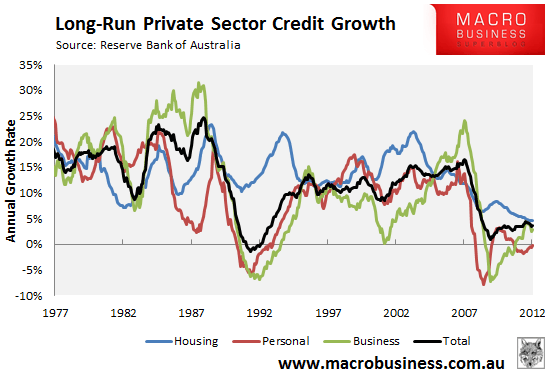
Personal credit growth (0.2% MoM; 0.1% QoQ; -0.3% YoY) rose over the month but remained lower over the year. Business credit (0.7% MoM; -0.3% QoQ; 2.8% YoY) also rose over the month, but is up over the year. Housing credit (0.3% MoM; 1.1% QoQ; 4.5% YoY) grew over the year, but at the lowest level in the series’ 35-year history.

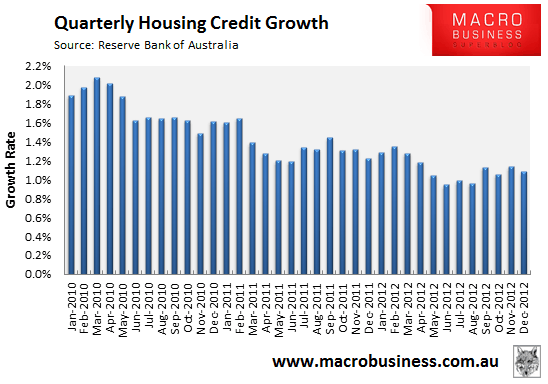
Focusing on the housing market, quarterly credit growth fell, but has recovered from the all-time low set in June 2012. Meanwhile, monthly housing credit growth (0.32%) was the fourth lowest recorded result in the series’ history, but it too has recovered from June’s low (0.20%):
Finally, a breakdown of owner-occupied credit and investor credit is provided below:
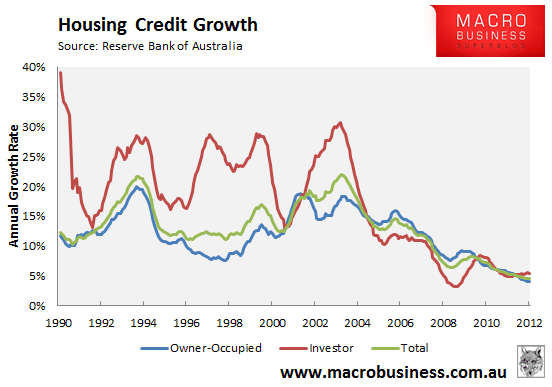
Investor credit growth (0.4% MoM; 1.2%QoO; 5.5% YoY) continues to out pace owner-occupied housing credit (0.3% MoM; 1.0% QoQ; 4.1% YoY).

unconventionaleconomist@hotmail.com

www.twitter.com/Leithvo


48 Responses to “ “Housing credit growth weakened in December”

  1. reusachtige says:

    We live in Bizarro world!

  2. MJV says:

    Good stuff, if households can maintain this adjustment I might even get on board deficit-financed infrastructure spending!

  3. Gunnamatta says:

    Certainly puts the January price rises in context.

    That said expecting endless slight downturns is probably optimistic, there will always be bounces.

  4. DaveC says:

    Hypothesis:

    Housing credit growth can rise faster than inflation as long as real property prices are allowed to increase. The cycle is self-sustaining, as higher lending supports the higher purchase prices, which in turn justify the higher lending, on the basis that loan-to-value ratios (the principal credit underwriting constraint) remain stable.

    However, this can only continue up the point where net borrower incomes are completely exhausted by repayment obligations. At that point, real growth stops, since borrowers cannot be lent any more money.

    Clearly the behaviour of a full economy is a bit more complex than this simple model, however I suggest it is a useful insight which might be coming into play.

    Discuss.

    • Gunnamatta says:

      Well currently 1/3 of mortgages are being serviced on an interest only basis – so add that in. Mortgage debt is circa 85% of GDP, debt to disposable income circa 145%.

      • DaveC says:

        Good points. I was also specifically thinking of the kind of serviceability measures that get used in underwriting.

        The numerator is typically something like assessed income, less tax, less existing obligations, less living expenses based on the Henderson Poverty Index (a poverty index, I kid you not). The denominator is typically the scheduled repayment, at a 1% interest rate stress. At around 1.0, you’re a lend.

        Now there is generally no benefit in having a buffer over this threshold. No interest rate discount, no capital reduction for the lender. So while not everyone is at the threshold, I’d suggest the threshold for an average borrower (for any given type of property) effectively sets the price, once you’ve reached the point I’m talking about.

    • Bobby Fischer says:

      Correct.

      For additional points, let’s dust off Irving Fisher and the inevitable debt deflation around the corner.

      What? Didn’t the RBA/Treasury let you know about this when credit bubbles burst? Inconceivable:

      https://en.wikipedia.org/wiki/Irving_Fisher#Debt-deflation

      “According to Fisher, the bursting of the credit bubble unleashes a series of effects that have serious negative impact on the real economy:

      -Debt liquidation and distress selling.
      - Contraction of the money supply as bank loans are paid off.
      - A fall in the level of asset prices.
      - A still greater fall in the net worth of businesses, precipitating bankruptcies.
      - A fall in profits.
      - A reduction in output, in trade and in employment.
      - Pessimism and loss of confidence.
      - Hoarding of money.
      - A fall in nominal interest rates and a rise in deflation-adjusted interest rates.”

      Definitely discuss.

  5. dam says:

    obviously the model of low credit growth = drop in house prices is wrong.Something else is happening.

    • jelmech@bigpond.com says:

      You reckon?
      Have a good look around.

    • SvetlanaBabe says:

      Fudged stats from the Real Estate number-crunchers, possibly?
      What I’m seeing in the Eastern Suburbs of Melbourne is that not much is being sold at all!

    • Mav says:

      Obviously you need to learn to back up your arguments with data.

      Can MB give Dam a guest post to prove his thesis? ;)

      • dam says:

        What do you want me to argue about ?? I read many many time here that house prices will crash/drop/whatever when credit growth get under 10%/5%/…
        it is not happening (cf the last few MB posts today).The model is wrong, nothing to ague about.

      • Mav says:

        I read many many time here that house prices will crash/drop/whatever when credit growth get under 10%/5%/

        Surely, you can provide a link to such an “argument” being made on MB… unless it is a fictitious product of your imagination.

        AFAIK, MB has argued a slow melt during the “dis-leveraging” cycle and all data points support that thesis. You are just indulging in a bit of straw man argument here.

      • Bobby Fischer says:

        Wrong dam. This is typical twisting of the facts – traits shared by internet trolls with an agenda.

        Anyway, try some facts for size:

        1. Data we are considering is not real december data, there is a significant lag as pointed out by others already

        2. It is not the absolute level of credit growth that matters. It is the acceleration or lack thereof in debt that matters, and there is also a lag built in.

        Steve Keen’s credit impulse covers this issue in detail and the correlations are very high between credit acceleration (deceleration) and house price rises (falls). See here for the strong correlation between mortgage growth and real house prices in Australia over 20 years:

        http://cdn.debtdeflation.com/blogs/wp-content/uploads/2011/08/082811_0444_UpdatedCred1.png

        So, other than obfuscating property sector facts, why your sudden prodigious output on this website? You were simply a ghost in previous times. Funny that, with the perilous state of the market and all.

      • Bobby Fischer says:

        Lag on HOUSE price data for December I should have said under point 1…

      • dam says:

        Cor 0.65 LOL and lagging with that, probably not significant.Always painful to see “economist” using stats to look pretty.

        Why am I not surprised ? ;)

      • DrBob127 says:

        probably not significant

        That word keeps being used whenever there is an unfounded opinion that the author would like to believe is a fact.

    • Jack says:

      I will have a go with an unsupported thesis

      Low volume of sales , those that bought paid cash so low credit growth, they bought expensive houses at a discount and so average sale prices are up.
      Maybe overseas buyers perhaps.

    • Stormy Waters says:

      Surely there’s a bit of a point here. Housing credit is, and has been for 2/3/4 years, roughly half the rate during the 90′s recession. Yet prices have broadly kept rising in nominal terms.

      If credit velocity is a main determinant of house price growth then there must be something that is offsetting it OR nominal house price falls require not just a low credit velocity but a negative one…i.e. outright deleveraging.

      • Bobby Fischer says:

        That’s because it is the second derivative of credit (rate of credit growth) and not the absolute level that matters.

        Seriously, Prof Keen has overwhelming shown that in data for Australia and US going back over 20 years the the correlation is very strong. I’m not sure why this is even being debated. Dam needs to read this too and then see later articles that reinforce this position.

        See here:

        Keen, Steve (2011). “Economic Growth, Asset Markets and the Credit Accelerator”, Real World Economics Review, No 57.

        paecon.net/PAEReview/issue57/Keen57.pdf

    • kodiak says:

      HIgher prices + lower volume = no conviction. There’s no recovery in housing – yet, anyway.

  6. Opinion8red says:

    The final chart tells you all you need to know.

    DBN!

  7. The Patrician says:

    So housing credit (debt) continues to grow.
    We are still not deleveraging.

    Stop cutting interest rates.

    • truth seeker says:

      Exactly. My concern is the low interest rates are delaying the inevitable and may make the deleveraging cycle more severe when it does occur.

      • Gunnamatta says:

        For sure they are. They are also, when in conjunction with high AUD, encouraging spending on consumer items from OS. When that deleveraging comes it is going to be uber painful because it is coming along with a hollowed out economy, lower AUD and rates going higher (to reflect bank OS borrowings to feed the current binge)

        I am coming around on the rates AUD equation. I reckon rates arent having any effect on bringing the AUD down, but are feeding the zombie real estate market.

    • Explorer says:

      We have been deleveraging the most expensive debt, credit cards and personal loans at different times since 2007. As this debt is also non-deductible it has a much higher effective post-tax cost than loans with deductible interest.

      Remember “Total” in the chart above includes “Business”.

      Eyeballing the right hand side of the chart and taking out Business seems to indicate about net 0 credit growth for households over the past 3 to 5 years (or a large part of it).

  8. npi_tweet says:

    I like this. This morning I feel like this is all coming to a crescendo! Next 12 months maybe?

    But there is only one indicator that I am waiting for an uptick……inflation.

    A rise in inflation will be the sweet smell of financial napalm, that is when the real games (and opportunities) start.

  9. Pfh007 says:

    The fact that the credit growth graph continues to descend while interest rates are being steadily driven by the RBA closer and closer to ZIRP is the big news.

    At any other time over the last 20+ years rates like these would have seen a ‘frenzy’ on the nature strips of our capital cities and the Merchants of Debt running out of tea bags and iced Vo Vo’s as the ‘investors’ rush in to secure their dose of the savings habits of foreigners.

    Clearly the mood has changed.

    What remains unknown is whether this apparent change in attitude by households towards debt and housing is permanent?

    Will the attitude go further and become a downright suspicion and distrust of debt (re my parents/grandparents) or can the interested parties including the RBA breath life back into the debt furnace by lying on their bellies and puffing lots of hot air into the embers.

    • Opinion8red says:

      The fact that the credit growth graph continues to descend while interest rates are being steadily driven by the RBA closer and closer to ZIRP is the big news.

      ^This^

      • Tarric says:

        Indeed, if the latest sequence of rates cuts were designed to reignite the appetite for credit towards previous levels they have clearly failed miserably.

        Even with rate cuts we have sent at best a small nominal increase since the rate cut cycle began, I just wonder whether we will see moves towards a large correction of housing prices in 2013.

        The latest round of property price data would seem to suggest that investors are snapping up properties because of the rate cuts and FHB are still very wary of getting into the market. Can this trend continue and the slow melt vs inflation go on? or will we see a trend towards lower prices in the coming months?

        If we see unemployment heading higher at a great rate of knots then we could see a feedback loop of job losses and lower prices. However by the same token the market and indeed most of the Australian public seem to cling to the idea that property only goes up.

        Honestly while I see Melbourne heading down 5% nominal this year the more resilient markets like Sydney (due to restrictive planning and no one wanting to live out West) and Perth (mining boom) could definetly stay static or even eek a small price rise in real terms.

      • Explorer says:

        “No one wanting to live out west”.

        Take a drive out around Kellyville. It was green fields 15 years ago. Whether they want to or not, many are in fact choosing to live there.

        It would be interesting to see where additional dwellings have been constructed by postcode over the past 10 years. Apart from some very large former industrial sites being turned into apartments (eg Rhodes, Breakfast Point, Nestle, AWI, Dulux in Canada Bay) I expect that the growth rates (from a very low base) are highest in the fringe. Absolute numbers are likely to be more evenly spread between gentrification suburbs, suburbs moving to units and the fringe.

        http://blog.id.com.au/2012/australian-population/population-growth-and-change-in-sydney-2006-2011/

        The table shows that the absolute growth in numbers is in the west, the high growth is in the middle ring as changes in density take place and CBD as the living city philosophy continues.

        Rank LGA Name Population 2011 LGA Name Growth (no.) 2006-2011 LGA Name Annual average growth (%) 2006-2011
        1 Blacktown 312,479 Blacktown 31,867 Canada Bay 3.1
        2 Sutherland Shire 219,751 Parramatta 20,663 Auburn 2.8
        3 Fairfield 196,622 Sydney 17,898 Camden 2.8
        4 Bankstown 190,637 Liverpool 17,168 Parramatta 2.6
        5 Liverpool 188,083 Bankstown 13,780 Blacktown 2.2

    • aj. says:

      What is also interesting is that investor debt is somewhat rising. My view is that this is more insidious than people realise and will further divide up our society into renters/debt serfs and owners.

      Remember, an investor with a lot of equity can borrow at very very cheap rates now with basically zero risk of a margin call. If they have a good cash backing then this is even less risky. Praying for a crash will really only wipe out the new buyers and the half-ar&e speculators – the good investors will just snap up the quality stuff with a view to longer term yield and capital gains, and they will just buy up more of the good stuff if the market falls.

      Established housing is just too investor friendly, and low rates are just making it more so. The RBA and the gov know that nearly all Australia’s wealth is tied up in housing – I expect rates to continue to fall and property owners, including investors, to be protected at any cost.

      That’s not to say we might not have a nasty correction, but this may not really hurt the investors as much as people think.

      • Pessimist says:

        Jobs are disappearing fast from certain regions of the country and with job losses there will be forced sales.The nasty correction is not too far away.

      • Explorer says:

        Manufacturing based regions are likely to suffer unless the dollar falls. Stability will coninue to grind away over time for a few years as the slow to adjust gradually take the plunge to offshore sourcing and new competitors source offshore at lower prices.

        Geelong could prove very interesting and Elizabeth in SA as Falcons and Commodores are assigned to history.

      • Explorer says:

        And the towns and regions currently benefiting from mining/processing investment must also be at some risk as employment declines as the peak of investment passes. Caravan parks in Port Hedland might become available for travellers again and the Golf Club lose income from being the overflow!