
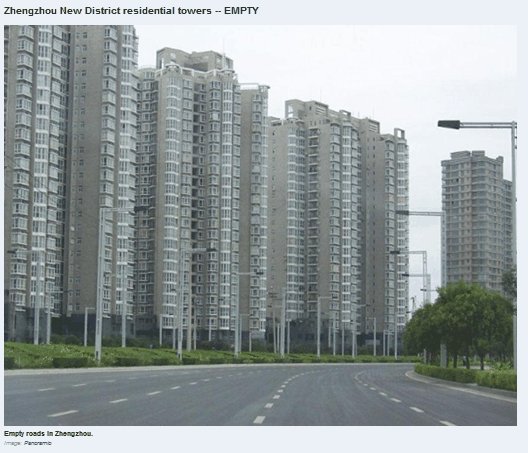
A cracking article was published yesterday in Caixin, discussing how China’s local governments, which are addicted to revenue from land sales, are feeling the pinch now that the volumes of land sales and prices are falling. The article also illustrates the corruption endemic within the Chinese economy:
The development-ready land market, long a reliable revenue source for local governments across China, has suddenly turned cold. And city halls are shivering.
Government-sponsored land auctions in cities nationwide have slowed dramatically in recent months, reflecting shrinking consumer demand and what one executive called a “winter mode” strategy among major developers. Nominal land values have fallen, and some auctions have been canceled due to a lack of bidders.
“The land market is basically deadlocked,” said Chen Xiaotian, president of China Real Estate Information Corp. (CIRC), a market research firm.
The cool-down follows last year’s decision by the central government to rein in soaring home prices and dampen speculation with measures such as stricter mortgage terms for buyers of second and third homes, as well as restrictions on bank loans for developers…
But local governments now face a dilemma. On the one hand, they see a need to control real estate prices, and would never dare disagree with or try to disrupt central government policies. But land sales have plunged, hurting their ability to pay for public services, ranging from police patrols to teacher salaries.
For example, in the Shandong Province capital Jinan, not a single developer bid for nine of the 11 plots offered by the city in early November. The two plots that sold went for bottom-line prices.
A city with a serious land market crash is Guangzhou, where in November some 32 plots failed to sell. In some cases, auctions were suspended by the city government, which blamed poor market conditions.
These plots were supposed to generate about 18.7 billion yuan for Guangzhou’s city government, representing some 29 percent of the planned land sale revenues written into the 2011 fiscal budget…
Big developers are feeling the pinch, too, and some small property companies reportedly started edging toward merger talks or bankruptcy. But local government officials are apparently a lot more jittery…
Land sale revenues for local governments in 25 cities declined 11 percent between January and November… “Sharp declines in land revenues have put enormous financial pressure on local authorities,” said Li. “Right now, local governments are more worried than developers”…
A source at a state-owned property firm in one provincial capital told Caixin that local agencies don’t have enough money to cover basic healthcare costs or pay teachers.
“City officials are coming to us and asking us to buy land to bolster the land market,” said the source, who declined to be identified because of the issue’s sensitivity. He said his company in November complied with a local officials’ order to buy a 900,000 square-meter site “whether we wanted to or not”…
CRIC’s Chen said local governments have balked at the idea of price cuts because they fear a loss of control over the entire land-housing market. Reducing land prices, they reason, would spark a steady decline for housing values, forcing further land price cuts afterward…
Of course, Chen said, government-owned property developers can be pushed by local officials to buy land, whether or not they want it, especially in second- and third-tier cities. The provincial capital developer source, for example, said if his company has the money “and it’s within our power, we’ll still acquire land. If we don’t buy, the local government will be hard to hold on financially.
“After buying land, the government will take care of you in other ways (such as) special treatment for future land transactions,” he explained.
Yet no amount of arm-twisting is likely to reverse weak land markets in major cities as long as the central government succeeds in cooling house prices. Only when land and housing prices are balanced, Chen said, will the winter end.
Meanwhile, Steve Dickinson, lead lawyer at the China Law Blog and resident of Qingdao, believes that the real estate bubble in Qingdao has burst, and this has led to protests and picketing from disaffected apartment buyers who have seen their equity evaporate. At the same time, the purchase of undeveloped land has virtually stopped, crunching local government revenues:
Since June of this year, officially advertised prices for new residential real estate projects in Qingdao have fallen an average of 30%. In a market that has seen nothing but price increases for many years, this has been a shock to the local real estate purchasers. As is typical in China, most of the new projects have not been completed. In a typical project, buyers purchased in June for a project that will not be completed until sometime at the end of next year. Now they are seeing units in that very same complex being sold at 30% or more less than the amount that they paid in June. Since the price is in free fall, they have no idea how bad it will be.
Owners in these projects have formed groups on QQ and Weibo to discuss their fate and to share rumors. On many projects, these unfortunate buyers have demanded that the developer reduce its price to reflect the recent discounts. In the alternative, they have demanded that their purchase contracts be cancelled. Most of these buyers have paid substantial down payments, so the reduction in price or the cancellation would require the developer to pay refunds to the buyers. Of course, none of these remedies are contemplated in the purchase agreements. Developers have therefore consistently refused to cancel purchase contracts. As a result, many buyer groups have organized formal protests, picketing at the sales offices of the distressed projects. These protests have had some impact and there are reports that some developers have offered at least partial price discounts. No developers have offered refunds.
The impact of the price decline has been considerable. Since the prices are widely advertised in the local newspapers and other media, the decline and the amount of the decline is well known in the local community. Most local residents have real estate fever, and they will freely tell you that prices have declined a minimum of 30%. This has had an immediate impact in three important ways. First, the sale of existing units has fallen dramatically. The only sales occurring are for drastically discounted units, with 30% to 50% discounts becoming normal. Second, work on uncompleted projects has slowed or stopped. Thus, all those buyers who paid deposits risk being trapped in permanently uncompleted projects. Third, purchase of undeveloped land has virtually stopped. Even though the local government has offered substantial discounts, with so many dead or dying projects littering the local landscape, developers are in no mood to take on new land at any price. This is particularly true in the light of Chinese law which prohibits land banking and requires land to be developed within two years after purchase. The lack of land sales then means the primary source of income for the local government has dried up…
Once a real estate bubble bursts there is no government powerful enough to stop the resulting collapse in prices and subsequent effects. The real estate bubble has burst in China, and now the government must work to contain the effects. The task is huge because of the wide ranging impact on the banking sector, local government finance and general social stability. Though governments cannot stop the bubble from bursting, governments can play an important role in dealing with the impact. Some governments push the economy to recover quickly. Others take counteractive measures that make matters worse. We will have to wait and see which approach China takes. So far, the signs are not encouraging.
When Jim Chanos first spoke out about China’s housing bubble, he mused at how the Chinese believed that newly constructed apartments were a solid store of value, much like a bank deposit. To Chanos, China’s apartments are poorly constructed and degrade quickly, requiring lots of maintenance and upkeep to keep them in good condition. Rather than being an asset, they are a financial black hole.
Confirmation of Chanos’ view is provided on the China Urban Development blog, run by Adam Nathaniel Mayer, an American architectural designer and writer based in China. In his latest post, Mayer takes aim at China’s shoddy construction and corruption:
As someone who works in the building industry in China, I am often asked why the quality of construction of most new buildings is so poor. The people who usually ask are expatriates from places like Europe or America; rarely does someone native to China who hasn’t spent time overseas pose the same question.
This perhaps has to do with the fact that building quality in China is relative. Most Chinese first-time home buyers moving into brand new housing tower blocks do not have the frame of reference to evaluate finish material quality. This is exacerbated by the fact most housing developers sell units as empty concrete shells, leaving it up to the owners to fit them out with finishes and fixtures…
The quality disconnect comes at the level of finish materials; both on the building’s exterior and interior…
Construction projects require huge budgets and bank loans- by cutting corners here and there, developers and contractors can pocket large sums of money. This means skimping on things like wall insulation, substituting quality exterior and interior cladding materials for inferior ones, and even using cheaper plumbing and electrical equipment…
The real estate development business in China is still like the wild west, and developers who have long-term vision are not easy to come by. Most are still looking to make a buck as fast as possible before the frenzy slows down.
I’ll keep you posted as interesting articles on the Chinese economy come to hand.
unconventionaleconomist@hotmail.com
