I had an interesting chat with an old hand in the coal market yesterday. He described how the in the eighties, as Australian coal producers jockeyed to supply Japan, the annual pricing contracts that determined prices and volumes were a like a Presidential cycle. You’d spend a year negotiating, then agree terms, then resume negotiations the following day for next year.
It was painful and ceaseless but provided essential stability of pricing for the capital intensive businesses at both ends. For Australia it was a boon for the trade account and Budget, also providing predictable export revenues and tax receipts, even though the coal was sold at a discount.
The same annual pricing system existed for iron ore until 2008. Then something happened. BHP and Rio attempted a bold merger. Don Argus toured Canberra and rumours began to spread that unless the merger was endorsed, the iron ore majors might be vulnerable to foreign takeover.
It was all rubbish of course, as FIRB has proved on every second Chinese takeover proposal ever since. The real motivation was to create an iron ore monopoly capable of gouging the Chinese to eternity and back.
Canberra rubber-stamped the idea. Asian capitals – including in Korea and Japan, looked on, incredulous. What had happened to Australia’s commitment to free trade they asked?
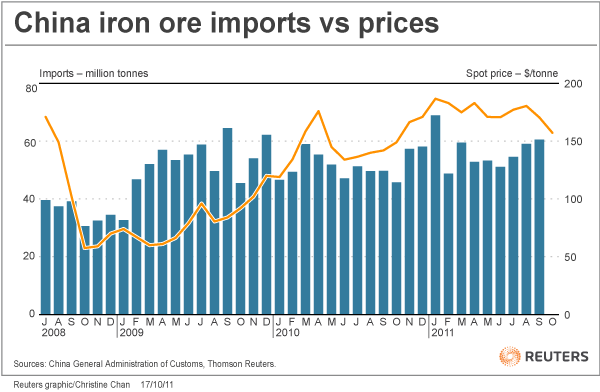
When prices collapsed a few months later, the market killed the idea, but still incensed Chinese mills reneged on annual contracts and bought iron or much more cheaply in the spot market.
As it turned out, that was a mistake. By mid 2009, the Chinese own insatiable need for iron ore soon returned the market to supply shortages, and the mining majors refused to return to annual contracts. They installed instead a quarterly pricing mechanism that referenced the spot price much more closely and BHP in particular kept the pressure on for even shorter contracts.
The rest is history. The iron ore spot price soared and Mining Boom Mark II arrived.
I make no bones about being against the BHP/Rio merger. To me it was always on the nose in principle and to my mind, strategically short term thinking as well. The companies themselves are now paying some price. The very unusual Canadian blocking of BHP’s PotashCorp takeover being one example.
Like it or not, however, the outcome of an iron ore and coal pricing system moving towards a floating price now looks inevitable, as Reuters commodity reporter, Andy Home says today:
Vale, which has previously said it was comfortable with its quarterly pricing mechanism, seems to be bowing to buyer pressure. Chinese steel mill sources have told Reuters that the company is offering to price Q4 deliveries against OctoberDecember spot rates, in effect removing the historic time lag.
Vale itself is maintaining official silence on the issue but if it does shift its quotational period, it will be following, again, in the foot-steps of BHP Billiton. Marcus Randolph, head of that company’s ferrous and coal business, told reporters during the recent annual World Steel Association conference that BHP is now selling the “overwhelming majority” of its iron ore using monthly, rather than quarterly, reference prices.
Indeed, it is actively promoting an iron ore trading platform, along the lines of the Global Coal system, as a way of moving iron ore pricing even closer to spot prices. It is clear that the iron ore pricing revolution is still evolving. Quarterly pricing of the sort espoused by Vale, and to some degree by Rio Tinto, always looked no more than a staging post between annual and spot pricing mechanisms. It was a sop to a steel industry that was enraged by the price volatility that followed the demise of the old benchmark system, even if many steel mills were themselves instrumental in causing the revolution in the first place.
The annual benchmark is now dead and buried. Even the China Iron and Steel Association (CISA), which went into a period of public denial that annual pricing had gone for good, has now just launched its own spot iron ore index. Quarterly pricing may be poised to go the same way since it too risks disconnect with the shorter-period pricing that is gaining ever-increasing traction.
So the question we need to ask ourselves is, then, what does this mean? To me the answer is playing out right before our eyes: volatility.
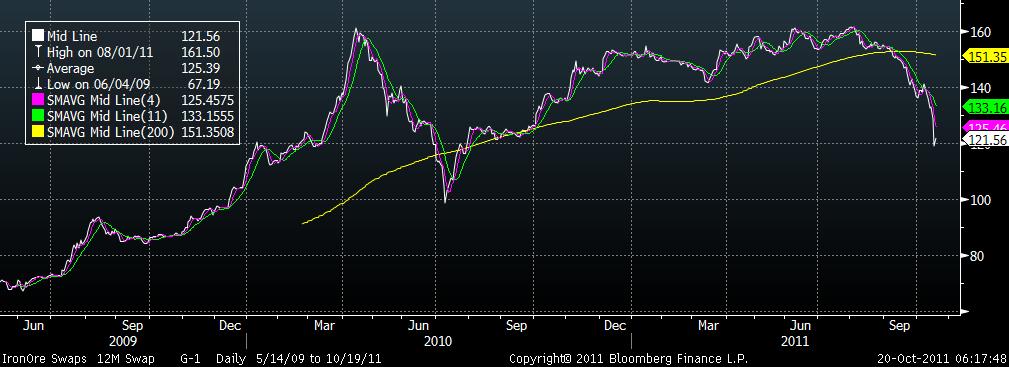
Here’s is yesterday’s iron ore swaps market:
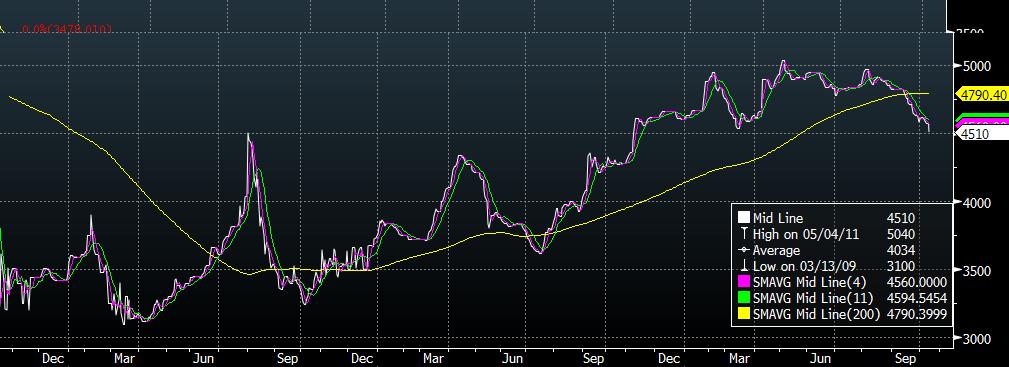
Not surprisingly, after Tuesday’s crash, we’ve had a 2% plus bounce. However, the ore price continues its catch-up, plunging 1.7% through the $150 mark to $147.70. Shanghai rebar also looks to be accelerating to the downside:
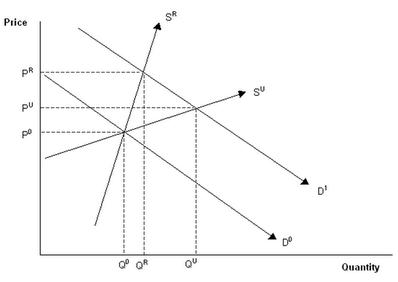
In a world dominated by wildcat finance and unstable money flows, as well as perceptions of supply shortages, simple economic theory makes it clear that you should expect just this outcome, booms and busts:
Q0 and P0 represent the initial equilibrium situation in any market. Initial demand is provided by D0, whereas supply is shown as either SR (restricted) or SU (unrestricted).
So, we’ll get higher spikes and lower lows. I don’t know what the overall effect will be on returns although I suspect lower price and volatility would probably win out in the end. What I can say is that the volatility has enormous policy implications.
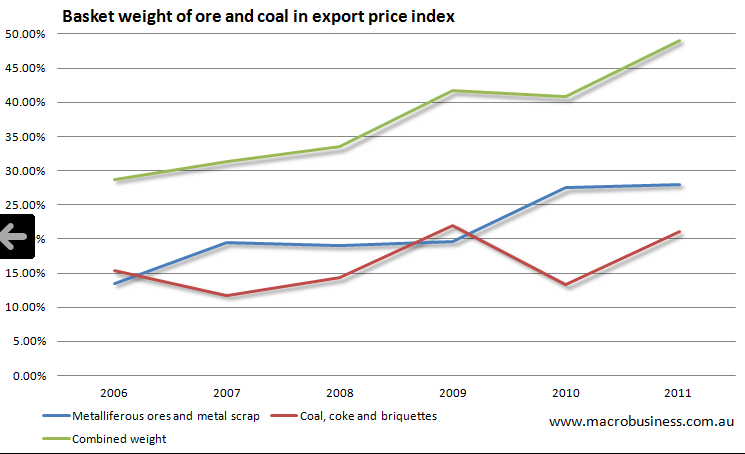
It may be that the Australian government couldn’t prevent the mining majors and Chinese wrecking the annual contract system. But the fact that they have presents a huge conundrum. Iron ore and coal represent 50% of Australia’s terms of trade, from Rumplestatskin earlier this week:
This kind of dependence resembles (though is not as extreme as) Norway and oil, or Chile and copper, or any number of petro-states. It is no coincidence that the same list of countries heads the list of the world’s largest sovereign wealth funds or, as some call them, stabilisation funds.
The reason why is that although mining companies can endure volatility easily enough, countries can’t. Wild volatility in export and tax receipts is a nightmare in the provision of structural services and expenditure. It is also an unwelcome challenge for every industry group outside of the boom sector via currency and interest rate volatility, as everyone has discovered this year.
If we aren’t or can’t going to manage the key prices in our terms of trade. Then managing the volatile income flows that stem from that failure is essential via a fiscal mechanism like a big mining tax. For a country also supporting a credit and asset bubble, to not do so is crazy.
The reason why is that although mining companies can endure volatility easily enough, countries can’t. Wild volatility in export and tax receipts is a nightmare in the provision of structural services and expenditure. It is also an unwelcome challenge for every industry group outside of the boom sector via currency and interest rate volatility, as everyone has discovered this year.
Australia’s predicament summed up in one paragraph.
Its good for mining companies, bad for everyone else.
We may have had a little currency volatility this year but no interest rate volatility at all. So half right.
It would be better to plan assuming a more moderate position (allocate expenditure on that basis) and anything above that is cream – to forward plan on peak return solely is foolhardy. This would then be more aligned to resource companies forward planning methodology, they well understand the cyclical nature of the business.
‘Bad for everyone else’. Of course not. That is an extreme statement. Truth is most Australian’s have experienced a healthy exchange rate that curiously is rather enjoyed – overseas holidays, cheap online shopping, petrol, imported goods etc, so many may, when they consider their daily lives, disagree.
“It would be better to plan assuming a more moderate position (allocate expenditure on that basis)”
Can you please be a little more specific? The spot price info is outlined above.
Maybe, 3d1k, you can compare your moderate view with that of treasury and we can see the real budget deficit picture. I haven’t forgotten volumes but lets ignore that important aspect for the moment
Australian’s have experienced a healthy exchange rate that curiously is rather enjoyed – overseas holidays, cheap online shopping, petrol, imported goods etc
Yes we enjoyed spending money on imported holidays, imported shopping, imported petrol, and imported products.
All good. No downside to that at all!
We’re reliant on imported petrol and many imported goods, we enjoy overseas holidays. It’s the real world – all good!
DFM is probably the guy to ask but is there any plots of currency volatility doing the rounds? I’d be interested to see how this recent period compares historically (post float).
Note volatility chart:
http://www.macrobusiness.com.au/2011/10/australian-dollar-valuation-report/
thanks. Huge swings in 08 when everything went pear shaped, and in 09 when the dollar began to recover. Other than that it looks like 10-20% movements have been a feature post float, i.e. we’ve been contending with a volatile currency since it floated.
Very true. If we ignore the volatility then it’s really quite flat.
What I said was apart the 2 years of the GFC — I think most objective punters would consider this period to be extraordinary — volatility looks to have been range bound since the float (10-20% annual)
Very true. If we ignore the volatility then it’s really quite flat.
That’s a joke right?
Yeeeeeees…
ok back at my desk: the annual data you have linked has mean 15% +- 7% so the current annual volatility is well within what the country has experienced since the float.
If you exclude the two GFC years 08/09 you get 13+-5 which puts the current year at the upper bounds. So the data doesn’t support a claim that volatility is excessive now.
I’d actually like to see some weekly numbers from DFM (I do not have data back to 83) because I suspect/expect that weekly volatility has been much higher recently and would be more likely to support your claims.
Most commodities operate this way, including important ones like oil and food.
I don’t see what the big deal is. Sure, Treasury will find it harder to project corporate tax revenue. But since whan have Treasury forecasts ever been right?
Doesn’t it make you just a bit nervous that Coal and Iron Ore much up about 50% of our terms of trade? I would much prefer some element of stability in that.
It is not the boom / bust nature of those commodities so much – that is well documented, but the fact we are now so hopelessly reliant on the income they bring.
It is a bit like trying to run a family budget when your salary swings wildly from month to month. Makes longer term planning very difficult.
@darklydrawl
if foreign ownership accounts for over 80% of Australia’s miners, most of the money volatility is of no concern to Australia.
I don’t see what the big deal is
The point is our export income is becoming increasingly volatile, which means Treasury forecasts will likely be even more off the mark in the future. It also makes planning extremely difficult!
That’s the price you pay when you hollow out your economy and bet the house on one country and two commodities.
Treasury forecasts being volatile: ‘That’s the price you pay when you hollow out your economy and bet the house on one country and two commodities.’
No. That is the price you pay when you base all forward estimates on peak commodity pricing. A little prudence is in order, an inbuilt anti-volatility mechanism if you will.
Miners and farmers have been dealing with volatile commodity prices for, I don’t know, centuries.
Ever heard of futures markets? If red-neck farmers and miners have worked out how to deal with price volatility, why can’t PhD qualified boffins at Treasury?
Hence a mining tax and stabilisation fund
HnH, as I ask below do you mean the MRRT or another tax altogether and if the MRRT how does the tax itself escape effects of profit volatility?
“Hence a mining tax and stabilisation fund.”
I’ll take that as a joke. Anyway, we already have a mining tax, actually two: royalties and corporate tax.
Sidelined, you may not have heard, but the futures markets are not for hedging, primarily speculating (financialisation) and hence drive the volatility.
Same with FX. Fully floating currencies are dogsends for traders….
Having said that why is it ok for private companies and individuals to use hedging products/strategies but not governments?
Taxation is the hedging, and managing your currency (Hong Kong anyone?) plus using stabilisation funds (not really used to fund anything, but to reduce speculative flows of capital) are those strategies…
“Having said that why is it ok for private companies and individuals to use hedging products/strategies but not governments?”
Because they are risking their own money or the money of those who choose to invest in them.
Allowing governments to engage in hedging and other speculative activities is a recipe for disaster.
As for speculators, isn’t it standard economic theory that they reduce, not increase, volatility?
Sidelined hedging and speculating are two totally different things. Hedging is a legitimate method of risk management but to hedge you need to have some exposure to the underlying.
Speculating on the other hand is gambling but for some reason it is not called gambling.
Standard economic theory, such as it is, assumes speculators provide liquidity to markets but assumes that trades are dominated by hedgers. In other words the economic theory bears no relationship to reality.
+1
“Sidelined hedging and speculating are two totally different things.’
Sure, but speculators and hedgers are risking their own money. It would be a huge mistake to allow governments to participate in these activities.
Also, my point was that traders and speculators smooth out volatility. Is this wrong? If so, how?
Still despite its volatility this new pricing system is at Australia advantage.Higher prices the better even if it has to be average prices.I dont see how the merger would not have been hugely profitable for Australia.
“This kind of dependence resembles (though is not as extreme as) Norway and oil, or Chile and copper, or any number of petro-states. It is no coincidence that the same list of countries heads the list of the world’s largest sovereign wealth funds or, as some call them, stabilisation funds.”
There is no point getting into a SWF argument with you about this because our views have been stated many times.
As far as the comparisons with Norway, Chile and the petro states go you don’t paint the full picture. The RBA has documented the extent of oil and copper revenues to these nations GDP. I can find the article if pressed but from memory we’re talking well over 50% (near 80% for one of them??) whereas resources contributes ~8% to Australia’s GDP. As a result of oil (and copper) totally dominating the GDP of those other countries, they run large current account surpluses.
My point being that not only is it “not as extreme”, the reality is that iron and coal to Australia are not even in the same ball park re: effects of the country’s GDP as oil (and copper in Chile).
ok my memory failed me. my % were for exports rather than GDP. % of GDP numbers are
Chile 7% (still manages a current account surplus by the way)
Norway 27%
Petro states (those listed):
Abu Dhabi 59%
Kuwait ~ 50%
—————-
http://www.rba.gov.au/foi/disclosure-log/pdf/101114.pdf
And if iron ore and coal prices were to drop by two-thirds over the next 12 months, you would expect the effects on our economy to be minimal?
Of course not. And if any other 8% portion of the other 92% of the economy dropped by 2/3 that would also have a similar impact.
But the comment was about comparisons between us and Norway etc. IMO apples and oranges.
My guess would be that if iron ore prices dropped by two thirds over the next twelve months some sort of global calamity had occurred – $150 to $50? Commodities would be the lease of our problems.
‘least’
I’m quite sanguine about it Lorax.
Volatility like this will drive adjustments at all levels in the economy. So what? It is the new normal.
HnH, you’ve got a hell of a way of depressing a guy first thing in the morning.
The question to me is: are BHP & Vale chasing shorter contracts for short-term goals while essentially giving up on any kind of long-term planning? Why does that kind of short-termism sound all too familiar?
It’s all about making hay while the sun shines then jumping out the window with a golden parachute when things go awry.
+1
HnH you say
“Then managing the volatile income flows that stem from that failure is essential via a fiscal mechanism like a big mining tax.”
The volatile nature of commodity prices impacts profits. A mining tax based on windfall profits (MRRT) will in turn be volatile. Am I missing something here. Are you talking of the MRRT or another tax altogether?
It’s what you do with the tax that counts, not the exact nature of it. If the government budgets on a moderate tax haul, based on say iron ore at $90 a ton, and puts aside any cream in a sovereign wealth fund, we will have a reserve to cushion the transition when (if) the iron ore runs out. (I say if because from the air it looks like most of Australia is iron ore.) Alternatively, you could put the cream into investing in long term infrastructure projects – NBN, anyone? The only really bad thing is to squander it on recurrent expenditure.
I agree that it is what you do with the tax that counts. I am simply cautioning against reliance on a mining tax as a counter to volatility, as I understand HnH to mean – the tax itself applied to ‘super’ profits, profits affected by volatility, doesn’t seem to fix the HnH’s volatility concerns.
Certainly some of the proceeds from any ‘cream’ should be directed to infrastructure to support the resources sector from whence they came – better roads, deepwater ports etc.
Cheers
Tax prevents income surges entering economy in the good times, keeps rates lower, reduces slowdown for other sectors, keeps dollar lower ie lower volatility in economy and government receipts.
When bad times come, money in fund can help for stimulus ie. lower volatility in drop in economy and rebound in government receipts
Sorry old boy, not up to wrestling you and Carl today. My view is simply: big mining tax + SWF + remove negative gearing = lower dollar, lower interest rates, less boom & bust
3d1k
yes, cash flows into government will be volatile, but as Alex Heyworth says, the Government should be taking a longer term view and should bank/invest overseas the big volatile inflows.
As long as the Government doesn’t try to use the windfall tax as part of its expected recurring income it (and our economy) should be indifferent as to whether the flows are volatile. It’s when governments start to rely on bubble income as baseload recurrent income that they really come unstuck (like the Irish government relying on 25% of its tax take from property transaction taxes, which suddenly evaporated when the Government supported bubble popped).
Taking progressively higher amounts out of resource company profits as the resource prices go higher prevents those super profits suddenly sloshing in and out of the Australian economy. It also reduces the incentive for the resource companies to make major infrastructure investments based on short term price changes because they know they won’t get the very short payback from spiking resource prices, which is a further dampener on volatility and short term swings.
As Alex says, the Government then uses either the banked capital or income flows to intervene in downswings of resource prices and inflows (i.e. reduce the effects of volatility on the Australian economy) and to try and prevent the Australia of 2100 looking like the Nauru of 2000.
I hope our government invests more wisely than Nauru’s did!
There has been extensive discussion here at MB over recent times on the viability of a SWF or stabilisation fund. Opinion is divided on the subject and indeed my own opinion changed as a result of some excellent argument by commenters here (really Carl, as he is this week) and DE’s Sectoral Imbalance primer.
No offence intended but your third para is nonsense. There is nothing short term when it comes to resource companies infrastructure investment. You do realise that most projects take several years to completion – with no guarantee of commodity pricing at the end. Nothing short-term at all about it. We must the one of the few nations on the planet that actively promote prevention of economic growth of a worthy and valuable sector.
DE supports an SWF. As does UE. In the plain cold light of day, saving the proceeds of the boom is the ONLY sane course. All of the debate and objections are about political roadblocks to change, including sectoral imbalances.
Change the macro settings and we could save money from the boom (but here I am getting into the debate once more. Bye!)
From memory DE agreed with me on sectoral grounds but thought it might be justified for perceptions. Maybe you can link to his previous remarks on this.
Rumplestatskin does not support a SWF.
I don’t believe that I’ve ever read any comments from Prince, DFM, and the rest of the bloggers on this.
The obvious solution to commodity price fluctuation is hedging, to be implemented via short positions on mining companies. It is a shame that the current political system would not allow the government to do this
Given the amount of investment needed in the pipeline, it strikes me as somewhat risky for mining companies to switch to a spot pricing mechanism. Then again, the annual pricing doesn’t work for China in the same manner as Japan. During the 2007 period when price was booming, some iron ore producers stop delivering their contract and sold their ores on the spot market instead. This can never happen in Japan as the Japanese steel industry acts like a cartel. China is a different model, and the CISA speaks only for Baosteel. Moving to the spot market is therefore inevitable.
If iron and coal sales move to monthly spot prices, and a market develops, then there will be shortly a series of derivatives developed and sold to “manage”/ hedge the volatility that shorter pricing periods bring about.
Vendors and buyers will take views on where the market is moving and work out how much hedging will cost them and decide how much volatility they want to sell or pay to remove (banks and brokers and exchanges will take their clip on each turn). Once people get used to managing the new volatility with old derivative products, and if some of the speculation/position controls being introduced into other commodity markets are introduced, it should reset to a new level of volatility somewhere between the old annual negotiations and current naked transactions based on monthly spot prices.
We need to get used to the new volatility. Perhaps the old annual contract system will come to be seen as an interesting aberration that existed for a short while until normal market mechanisms returned.
I’m ore of the view that the hedging products will make the volatility worse…
Was your “ore of the view” a typo or a very bad pun?
agree with you on that. Once we start allowing speculators to dominate pricing, volatility will be much worse.
(assuming that like other derivatives markets that speculators dominate trade volumes)
[...] as half of its terms of trade, will have to deal with increased volatility in its tax receipts, argues Macrobusiness — and all without the stabilising benefit of a sovereign wealth fund to smooth things out. [...]
Short term contracts have arisen due to China’s view of iron ore contracts as a free option. When prices are rising they expect miners to stand by the contract. When prices are falling they renege and want to go to the lower spot price. Miners dont want to be treated like mugs.
That’s true. But the miners also played a role. They gouged hard and attempted an ludicrously anti-competitive merger. It wasn’t all China having it’s cake and eating it too.