
Bernanke chooses deflation

So, down we go. The last impediment to lower … well … everything (except the $US) has been removed. There’s no QE3. Markets didn’t muck around. Everything risk and $US sensitive took an instant pounding and the $US jumped. The equity market got smashed into the close and is signaling more to come.

What we got from the FOMC was Operation Twist, as advertised. The FT showed some deference in reporting the outcome:

The US Federal Reserve launched “Operation Twist” on Wednesday in a bold attempt to drive down long-term interest rates and reinvigorate the faltering economy.

The central bank said that it would buy $400bn of Treasuries with remaining maturities of six to 30 years and finance that by selling an equal amount of Treasuries with three years or less to run.

“This programme should put downward pressure on longer-term interest rates and help make broader financial conditions more accommodative,” said the Fed. The policy is named after a similar attempt to “twist” the shape of the yield curve in the early 1960s.

The Fed also sprung a surprise by pledging to reinvest any early repayments from mortgage securities back into debt issued by mortgage agencies such as Fannie Mae and with a strong focus on buying 30-year Treasuries. “We got a double twist,” said Diane Swonk, chief economist at Mesirow Financial in Chicago.

Such a large move suggests that Ben Bernanke, Fed chairman, is deeply alarmed by the slowdown in the economy and decided to override opposition on the rate-setting Federal Open Market Committee and provide as much stimulus as easily practical. The purchases will run until June 2012, setting the course of Fed policy for the next nine months.

The FT is wrong, this is not big, nor a rabbit out of the hat. As I’ve argued before, at the zero bound, where the only price signal is the signal of policy-maker intentions to deflate or inflate the system, you can’t feed a market rich desserts with thick topping then offer them a dry donut and still expect the system to inflate. Only a bigger dessert with more topping will serve.

I see no reason why both stocks and commodities shouldn’t revert to the prices we saw pre-QE2, roughly 20%+ down for commodities and maybe 15% on the S&P. And that’s before we factor in any recession.

So, what might the “Twist” achieve? Ironically, it may have some effect on the real economy. I can see it achieving two ends. The first is that pancaking the long bond potentially lowers a huge swath of mortgage rates in the US. That may, in turn, fire off a new round of refinancing activity. The following chart from Calculated Risk shows what the Twist is seeking to reverse:
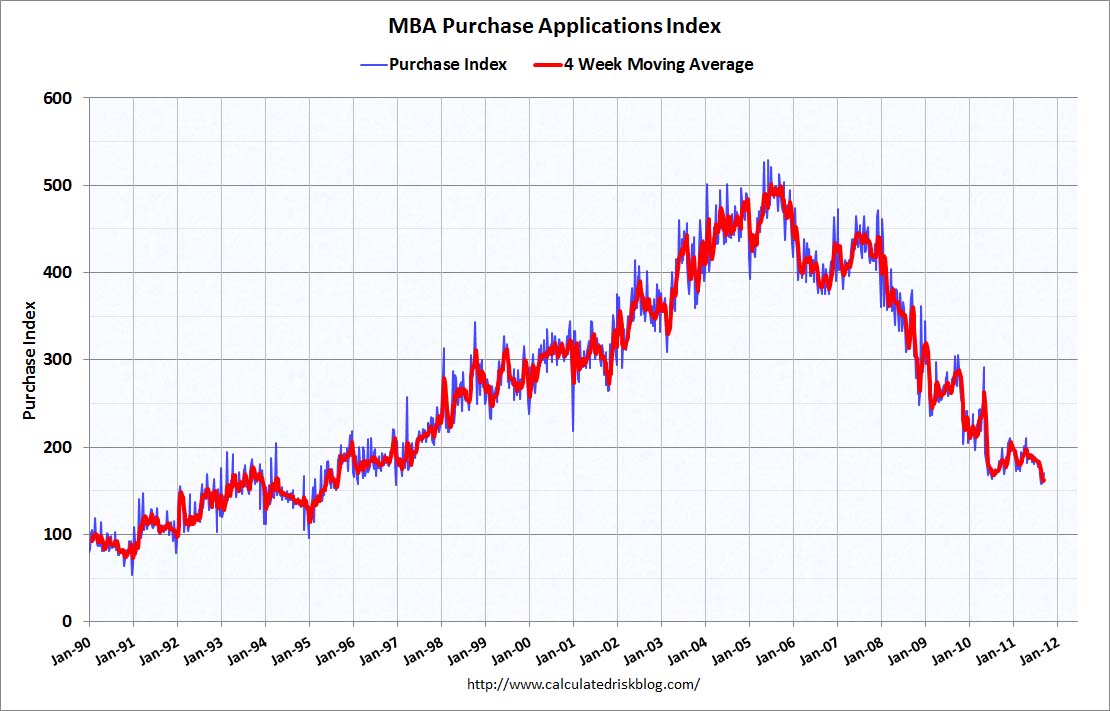
Any such success would free up some more equity in US housing for spending money. Perhaps not a great idea long term but in a world of limited options who cares about that.

The second effect of flattening the yield curve for banks may be to disrupt their very easy carry trade of borrowing short term funds at zero and dumping them into long bonds for an easy margin. By flattening the curve, banks may be forced to lend that money instead.

The deflation in commodity markets (especially oil) should also work to boost demand.

So, we now have a struggle set up between deflation in global market pricing and (assuming it works) inflation of lending targeted at demand. There’ll be some new equilibrium struck between these two.

In theory this looks OK, but the fly in the ointment for me is the $US. With Europe burning and the Fed being seen to be backing off debasement of its currency, the $US must rise. That will slowly choke off the US export recovery and, making matter worse, will exaggerate the downswings in equities and commodities.

The new equilibrium we are about to find is lower.


41 Responses to “ “Bernanke chooses deflation”

  1. Rob Z says:

    Finally, we might see the froth gone and return to something that truly represents the current world economic situation.

    • jim says:

      The world has been living in a false economy since 1995. The sooner we get back to a real economy the quicker we can recover. That means realistic home prices, stock prices, real interest rates and currency valuations. Included in that should be imigration enforcement. We will deflate.

      We need to reform wages and salaries so that they reflect a true value. No one is worth 78 million a year let alone someone at a oil company who drew over a billion in one year. Even the managers at the local banks are overpaid at the expense of interest income for the savers.

      With zero interest millions of retirees and savers have been taken out of the spending mode. That is huge hit to the economy not only in income but in confidense. Zero interest is another form of taxation and for some folks going to zero interest from 5.5 CD’s is like paying 80% in taxes if you happened to have spent a life time saving for the future.

      Oh happy days!

      JPM

  2. greggsy says:

    excellent article, than you.

  3. Nick says:

    Sorry HnH. I agree this will not be effective at all.
    .
    Yo say “That may, in turn, fire off a new round of refinancing activity” and “would free up some more equity in US housing for spending money”.
    .
    There may be a rush to refinance to reduce your mortgage costs (who wouldn’t). But the moneu freed up will go to paying off debt. It will be seen as a big opportunity to get back ahead of the game for the first time in 5-6 years. This is a good thing, but not stimulatory for demand.

  4. Velociraptor says:

    >Any such success would free up some more equity in US housing for spending money.<

    This equity?
    http://www.cnbc.com/id/42957613/Homeowners_Drowning_in_Negative_Equity

  5. The Lorax says:

    you can’t feed a market rich deserts with thick topping then offer them a dry donut and still expect the system to inflate

    Desserts not deserts. Deserts are regions that receive very little rainfall.

  6. The Lorax says:

    With Europe burning and the Fed being seen to be backing off debasement of its currency, the $US must rise. That will slowly choke off the US export recovery

    Yeah agree … exports are the only thing working in the US economy ATM. QE3 is inevitable IMO.

  7. Sherlock says:

    They’re one rabbit closer to the day when there are no rabbits left …

  8. Dr Nick Riviera says:

    There’s no QE3

    …contrary to the strident claims we’ve read for weeks that it was locked in. In the words of Mike Williamson (for AFL followers of a certain age) “I tipped it”.

    The first is that pancaking the long bond potentially lowers a huge swath of mortgage rates in the US.

    I commented a few weeks ago that operation twist could lead to mortgage refinancing, if the long bond rate fell, and make punters a few bucks better off but there is a big “IF”. Once again the Fed are targeting a quantity (400 bill) rather than a price. On that basis it is no guarantee that rates will move in the direction or magnitude they expect. Any significant move down may end up being dumb luck rather than planning.

    Any such success would free up some more equity in US housing for spending money.

    Only if punters choose to spend the difference. They could, as an alternative, choose to use the difference to pay down debt.

    The second effect of flattening the yield curve…

    as above. This is not a lock because they are not targeting price.

  9. SvetlanaBabe says:

    The new equilibrium will be MUCH lower than people think!
    We should get to around 2700 on the local bourse. pretty quickly now.
    Gold will be about $2,500 an ounce in local dollars as well.

  10. Dr Nick Riviera says:

    Interesting comment I came across on pragcap (from an economist no less):

    Well, I recently decided to refinance from 30-yr fixed @ 4.5% to 15-yr fixed @ 3.25. To do this my family will have to cut discretionary spending by about $350/mo. For the first time, we’ve put ourselves on a….a….a….. budget. ouch!

    Dinners out, new clothes, DVDs, etc. all cut. I’m wondering how many other people will do this and how, on balance, it will affect the real economy. (along with the lower interest payments that will also sap income and expenditure, especially by seniors who tend to be savers)

    So sample size for this survey is one (!) but it does make you wonder about punters deciding to take the opportunity of low rates to pay down debt rather than spend like drunken sailors.

    • The Prince says:

      That seems to be the meme down under as well, which I kind of noted in my “Time to Refinance” piece a few weeks back.

      The complete reversal in the household savings ratio is illustrative.

      I wonder why those who consider lower rates as a trigger for more lending don’t consider the empirically observed state in private debt saturated economies whereby lower interest rates actually mean more saving and less credit growth and hence spending.

      The evidence is abundant – but for the evidence to be considered economists would have to consider private debt dynamics, which they routinely ignore.

    • Mav says:

      So the penny finally dropped for atleast one US “economist” :)
      .
      Dinners out,
      The local restaurant will have to hire some more illegal immigrants.
      .
      new clothes, DVDs, etc. all cut.
      .
      Wen, better get that “internal consumption” going in China. But I doubt mainland Chinese will buy legit DVDs.

  11. Adrian says:

    Interesting H&H, and if we do get deflation Bernanke’s PhD has been worth all those years studying the great depression. Pretty much all the futures are down and I was surprised the AUD didn’t fall further.

    Thanks for the great post.

  12. The Lorax says:

    Some classic Carr this morning…

    The Fed in this statement suggest that inflation has moderated when in fact it has accelerated. The numbers are there for anyone to see. The reality is that the Fed has not and cannot provide the “ample data” proving a case for action. Growth is not as weak as the Fed make out and the outlook is not as dire.

  13. Sweeper says:

    Just read Bernankes statement. Either he is under real pressure from Republicans or he has lost the plot well and truly.

    He admitted that 1.”inflation will settle, over coming quarters, at levels at or below those consistent with the Committee’s dual mandate” & 2. “there are significant downside risks to the economic outlook”. So he knows that the Fed will miss its price stability & employment mandate, yet he is not going to do anything about it.

    It was only when core inflation drifted down to a low of .6% (in Oct 2010) that the Fed felt concerned enough to launch QE2. .6% was reached even though there was no recession in 2010 and GDP grew at about 2.5%. Does Bernanke really believe that if the US goes in to recession now, there won’t be negative core inflation. How can they take that risk?

  14. learner says:

    I recon most have this wrong. Please remember for 3 years the world has been in a currency war. The FOMC is and has always been dealing with the Chimerica imbalance and their latest move could be paraphrased as follows. Stop deflation and wind up the financial system pushing commodities as far as they can without hyperinflation by printing money but keeping it within the financial sector (QE1 And 2) then open the flood gates (twist) and flush China out.

    Learners take on the next 9 months…. Commodity prices crash and takes the Chinese shadow banking system and the US $ peg with it. US housing starts recovery and the world is a better place.

  15. Stavros says:

    Falling comodity prices and less specualtion…sounds ok to me.

    There are other ways to lower the US dollar and maintain US export competiveness…

    The Chinese have been doing it for years, the US will do it too

  16. aj. says:

    So does that mean it’s official? Money is now free… and the misallocation of capital for the ecological vandalism of the world can continue… phew.

    (Gee i hope my local beach gets more units and shopping centres)

  17. Clarky says:

    Operation twist will also put a clamp on bank profits from their borrow-short, lend-long portfolio (if significant numbers of existing borrowers refi).

    Bernanke, as head of the bank-of-all-US-banks, must be desperate if he is willing to chop the profit margin of his already struggling banker buddies.

    …or else he believes that most existing borrowers won’t have the option to refi.

    • Dr Nick Riviera says:

      On the contrary, by deciding to roll over $ from expiring MBS into new MBS purchases that seems like they had concerns about housing and are providing a further lifeline to banks.

      And whether the twist part works is doubtful because they are setting a quantity of purchases rather than targeting a price. e.g. If you go into say a fruit and vegie market with the objective of buying 400 apples, and the quantity available is much larger than that, then how the prices moves is anyones guess. On the other hand if the current price of apples is $4 a kg and you go into the market saying your are a buyer at $4.10 then this becomes the new market price.

  18. Nick says:

    Talk on Bloomberg is now of BoE Mervyn King doing similar QE Twist on bond purchases. The arguments put forward are that even though inflation will supposedly be running at 5% by year end (twice their target) that growth should be the only focus now.
    .
    Well, eroding spending power of $$ by 5% per annum would certainly feel a lot like being in a recession to me FFS.

  19. [...] Bernanke chooses deflation MacroBusiness [...]

  20. [...] Bernanke chooses deflation MacroBusiness [...]

  21. frobn says:

    “The deflation in commodity markets (especially oil) should also work to boost demand.”

    What happens when you boost demand of a limited or constrained commodity like oil? Hint: look at the sky.

  22. Nick says:

    I am starting to think Twist will work better than most people think. Sure, it is causing a lot of ‘financial market pain’ at the moment in terms of falling share prices, etc. But it appears to be cutting the legs off commodities prices including oil and food. Essentially the biggest drivers (components) of inflation in many countries in the last year or so. So it should cause some relief on that front and for consumers if it lasts.

  23. Mav says:

    The first is that pancaking the long bond potentially lowers a huge swath of mortgage rates in the US. That may, in turn, fire off a new round of refinancing activity
    .
    Refi’s may also helf the banks “fix” the paperwork on those mortgages that are just a bunch of forgeries stapeled together with robo-signed statutory declarations.

  24. joebhed says:

    OK, so the central bankers are in full complement around the plain truth that we’re screwed, as far as they can see.
    And that’s why austerity is the only thing that makes sense.
    What we have is debt saturation in a debt-based money system.
    Everyone who hasn’t read “How Debt Money Goes Broke”, should.
    Not because the evolution of this slide provides any new markers, but because it recognizes that it is the debt-based money system that is insolvent. And broken.
    Unfortunately, the CBs all went to to the same financial biz-schools so they are blind to the reality of national monetary systems.
    They see their policy tools from the limited perspective of fractionally-reserved, debt-based money, endogenousness notwithstanding.
    Pity.
    We’re getting close to transition time.
    I can feel it.
    The Money System Common

Leave a Reply

You must be logged in to post a comment.