
Official statistics reveal that two companies a day in the construction and building-related sector are collapsing, as late payments from creditors worsen, activity dries up and banks put the squeeze on funding.
The latest statistics on liquidations and voluntary administrations show that between June 1 and July 18 almost 100 companies in the construction and related industries collapsed, 23 of them in Victoria, 45 in New South Wales and 15 in Queensland.
The trend appears to be worsening in NSW, with 18 construction-related companies failing in June 2012, compared with 24 in June 2013 and 21 collapsing in the first 18 days of July 2013. These included such companies as JBP Construction, Paint Rite Australia, Quick Home Australia and Kona Constructions and Maintenance.
It supports the general economic statistics, which showed that in the March quarter, gross domestic product figures seasonally adjusted construction activity fell 2 per cent.
…According to the country’s biggest receivables management and credit report company, Dun & Bradstreet, the trade payment terms for the construction sector are 55.3 days in the June quarter, slightly up from 55.1 days in the June 2012 quarter, and is almost double the conventional payment of 30 days.The national average was 54.1 days in the June quarter.
No argument from me but there was a glimmer of hope yesterday that the sector is turning. Australand released a decent result. From Citi:
ALZ 1H13 result points to a solid recovery in Australian residential markets. ALZ saw a 36% lift in contracts on hand from Dec 12. Management now forecast 3-4% growth in earnings for the full year. We leave our earnings largely unchanged (Citi forecasts 4.7% growth) as we think guidance looks conservative given the building momentum in the residential business. Our target price rises slightly to reflect the roll-forward in our NAV.
- What we liked — The large number of residential contracts in hand expected to settle in the 2nd half gives good coverage for full year earnings with room for upside should the current momentum be maintained. Commentary on the call indicated that the key Victorian and Queensland markets have bottomed and are improving. This gives us comfort that sales momentum will continue and confidence in our full year forecasts sitting ahead of company guidance. Cost control is also clearly evident and Citi now forecast a 15% reduction in costs for FY13 vs. FY12.
- What we didn’t like — The Commercial and Industrial development business has seen margins slip from ~11% in FY12 to ~9.2% in our forecasts for FY13. This is partially a function of working through impaired land, but also a function of greater competition pressuring margins. ALZ have also provided rent guarantees on some of their sales to 3rd parties, casting some doubts on the final margins they will achieve. Visibility on future development starts is low. Hence, forecasting growth for FY14 C&I earnings is difficult. We stay conservative in our assumptions here for future years as a result.
- Implications — Potential corporate activity in ALZ has overshadowed an otherwise impressive operational performance. With these distractions now apparently over, ALZ’s solid earnings story and upside from further growth in residential markets deserves greater investor consideration. The evidence of recovery in residential markets also has positive implications for SGP and MGR. Retain BUY.
Don’t get me wrong. I would not buy this stock. The office and industrial exposure is big and the growing glut in the former is a major headwind. Moreover, the large land bank is also a risk to the balance sheet if, as I think likely, land prices stall again. But the commentary on residential dwelling construction is interesting and shows that the recovery, such as it is, is starting to stabilise some large players (I’m talking about dwelling construction here not engineering construction).
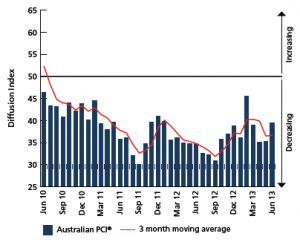
Things have been getting worse more slowly in the construction PMI for some time:
The same slow trend is apparent in new orders for houses and apartments:
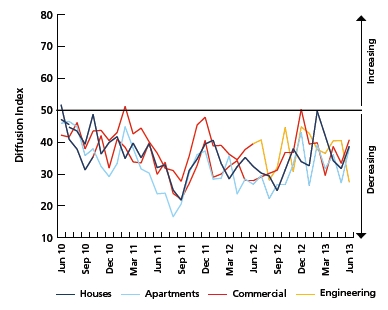
We’re sure not turning on a dime. But these are the kinds of mixed messages one might expect as a the market bounced along the bottom.