

Is Australian property worth the risk?

This morning, Residex’s John Edwards sees the same momentum building in the property market that we are all seeing in the past few weeks of auction clearance rates:
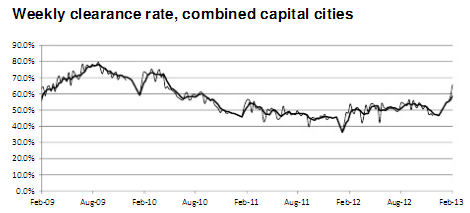
He argues that property prices are likely to accelerate from here. And in the short term he may be right. Although we haven’t yet seen much growth in mortgage issuance outside of fiscally stimulated bounces, the kind of clearance rates we are seeing are consistent with higher credit growth to come.

But I wish to make two simple observations.

Those looking to the RBA for succor that property price rises are inevitable are only seeing half the picture. In the post-GFC environment, APRA is just as important to credit availability. It is APRA that has to date forced banks to lend dollar for dollar on deposit growth. This means that there is an implicit macroprudential constraint on the distribution of credit, even if the price is cheap. By that I mean considerably tighter credit standards than pre-GFC.

I do not see this changing unless APRA itself changes, or is changed. And if it does not change then property price growth is inherently limited. Right now deposits are growing at 7% per annum and falling. Given they make up 60% of funding, that means aggregate credit can only grow at 4.5%, more or less. That’s where it is now.

There are swings and roundabouts here. People are paying down debt faster so there is more credit availability despite capped aggregates. The stock market rally may draw out deposits but it also boosts equity. But so long as APRA maintains this discipline, property prices cannot rise like they used to, nor far above inflation, for any period of time.

In an era of volatile financial assets and low returns that looks pretty good, especially when you tack on some rental yield. Certainly it appears early-moving property investors think so. But the analysis is not yet complete. We have not yet considered risk.

I have never been a part of the “don’t buy now” narrative and have seen the slow melt in Australian house prices largely as a function of two forces. One is credit conservatism in the populace limiting demand. The other is regulatory intervention backing that up. Both the RBA and APRA have prevented credit expansion so that offshore borrowing by the banks and external risk for the country remains contained. Crucially, this endeavor was made possible by the mining boom, which enabled property suppressing interest rates and economic strength to co-exist.

But that has begun to change. The 15% or so correction in the terms of trade means that the mining boom is ending. So far it has done so reasonably gently. And it may continue to do so if China keeps on spending on the fixed-assets that require iron ore.

But that is not my base case. Rather, I am of the view that China is serious about rebalancing because the costs of inaction are now higher than the costs action. I therefore expect the trend in Australia’s terms of trade to continue to be down for the next few years. Which means at some point both national income and mining investment are going to drop more precipitously.

That will mean rising unemployment and falling standards of living will pressure rents because more people live together. The corollary of falling property prices, despite falling interest rates, is easy enough to draw. Really, this is a terrible irony. Folks have avoided property for a couple of years for fear of an interest rate triggered shakeout. Now that rates are falling because real risk is growing, the market is warming up.

Of course, if your long term goal in buying a property is to live in it then who cares, right? So long as your equity is good and you intend to live in it for a goodly period.

But if you’re investing for capital growth and yield over the medium term then I’d be asking myself if you’re being appropriately compensated for risk, especially when you can get the same exposure in bank shares, with better yield and the same capital growth prospects. And most importantly, in a liquid form.



48 Responses to “ “Is Australian property worth the risk?”

  1. dam says:

    It s not all about credit as we can all see the credit growth is subdued but property prices are going to rise substantially this year (trend could be around 7-8%).Something else is happening.

    • Of course it is about credit. There is nothing else. But let’s say you’re right, even at 10% , is it worth the risk as we go over the mining investment cliff? You can buy bank shares with the same exposure with a grossed up yield of 7% plus growth prospects if property rises and they’re liquid so you can get out fast.

      • dam says:

        if you say so.

        Even Keen agree with you, showing that property prices will rise even faster than in 2009, with his credit growth acceleration chart :

        http://cdn.debtdeflation.com/blogs/wp-content/uploads/2013/02/020513_0039_Mortgageacc2.png

      • There’s nothing in that chart suggesting 7-8% capital growth unless there is more credit acceleration which is my whole point.

      • Peter Fraser says:

        The overall market has changed – certainly more home buyers, but importantly more demand from business and even small developers are appearing after a long holiday.

      • Nobody is disputing that. And?

      • Peter Fraser says:

        You were questioning credit growth.

      • Go on. Are you saying you are seeing loosening standards?

      • Peter Fraser says:

        Greater demand and from the business sector that has been reluctant to borrow recently. They are now looking to expand, and people are looking at start ups again.
        Loosening standards – not from any lenders that matter. The fringe lenders are definitely changing their requirements and reducing rates.

      • Janet says:

        Which is why there should be an ‘encouraged’ switch from property speculation to business creation. Once investors get it into their heads that property isn’t going to do it for them this time…(“I’d better plough my cash and debt into a business”)…then we are getting somewhere. As I have always advocated…drop interest rates to 0% if necessary, but stop any leakage into property speculation via other controls.

        If I am to be proven wrong about any of my views, it will be that the RBNZ, who are talking similar to that which I have just outlined, actually DO SOMETHING other than talk. It’s a error of judgement that I will happily apologies to all and sundry for….but I doubt I’ll have to….

      • China-Bob says:

        @Janet I like your thoughts BUT the law of unintended consequences comes immediately to mind. It always seems to me that macro-prudential tools hurt the poor by keeping them out of the game. They have little or no effect on the IP investor because he typically has plenty of equity.

        Exactly this case is happening at the moment in the US because although conventional loans are cheap, most of the population does not qualify. As a direct result rents are up about 20% for more desirable properties (exactly those properties that were difficult to rent in the thick of the GFC). On one Dallas IP I just increased the rents from $1800/month to $2400/month, and I’ve just signed new tenants.

      • dam says:

        Investment cliff is not in the book yet and even it would only to be back to 2007 level, if I remember the situation was to too dire then.

      • Christiaan says:

        Then why are you wasting time here Dam? get out there, buy, buy, buy!!!

      • dam says:

        It s good to see that you have finally wised up and are advising people to buy now or see financial position going backward as prices increase faster than their saving.

        yes I m on the hunt for another one.

      • Christiaan says:

        Not necessarily Dam.
        .
        In fact your presence here along with Peter Fraser is a great advertisement for why not to buy!
        .
        The more bullish spruikers on MB the better, it tells me you are struggling which in turn is reinforcing what I am seeing in the industry down here.

      • aj. says:

        Haha – I’m with you C – no one ever gives their hot tips away. Like the stock market – if the advisors and brokers were so good they wouldnt need clients – Dam’s motives are either self validation or spruiking – but they are not benevolent.

        Rent-seekers in their nature are a bit icky.

      • OK, so now you’re changing the goal posts. But at least we’re getting somewhere.

        You don’t believe the underlying thesis, which is fine. You assume China will keep buying our dirt at current prices, which is fair enough.

        That’s why we call it a market.

        But don’t come at me with this credit don’t matter drivel.

      • dam says:

        I did not say credit do not matter, I said it s probably not all about credit.If credit to the median bloke was the only thing that matters we would not have this very strong renewed activity in property.

        What is it I don’t know, “Chinese money “, investors using their home equity to invest.We had few hundred of thousand new immigrants (210k permanent visa in 2012-13) the last few year coming in, they could be now buying houses as well with saving held outside of Australia.

        I don’t know, but credit does not tell the whole story IMO.

    • russellsmith55 says:

      ‘Something else is happening’.
      What are you suggesting? I don’t really understand where price growth will come from if people aren’t going to be bidding it up with savings or credit.

  2. flawse says:

    HnH (or anyone) (if you have the time and sorry this is a bit basic….my brain is foggy this morning (as usaual perhaps)

    At the moment you indicate domestic deposits make up 60% of funding. Does this matter so much if overseas funding (read China)is readily available? Frankly the weight of overseas money seeing Aus as one of the really desirable places to invest is the kink in my thought train.

    Secondly, I look at credit the same as Ray Dalio’s framework. The very act of lowering interest rates increases credit available. Whether it is taken up by the private sector is another matter. However Aus with its unbounded enthusiasm for property DOES take it up and pretty quickly at that. A fairly large proportion of this credit ends up in property as the only alternatives are rapidly depreciating value consumption items including cars.

    Further we seem to be continually inventing new ways for banks to be able to cover their asses via new secritisation rules and products while using the taxpayer as the back-up.

    So all in all lowering interest rates doesn’t seem to inhibit the flow of funds here all that much and i suspect without some definite action this trend will get ‘worse’.
    It just looks to me like this property thing will go on until it can’t.

    Frankly I’m lost. I do think the whole damned thing is going to rend from top to bottom buit it might be 10 years or more away.

    OTH nearly everyone in here underestimates the inflation headed our way that is in the pipeline. China has been re-balancing for years and as this gathers momentum and becomes more visible it will rain inflation on us. So property might raise dam’s 7 or 8 % this year and maybe even next but if you ever hit this damn thing with a rate rise of any kind, say in two years time, the bubble isn’t just going to burst….we’re all going to get slimed.

    As I said my thinking gets pretty fuzzy around this topic!

    • The offshore money that comes to Australia can assist in deposit growth but it’s included in the totals.

      Wholesale dough no matter how cheap is no good if APRA will only allow deposits to fund loans.

      That said, APRA may cock it up.

    • Deus Forex Machina says:

      Brilliant Article Dave…I think you have summarised the situation really well.

      Flawse – yes offshore has invested in Australia, in our bonds and deposits or NCD’s, but the banks are trying to rebalance away from the over reliance on Short TErm market instruments and on offshore unsecured borrowing back toward something more sustainable like deposits from Ausrtralians.

      Indeed the new liquidity framework puts deposits as the gold standard.

      The big difference in the outlook for credit creation from the banks is a simple one.

      Prior to the GFC banks would set their growth targets based on the assets they wanted to acquire (loans they would write) did all their other fancy stuff and out dropped a funding task.

      It was then up to the Treasurer and his/her team to go get the cash at the most affordable level possible.

      Now the paradigm has been turned upside down. Bank Asset growth planning starts with a question to the Treasurer and his/her team as to what they can fund and then asset growth targets flow from that.

      It is a very important change.

      Add in the fact that APRA is telling the Banks not to grow faster than system, so underlying demand, and the preconditions to one Major to ramp up lending is lost which means that it won’t happen because none of them can take that lead and drag the others with them.

      So if Credit creation was tied to the big uptick in property prices that we saw in the mid 1990′s and the 10+ years after it is up to the borrowers to drive the demand not for banks to offer the supply.

      Australians might just want to borrow extra cash but at present that is not evident and without that then the preconditions for the credit boom that might drive prices higher seems absent.

      Cheers

      Greg

      • Mav says:

        +10. Great explanation re funding game change within the banks.

      • Revert2Mean says:

        God I hope you’re right. The last thing we need is another credit bender.

      • flawse says:

        Thanks Greg….I’ll ruminate on that one for a while. Just this part and it’s not a debate just humble observation which you may be able to shoot down. It is looking to me like people are VERY willing to borrow further to get in on the property ladder. Dammit I’m under heavy pressure myself!!! Really it’s just my on the ground observations and feedback from others writing in here. Dam’s 7 to 8% rise this year looks spot on to me!

        Re hte overseas funding….I think it will keep coming and I think banks will alter course as to their reliance on it. Deposits have been easy to get even at negligible or negative interest rates. This won’t go on forever. I’d guess at that point they’ll take the easy road to a further reliance on overseas funding….lord help them if they start reporting reduced profits!

      • energywonk says:

        Wicked

  3. Explorer says:

    I’m very interest in risk but have done most of my analysis in the stock market looking at growth over periods from 2 months to 5 years divided into percentiles.

    If risk is looked at as the probability of a fall in values then there is little doubt that risk is highest when the longest time periods have experienced their highest levels of growth. A confounding factor is that generally stock market cyclical bull uptrends don’t last 5 years. The median upswing lasts about 2 years and the average about 2.5 years from the bottom.

    With hindsight the risk is greatest at tops and lowest at bottoms of cycles.

    I suspect it is the same with any asset, including housing. The risk is greatest at peaks and lowest at bottoms.

    So have we recently been at a peak or a bottom in the market in which you are interested?

    What has been the growth rate over the last 1, 2,..5 years both absolute and against growth in GDP? Well we know that growth over the last 2 years has been exceptionally modest so likely to among lower percentiles, although growth over the last 12 months has been stronger and maybe above median rates and therefore around the 55th percentile.

    Have the head/tail winds of the last few years reversed in any way? Well interest rates have fallen, fiscal consolidation has been relaxed and the savings rate has stopped climbing.

    While there may be medium to long term risks based on the demographia survey data, perhaps the risk for the next year or two is relatively smaller.

    Does the data from RP or similar allow calculation of growth rates for multiple periodicities over a longish period? (Free Yahoo data has enabled me to do it for shares for the period from 1984.)

    This analysis won’t ring bells at the top or bottom, but it tends to highlight increased or decreased risk of capital loss.

    For an example of this type of analysis for the stock market at March 2007 and January 2012 see:
    http://thortsoninvesting.blogspot.com.au/2012/01/ask-your-financial-planner-this.html

    It is likely to be far less reliable with short data or from the point of the bursting of a large bubble eg Japan from 1990.

    • dam says:

      The issue is, you cannot look at the risk on investment in property without looking at the whole investment universe.

      And in comparison to other investment, property has shown even recently to be of very low volatility (probably thanks to very motivated governments ). It s a fact.

      This risk (&compensation for it) compare extremely favorably with share market (or most of investment vehicles) that crashes 50% every 5 years and return nothing when survival bias is taken into account.

      • Jack says:

        Dam on that line of thinking investing in banks shares are a no brainer, CBA for example the value is over 12 times the original listing in 95, paying fully franked divedends, guaranteed by the taxpayer, liquid, no crazy nutjob tenants, no location specific risk. Profits fueled by specufestors that believe negative gearing a rental property by borrowing interest only is a great idea.
        - Never fall in love with one specific asset class or investment.

      • dam says:

        yes it s probably not bad, no need to get all eggs in one basket.The advantage of property is it s dam easy to gear it at very very low rates (if you have an house), margin is very reduced and expensive on stocks (fortunately since it s bloody volatile).

        concerning NG, it s now history with these low rates, most investors are going to be positively geared ( or minimal neg).

        And these low rates will stay low for a very very long time, they re going to be very sticky, too much pain if they raise even a bit (look at the uproar when they increase by as little as 25pts)

      • dam says:

        “Never fall in love with one specific asset class or investment.”

        it s less true now as since few years most investment are extremely correlated, all over the world.

      • dumpling says:

        But volatility is not a risk. Barring total loss of capital, inadequate return is much greater risk than volatility.

      • dam says:

        volatility is risk in the context used here by HnH (akin MPT)

  4. Lothar Grosserschlongen says:

    Is it just me or is all this starting to look like a ‘return to normal’ as per the bubble graph?:

    http://anglesoneconomics.wordpress.com/2010/09/10/real-estate-case-studies-at-a-glance-fitting-the-rodrigue-bubble-curve/

  5. tsport100 says:

    And all this Conjecture is based on fraudulently manipulated auction clearance rates? lol

  6. ceteris paribus says:

    Houses and Holes,

    If my understanding is accurate, the point of your article is simple, specific and 100% correct- namely,
    hosing prices may be trending back at the moment- but from a very high base. Given the totality of circumstances, residential property, as “an investment class”, must be considered high risk.

    Mr Edwards is breathtakingly complacent in his confidence.

  7. Lori says:

    If Chinese have a ratio property price/disposable income of 45 Australian bubble will never burst as or 8-10 ratio is still very low for them. The government shouldn’t allow to foreigners to buy residential property. It serves not its people, but foreign gamblers.

    • PhilBest says:

      The thing with the Chinese ratio of “45″ is that it includes the incomes of a high proportion of the population who have no housing at all as yet.

      The way the housing market behaves after decades of having everyone housed, and in decent houses, and at affordable prices, is quite different. It is amazing how quickly people regard something absolutely unique and absurd as “the new normal”. How people could ever say “property always goes up” when it has never gone up 7% to 10% per annum for several years consecutively, ever before, always has been beyond me. My own intuition has always said to me, “not normal; an exception to the rule that property always goes up is now far MORE likely, not less likely”.

      Nothing I have learned has done anything other than strengthen rather than weaken that contradiction. I see this as a parallel to what Ludwig Von Mises famously said about credit expansion:

      “……There is no means of avoiding the final collapse of a boom brought about by credit expansion. The alternative is only whether the crisis should come sooner as the result of a voluntary abandonment of further credit expansion, or later as a final and total catastrophe of the currency system involved……”

      That could be reworded to apply to house prices.

  8. China-Bob says:

    Im a bit late to the party but here’s my thoughts:

    - More then half the Australian investors that I had convinced to invest along side me, have pulled their money (within the last 3 months), it’s all gone straight into real estate.

    - Even HnH is suggesting Megabanks as an alternative investment to Aussie RE, but wait a minute where is it that these banks are making their $B, ahh that’s right Aussie RE….

    - Aussie Manufacturing Investment alternatives stink, they have no definable future and absolutely no political backing, making them extra risky. For goodness sake, there will be a federal election in about 6 months but neither party considers it necessary to even suggest it has a coherent Industrial policy. (I cal that writing on the wall)

    - Retail? I dont know enough about this sector but the trend is definitely not positive.

    Bottom line I cant find a lower risk investment than RE within the Australian markets, which is kinda why I’m back in the US.

    • Actually, H&H is suggesting that banks are a better option IF YOU WANT EXPOSURE TO REALTY which he pretty clearly argues is a bad idea and if you must do it then do it in a liquid form…

      • dam says:

        I could be wrong but the volatility of banks stocks does not seem lower than the asx (which includes lot of banks of course) and these stocks are still not back to their high before GFC.These stocks crashed badly in 2008, property did not, at least to this level.

      • WE get it, Dam. You like property.

        My argument is the risk outweighs the upside but if you insist on exposure go with something liquid.

        Your entire argument is backward looking. You have not once address my primary risk concern looking forward, which is China, which suggests to me you;re investing with your heart not head.

      • dam says:

        I hear what you say.But China will always be there and I do not need much liquidity for my time frame of investment, and within 20 years on of the big 4 could have disappear, the houses/apt will still be there for sure.

      • China-Bob says:

        I reread and H&H is correct, but it still leaves the question of where else to invest, especially when the momentum is clearly shifting back into housing.

        Cash is a risky bet unless you expect major asset devaluations.

        Foreign assets look very attractive to me, but that’s because I expect Aussie politicians to do everything possible to support housing prices. So something will have to give, but again this is also not so certain because housing price increases can only really happen if credit expands which means more Hot money demand for AUD

  9. zzjjordan@gmail.com says:

    The graph on which all this is based cries out for seasonal adjustment before analysis: it dips every Dec/Jan and rises strongly every Feb. My “seasonal adjustment by eyeballing” suggests that there was no trend rise in Feb….