Find below Glenn Stevens new speech on why we are different: The Lucky Country! One wonders he hasn’t been reading…
Thank you for coming today to support the Anika Foundation.
Before I proceed I want also to thank Macquarie Bank for their support, once again, in providing today’s venue and sustenance, and the Australian Business Economists for their continuing organisational support for these annual functions.
It is slowly becoming better recognised that the Australian economy’s relative performance, against a very turbulent international background, has been remarkably good. Many foreign visitors to Australia comment on this relative success and I have noticed an increase in the number of foreign companies interested in investing in Australia as a result, notwithstanding our domestic tendency towards the ‘glass half empty’ view.
But some observers – admittedly not the majority – still harbour concerns about the foundations of recent economic performance and question the basis for confidence about the future. There are several themes to these doubts, but the common element is that recent relative success owes a certain amount to things that will not continue – to luck – and that our luck may be about to turn.
Rapid growth in Chinese demand for resources, for example, has been of great benefit to date, but what if the Chinese economy suffers a serious downturn? Another potential concern is dwelling prices. Australia saw a large run up in dwelling prices and household borrowing until a few years ago. Some other countries that saw this subsequently suffered painful corrections and deep recessions, associated with very stressed banking systems. Can Australia escape the same outcome?
A further theme is the focus on the funding position of Australian financial institutions, insofar as they raise significant amounts of money offshore. Could this be a weakness, in the event that market sentiment turns? Actually, this is another version of the old concern about the current account deficit: what will happen if markets suddenly do not want to fund our deficit? It has long been a visceral fear among Australian officials and economists that global investors will suddenly take a dim view of us. The same sorts of concerns of organisations such as the International Monetary Fund and the ratings agencies seem to lie behind a perpetual question mark about Australia and its financial institutions.
It is unlikely we will ever be able to change definitively the views of all the sceptics. And – let us be clear – we should welcome the sceptics. Perhaps some of their concerns are valid. The Reserve Bank gives a lot of thought to these issues; we certainly do not dismiss them. We should always be wary of the conventional wisdom being too easily accepted. We should never, ever, assume that ‘it couldn’t happen here’.
It is in that vein that I wish to pose a set of questions that are thrown up by these sceptical views. In particular:
- How much of the recent relatively good performance was due to luck? To what extent did we improve our luck by sensible policies, across a range of economic and financial fronts?
- Are there signs of any of the things going wrong that people typically worry about?
- And if there are, or were to be, such signs, could we do anything about it?
To begin, I shall re-state some key metrics.
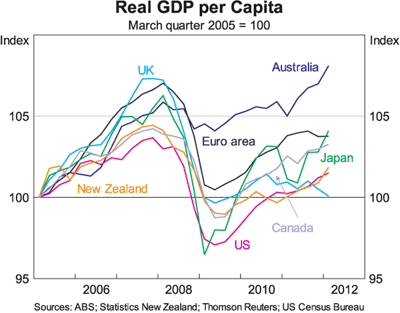
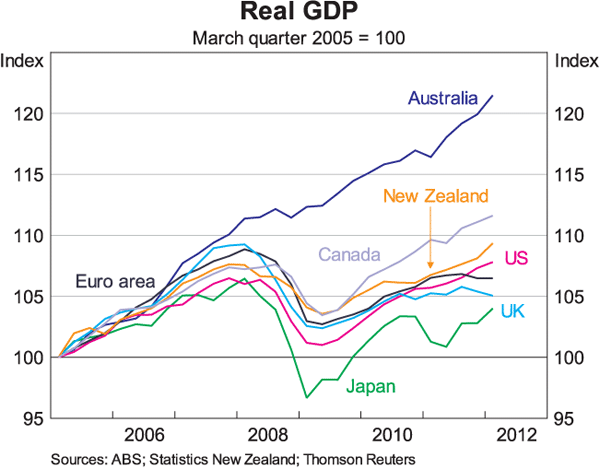
Graph 1
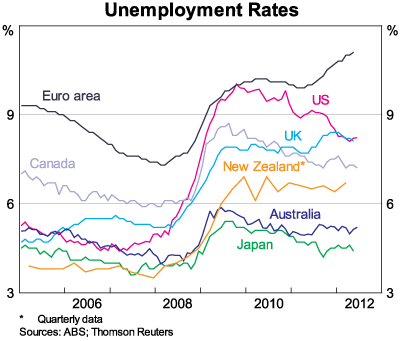
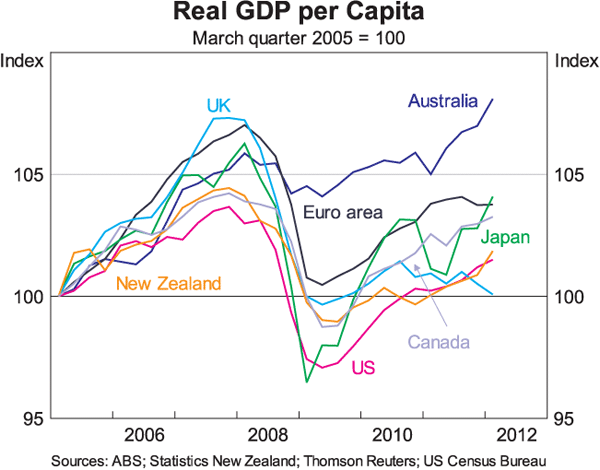
Graph 2
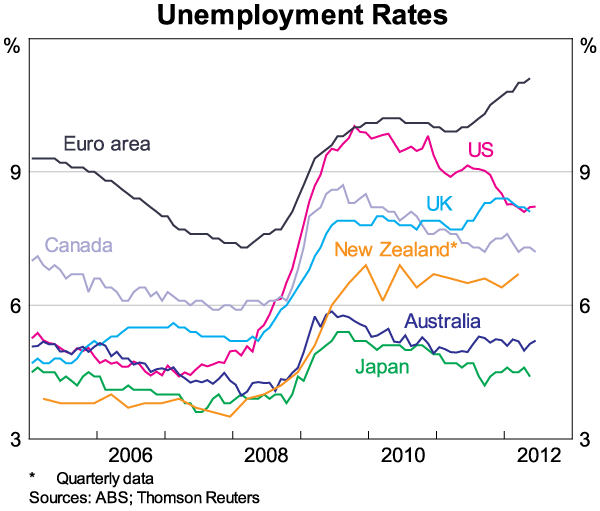
Graph 3
These charts really require no exposition (Graph 1, 2 and 3). The message is clear. It is fair to conclude that, given the circumstances internationally, the Australian economy has exhibited more than acceptable performance over recent years. This conclusion would stand whether comparisons were made either against most other countries, or against our own historical experience.
Why was it that Australia did not have a deep downturn in 2009 when so many other countries did? And why was it that we have returned to reasonable growth, when others have struggled to do so?
This question has been answered on numerous occasions. There are several elements.
First, the Australian banking system went into the crisis in reasonable shape. To be sure, there were some poor lending decisions during the preceding period of easy credit and there was, in hindsight, too much reliance on wholesale funding. But among major institutions, credit quality issues have turned out to be manageable. Asset quality was not as good among some of the regional banks, and even less so among some foreign banks operating in Australia, but the problems have not been insurmountable.
Some observers might counter that the banks received assistance with wholesale fund raising in the form of the government guarantee. But the banks paid for that, and it was an appropriate response at a time of massive market dislocation when all their peers were receiving like assistance – and much more. Moreover the banks have neither had, nor needed, access to this for some time now and the stock of guaranteed liabilities outstanding has fallen by about half from its peak level, as issues mature or are repurchased
So our banking system, while not entirely free from blemishes, was nonetheless in pretty good shape overall. Banks were able to raise capital privately in the depths of the crisis. The lowest rate of return among any of the major banks over a year during the crisis period was about 10 per cent. The Australian Government has not needed to take an ownership stake in a financial institution.
Second, Australia had scope for macroeconomic policy stimulus, which was used promptly and decisively. Interest rates were lowered aggressively, from a high starting point, lowering debt servicing burdens at a rapid rate. The fiscal stimulus was one of the larger ones, as a percentage of GDP, among the various countries with which we can make comparisons. The evidence suggests that these macroeconomic measures were effective in sustaining growth.
Thirdly, the rapid return to growth of the Chinese economy saw demand for energy and resources strengthen again after a brief downturn in late 2008 and the first couple of months of 2009. This reversed the fall in Australia’s terms of trade, and in fact pushed them to new highs, which led to a resumption of the historic investment build-up that had already begun. It benefited the whole of Asia, which staged a very pronouncedV-shaped recovery on the back both of the Chinese measures and things other countries did themselves.
A fourth element that many people add is that the exchange rate fell sharply, which was an expansionary impetus for the economy. But of course the exchange rate was responding endogenously to the various shocks and policy responses, and has since reversed the fall. It was doing what it was supposed to do. Perhaps the real point is that the right exchange rate system was implemented nearly 30 years ago, and that it was allowed to work.
So Australia had these things going for it.
Was this all just luck?
We could not deny that our geography – thought for much of our history to be a handicap because of the distance from European and American markets – combined with our natural resource endowment has provided a basis for the country to ride the boom in Asian resource demand. We did not create that, though we still have to muster the capability to take sustained advantage of it.
But a well-managed and well-supervised banking system is not an accident.[1] Years of careful work both by banks and APRA went into that outcome.
Nor was the ability to respond forcefully, but credibly, with macroeconomic policy just luck. You don’t suddenly acquire the credibility needed to ease monetary policy aggressively while the exchange rate is heading down rapidly. Authorities in lots of countries would not feel they could do that. At an earlier point in time we probably would not have felt we could have done it either. The credibility needed to do it comes from having invested in a well-structured framework, and having built a track record of success in containing inflation, over a long period. The floating exchange rate is an integral part of that framework.
Likewise, you can’t have a major fiscal easing and expect it to be effective if there are concerns about long-run public debt dynamics, as recent debate elsewhere in the world shows. You need to have run a disciplined budget over a long period beforehand, so that the amount of debt you have to issue in a crisis does not raise questions about sustainability. In both the monetary and fiscal areas, of course, having used the scope we had so aggressively, it was also necessary, as I argued in 2009, to re-invest in building further scope, by returning settings to normal once the emergency had passed.
So, yes, Australia has had its share of luck. But to explain the outcomes, we need also to appeal to factors that didn’t just happen by accident.
Of course, that doesn’t mean we still couldn’t have problems. Even if success to date hasn’t been due to luck alone, perhaps our luck could turn so bad that all our efforts at good policy making could be overwhelmed.
Let us then take a look at some of the potential pressure points that people sometimes worry about. The first is the Chinese economy.
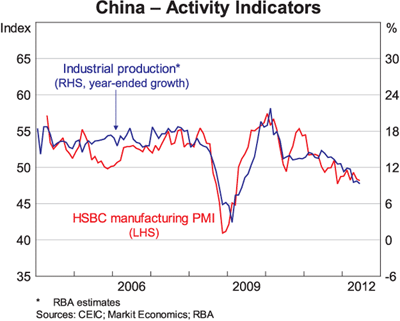
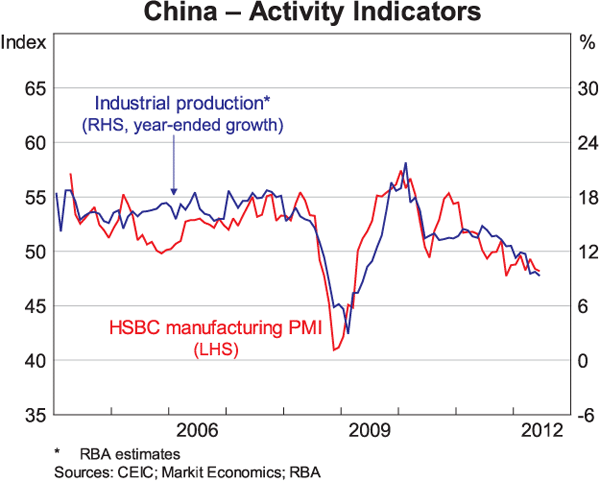
One of the data series people pay a lot of attention to is the Chinese version of the so‑called ‘Purchasing Managers’ Index’. The usual commentary surrounding such indexes invariably refers to the ‘50’ level as the threshold between growth and contraction in the sector of the economy being examined.
But what have these PMIs actually been saying about the Chinese economy? Properly calibrated, as in this chart, they suggest that growth in China’s industrial production has been running at about 5 percentage points below average, which means it is just under 10 per cent (Graph 4). But it is a long way from a contraction. We did actually see Chinese IP contract late for several months in 2008; we are not seeing that at present.
Graph 4
The conclusion I draw is that the Chinese economy has indeed slowed over the past year or so. It was intended that a slowing occur. But the recent data suggest that, so far, this is a normal cyclical slowing, not a sudden slump of the kind that occurred in late 2008. The data are quite consistent with Chinese growth in industrial output of something like 10 per cent, and GDP growth in the 7 to 8 per cent range.
To be sure, that is a significant moderation from the growth in GDP of 10 per cent or more that we have often seen in China in the past five to seven years. But not even China can grow that fast indefinitely and there were clearly problems building from that earlier breakneck pace of growth. Inflation rose, there was overheating in property markets and no doubt a good deal of poor lending. It is far better, in fact, that the moderation occur, if that increases the sustainability of future expansion.
Moreover, the Chinese authorities have been taking well-calibrated steps in the direction of easing macroeconomic policies, as their objectives for inflation look like being achieved and as the likelihood of slower global growth affecting China has increased. Prices for key commodities are lower than their peaks, but are actually still high.
So far, then, the ‘China story’ seems to be roughly on course. It is certainly true that we will feel the effects of the Chinese business cycle more in the future than we have been accustomed to in the past. That presents some challenges of economic analysis and management. But even so, it may be better to be exposed to a Chinese economy with a high average, even if variable, growth rate, than, say, to a Europe with a very low average growth rate that is apparently also still rather variable.
Next I turn to dwelling prices. As everyone knows, dwelling prices rose a great deal over the decade or more from 1995, and not just in Australia. This occurred globally. The fact that it was a widespread phenomenon is a hint that we should be wary of explanations that are solely domestic in their focus. It suggests that the global dwelling price dynamic had a lot to do with financial factors – and there is little doubt that finance for housing became more readily available.
In various countries prices have subsequently fallen. In the United States, for example, prices are down by about 30 per cent from their peak, though they look like they have now reached bottom. In the United Kingdom the fall was smaller – at about 15–20 per cent. In Australia, the decline since the peak has been about5 to 10 per cent, depending on the region. There are of course prominent examples of particular localities or even individual dwellings where price falls have been much larger.
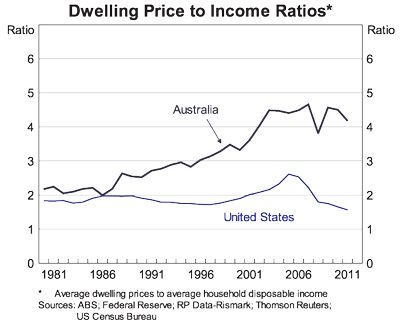
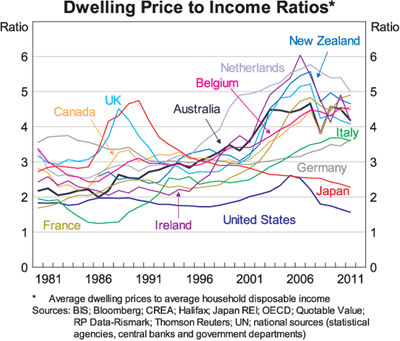
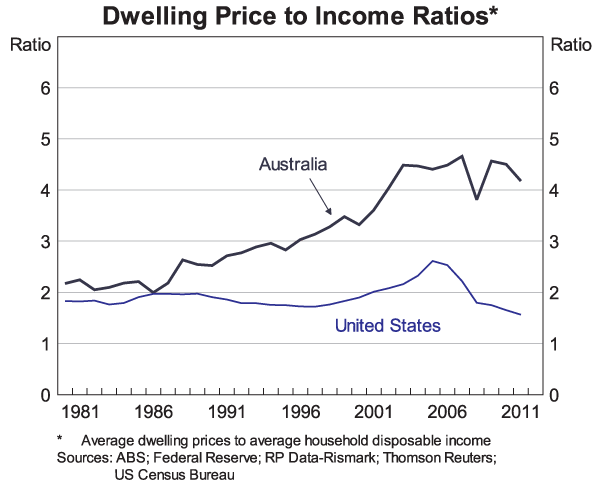
Scaled to measures of income, Australian dwelling prices on a national basis have in fact declined and are now about where they were in 2002 (Graph 5). That is, housing has become more ‘affordable’. Four or five years ago we supposedly had a housing affordability ‘crisis’. Now it seems that the problem some people fear is that of housing becoming even more affordable.
Are dwelling prices overvalued? It’s very hard to be definitive on that question. There are two aspects to the claim that they might be. The first is that prices relative to income are higher than they were 15 or 20 years ago. If this ratio is somehow mean-reverting, then either incomes must rise a lot or prices must fall. It could be that this analysis is correct, but the problem is that there is no particular basis to think that the price to income ratio 20 years ago was ‘correct’. There are reasons that might be advanced for why the ratio might be expected to be higher now than then – that the mean has shifted – though again there is little science to any quantification for such a shift. In any event, arguments that appeal to historical averages for such ratios lose potency the longer the ratio stays high. In Australia’s case the ratio of prices to income on a national basis has been apparently at a higher mean level – about 4 to 4½ – for about a decade now.
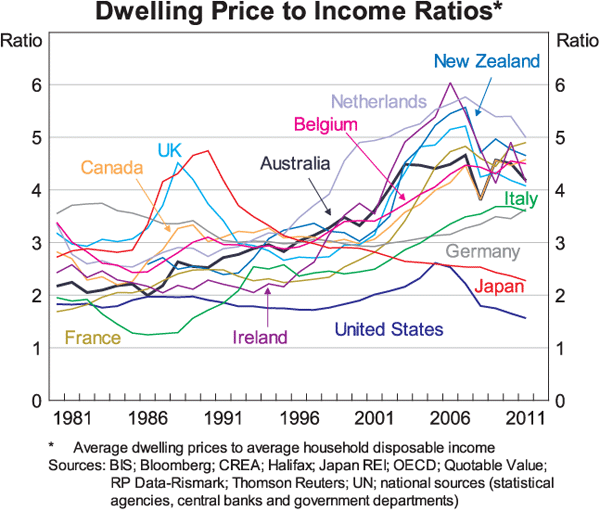
The second support for the claim that dwelling prices are overvalued is the observation that they seem high in comparison with other countries. In seeking to make such comparisons, though, there are serious methodological challenges. The key difficulty is in sourcing comparable data on the level of prices across countries. Such data are, at best, pretty sketchy. With that caveat very clearly in mind, consider the following two charts.
Simply comparing Australia and the United States, it is hard to avoid the impression that gravity will inevitably exert its influence on Australian dwelling prices. But if we put these two lines on a chart with a number of other countries with which we might want to make comparisons, the picture is much less clear (Graph 6)[2] To the extent that we can make any meaningful statements about international relativities, the main conclusion would be that Australian dwelling prices, relative to income, are in the pack of comparable countries. In this comparison, the United States seems the outlier.
Graph 5
Graph 6
None of this can be taken to say definitively that Australian dwelling prices are ‘appropriate’, or that there is no possibility they will fall. It is a very dangerous idea to think that dwelling prices cannot fall. They can, and they have. The point is simply that historical or international comparisons, to the extent they can be made, do not constitute definitive evidence of an imminent slump. At the very least, the complexity of making these comparisons suggests we ought to look at some other metrics in thinking about the housing market.
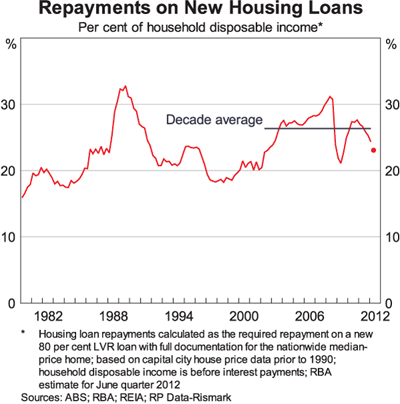
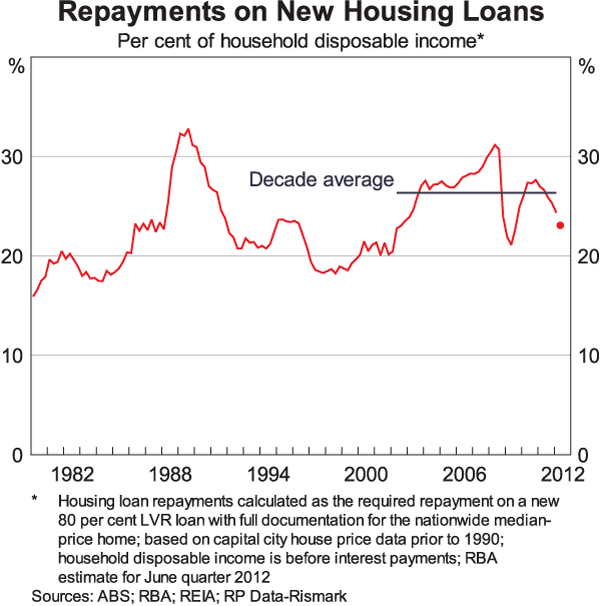
One would be the performance of the associated mortgages. Here, the main story is that not much has changed. Arrears remain low and if anything have been edging down over the past year. That in turn is not altogether surprising given that debt servicing burdens have declined (Graph 7).
Graph 7
As a result of lower house prices and therefore lower loan sizes, somewhat lower interest rates and a good deal of income growth, the repayment on a new loan on a median-priced house as a share of average income is now at its lowest for a decade (except for the ‘emergency’ interest rate period in 2009).
It is true that a low unemployment rate is a key factor helping here, but it is also true that the proportion of households that are ahead on their mortgage payments is also high – with some evidence pointing to over half – which would provide a buffer of some months for those households in the event a period of lower income was experienced. If we look at applications for possessions of dwellings, they have been running at about 0.15 per cent of dwellings on an annualised basis. Such applications have actually declined since their peak in both NSW and Victoria, though they have risen over the past couple of years in WA and Queensland. In the United States the most comparable figure for repossessions – ‘foreclosures started’ – peaked at over 2 per cent of dwellings.
The conclusion? We should never say a crash couldn’t happen here, and the Reserve Bank continues to monitor property markets and the performance of mortgages quite closely, as we have for many years. But it has to be said that the housing market bubble, if that’s what it is, seems to be taking quite a long time to pop – if that’s what it is going to do. The ingredients we would look for as signalling an imminent crash seem, if anything, less in evidence now than five years ago.
What then about funding vulnerabilities?
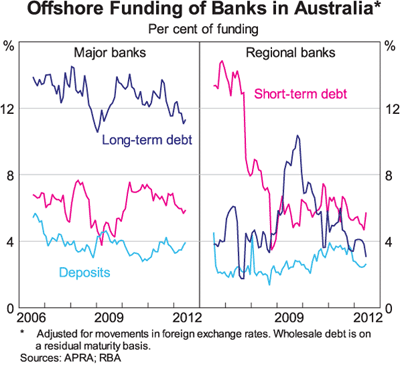
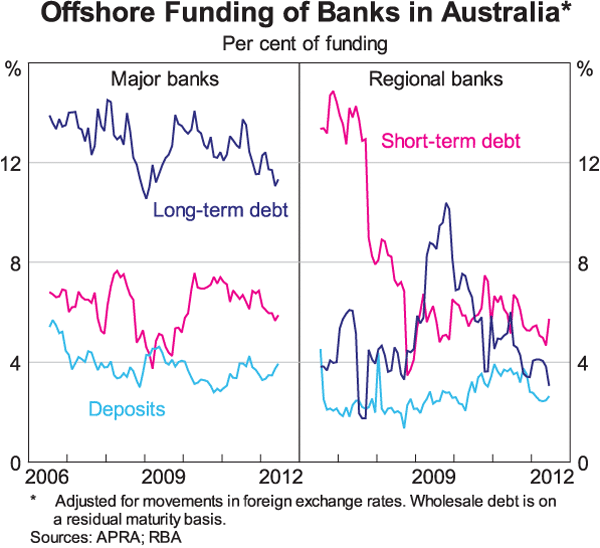
The pre-crisis period saw too much ‘borrowing short to lend long’, and too much reliance on the assumed availability of market funding. Banks everywhere have been adjusting away from that model over recent years, Australian banks among them. The share of offshore funding has fallen, and its maturity has been lengthened (Graph 8).
Graph 8
The flip side of this is of course the rise in domestic deposit funding, which has occasioned such competitive behaviour in the market for deposits.
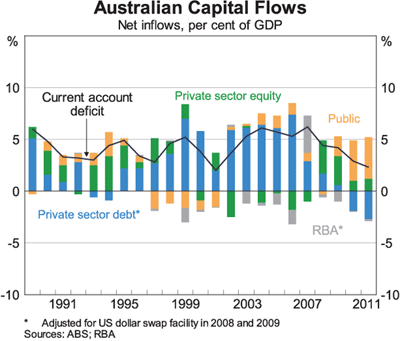
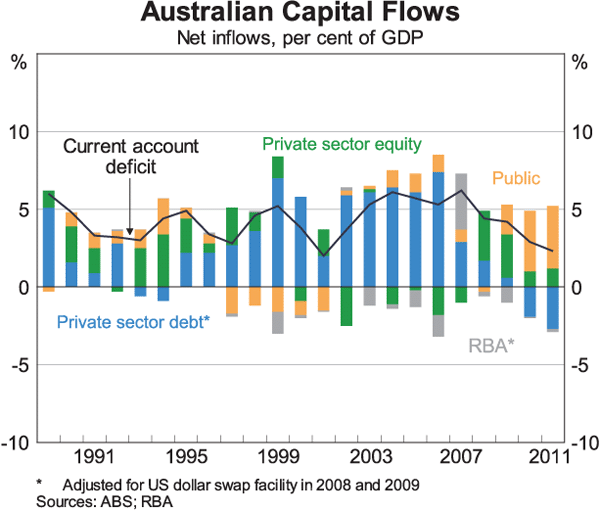
Interestingly enough, while we have been told over the years how Australian banks were doing the country a favour by arranging the funding of the current account, they have stopped doing this over the past year without, apparently, any dramatic effects. As measured in the capital account statistics, there has been a net outflow of private debt funding over the past two years, offset roughly by increased inflow of foreign capital into government obligations (Graph 9). This has occurred with a net decline in government debt yields and a net rise in the exchange rate. The current account deficit has, in other words, been easily ‘funded’ without the assistance of banks borrowing abroad – in fact, while they have been net re-payers of funds borrowed earlier.
Graph 9
A reasonable conclusion is that the degree of vulnerability to a global panic of any given magnitude appears to have diminished, rather than grown, over the past few years. It hasn’t completely disappeared, and it would not be sensible to expect it would, unless we were pursuing a policy of financial autarky. But there is little reason to assume that Australian institutions are somehow unusually exposed to these risks compared with most of their counterparts overseas.
In the end, of course, any bank’s ability to maintain the confidence of its creditors is mainly about its asset quality. That brings us back to lending standards, the macroeconomic environment, and so on. One would think that, overall, things look relatively good in Australia, compared to the world’s trouble spots. Think for just a moment about the holdings of government debt on the books of banks in any number of other countries, and about the state of public finances of many of those countries.
The arguments I have presented amount to saying that some necessary adjustments have been occurring gradually and reasonably smoothly. China’s growth had to moderate. It has slowed, but it hasn’t collapsed. Housing values and leverage in Australia couldn’t keep rising. They haven’t. Dwelling prices have already declined, relative to income, and it is in fact not obvious that they are particularly high compared with most countries. Housing ‘affordability’ has improved significantly; over 99 per cent of bank-held mortgages are being serviced fully.
Banks have reduced their need for the sort of funding that might be difficult to obtain in a crisis situation. The current account deficit is being funded by a combination of direct equity investment, and flows into high-quality Australian dollar-denominated assets, the latter at costs that have been falling. In fact, the Commonwealth of Australia, and its constituent States, are at present able to borrow at about the lowest rates since Federation.
Markets do not, then, seem to be signalling serious concerns about Australia’s solvency or sustainability. But markets can be wrong sometimes. They can sometimes be too optimistic (and other times too pessimistic). So even though we don’t face immediate problems, we should ask: what if something went wrong? Below I consider a few possibilities.
If the thing that goes wrong is a major financial event emanating from Europe, the most damaging potential transmission channel would be if there were a complete retreat from risk, capital market closure and funding shortfalls for financial institutions. Let me emphasise, importantly, that this is not occurring at present and if it did occur it would be a problem for a great many countries, not just Australia. But in that event, the Australian dollar might decline, perhaps significantly. We might find that, in an extreme case, the Reserve Bank – along with other central banks – would need to step in with domestic currency liquidity, in lieu of market funding. The vulnerability to this possibility is less than it was four years ago; our capacity to respond is undiminished and, if not actually unlimited, is not subject to any limit that seems likely to bind. An alternative version of this scenario, if it involved the sort of euro break-up about which some people speculate, could be a flow of funds into Australian assets. In that case our problem might be not being able to absorb that capital. But then the banks would be unlikely to have serious funding problems.
If the thing that goes wrong is a serious slump in China’s economy, the Australian dollar would probably fall, which would provide expansionary impetus to the Australian economy. But more importantly, we could expect the Chinese authorities to respond with stimulatory policy measures. Even if one is concerned about the extent of problems that may lurk beneath the surface in China – say in the financial sector – it is not clear why we should assume that the capacity of the Chinese authorities to respond to them is seriously impaired. And in the final analysis, a serious deterioration in international economic conditions would still see Australia with scope to use macroeconomic policy, if needed, as long as inflation did not become a concern, which would be unlikely in the scenario in question.
If dwelling prices in Australia did slump, then there would be obvious questions about how that dynamic could play out. In such circumstances people typically worry about two consequences. The first is a long period of very weak construction activity, usually because an excess of stock resulting from previous over-construction needs to be worked off. But we have already had a fairly protracted period of weak residential construction; it’s hard to believe it will get much weaker, actually, at a national level. The second potential concern is the balance sheets of lenders. This scenario is among those routinely envisaged by APRA’s stress tests over recent years. The results of such exercises always show that even with substantial falls in dwelling prices, much higher unemployment and associated higher levels of defaults, key financial institutions remain well and truly solvent.
Of course, it can be argued that the full extent of real-life stresses cannot be anticipated in such exercises. That’s a reasonable point. But we actually had a real life stress event in 2008 and 2009. The financial system shows a few bruises from that period, but its fundamental stability was maintained
Conclusion
Most Australians I encounter who return from overseas remark how good it is to be living and working here. We are indeed ‘lucky’ in so many ways, relative economic stability being only one of them.
But what matters more is what we do with what we have. Not every good aspect about recent performance is down to luck. By the same token there are things we can do to improve our prospects – or, if you will, to make a bit of our own future luck. Some of the adjustments we have been seeing, as awkward as they might seem, are actually strengthening resilience to possible future shocks. Higher – more normal – rates of household saving, a more sober attitude towards debt, a re-orientation of banks’ funding, and a period of dwelling prices not moving much, come into this category.
The years ahead will no doubt challenge us in various ways, including in ways we cannot predict. But what’s new about that? Even if the pessimists turn out to be right on one or more counts, it doesn’t follow that we would be unable to cope. Acting sensibly, with a long-term focus, has as good a chance as ever of seeing us through whatever comes our way.
Most of all, and to return to the whole point of today’s event, we have much to live for. We want to do everything we can to ensure the next generation can share the positive outlook that most Australians have (almost) always had. That is why the Anika Foundation’s work is so important, and why your presence here today is so valuable. Thank you again for your support.


…yep. He has.
Whilst in an upbeat frame of mind, this chart from Credit Suisse places Australia at the top of the global pile in terms of median wealth 2011:
http://www.washingtonpost.com/blogs/ezra-klein/files/2012/07/medianwealth.jpg
The lucky country.
Well that should put a sock in the mouth of all the bloody whingers going on and on about just how tough they have it.
They should shut up, work harder, get off the dole, present themselves smiling ear to ear, and admit to themselves that their small businesses and reatil stores are in decline solely due to their abhorrent attitude.
By the way, I can say from first hand experience, Japan 2012 (and 2011) is not in a such good position.
There wasn’t a comment near that graph stating that, “shorter bars are better”? I ask cause even to this day, there are more Porches per head of capita in Greece than elsewhere. I got that from the Japanese media.
Aren’t we on the top just because only our housing bubble hasn’t yet bust?
that and the strong AUD
Lori…correct.
Hmmmmmmmmm we’re more than twice as wealthy as Canadians who are, in turn poorer than France Italy Ireland et al who are all in line to ‘go under’
I’d have to suggest a bit of concern for CS’ methodology.
“He uses statistics as a drunken man uses lampposts – for support rather than for illumination.” ~Andrew Lang
+1
Great quote!
Sorry but I have to steal this quote. Love it
And of course it’s all measured in US dollars…
It not just the methodology, but the whole concept of global wealth comparisons is misleading. It is unrealistic to conclude that the typical Australian compares his or her economic situation to that of people living in other developed countries. This sense of irrational pessimism in Australia is rather a reflection of Australian citizens making localised comparisons; a sense of entitlement over thy neighbour.
I believe the economic term is relative deprivation but an aphorism by Marx sums it up best: “A house may be large or small; as long as the neighboring houses are likewise small, it satisfies all social requirement for a residence. But let there arise next to the little house a palace, and the little house shrinks to a hut. The little house now makes it clear that its inmate has no social position at all to maintain, or but a very insignificant one; and however high it may shoot up in the course of civilization, if the neighboring palace rises in equal of even in greater measure, the occupant of the relatively little house will always find himself more uncomfortable, more dissatisfied, more cramped within his four walls.”
We can also infer that people not only make static comparisons, they perceive their economic situation relative to where they expected to be based on their past experiences. For example, many a home owner in Perth expected price increases during 2004-06 to continue interminably. How would they percieve their economic situation knowing that the price of their four bedroom detached house has increased no more than inflation.
My first thought was I’m glad I don’t have to clean that. Including all the bathrooms it’s likely to have.
You’ve got to be front row centre on the short bus to ignore what exactly makes up that ‘wealth’ (hint: inflated house prices!)
“Simply comparing Australia and the United States, it is hard to avoid the impression that gravity will inevitably exert its influence on Australian dwelling prices.”
Brilliant….gravity?
China sells to the EU, EU tanks, China contracts, commodities prices and volumes tank. The AU dollars drops to 80cents and every other sector outside of mining cheers yeh!
House prices fall due to gravity…lol
“Australia is a lucky country, run by second-rate people who share its luck.” – Donald Horne, 1964
‘second-rate’.
‘share’.
Oh where to begin in discussing this famous phrase in its current context.
“Oh where to begin in discussing this famous phrase in its current context”
Too easy……..
“Actually, this is another version of the old concern about the current account deficit: what will happen if markets suddenly do not want to fund our deficit?”
When we run out of things to sell and its just foreign institutions and government rearranging the ownership pie.
Its not an issue until its an issue.
Exactly Jack. Why doesn’t Stevens talk about all our mines and industries that we have sold to fund the CAD?
We have no worries because the CAD is being funded by Foreigners now lending the Govt money. He conveniently neglects to mention the continued sales of assets to foreign buyers.
Importantly!
We can fund a CAD…just keep selling everything and borrowing more…well we can until we can’t.
However, importantly, chronic CAD’s tell you things are wrong in the structure of your economy. The same as a chronic budget deficit or chronic private and household debt.
Chronic imbalances tell you that you have got something badly wrong in the structure of your economy.
That things have gone scarily out of kilter here seems obvious to anyone with any sort of practical ear to the ground.
“By the same token there are things we can do to improve our prospects …. a period of dwelling prices not moving much, come(s) into this category.” That’s fine for those that can afford the negative carry; but what about those that can’t? Sell, comes to mind….
Are there any success stories of slowly deflating asset bubbles as big as ours in the past?
Ah, no…
Japan?
No, it’s just a time-bomb waiting to happen, as nothing has been done to address the root cause of the problem, which is actually getting worst – hence continuing deflation. Today it needs 50% of its GDP just to make the interest payment on its enormous debt, which is growing by nearly 10% p.a. And this with a 0% interest rate.
Tick, tock, tick, tock…
Good to see you back Gus.
This speech reeks of complacency and self-congratulation.
No. It addresses questions raised by a sceptical new kid on the block, questions being picked up and plastered all over MSM without requisite understanding.
in MB parlance +100
Somewhat different to the average commentator on MB who is absolutely certain they are right, and Glenn is wrong, usually without anything other than anecdotal experience.
All his arguments are now open to rebuttal ; just list the basis for the rebuttals
3d1k It’s full of half-truths, deliberate obfuscation and downright deception.
So I’m not too sure what it actually does address?
Smokester
To fund the CAD
We have sold off 80% of our mining ASSETS…not the stuff we dig up…the actual assets
We long ago sold off our food chain. We are currently selling or closing down whatever vestiges of it remain in Aus ownership
We need to continually sell more assets or borrow
Should we be sanguine by the news that instead of the Banks running/funding the CAD the Govt is now absorbing the Foreign liabilities that are not covered by Asset sales?
NOw Stevens can be dismissive of the CAD. As Jack says it doesn’t matter as long as we can continue to borrow the printed rubbish from the US UK et al and we can find more assets to sell.
If we start running out of assets to sell or, in a fit of misguided nationalism, start threatening to confiscate them the flow of funds is going to dry up pretty damned quickly including line-up of people who want to send some of Prince’s ‘meta money’ here.
Minebot:
It doesn’t address the questions of skeptics, it dismisses them. The RBA ignored the skeptics in 2011, got things horribly wrong, and were forced to backflip and cut rates. Inexplicably they’ve recently returned to their hawkish position despite very little evidence that the economy is strengthening, and a dire global environment. I expect the RBA will be forced into another backflip later this year, when again, the “skeptics” will be given no credit for getting things right.
P.S. Given that things are so bloody wonderful, I eagerly await your congratulations to the Rudd/Gillard government for delivering a world-beating outcome. It seems to me, we are in the position we are either because of blind luck, or because the Labor government played some part in it. Which is it?
+1
His first line should have been, good to see macq sponsoring this thing given all the money we made them guaranteeing Aussie debt…..sht if we hadn’t they wouldn’t been here! so thanks again.
Glenn Stevens still hasn’t updated Graph 5, which evidently has incorrect information – Price-to-income ratio was well over 6.1 as per the one of sources (RPData) cited in the graph.
http://www.macrobusiness.com.au/2012/07/rp-data-contradicts-rba-dwelling-price-to-income-ratio/
I guess other *Cough* Joyeous *Cough* sources are still misleading the RBA.
Well call the RBA and ask them to justify their data rather than just commenting on a website. There is a PR guy there who will talk to the requisite economist who prepared the chart and check
“…rather than just commenting on a website.”
Well…actually….this part of the website is called the “Comments” section, because…well, people come here to comment.
If that’s OK with you.
Thanks Julius
The point about comments here, for some of us, is that we sometimes get good replies that add to our knowledge.
When I’m elected dictator I will proscribe my own views as the only ones acceptable.
We await your wise views, oh, Beneficent One!
Great reply!!!
You’re learning a lot!!!!
I have Smokster. I placed an FOI request with the RBA re the calculation of their dwelling price-to-income ratio, including listing all of my concerns (written about previously), and they fobbed me off.
Good one UE!
That alone is worth a post, and a complaint lodged with the Ombudsman.
Complain about RBA to the Ombudsman like the one in the link??
http://www.ombudsman.gov.au/pages/making-a-complaint/complaints-the-ombudsman-can-investigate/freedom-of-information.php
I don’t believe they will do anything.
This gives me one more reason o support whistleblowers and Julian Assange
I truly believe the 4:1 ratio is correct.
The average dwelling these days is a studio apartment in outer suburbs of Sydney.
Cmon get with the picture everyone…. ;>)
Thanks UE for trying.
There is a PR guy there who will talk to the requisite economist who prepared the chart and check
SMOKESTER, it seems this RBA PR guy does not listen to ordinary plebs like me and UE. Can you put in a good word for us and have this PR guy get the RBA to look at the chart again?
Smoke and Mirrors, this serves as absolute proof the ABS and RBA are complicit is selling BS statistics to try and convince us that what we all know IS happening… ISN’T!
“Dwelling price to average household disposable income” is a much better ratio than “Median House Prices Vs Average Wages” as it inflates the household disposable income figure by including young adults who statistically are staying at home longer due to the unaffordable housing market.
http://bit.ly/Qva9Sb
Conveniently the method the ABS/RBA use says we’re at 4x when the actual ratio is closer to 8x.
Disturbing UE.
What do they want ?? A petition presented to them?
Dissembling bunch.
Pitchforks and flaming torches.
Helps if the crowd ‘Urrrghhhs’ a lot as well.
I’ll be amazed if they reply, and your happy with their disclosure.
BTW I think we are lucky, but our luck is quickly running out.
“The share of offshore funding has fallen, and its maturity has been lengthened (Graph 8).”
Has this really fallen or is it just that the AUD is stronger now compared to 2006 ? Are there any graphs on how much is outstanding in foreign currency terms ?
Graph 8 states that it’s “adjusted for movements in foreign exchange rates”, so yes, I can only assume that it has fallen in FX terms as well.
In an emergency, I will create currency; my capacity to print knows no bounds.
“We might find that, in an extreme case, the Reserve Bank – along with other central banks – would need to step in with domestic currency liquidity, in lieu of market funding. The vulnerability to this possibility is less than it was four years ago; our capacity to respond is undiminished and, if not actually unlimited, is not subject to any limit that seems likely to bind.”
The Guv is agnostic on house prices, foresees steady prices for some time and the excesses worked off in other ways. AMP’s Shane Oliver shares this view.
This forecast will grind to pieces the balance sheets of our 1.1 million negative gearers, who need at least 6% price growth for steerage. I wonder whether they feel lucky too.
The Guv is agnostic on house prices, foresees steady prices for some time and the excesses worked off in other ways. AMP’s Shane Oliver shares this view.
More like pretend and hope approach to me.
This forecast will grind to pieces the balance sheets of our 1.1 million negative gearers, who need at least 6% price growth for steerage. I wonder whether they feel lucky too.
Problem is big portion of those speculators don’t know about this. Most that I talked to always said that it does not matter if price stall or is down a bit because their negative gearing deal make them good money from ATO etc… I bet they don’t know whether they actually make money or not from their speculation because it has become a faith-based system i.e. no need to question their assumption, they will surely get ahead when they sell
That has been my Thesis for the last 2 years and now where past Tax time the reality of the losses will be setting.
+1
Nice comment Deo.
+2
I hear it all the time.
“I got all me tax back this year eh. 45 grand!! Gonna buy a FPV. Ford gonna stop makin’ ‘em so they’ll be collector’s items.”
“45 grand? You must have lost a lot to be able to claim to get that much back.”
“Lost?”
+1 each for all of the above
Neznam I don’t have the answer to your question but note his comment that the CAD is now funded through Govt foreign borrowings.
If you follow the sectoral balances approach the issue is quite clear.
The corollary is that despite his claims that mortgage holders are ahead on their mortgages, that, with negative RAT rates in place, repayments as a % of income have not grown (WOW! REAALY!!!!)as a nation we are not saving. The Govt is now running the deficit the private sector was running under the Howard/Costello years of idiocy.
The Anika Foundation speech is always the highlight of Steven’s speaking engagement for me each year since he has been doing them as he always delves into something thoughtful.
Once again I think he has presented a cracking speech and I think he is asking as many questions as he is trying to answer and what’s more I agree with him.
I don’t believe he is saying we are immune nor gilded nor that he is complacent. Indeed I’d argue that many of the quotes above in this comment stream if followed by the next sentence he spoke might just have a different context and meaning.
I don’t always agree with the RBA but they continue to be the best central bank in the world and I know that even though they may not think they need to cut rates again that if they need to they will.
It’s like Harvey Penick used to say – you gotta dance with what brung ya – that’s what the RBA continues to do
Cheers
Greg
How can you claim that they are the best central bank in the world when they won’t even contemplate introducing macro-prudential tools? At least Canada, the UK and NZ are looking at these types of measures.
Oh no, MB civil war!
Now who said there is confirmation bias on MB?
You should listen in on our investment meetings…
I shake my head at any thought there’s “groupthink” here!!!
But from good debate comes opening up of views – or a smackdown from Leith “the Guns” van Onselen…
…and pencils in backs
Pencils? This is the 21th century, its styluses.
Ask APRA or the government RBA got sacked from that job years ago.
Rubbish. They are responsible for financial stability. They are also on the Council of Financial Regulators, which meets monthly. They should be pushing for macro-prudential tools. Period.
I think the cleanest sheet in a hamper full of dirty linen analogy applies here.
Or Churchill’s democracy analogy (i.e best of the worst)..
“The best central bank in the world” would at least be looking at tools to mitigate the credit cycle, rather than burying its head in the sand. It has failed badly on this front.
oh yes it has failed badly, and now the entire population is going to feel the effects of their failure with lower living standards. its already happening. epic fail by the worlds best central bank…LOL
Meerkat Alert. Whoop, Whoop, Terrain, Terrain.
Agreed on the macro-prudential tools. Other countries at least have or consider to have the measures to ensure population not over-leveraged in debt-fuelled asset bubble. RBA is surely lacking in this area.
As above for the tools thing but equally they just might disagree, in fact I think they do.
But the reason we have had 22 years without a recession is that they react appropriately when they need too.
Housing is your thing but I do think they killed Sydney and its bubble in 2003-4 when they needed to the Melbourne thing in 2009/10 was beyond their control but they jawboned and talked jacked rates up as soon as the data gave them the opportunity…
Just like trading Central Banking does not have 20:20 foresight but we all have 20:20 hindsight.
The RBA gets the gong because they are flexible and this is not a one factor economy – they always try to do the least amount of harm in aggregate and I think they have done a more than commendable job.
You forget that “Bubbles” McFarlane was, himself, a key driver of the 1998-2003 housing bubble. The RBA under his watch dropped rates far too low given the economic circumstances. In turn, the RBA helped feed the inexorable rise in credit demand (and house prices) over this period.
Granted but I’m not as hard as some on old “bubbles” I really liked what he did when he had to and also his intervention in some other areas of the economy when he needed to
“You forget that “Bubbles” McFarlane was, himself, a key driver of the 1998-2003 housing bubble. The RBA under his watch dropped rates far too low given the economic circumstances. In turn, the RBA helped feed the inexorable rise in credit demand (and house prices) over this period.”
Thanks for reminding many. May a I suggest a post on his legacy and Costello’s love?
the best central bank in the world!!!!!
OMG! yeah, letting inflation run to 5% in early 2008 was a stroke of central banking pure genius!
i would argue they are amogst the worst central banks in the world.
OMG, you mean there are good ones?
good point, there arent any good ones. there are just those that have learnt from their mistakes and are trying to fix things like UE described above…….and then there is the RBA. these guys dont even see the need for monthly inflation readings FFS
Well it’s moot if any of them actually learn from the past, enough to change behaviour. However, they have grown very shrewd at sweeping things under the rug and kicking cans down the road…
WE’ll they did get blind sided by that then didn’t they – but they were jacking rates up to fix the issue when the GFC came tumbling through the economy and they had to cut in late 2008. (by the way that was one data point)
Like I say Central Banking and trading are similar – you make calculated risk adjusted bets in uncertainty and you have stop losses.
That’s what the RBA does when it reverses course.
Would you rather the doctranaire ECB or Bundesbank or the Flexible RBA???
Sure. But the RBA should also be pushing for longer-term policy measures, like macro-prudential tools, to mitigate the credit cycle. They are responsible for financial stability are they not?
How do you know they are not?
Unlike us its not cool for the RBA and APRA to disagree in public. But I know for a fact as former Treasurer of an ADI that some of the more innovative approaches to funding and liquidity that the banks have done over the past years have been stamped by the RBA when other regulators said no and thus they got through.
I reckon they will be working away behind the scenes pushing all the stuff we need balanced by the stuff that wont harm the economy.
agree its not a perfect science but they were never jacking up rates in 07. they were meaningless little 25bps hikes while inflation was running wild. they should have hiked 50 bps several times and would have been justified by the data. but they NEVER ever hike by 50 bps. but they will cut by 50 bps on a whim. yes, they are flexible no one can argue with that. but you could also argue 22 yrs without recession is proof of their failure not success. in that 22 yr period debt levels and asset price inflation and CPI soared to unbeleivably dangerous levels. while this was happening of course everything looked fine while everything was going through the roof but was it sustainable? doesnt look like it. if we have had 22 yrs of failure we are in for one hell of a bust which is exactly what a 50% stock market crash is telling you. the RBA has sat back and let this madness go unchecked while sitting there patting themselves on the back saying what a great job they have done. an example of their epic failure is how they have recently managed to lose control of the economy with interest rate cuts, the ONLY tool in their tool box. 125 bps of cuts and has it had any impact on anything? no, this is what happens when you let credit bubbles get so big that the economy stops responding. they have lost control and the worst thing is they dont even realise it. and meanwhile you have RBA people like luci ellis lecturing the US FED on how to prevent credit and housing bubbles? lets see what the CPI data says tomorrow. the RBA has one job and one job only, inflation targeting, it doesnt look like they are very good at it.
yeah I reckon they know what they have to do and they are trying to do it as gently and over an extended period – as you say if 22 years has to unwound quickly then heaven help us.
GB
TLDR
Please use some grammar or sentence breaks I couldnt read any of that…
Yes, the same Dr Ellis who was singing a different tune back in 2006.
http://www.rba.gov.au/publications/rdp/2006/2006-12.html
“The resulting expansion in both sides of the household balance sheet is an important development for policy-makers to monitor, but it is probably not of itself a cause of financial instability.”
Talking about North America – “To the extent that this reduces the margin of safety for some borrowers who are now able to borrow more than the older practices would have implied, this might mean that more households are facing greater financial risks than previously
But overall, this easing of financial constraints is a reflection of their ability to repay and withstand those risks. Therefore it cannot be assumed that a shift away from the earlier lending practices based on rigid ratios implies that financial vulnerability has increased in any significant way.”
And “The most important lesson to draw from recent international experience is that a run-up in housing prices and debt need not be dangerous for the macroeconomy, was probably inevitable, and might even be desirable.”
You think they should have raised the OCR more than the multitude of times leading up to 2008?
Where did you study and who the f*ck are your clients?
Spambot ate my homework.
“as long as inflation did not become a concern, which would be unlikely in the scenario in question.”
Except that one of the ways the Chinese Govt will try to get out of the slump will be to try to invigorate its domestic economy. We have seen this in the last few years with large wage rises and increases in social security benefits for workers imposed on companies. If this continues inflation is not ‘unlikely’
I’m sorry to hear that DC.
But times are tuff and every ones gotta eat inc. spambots.
Forgive they know not… etc.
He gives the game away in only the second line… “I want also to thank Macquarie Bank for their support”
Who is the biggest holder of AOFM sponsored sub-prime mortgages in Australia?
You mean biggest seller of sub-prime mortgages?
Biggest holder is us taxpayers, left holding the sub-prime basket case.
Answer your own question and tell us all who is the biggest holder of AOFM spnsored sub prime mortgages and what exactly are AOFM sponsored sub prime mortgages. And follow on from Mav and tell us who is the biggest seller as well
Smokes and mirrors. No need to be condescending.
You see, tsport100 probably does not works in the FIRE sector and so may not understand how financial turd is polished and sold to taxpayers.
As usual, I am the lazy one who can’t read long speeches
. So links to the audio podcast:
http://www.brrmedia.com/event/99527/glenn-stevens-governor-reserve-bank-of-australia
http://www.rba.gov.au/speeches/index.html
2nd link from RBA has the mp3s that can be downloaded.
Gees, Mav…you can listen to Glen Stevens talking for that long??
Wow! That’s what I call staying power!
I’d be asleep by about the fourth paragraph
Reading it ya snoring at the 4th sentence.
Ta MAV
I downloaded it and listened as I walked (exercise). I mentally switch off for the parts that are boring (most of it), focus on the sound of cutlery in the background and imagine banksters eating away into an early grave
I love the ‘household income’ thing.
Call me old fashioned but when my boys were born in the early 90s my beloved suspended her career to look after them and took part time gigs to ‘keep her hand in’.
There was no day-care industry.
NOW, both partners HAVE TO WORK to stay afloat and the day care industry flourishes. Nowadays why are there so many feral youths with out ‘values’? No ambition? No leadership in their lives?
Fail Mr Stephens using ‘household income’ and stringing it back to when family came first and that income was the bread winner and children were brought up and reared and loved…as opposed to ‘dropped off’ so we can pay the 100% inflated mortgage.
Fail
Wow. I’m now beginning to understand what you bears really want.
Everything in life given to them for free.
I’m guessing you also can’t believe that women still get to vote?
How do you arrive at that conclusion Champ?
Everything in life given to them for free.
Erhh no, its the rusted on class of little landlords, with their unearned (i.e. free) extraordinary capital gain who want things for free. They are the ones agitated that some of this unearned gain be retracted.
The second bit is idiocy the likes of Andrea Dworkin would struggle to contemplate.
It has nothing to do with subjugating women to domestic duties, its is disingenuous, bordering on obscene to slur such a view.
The polity of gender progression is to enhance choice for women. Many women would like to, and if economically enabled .. DO CHOOSE… to stay at home and nurture their children.
Current prices deny them this choice for the most part.
To put it kindly as possible, please f*ck off with your blatantly obnoxious views.
I’ve previously come under the same sort of bogus attack and this is an interesting link to ponder:
http://www.guardian.co.uk/money/2010/jun/18/new-mothers-work-debt-worries
Rather backs up your point RP.
ya gotta luv the way its royal obnoxiousness tries to take the high moral position thru libellous slander.
Gives microbes a bad name
What is it about open, honest, and intelligent discussion about contemporary financial affairs and their relevance to the manner in which we now live our lives, that attracts these ill-mannered whackos?
Perhaps they are a product of the very circumstances of which you speak, VR.
Anyhow…RP:
“To put it kindly as possible, please f*ck off with your blatantly obnoxious views.”
Please allow me the honour of seconding the motion.
My wife has two degrees and has been an intensive care Nurse manager and now does forensic pathology, why don’t you scurry back under that rock from whence you came.
Geez V, your opening yourself up to the “blame anyone but me” tag there.
But in essence I do agree. The social price for the 2 wage household is enormous. And lasting. Those kids you describe will grow up and have families of their own , never knowing the benefitial nurturing effects of a stay home mum – the most important job in the world IMO.
Those evil Banks!
I’m not sure you relate a mother having to work with not loving their kids.
Forget about female advancement in the workplace…let’s go back 20 or 30 years shall we!
Seriously warped views of the world
I have re-read my post and cannot see anything whatsoever regarding relativeness to unloving working mothers. That is your perverse spin.
Are you always so grossly out of whack in your opinionated views?
FW syndrome GSM
“let’s go back 20 or 30 years shall we!”
You are hilarious.
can you outline the choices where we might accomplish such a thing?
http://www.amazon.com/The-Two-Income-Trap-Middle-Class/dp/0465090826
Perhaps Elizabeth Warren and her daughter also have a warped view of the world – they have written an entire book on the “Two income trap”.. and that was BEFORE the mortgage bubble burst and America went broke.
Mav – I have linked to this several times before – well worth watching. Elizabeth Warren ‘Coming Collapse of the Middle Class’ two income trap, bit slow to start but enthralling thereafter:
http://www.youtube.com/watch?v=akVL7QY0S8A
I learned more from this extended version of Steve Perry’s Oh Sherry. Also a bit slow to start, but man could that dude belt it out.
http://www.youtube.com/watch?v=qGZgzE-KaiY&feature=fvwrel
“…let’s go back 20 or 30 years shall we!”
Actually, Macrobears, I think you’ve already gone back well beyond that….to around about the Stone Age, I suspect.
+1 it doesn’t matter whether is mum or dad but kids need solid parental care and guidance and availability through their whole development.
We do have policies that pretty much force both parents to work to cover costs in the mistaken notion that the economy is somehow more important than the community it supports.
Theres probably lots of Greeks over the next few years who will remember fondly the early 2000s when they could retire at 56 and spend time with their friends and family, and rue the nasty post 2011 days when they retire at 65.
Not sure how you would ensure that the world stays full of single income households. I suspect that some of the incentive for a second income was to buy a bigger house/spend more etc and it was entirely voluntary. If house prices went up , thats lifeI understand the public service used to make females retire when they got married. Maybe we could bring that back
What does this post even mean? Greece in 2000 vs the Australian public service policy?
I have not always seen eye to eye with you Big V, but this is a great post +10. I was at Troon in the early 80′s, remember bish & bash? We are not allowed to anymore! He he!
NB Mr Oppenheimer:
“my beloved suspended her career to look after them”
It’s difficult to conduct discussion in a public sphere on ‘acting sensibly, with a long-term focus’ when doing so gets dismissed as pessimism.
That is sooooo true
Just watched ABC news.
There translation of the Governor Stevens speech
“There is no Property Bubble”
I guess we cannot scare the oldies with the property porfolio.
Looks hope that conclusion will end up on Media Watch.
Would you like the link?
http://www.abc.net.au/mediawatch/tipoffs.htm
TM.
Fear not. There will be some spilt coffee when the mega mortgage mugs open their papers tomorrow:
http://www.theage.com.au/business/house-prices-cant-fall-a-dangerous-idea-rba-20120724-22m9v.html
A good turnaround from Chris Zappone after he moved to writing about RBA and interest rates – Couple of years ago, I used to curse him after reading his Domain articles.
From the link;
“We should never say a crash couldn’t happen here, and the Reserve Bank continues to monitor property markets and the performance of mortgages quite closely,” said Mr Stevens.
Yes I bet you watch those mortgages Guv. In fact, Mega bank will be informing you of every twitch in their performance.
The fact that this is being raised in the current climate tells me this is firmly on the RBA’s radar and for good reason.The average IP owner I know is still under the spell of the 7 year doubling mantra.There are a lot of brainwashed people out there.
Just like Mr Bernanke commented and watched. LOL.
This will be one of those speeches that will come back to haunt the Guv……
Surely he mustav heard of MB by now…. I feel for his ears
We were warned though
A response of Stevens to a query at the American Chamber of Commerce “do” in Adelaide alluded to him promoting a more positive tone as part of his responsibilities.
“Australia is a lucky country, run by second-rate people who share its luck.”
Still holds true nearly 50 years later and more than it ever did.
Shut your eyes and hope for the best Governor Stevens.
I was interested in Stevens’ comment that if China slumped, then hey Aus wouldn’t suffer too badly because the Aus dollar would devalue and help exporters.
Ahhh, yes, there would be some mitigation but I suggest it would be limited. For example, theoretically a lower Aus dollar might help tourism, but if China slumps then far fewer Chinese are likely to visit Aus regardless of the value of the dollar. Similarly if China slumped Europe and the USA would get even uglier – again likely cancelling out any benefits of the lower dollar.
So, a rather simplistic view from Mr Stephens
Something I a mentioned here before. Seems to me if China slumps, we all slump – would like to know where all the demand for our exports would come from.
“Scaled to measures of income, Australian dwelling prices on a national basis have in fact declined and are now about where they were in 2002 (Graph 5). That is, housing has become more ‘affordable’.”
Could have fooled me. I guess figures can be twisted any which way. I just cannot see how (comparing apples with apples) housing is more affordable today than it was 10 years ago. As in July 2002. That is certainly not the case in Melbourne, I mean give me a break Glenn, please.
There seems to be a disconnect between measures of what constitutes “average incomes and average dwellings”. Surely median house prices should be compared to median incomes? Average with average, median with median,no? I assume “dwellings” includes all types of construction, not just stand alone houses. There is no way detached housing is as affordable today as it was in 2002. The proliferation of multistorey unit development today would tend to give a lower overall”average” dwelling price? And would not “average” incomes be skewed (upwards) by huge wages to those employed in the booming resources sector? The extreme wages of a few distorting the average of the many. Similarly with “household incomes” rising largely due to the children of boomers staying at home much longer than they used to and mothers working more hours than many would like to. Both due to the punitive cost of Australian housing. The RBA’s assertion of a current “dwelling” price to income ratio of 4 to 4.5 as being somehow “affordable” and by, extension, appropriate, is insulting.
[...] week, RBA governor Glenn Stevens assured us the big Aussie banks are solvent, that he can and will print dollars if necessary and cannot see a [...]