
As expected, the FOMC made no mention of the now infamous “taper” but markets sold off anyway on the fact that “downside risks” have “diminished”. In his Q&A, Bernanke did say that tapering could begin at 7% unemployment but that low inflation is also a factor. If these factors balanced out, tapering could begin this year and end mod 2014.
Here is the statement, which seems to play second fiddle to Bernanke’s Q&A these days:
Information received since the Federal Open Market Committee met in May suggests that economic activity has been expanding at a moderate pace. Labor market conditions have shown further improvement in recent months, on balance, but the unemployment rate remains elevated. Household spending and business fixed investment advanced, and the housing sector has strengthened further, but fiscal policy is restraining economic growth. Partly reflecting transitory influences, inflation has been running below the Committee’s longer-run objective, but longer-term inflation expectations have remained stable.
Consistent with its statutory mandate, the Committee seeks to foster maximum employment and price stability. The Committee expects that, with appropriate policy accommodation, economic growth will proceed at a moderate pace and the unemployment rate will gradually decline toward levels the Committee judges consistent with its dual mandate. The Committee sees the downside risks to the outlook for the economy and the labor market as having diminished since the fall. The Committee also anticipates that inflation over the medium term likely will run at or below its 2 percent objective.
To support a stronger economic recovery and to help ensure that inflation, over time, is at the rate most consistent with its dual mandate, the Committee decided to continue purchasing additional agency mortgage-backed securities at a pace of $40 billion per month and longer-term Treasury securities at a pace of $45 billion per month. The Committee is maintaining its existing policy of reinvesting principal payments from its holdings of agency debt and agency mortgage-backed securities in agency mortgage-backed securities and of rolling over maturing Treasury securities at auction. Taken together, these actions should maintain downward pressure on longer-term interest rates, support mortgage markets, and help to make broader financial conditions more accommodative.
The Committee will closely monitor incoming information on economic and financial developments in coming months. The Committee will continue its purchases of Treasury and agency mortgage-backed securities, and employ its other policy tools as appropriate, until the outlook for the labor market has improved substantially in a context of price stability. The Committee is prepared to increase or reduce the pace of its purchases to maintain appropriate policy accommodation as the outlook for the labor market or inflation changes. In determining the size, pace, and composition of its asset purchases, the Committee will continue to take appropriate account of the likely efficacy and costs of such purchases as well as the extent of progress toward its economic objectives.
To support continued progress toward maximum employment and price stability, the Committee expects that a highly accommodative stance of monetary policy will remain appropriate for a considerable time after the asset purchase program ends and the economic recovery strengthens. In particular, the Committee decided to keep the target range for the federal funds rate at 0 to 1/4 percent and currently anticipates that this exceptionally low range for the federal funds rate will be appropriate at least as long as the unemployment rate remains above 6-1/2 percent, inflation between one and two years ahead is projected to be no more than a half percentage point above the Committee’s 2 percent longer-run goal, and longer-term inflation expectations continue to be well anchored. In determining how long to maintain a highly accommodative stance of monetary policy, the Committee will also consider other information, including additional measures of labor market conditions, indicators of inflation pressures and inflation expectations, and readings on financial developments. When the Committee decides to begin to remove policy accommodation, it will take a balanced approach consistent with its longer-run goals of maximum employment and inflation of 2 percent.
As Calculated Risk added, the new inflation forecasts are so low that the enxt move could well be to expand purchases:
Inflation projections of Federal Reserve Governors and Reserve Bank presidents
PCE Inflation1
2013
2014
2015
June 2013 Meeting Projections
0.8 to 1.2
1.4 to 2.0
1.6 to 2.0
Mar 2013 Meeting Projections
1.3 to 1.7
1.5 to 2.0
1.7 to 2.0
Dec 2012 Meeting Projections
1.3 to 2.0
1.5 to 2.0
1.7 to 2.0
Core Inflation projections of Federal Reserve Governors and Reserve Bank presidents Core Inflation1 2013 2014 2015 June 2013 Meeting Projections 1.2 to 1.3 1.5 to 1.8 1.7 to 2.0 Mar 2013 Meeting Projections 1.5 to 1.6 1.7 to 2.0 1.8 to 2.0 Dec 2012 Meeting Projections 1.6 to 1.9 1.6 to 2.0 1.8 to 2.1
And the Fed’s unemployment forecasts suggest no taper until late 2014:
Unemployment projections of Federal Reserve Governors and Reserve Bank presidents Unemployment Rate2 2013 2014 2015 June 2013 Meeting Projections 7.2 to 7.3 6.5 to 6.8 5.8 to 6.2 Mar 2013 Meeting Projections 7.3 to 7.5 6.7 to 7.0 6.0 to 6.5 Dec 2012 Meeting Projections 7.4 to 7.7 6.8 to 7.3 6.0 to 6.6
The ten and thirty year bonds sold off anyway:
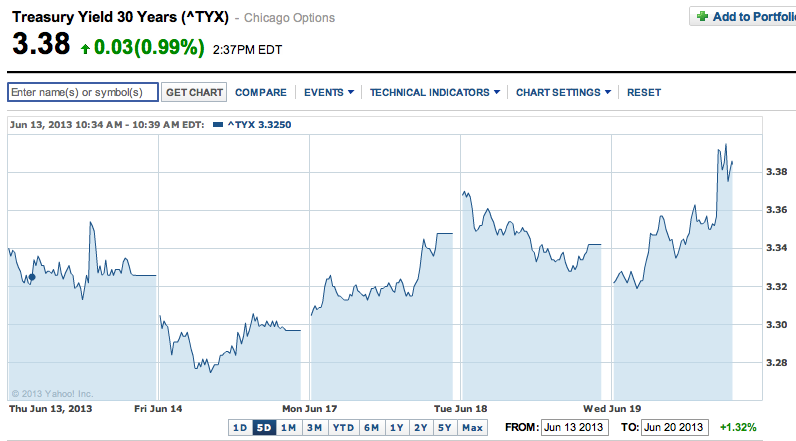
It seems that for the time being at least, markets are more interested in what the Fed says than what it does, and the combination of hints took a bid out of the safe havens.
Or, maybe it’s the imminent departure of Ben Bernanke, from Bloomie:
President Barack Obama clearly signaled this week that Federal Reserve chairman Ben S. Bernanke will be leaving the central bank when his term ends in January and that looming departure means Bernanke will want to begin tapering asset purchases this year, said Harvard University economics professor Martin Feldstein.
The Fed has been making $85 billion in monthly bond purchases in an effort to spur job growth and galvanize faster U.S. economic expansion. The policy making Federal Open Market Committee is meeting today in Washington, with four more FOMC meetings scheduled before the end of the year.
Either way, I still expect the back up in rates to slow US housing in the months ahead, tapering the taper.
