Yesterday’s New South Wales State Budget revealed some positive news regarding the success of the recently re-vamped First Home Buyers’ Grant (FHOG), which last October removed the $7,000 grant on pre-existing dwellings to an expanded $15,000 grant on newly constructed dwellings.
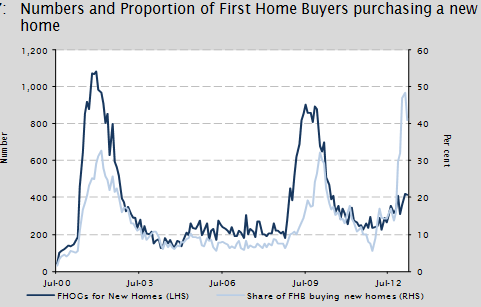
According to the Budget Papers, the change to the FHOG has led to a large increase in first home buyer (FHB) demand for newly constructed dwellings, with around 40% of FHBs purchasing new dwellings currently, versus roughly 15% prior to the changes:
Advertisement
In the 2012-13 Budget, the Government more than doubled the First Home Owner Grant for new homes and aligned the threshold for grants and stamp duty concessions to $650,000. This has provided a significant boost to the housing construction industry and over the first four months of calendar 2013, the number of First Home Owner Grants for new homes was more than 60 per cent higher than a year earlier.
To maintain the momentum of this initiative, the Government has decided that the benefits of up to $35,240 for first home buyers of new homes will be extended for a further two years until 1 January 2016.
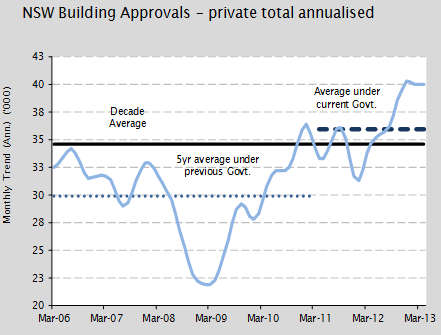
The New South Wales Budget also notes a significant pick-up in overall construction activity since the Government came to office, with dwelling approvals now running around 15% above the decade average:
After an extended period during which residential building approvals were significantly below their long-run average levels, levels are now more than 15 per cent above the decade average, with multi-unit approvals driving most of the improvement.
The Government’s Building the State package is contributing to this growth, as current private sector building approvals have increased to an annualised level of around 40,000. The level of approvals in April 2013 is 83 per cent above the low of 21,800 in February 2009.
Advertisement
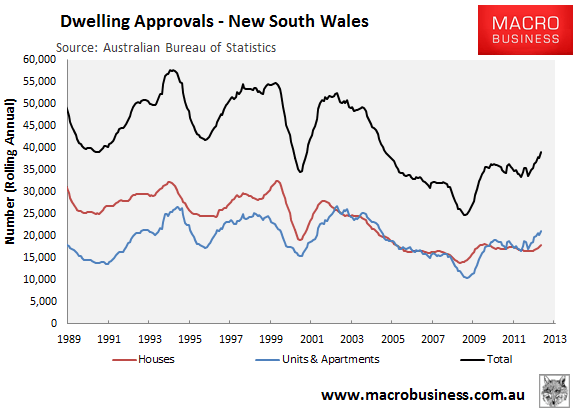
While the re-vamped FHOG appears to be working, and New South Wales dwelling approvals have clearly picked-up, dwelling construction remains highly subdued overall, still tracking well below 1980s and 1990s levels (see next chart).
While the early signs are good, much more construction is needed before the New South Wales Government can claim that housing supply is back on track.
Leith van Onselen is Chief Economist at the MB Fund and MB Super. He is also a co-founder of MacroBusiness.
Leith has previously worked at the Australian Treasury, Victorian Treasury and Goldman Sachs.