

After falling for six consecutive months between September and February, Canadian house prices have struck back, with the Teranet repeat sales index registering a 1.1% increase nationally in May, the third consecutive monthly increase (see next chart).
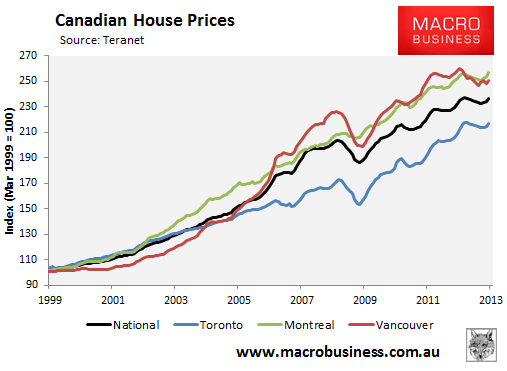
Canadian house prices are now down only -0.1% since values peaked in August 2012 and remain 27% above their April 2009 low.
Looking at the major markets, falls have been sharpest in Canada’s third biggest city and bubbliest (and most supply-restricted) market – Vancouver – where prices are down -3.7% since values peaked in June 2012, although prices did rise by 0.7% in May. Prices have also fallen moderately in Canada’s largest city – Toronto – with values retracing by only -0.2% since peak, following a rise of 1.0% in May. By contrast, values in Canada’s second largest market – Montreal – set a new all-time high in May after increasing by 1.2% over the month.
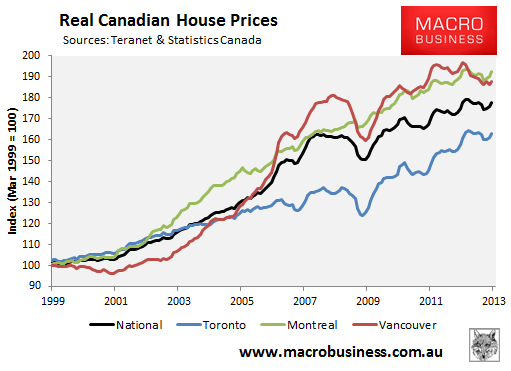
In real (inflation-adjusted) terms, Canadian house prices have fallen by 0.9% since peak, with Vancouver down 4.6%, followed by Toronto (-0.9%), and Montreal (-0.5%):
Despite the recent recovery in Canadian house prices, analysts remain nervous. Overnight, the Bank of Canada (BoC) warned that an overbuilt and overpriced condominium (apartment) market, particularly in Totonto, is posing a risk to Canadian households, banks and the economy in general:
“If the upcoming supply of units is not absorbed by demand as they are completed over the next 12 to 30 months, the supply-demand discrepancy would become more apparent, increasing the risk of an abrupt correction in prices and residential construction activity,” it says.
“Any correction in condominium prices could spread to other segments of the housing market as buyers and sellers adjust their expectations.”
That could start what it terms a negative feed-back loop. A plunge in house prices bites into net household worth, shatters confidence and consumer spending, impacting income and job creation.
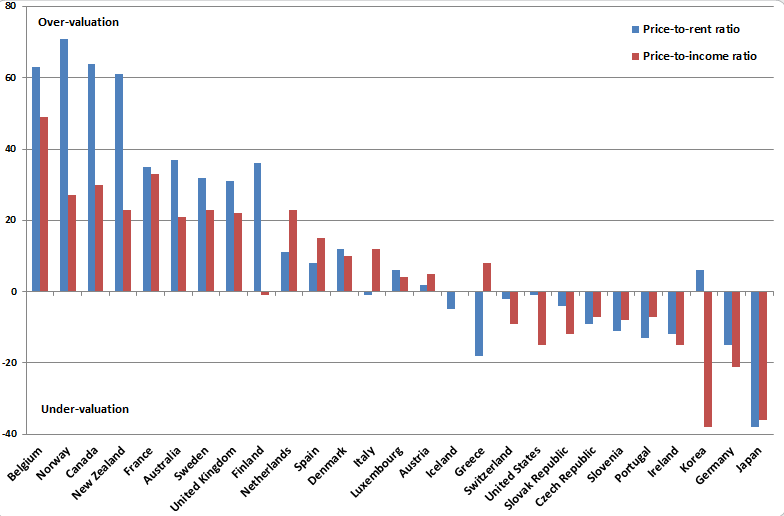
Meanwhile, the OECD last month ranked the Canadian housing market as the third most overvalued out of the 27 member nations, with prices relative to rents 164% overvalued and prices relative to incomes 130% overvalued (see next chart)
Although the OECD’s secretary-general, Angel Gurria, does not believe Canadian housing is a bubble:
An overvalued housing market and a bubble are not the same thing. The housing market has been building very steadily over a period based on growth, jobs, good income, and a Canadian economy that’s been in good shape. Frankly, it’s not a bubble in the sense of a great big speculation in the property market. I think there will be a cull in some investment in the sector, which will see prices stabilize over time.
Time will tell.
unconventionaleconomist@hotmail.com
