


A bit of talk from a prominent Fed watcher seems to have hit home, and has seen traders looking at the capital markets through slightly more optimistic eyes. Throw in some good US data in the shape of US retail sales and weekly jobless claims and you have the S&P 500 closing up 1.5%, with the bulls completely dismissing the terrible Nikkei tape.
Certainly the 0.6% month-on-month gain in retail sales is obviously positive, however it has to be said that it needs to be viewed in the context that both personal income and savings are still very subdued and certainly won’t have altered the Fed’s view in any shape or form. Still, it has provided more ammunition for the bulls whom were already in a buoyant mood going into these releases – when you see a 200 pip rally in AUD/USD and steady gains in emerging market currencies, you know things are looking better.
The Hilsenrath article seems to have put the market back in check and more aligned with our call that ‘tapering’ will occur in December, if not early Q1. There doesn’t seem too much new news in the article to be fair, and we have heard already from the Fed that tapering wouldn’t occur at once, and would not result in a huge shift in monetary policy. Most strategists and economists would have long realised that a slowing of asset purchases is nothing like the raising of short-term rates; however both these views saw an eight basis point (bp) move lower in US bond yields and a flattening of the curve to 187 bp. The irony being USD/JPY rallied to 95.81 even though yields fell, thus this divergence from the yield spreads shows that the pair is being primarily driven by the JPY right now.
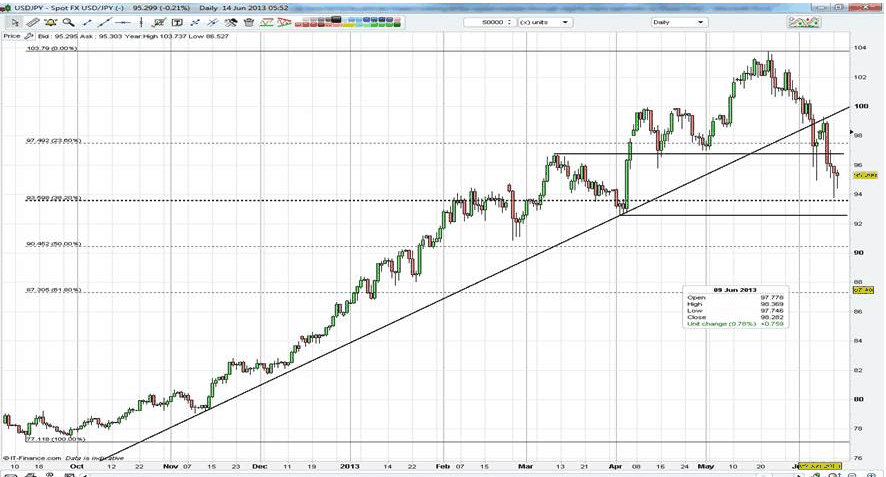
We’ve seen a bias to sell USD/JPY today, although with 85% of clients still net long, many are looking for a bottom in this pair. We’ve seen a break of daily ichimoku cloud and the next big level is 93.57 (the 38.2% retracement of September to May rally), and we’d expect this level to be defended with vigour, and tactically it may be worth being long from here with stops below 92.56 (the April low). Still, like the Nikkei, it’s a trade for the brave, although with the weekly MACD still above the zero line, the moves still feels corrective in nature.
(Daily chart of USD/JPY)
On a more fundamental basis, there’s been a barrage of commentary both from the BoJ minutes and various officials on the wires. The minutes didn’t really contain too much, and it’s interesting that they are watching Fed policy and the impact that could have on Japanese yields; perhaps they should focus more on the listening to markets so we don’t get such huge spikes in volatility. Comments from finance minister Taro Aso detailing that changes to corporate tax wouldn’t be overly effective because a number of firms don’t actually pay corporate tax, was also complemented by views he is not commentating on equity and forex moves. Whether that’s reason to sell USD/JPY or the Nikkei seems unreasonable to us, given this is more the job of the BoJ.
News flow from China has been negative today, with the Ministry of Finance (MOF) failing to sell its full expected bill issuance of RMB15 billion. However, the bigger story (which probably won’t surprise many), citing an internal review of China’s commerce ministry, is that fake invoicing inflated China’s official import and export totals by $75 billion in the first four months of 2013. An alternate estimate found that year-on-year export growth for January to April was actually around 7%, while import growth was 6%. China officially reported export growth of 17.4% in the same period, while imports grew 10.4%. China sceptics will be having field day over this news, and many will question what this actually means for the level of real growth. The Shanghai Composite hasn’t really reacted yet, with the index up 0.2%. It will be interesting to see if it falls into the close, as this would be the ninth days of losses; the worst run since December 1994.
AUD/USD has found sellers all day after rallying hard to 0.9666 overnight, although to be fair this is USD’s story as EUR/USD and GBP/USD has also fallen today. It seems the 200-pip rally has provided the AUD bears better levels to re-apply shorts, with the bears clearly keen to see a daily close below the October 2011 low of 0.9388, and the pair targeting 0.9218 (the 61.8% retracement of the May 2010 to July 2011 rally) if this were to occur. The ASX 200 on the other hand hasn’t reacted to the stronger USD with the index up a sizeable 2.1%. It’s been a long time since we saw both the financial and materials sectors both near the top of the pack, but clearly with both them both on fire, the broader index is retracing some of the recent losses. It seems the stocks that had been on broker’s wish list have been bought in earnest today and hopefully better days lie ahead. This has been the strongest rise in eleven months and it feels like it could be time to have a nibble at a few favourites.
US futures have pushed a little lower in-line with the fall from the high in the Nikkei; however our calls for Europe still look promising with gains across the different markets expected. There is a number of data releases that traders need to be aware off, with European CPI (final revision) expected to revised up to +0.1% from -0.1%. Euro-area employment is also due, while in the US we get reads on industrial production (+0.2%) and University of Michigan consumer sentiment figures. We will also be watching GBP/USD, with the pair closing back above the long-term 200-day moving average at 1.5700. There have been a number of failed breaks of this level over the last couple of years, both above and below, and it will be interesting to see if the strong trend can hold here.