We, like many in the market are longing for the June 20 FOMC meeting to hopefully provide the clarity needed to get traders and investors to sing off the same song sheet. Two-way volatility was always the Fed’s intension, as markets have moved in one direction for too long, and as with any shift in monetary policy, fully requires a gradual ease into change.
Until the meeting however, we are likely to continue to see sizeable intra-day ranges in the USD and its G10 and emerging market partners, while US treasuries will continue to see the similar moves like yesterday with the ten-year hitting a high of 2.29%, before reversing and closing at 2.17%. A look at volatility measures shows the VIX at 17.07% (approaching the recent high of 18.5%), and AUD/USD volatility (as measured by one-month at the money options) at the highest level since June 2012. The BOA/Merrill Lynch ‘MOVE’ index, a measure of US treasury volatility across the curve, is now is also at the highest level since June 2012. It is clear we are at an inflection point and these sorts of moves are thematic of a market place which is trying to re-adjust to a future more closely aligned to fundamentals than central bank support.
It was only a number of months ago that we were talking currency wars, and of course that is still prevalent with the BoJ trying its best to export its deflation to the rest of the world. However, it was interesting to see countries like Brazil, Indonesia and Turkey all conducting exercises to strengthen their currencies, namely through central bank auctions. Central banks around the world, especially those who rely on overseas trade, love a lower currency, however the falls need to be orderly, and clearly as the USD-funded carry trade is unwound, these currencies are falling way too quickly. Once again the move higher in the US yield curve (difference between two and ten-year bonds) to 190 basis points are at the centre of this and are having a dramatic effect across the world.
Asian markets have once again been offered, with the ASX 200 trading to a low of 4710 and in and out of ‘correction’ territory. Local traders have also been talking about the volatility seen in the US stock market, with the S&P 500 falling 1.2% on the open, subsequently rallying 1.1% and then diving 0.8% into the close. According to Bespoke Investments, we haven’t seen intra-day moves like that since 2011. Japan hit a low of 12,994, with the overnight moves in USD/JPY clearly at the heart of it. The pair traded to a low of 95.59, four pips shy of the base of the ichimoku cloud at 95.54, and this has proved once again to be the key ‘buy-zone’, with macro traders squaring and reversing positions, taking the pair quickly back to 96.50. The Nikkei seems to have found support on the back of the currency moves, while we are also seeing good buying in Japanese bonds. This is interesting given the lack of action from the BoJ yesterday and the idea that it wants to keep its powder dry with regard to increasing the duration on its fixed-term liquidity operations.
A move this year above 2% in Japanese yields (premised on inflation expectations) would cause serious ramifications on almost every asset class. That is of course if we see substantial nominal and real growth, as on current levels of growth the sovereign would need to use around 80% of all tax revenues just to pay the interest component of the massive levels of public debt. Thus, the slight moves lower today have provided some relief, although the equity market is still down 0.2%.
The ASX 200 has been a sea of red, not just in the different sectors (which are all lower), but on a stock level – 73% have fallen on the day. In terms of levels we are now watching 4700, while 4648 is the ‘break-even’ level for the year. Below that, 4615 is the exact 50% retracement of the 31% rally from the June 2012 low’s to the recent high of 5249. Bear in mind it took 238 trading days to rally to 5249, however we are only 2% away from cutting half of those gains and it’s only taken 19 days thus far. To use a well-worn trading metaphor ‘up the stairs, down the elevator’. Interestingly, one just has to look at the Australian yield curve which is now at the highest level since August 2011 at 90 basis points (the difference between two-year bonds and ten-year bonds), and a simple overlap against the ASX 200 financial sector shows that the steeper this curve gets, the more likely traders are to close profitable yield-plays. Clearly as bond yields increase, the still high net yields on offer from the banks become less compelling, hence banks are sold. It seems logical therefore that if you think yields at the long-end of the curve are rich and deserve to be lower, banks are probably good buying right now after a strong pullback.
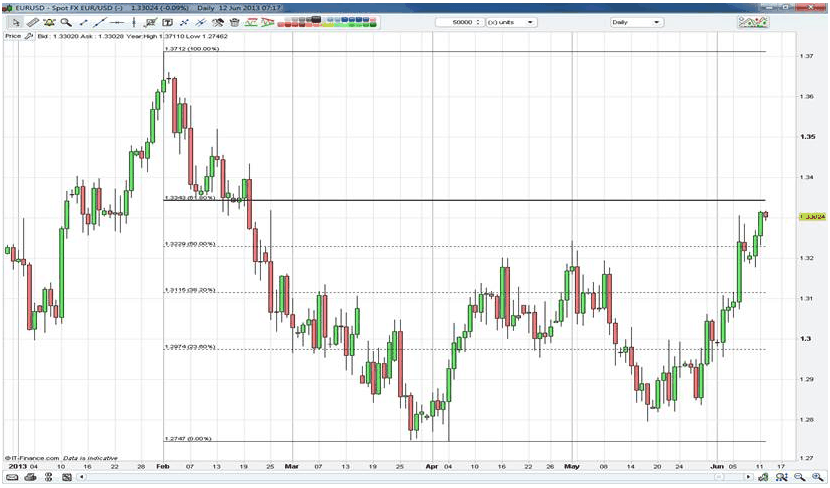
European markets look set for a weaker open. Traders will still be keen to watch volatility in their own markets, with eurozone industrial production in focus on the data side. Unemployment data is also seen in France and the UK, with EUR/USD and cable both looking strong, with EUR/USD honing in on the 61.8% retracement of the year’s high to low at 1.3343. A break of this level should see 1.3500 in play, and that is where the ECB will really ramp up its easing rhetoric. It will be also interesting to see the level of demand at the upcoming $21 billion US ten-year auction. A bid/cover above 2.7x should see yields drop, especially after yesterday’s exhaustion pattern at the trend highs.