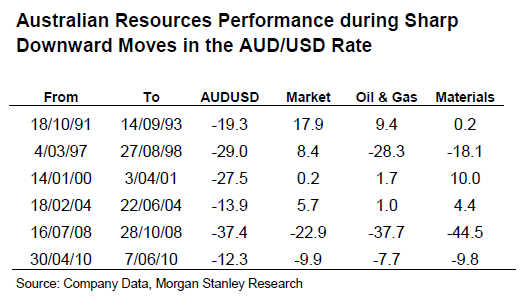
Morgan Stanley offers the obvious truth this morning:
All else being equal, a weaker AUD is a positive for resource company earnings: Holding USD commodity prices static, a weaker AUD results in positive translational benefits for ASX resource equities who sell their products in USD and report earnings in AUD.
But all things are rarely equal: As shown in Exhibits 1 to 3 on page 2, the AUD-USD rate is highly correlated to commodity prices, particularly bulks and oil. The demise of the “mining boom” brings with it a triple negative too,
in the form of lower prices, lower production volumes and potentially, deferral of growth projects – and it is the latter two factors that weaken the investment case for resource stocks in general.
A lower A$ may already be in consensus numbers: A$ futures have been lower for a considerable time, and we suspect market forecasts may have already impounded a level of earnings uplift from a lower currency. Historically the resources and energy sectors typically underperform a falling dollar and the wider market: Should the A$ begin a sustained correction, then the most appropriate investment strategy is to retain equities which have long-life, low cost production and strong balance sheets. Such equities are relatively better placed to hold dividends, and potentially take advantage of cheap exploration and production assets ahead of the next up-swing.
I’ve been saying it for well over six months and will say it again: dollar exposed industrials are the play if you want stocks in the period ahead.
David Llewellyn-Smith is Chief Strategist at the MB Fund and MB Super. David is the founding publisher and editor of MacroBusiness and was the founding publisher and global economy editor of The Diplomat, the Asia Pacific's leading geo-politics and economics portal.
He is also a former gold trader and economic commentator at The Sydney Morning Herald, The Age, the ABC and Business Spectator. He is the co-author of The Great Crash of 2008 with Ross Garnaut and was the editor of the second Garnaut Climate Change Review.