

The S&P 500 couldn’t quite make it into positive territory, although momentum is clearly positive, with Bespoke Investments highlighting that the market has put on gains 61 out of the last 96 days. Interestingly, there has only been one year in history where the S&P 500 was more consistently positive. It also points out that the Nasdaq has made a higher high for sixteen straight days, which is the longest streak since 1999.
The index closed at 1666.29, just a tick below the 200% retracement of the May to October 2011 sell-off at 1666.39 (see chart). A break here on a closing basis would bring the psychological 1700 level into play.
Chicago Fed president Charles Evans’ comments have been labelled hawkish by some, dovish by others, but we sit somewhere in between, possibly more in the hawkish camp though. He showed limited concern to the big miss to inflation of late, although he did say he would like to see it closer to its objective. Otherwise, his view on the economy was relatively constructive, suggesting he expects to see ‘self-sustaining growth’ at ‘escape velocity’ in 2014. ‘Escape velocity’ sounds like it’s straight out of a Star Trek film, however it will probably be the new word that traders and the media latch onto, and we’re sure this will come into play more often going forward.
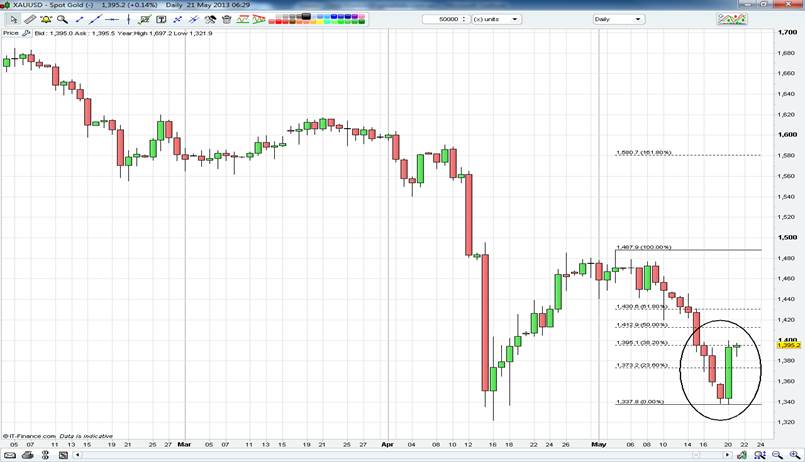
It’s worth highlighting that both gold and the USD were moving aggressively into his speech and showed little reaction to his narrative. Gold ended up printing a bullish outside day, although couldn’t quite close above the 38.2% retracement of the May sell-off at $1395. We’ve seen sellers today, and while the failure here is bearish, we’d prefer to wait until after Ben Bernanke’s speech, given the risk of dovish comments before putting on new shorts. Prior to the Fed Chairman though, we get James Bullard and Bill Dudley out today in US trade. Recall when James Bullard detailed to markets in mid-April that inflation had fallen too far below the Fed’s 2% goal, and a further fall could prompt increased asset purchases. Bill Dudley will speak a couple of hours after in a speech titled ‘lessons from the zero bound’.
Asian markets are subdued, with the ASX 200 the laggard, down 0.6%, while the Nikkei (up by 0.2%) has found buyers off the low of 15,264 (0.6%) on the open. The latter is a function of USD/JPY strength after comments from the economic minister Akira Amari, which look like he was trying to undo some of yesterday’s narrative (apparently it was lost in translation) by saying the stance of officials is that they prefer to maintain a weakening policy in the long term. The BoJ meeting is underway, although we will hear more tomorrow, and while we don’t expect much, the worrying moves in the bond market could be addressed.
Australia has moved lower, although we’d want to see the index fall below the May 2 low of 5117 before we got more concerned. Industrials have led the decline, courtesy of another raft of downgrades from mining services names. It’s hard to remember a sector where so many stocks have come out with guidance changes in such a concentrated timeframe; however, that is the impact that cost discipline is having within the materials space. There is an element of tact as well, because so many have announced guidance changes, and if they haven’t, the market will still price one in anyhow. Financials are also lower by 1.1% and one can’t help thinking that yesterday’s note from UBS that the Aussie financial sector is a ‘bubble’ is partially to blame, although the catalyst for this to burst doesn’t look immediately ready to create havoc. Still for the trader, where there is volatility there is opportunity; it’s a question of timing, because as offshore funds have found out, shorting banks over the last couple of years has been rather expensive.
AUD/USD has found buyers after the RBA minutes, with the pair re-claiming the 98 handle and looking to push back to key resistance at 0.9870 (the former uptrend drawn from the 2011 lows and 200-week moving average). A rejection of this level (providing we get there) could be the signal the bears would need to re-establish shorts, with a view to renew the trend down to 0.9582. The RBA minutes looked pretty consistent with the original statement, and to be fair we didn’t really learn a whole lot of new information. On a more negative note, Bank of America put out a note detailing that it sees China’s trade surplus one-tenth the size of the reported $61 billion so far this year, after accounting for fake transactions used to hide hot money inflows (reported in Bloomberg). This didn’t seem to worry too many, although there will be a number of traders/economists who won’t be overly surprised by this call.
European markets look set to open a touch lower and it will be an interesting session ahead of us. Data is limited to German producer prices and UK CPI/RPI. A number above consensus on the CPI print at 2.6% could bring cable back to key resistance at 1.5330 (the 38.2% retracement of the May sell-off). On the earnings side we hear from Burberry, Marks and Spencer and Vodafone on the FTSE, while in the US we get numbers from Home depot and Best Buy. Vodafone has a 5.66% weight on the market, so it could have an influence on the broader market. While many expect a tough quarter, the market is primarily focused on its dividend.