The great baby boomer sell-off

By Leith van Onselen

Quartz yesterday published an interesting article on the “great baby boomer sell-off” in the US, which it argues will kick-off later this decade and potentially cause the next housing crisis:

In the 20 years between 1990 and 2010, these consumers were at their peak family size and peak income. And suddenly, there was massive demand in America from the same kinds of people for the same kinds of housing: big, large-lot single-family homes (often in suburbia). In those two decades, calculates researcher Arthur C. Nelson, 77 percent of demand for new housing construction in America was driven by this trend…

In the coming years, baby boomers will be moving on (inching further through the python, if you will). “They will want to sell their homes, and they’re hoping there are people behind them to buy their homes,” says Nelson, director of the Metropolitan Research Center at the University of Utah… Nelson calls what’s coming the “great senior sell-off.” It’ll start sometime later this decade (Nelson is defining baby boomers as those people born between 1946 and 1964). And he predicts that it could cause our next real housing crisis.

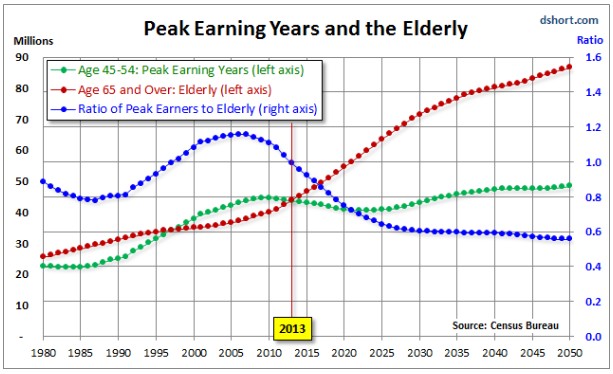
The quartz article follows data provided earlier in the week by Doug Short, illustrating the ageing conundrum facing the US:

The year 2013 is an inflection point in the chart above, with the elderly cohort dramatically increasing in numbers. The ratio of the two, the blue line in the chart, peaked in 2007 and began its long rollover in 2008, coincident with the beginning of the last recession. We have many years to go before this ratio approximately levels out around 2030.

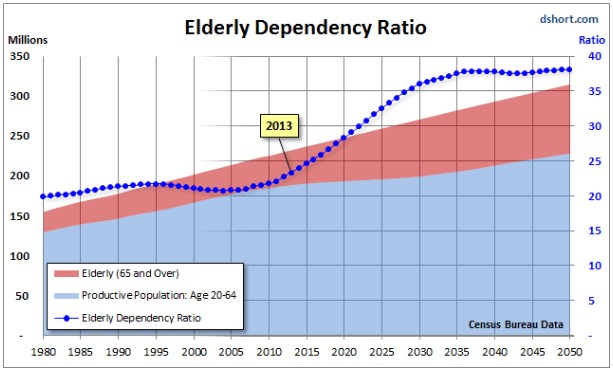
Even more disturbing is the elderly dependency ratio, the label given by demographers to the ratio of the 65 and older population to the productive workforce, which for developed economies is usually identified as ages 20-64. The next chart illustrates the elderly dependency ratio with Census Bureau forecasts to 2050. Note that in this chart I’ve followed the general practice in demographic research of multiplying the percent by 100 (e.g., the mid-year 2013 elderly dependency ratio is 23.3% x 100 = 23.3).

As the chart painfully illustrates, the elderly dependency ratio is in the early stages of a relentless rise that doesn’t begin to level out until around 2036, over two decades from now.

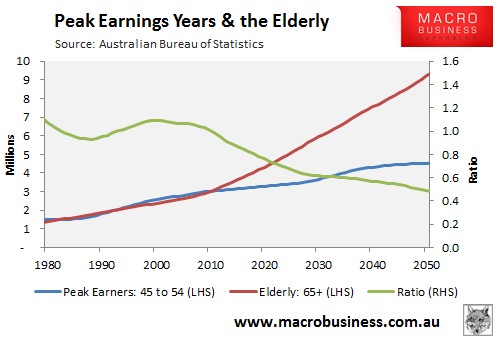
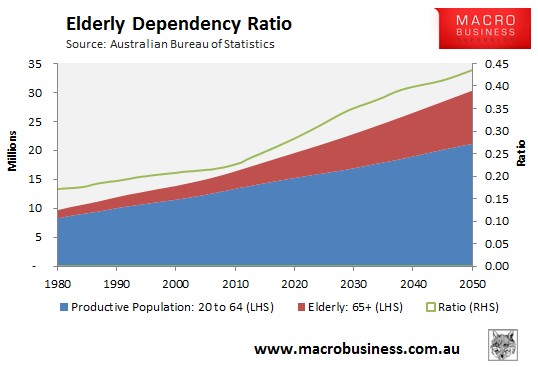
On the request of regular MB commenter, Explorer, I have re-created the above charts for Australia using the Australian Bureau of Statistics high growth (births / immigration) population projections (see next charts).

As you can see, Australia shares many of the same demographic challenges of the US, which would suggest that our economy and housing market should (other things equal) come under similar demographic pressures.

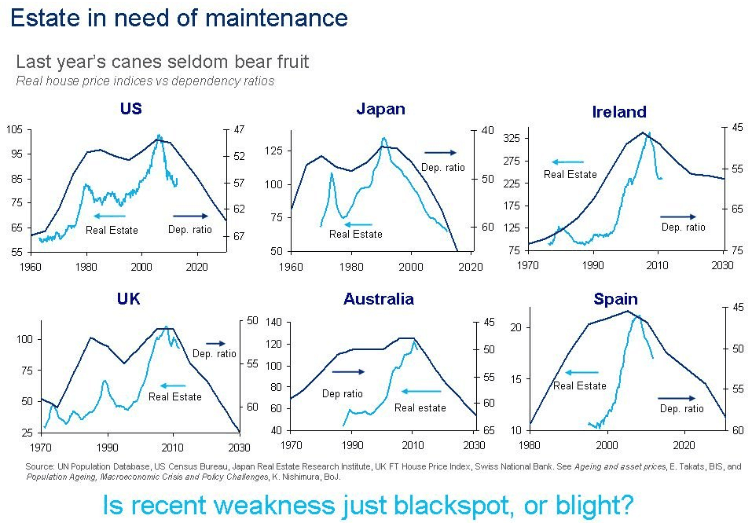
Indeed, last December, Citigroup released the below series of charts showing the relationship between dependency ratios and house prices in a range of countries:

Citigroup’s Matt King explained the chart as follows:

“It’s what I like to call “the most depressing slide I’ve ever created.” In almost every country you look at, the peak in real estate prices has coincided – give or take literally a couple of years – with the peak in the inverse dependency ratio (the proportion of population of working age relative to old and young).

In the past, we all levered up, bought a big house, enjoyed capital gains tax-free, lived in the thing, and then, when the kids grew up and left home, we sold it to someone in our children’s generation. Unfortunately, that doesn’t work so well when there start to be more pensioners than workers.”

For more analysis of this issue, check out the following articles:

Ageing headwinds for housing

The Baby Boomer Bust

The Demographic Time Bomb

Ageing and Asset Prices

China will grow old before it gets rich


62 Responses to “ “The great baby boomer sell-off”

  1. aj. says:

    The boomers are also the biggest holders of investment properties. The question the next generation has to ask is do they want to be debt serfs for life to fund the retirement of the rentseeker generation?

    This is without doubt a generational battle looming. The major parties – who represent boomer interests above all, and are boomer owned brands – will be doing what they can now to keep the ball rolling.

    Unfettered population growth? Zirp policies? Others?

    • Deo says:

      This is not generational battle, this is more to a war which has numerous battles inside it. The only hope for younger generation, both born locally or overseas, is to vote wisely and make sure the MPs understand that they cannot expect “business as usual” to enrich their BB generation in perpetuity.

      Many of my friends are looking to vote for smaller parties as protest vote and let the current MPs know that their days are numbered once the current Gen Y become more and more eligible for voting.

      • Gunnamatta says:

        I suspect I am well older than both you Gents, but I agree 100% with any sentiment that suggests that there is nothing in it for younger voters (and in some cases people as old as say 50) to vote for any mainstream party likely to create government.

        They are all beholden to a Boomer demographic

      • Deo says:

        Not sure about our age difference Gunna, but if you’re below 40 then I will be older than you ;-)

        I am not young but still have some problems with current unfair treatment against youth by the BB generation MPs.

  2. Pfh007 says:

    So tell me again why it is good policy for the RBA to drop interest rates in order to sustain household debt expansion by attracting more and more poorly informed Australians to the perils of debt mountain secured by assets whose ‘value’ was secured by a unique combination of factors (demography, easy credit, NIMBY excess, planning indulgence) that are unlikely to persist and are already receding?.

    It is a disgraceful policy.

    And no accident either, which is they are regularly publishing self justifying flimsy ‘platypus’ papers which can be summed up as “How I learnt to stop worrying and love debt”.

    A lot of commentators try to excuse the RBA policy of throwing poorly informed citizens under the household debt bus on the basis that ‘overall credit growth’ is good for the economy.

    I suggest if they feel so strongly about that they should go out and load up on debt themselves and spray it around the economy and not egg on the RBA to induce the less informed to do so.

  3. Mr Squiggle says:

    If we don’t want to have that many 60 year olds in 2050 , then don’t import so many 30 year olds in 2020.

    Migrants have a head start in the aging process.

    What we need is more population growth that is driven by net birth rates, not net migration

    • The Claw says:

      don’t import so many 30 year olds

      I’m stunned. Just seven words. Racist, ageist, and a hell of a good idea.

      • willynilly says:

        I can not see any racist or ageist comments in the Mr Squiggle post.
        We have been below replacement fertility for over 35 years now and there is not likely to be any increase why economic prosperity remains, the demographic paradox.
        Unfortunately, the baby bonus did little or nothing to raise the fertility as people do not have babies for the financial incentive. A long term tax break on families with more than 2 children may be a better idea.
        The average age of mums giving birth is now 34 and until we pop our housing bubble and families can afford to buy a home on a single wage, fertility will remain low.

      • Mr Squiggle says:

        Thanks Willynilly.

        My point is not about shutting the door, or turning our back on the outside world.

        For most of the Howard & Rudd years, the net migration to net birth ratio was about 2:1.

        I’m advocating a shift in emphasis so that net births outnumber net migrants.

        More babies will make these charts less scary, not more migrants

      • aiecquest says:

        Remember new permanent immigrants are only one part of the picture.

        Many of the net migrants or immigrants who fall under the 12/16 month in Oz population rule are temporary residents (and returning Australians) including 457s, international students and backpackers (living differently to most Australians and permanent residents), with a small proportion being eligible for skilled immigration application (capped number of places).

        According to the OECD students should not be included in net overeas migration data, which would translate into stagnant or possibly declining population.

      • willynilly says:

        Brilliant, someone else that gets our fudged population growth numbers. How many do you estimate of our 1.7 million temp visa holders have been counted under the 12/16 rule towards our oficial population growth?

    • willynilly says:

      Correct. 4.1 million boomers born here and now we have 5.1 million to support in old age. 80% of boomers will require full or part pensions.
      It was a big kick of the demographic can down the road.

    • drsmithy says:

      If we don’t want to have that many 60 year olds in 2050 , then don’t import so many 30 year olds in 2020.

      Alternatively, import them with time-limited visas that do not have a path to residency or citizenship.

    • Andy! says:

      Ah the need, not option, for 2 income households is a wondrous thing.

    • Peter Fraser says:

      We have to maintain a pro immigration policy otherwise generation Z will be left trying to support the massive numbers in Gen X and Gen Y in their dotage, and they won’t enjoy that.

      • russellsmith55 says:

        They will regardless. And what happens for the generations that come after them?

        I long for a day when people actually start fixing problems today without having to steal from the future. Just because you can’t see who you’re stealing from, or they may not even be born yet, it doesn’t make the act victimless.

      • JasonMNan says:

        Retirement at 70-72 ought to fix it.

      • russellsmith55 says:

        Sadly that does look inevitable. Problem is that a lot of people’s bodies/minds aren’t employable at that age even if they want to work, and pensions will still be needed.

        If they don’t qualify for the pension or unemployment, their children and grandchildren will have to support them.

        All roads lead to Rome.

      • JasonMNan says:

        The retirement age should have been extended gradually, starting in the 80´s. Maybe 18 months per decade Instead it will be done in one go, with the subsequent pain for the current cohort. Most companies have a corporate culture biased against older workers and they will resist hiring/retraining older employees. But as the pool of workers shrinks there will be no choice.

      • Explorer says:

        They will never be unemployed and will be able to bid up the price of their services to retired Baby Boomers.

        They will also bring the wealth transfer forward and distributing the built up wealth of the boomers to other than their offspring. IE it will go to the younger generations in the form of higher wages as boomers spend to gain services only available from younger generations.

      • Greconomics says:

        Bingo.

        Nurses won’t be earning $70k a year in 2020… more like $200k a year! If the oldies don’t like it, they’ll have to feed and bath themselves, administer their own medication and change their own poop bags.

        Economics is a bit like nature, you can distort the balance for a while, even for decades, but eventually, balance always returns.

      • Alex Heyworth says:

        Nurses will be imported from Asia (probably mainly India, as they speak good English) in droves on 457 visas. It is happening already. The nursing home my father in law is in has three Indian nurses. The wages they get here are far better than they would get in India. They are working here until they can afford to get married. Their parents are busy organizing the wedding plans and keeping the prospective husband’s family onside and up to date.

      • willynilly says:

        Peter
        pro-immigration is not going to happen as the aged voting bloc grows. SWe already have 3 political parties against immigration. I suppose the RE industry will push for it but voters will not accept it, especially if we have to double or treble immigration to compensate for our projected falling natural growth (deaths minus births).
        Nope, not going to happen. Oze aged votes want the doors shut!

    • Deo says:

      then don’t import so many 30 year olds

      Vote for Stable Population Party then…

  4. willynilly says:

    Less young people want to buy a big debt…
    http://www.heraldsun.com.au/business/jessica-irvine/home-ownership-on-the-way-down-for-most-australians/story-fnfhw5ld-1226588675841

    The ageing of our nation is unprecedented and using any formula from the past is quite wrong to do and to use an argument that they as many Gen Y as BB.s. .I have already given examples in Brisbane, like Jindalee, Rochedale, Chelmer as declining populations. If the theory was correct, that GenY will buy up the BB properties then the declining populations just should not have happened as other young families would have bought into those burbs. They did not as it is clear that the children of the boomers could not afford to buy the properties that their parents are in now. So it will end badly as these burbs start to kove to the death phase and prices drop accordingly as the children sell off the properties. This will drive down prices in surrounding burbs and well, you get the gist.

    Note, our death rates double over the next two decades, so supply will double as well and that really is what will drive prices down.

    Immigration will not grow as the aged become anti-immigration. We have three political parties standing on an anti-immigration stance now and that will only get stronger.Add to that the fact that many boomers are using their lump sum Super to try and pay out their mortgage and then rely on the pension and well, once again, the reality of the fiscal gap due to ageing will raise its head high as younger voters and taxpayers rebel against the fully paid pensioners living in their multiple million dollar homes.

    When I first joined the forums, I was called a boomer basher, yet I am one, and now you can observe that the demographic discussion is growing rapidly and I am sure you can read the angst already growing in the young. So will they be lemmings, like the boomers were, we thinks not and the statistics are showing that to be correct. Did you notice a certain FHB strike last year?

    The BB lemmings do not realise that as a cohort, they will drive down house prices in many ways.
    Boomers are now travelling OS, so our tourism is failing, so what happens to prices of homes in tourist areas? This is just one example of how the boomers will deflate their own property bubble….lemmings…http://www.smh.com.au/travel/travel-news/boomers-lead-travel-boom-20130215-2eijj.html

    • PhilH says:

      “Note, our death rates double over the next two decades, so supply will double as well and that really is what will drive prices down.”

      That’s correct, but not the whole story. Deaths increase supply disproportionately, because half the old-age deaths are people living alone, often in a family-size dwelling. That dwelling will then be occupied by, on average, 2.4 people, assuming that the current occupancy rate holds.

      Worst case is an extra 50,000 deaths per year, which will free up accommodation for around 120,000 people.

      Probable side effect: housing construction will fall dramatically.

    • Alex Heyworth says:

      What will probably happen in the suburbs you mention, willynilly, is that as the BB parents die or leave the family home for a nursing home, the large blocks they are on will be subdivided with two townhouses or a block of units taking their place. This will help to retain the value of the property (which is mainly in the land) and take some of the pressure off fringe development.

      • Peter Fraser says:

        Sounds reasonable, as they die over the next 10 to 30 years.

      • Alex Heyworth says:

        Well, it has already happened in suburbs slightly closer in such as Taringa or Toowong.

        The street I lived in as a teenager in the 60s (in Taringa) was full of houses on large blocks, many of them like ours were Queenslanders from the early 1900s. All since demolished and replaced by units.

      • willynilly says:

        Mmmm. not so sure.
        Toowong has increased by 7% since 2006 to 2011 to a total of 16,867, or 1,117 people in 6 years, or an extra 186 people per year. If units have been going up it means the population in the homes has been decreasing.
        Taringa – 7.3% to 8,466

        http://images.smh.com.au/file/2012/12/19/3901120/census_web/

      • Alex Heyworth says:

        The units going up in those suburbs happened years ago, in the 80s and 90s.

  5. Winston says:

    It’ll be interesting to see how prices hold up in coastal ‘retirement’ towns or on small acreage properties etc, as I don’t see many foreign buyers or young professionals wanting to live in or maintain houses/land so far from the CBD.

  6. Explorer says:

    Thanks Leith for ferreting this out.

    It might also have implications for share markets and other investments.

    On the other side is the mathematical ability to bring interest rates to zero bound over time, increasing the capitalised values of future cash flows.

    It is not only the dependency rate but also the absolute size of population. Increased dependency is one thing but a falling population between 25 and 65 is another, perhaps even more powerful factor. If that whole demographic falls in number then then the actual number of houses required will very likely also fall. That may mean more people will have holiday houses but it likely means that house prices fall more significantly.

    My understanding is that we expect in Australia that population in each age cohort grows and total population grows, but that the shape of the “hive” diagram changes to fatter at the top and skinnier at the bottom.

    Some references that I think show this are at:
    http://dspace.anu.edu.au/html/1885/41933/2000rp05.htm#18
    http://demographics.treasury.gov.au/content/_download/australias_demographic_challenges/html/adc-04.asp

    Some countries however actually face falling populations 25 to 65 and I believe this is the case in China from about 2020 because of the 1 child policy. I think Japan might face the same issue. Europe’s immigration might offset what would otherwise be the outlook to some extent. Some have said that after 2020 China won’t need to build another apartment for a generation or two. Perhaps Gina and Twiggy should cash out now or at least start lobbying India to follow the China model!!

    Leith I appreciate your efforts and hope that this might stimulate a potential guest author to take the analysis a step or two further.

    Thanks again.

  7. Aquarian says:

    Interesting post. I wonder whether it will come to pass or whether it might be like the Y2K story.
    Two personal insights. My inlaws are mid 70′s and hanging onto their mcMansion in the burbs despite cancer and encroaching dementia. I wonder how many boomers will just hang on until the bitter end?
    Second is that most two children families I know would love to have more children, but the pressure of the mortgage makes it impossible to consider, especially for those living in areas without good public schools.
    Everyone knows someone in that boat, so don’t need to labour the point.

    • steve99 says:

      My father is 83 but wont sell up, why? because like many from the old working class generations he lives in an area where the house prices are not enough to cover the cost of moving to a retirment village.(as an aside to this there was no superanuation for the vast majority of working class people till the 90′s so state pension only) His house is worth aprox 300k in a far flung outburb of Melbourne. The retirment viallges he was looking at want around $260k plus around $90 per week ongoing fees. After selling costs and other moving in costs etc he will be left with nothing but a micro sized donga and be down maybe $60 per week taking into account he wont pay rates any more.
      If you think that many potential sellers are in similar situations and are say 65 years old, however would like to move to some place with more ammenities then they are looking at as much as $500k to move into a high quality retirment village.
      The correlation here is that retirment viallage (scams) price their dongas pretty close to local house prices minus selling and moving costs etc
      The fact is that as the alternatives to staying put have become so expensive and very poor value for money, more will stay put.
      Another issue is that most gen Y’s and even most X’s dont realise that people wont even consider moving to retirement properties till maybe they are 70++ years old or so and in many cases much older, there is currently no rush for the door, maybe 10 from now there will be but there is a very fat tranche of genX behind them and much bigger in amplitude than BBers.
      http://www.abs.gov.au/websitedbs/d3310114.nsf/home/Population%20Pyramid%20-%20Australia

      • Janet says:

        I’m not sure its the owner/occupiers that are the root of the problem, Steve99. It’s the ‘I’m gonna be rich from property speculation” crowd ( no positive yield- all capital gains illusions) that are the problem. Take them out of the equation and like as not your Dad’s alternative accommodation would be way cheaper, as other property would fall in price. That would release him from his property prison if he wants to/needs to move.

      • Janet says:

        Oh, and as for “But his existing home would drop in price as well?”. All quite true. But whatever other equity/assets he or your family has become worth more in property terms. That’s where his chance of escape comes from….

  8. Rhett Morson says:

    the retirement home could come to the pensioner…

    eg nurses could live in with the aged in the empty nest

    • willynilly says:

      Rhett
      Well done for thinking outside the box. Good on you.

    • forty-niner says:

      In South Australia there is a charity that facilitates this sort of arrangement, not just for nursing care.
      The charity matches those in need of accommodation (need a room, rather than a house) with those who have spare bedroom/s and need some assistance to stay in their home. E.g. the renter might perform some of the physical tasks that are too much for the home owner (mow lawn, gardening, change tap washers etc.) in return for accommodation, or they might provide some carer support . . .
      I think it is one of the well known charities, might be St Vincent de Paul.

  9. tsport100 says:

    Those younger than 58 are net buyers, those older are net sellers.

    One stat from France:

    The buyers will stay constant at 33M while the sellers will rise by 1.2M every year for 25 years.

  10. davel says:

    The people above suggesting limiting immigration to improve demographics are trying to solve the wrong problem. The overall problem is creating a healthy economy with a dearth of working age population and a growing burden of elderly non-workers. Immigration is a way to do this, though it has its own issues and yes it creates a problem later. But it buys time to rebalance.

    In the coming 20-50 years, the developed economies of the world will be competing to ATTRACT immigrants not keep them out.

    The housing market is a bit of a smokescreen as its slow death is already written – it is the result of demographics that now cannot be substantially changed. The boom of the last 20 or so could be viewed as the shuffling of the deckchairs before hitting rhe iceberg.

    What remains is to save the economy, otherwise we’ll have BOTH a stuffed RE market AND a stuffed economy, as opposed to just one of these.

    • russellsmith55 says:

      You make good sense but Im not sure I agree with the ‘buys time to rebalance’ point. If the over-immigration had little to no effect on the later problem it would be fine; but it doesn’t. It makes it much worse. Like paying today’s debt with a bigger loan payable in the future. We get half the working years out of them as an Australian (of any culture) born here.

      Sooner or later you need to pay the piper. We’ve painted ourselves into a corner. We could be encouraging young families to have more kids / start having kids sooner. But they’re putting it off until later for a good reason – it costs too much to buy any house at that age. Let alone one big enough to have 3 or more kids!

      I don’t think a stuffed RE market is the end of the world, we might have been better off with a US style crash and recovery.

    • steve99 says:

      Or how about keeping workers on after the age of 50? Most employers in many fields start filtering workers out from 45 years old onwards and if you are out by 50 you have a terrible job finding real work again. I should know, was in telecoms/IT for many years but redundancey opened up a new door of emptiness as far as I am concerned. The myth of people choosing to work till 70 or so is just that, current attitudes do not facilitate such fantacies unless you are somehow self employed.

    • willynilly says:

      Russell
      We are losing people at historical high. 88,000 Oze left permanently last year. Other countries are attracting them as they can get similar wages and buy a home at 1/4 of the price. Our issue is not how to attract, but how to keep our own citizens here.

      • russellsmith55 says:

        That’s a good point, I’ve felt the pull to the US myself for awhile (staying for partner / future family reasons – for now).

        As always, the best place to start would be giving them a shot at the stereotypical Aussie dream without onerous debt :D

      • davel says:

        Yes, I’d agree.

        The thing about immigrants is that they tend to have more kids… they also tend to up the tax take as they dont come unless they have decent employment prospects (sssuming you get policies right). So the benefit is the time bought to try to recalibrate your govt and economy.

        Globally, people in developed countries are having fewer kids. Reason is that they are now a net cost, whereas in the old days they were a net gain.

        Yes, its tougher for Aus to attract immigrants to due to the high AUD and property. That will temper in next few years though.

  11. willynilly says:

    Is it fair that a pensioner can live in a multiple million dollar home, have none or little other case or investments and get the full pension?
    Talk about a ‘free lunch’.
    No, the boomers did not contribute more in tax during their working lives than they will take out in pensions and health costs.
    We need the PPOR, over $750k, included in the pension asset test and reverse mortgages provided by the govt, not banks.

    • flawse says:

      Speaking as a Boomer…damned good suggestion….however I’ll admit to renting and not owniung a multimillion dollar home :) (unfortunately)

    • The Claw says:

      We need the PPOR, over $750k, included in the pension asset test and reverse mortgages provided by the govt, not banks.

      I’d be happy to give a boomer or two a reverse mortgage.

  12. forty-niner says:

    This is a question for those familiar with US.

    In the Quartz article the following comment interests me:
    “According to data from the American Housing Survey, from 1989 and 2009, 80 percent of new homes built in that era were detached single-family homes. A third of them were larger than 2,500 square feet. And most startling – “I checked my numbers over and over again,” a bemused Nelson says – 40 percent were built on lots of half an acre to 10 acres in size. Now, he says, 74 percent of new housing demand will come from the people who bought these homes, now empty-nesters, wanting to downsize”.

    When I watched Gasland on SBS recently I was intrigued by the homes I saw – many of them seemed to be out in the sticks (so to speak).
    Do those homes represent the numbers that bemused Nelson (in above quote)?
    Most of the homeowners featured on Gasland seemed to be lower to mid middle-class at best. What do those folks do? Are they lifestylers? Do they travel miles and miles to and fro work (which accounts for the higher Annual Kms Per Capita of US in Figure 3 in The Atlantic Cities article)?
    3 Charts That Explain Why You Spend So Much on Transportation
    http://www.theatlanticcities.com/jobs-and-economy/2013/03/3-charts-explain-why-you-spend-so-much-transportation/4859/

  13. willynilly says:

    Another chart Leith may find interesting…
    http://esa.un.org/unpd/wpp/Analytical-Figures/htm/fig_15.htm

  14. willynilly says:

    And for those concerned about population growth going on forever…

    “In these projections, world population peaks at 9.22 billion in 2075. Population therefore grows slightly beyond the level of 8.92 billion projected for 2050 in the 2002 Revision, on which these pro- jections are based. However, after reaching its maximum, world population declines slightly and then resumes increasing, slowly, to reach a level of 8.97 billion by 2300, not much different from the projected 2050 figure.”
    http://www.un.org/esa/population/publications/longrange2/WorldPop2300final.pdf

    The low variant has us at 2.3billion by 2300

  15. hzhousewife says:

    One of my staff bought a house today.

    She is 27, left school at 15 mostly due to ill health. Budgeted to the nth degree so she had a solid deposit AND all incidentals saved for – legals/stamp duty/even one years rates. Bargained over a number of weeks and got a good discount on price ( paid 225 – big country town). Chose a location very near a good Primary and a very good Secondary school, and two doors down from her best friend. Did not include current boyfriends assets in any way shape or form. The house is not her “dream” home, it is something that will work for her and 2 kids for the rest of her life. Socially it is a good decision, and I think financially too.
    She may not have been to school but she grasped a lot of what I explained to her that MB had to say about housing and economics over the last 2 yrs.

    Despite the doom and gloom, this litte 3 person family is going to feel a lot more secure from here on in. I am pleased. Some real estate agent got a sale today.

    • aj. says:

      That’s a great anecdote to help communicate the social value of housing.

      It is a social tragedy with enormous flow through problems that we have allowed residential housing to become the play-thing of the finance industry using the greed and selfishness of the rentseekers and speculators.