
Sydney finally stokes supply

By Leith van Onselen

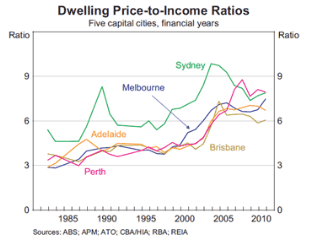
For decades, housing affordability in Sydney has been stretched, with homes typically costing far more than the other capitals when measured against incomes (see next chart).
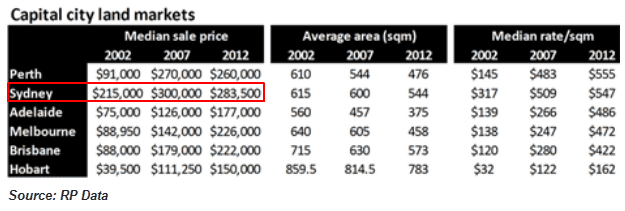
Underpinning the higher home prices are Sydney’s land values which were, for a long time, out of kilter with Australia’s other capitals (see next table).
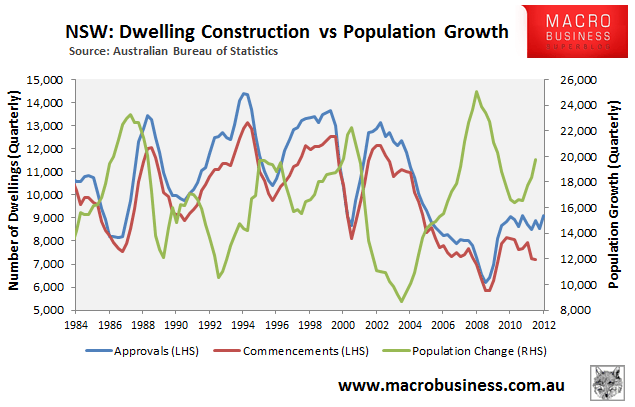
The rate of new dwelling construction in Sydney has also collapsed over the past decade just as the city’s population growth boomed (see next chart).
The election of the O’Farrell Government in 2011 appears to have ushered in a pradigm shift in housing policy, eschewing the former government’s preception that “Sydney is full” in favour of greater openness to urban growth.

In October last year, the O’Farrell Government abolished the $7,000 First Home Owner’s Grant (FHOG) on pre-existing dwellings, replacing it with a $15,000 grant for purchases of new properties up to $650,000. The first home buyer stamp duty exemption, which applied to new homes only, was also extended to homes valued up to $650,000 (up from $600,000 previously). And the Government also offered a New Home Grant of $5,000 to all non-first homebuyers of new properties up to $650,000, and vacant land up to $450,000 from 1 July 2012.

In addition to the cash grants, the Government announced that it would establish a $561 million fund to pay for road and sewerage infrastructure in new housing estates, with the explicit aim of stimulating housing supply in order to cater for Sydney’s population growth.

Over the weekend, the O’Farrell Government announced an ambitious plan to speed-up the supply of 172,000 new homes across Sydney, most of which will be on greenfield sites:

Eight existing suburbs will be re-zoned to accommodate 30,000 new homes in high density apartment blocks.

The Government has also released greenfield sites on the city’s north-west and south-west outskirts to build new houses, business parks and town centres over the next 20 years…

Premier Barry O’Farrell says the plan will meet the city’s future housing needs.

“It’s about ensuring that areas open up as the infrastructure is available,” he said. “It’s about better balancing the needs of this city.

“Ultimately economics drives everything.

“Our argument is the more blocks of land we can release the greater downward pressure we can put on housing.

“It has been so high for so long because under the former government not enough housing was developed because not enough land was being released.”

Speaking at one of the proposed sites, planning minister Brad Hazzard said the plan would solve the city’s housing shortage and curb rising prices…

The roads and transport to support the plan will be funded from the Government’s $62 billion infrastructure fund.

And later today, the Government is expected to announce the 20-year Draft Metropolitan Strategy Plan, which will set the highest targets yet for the construction of new houses and units and the creation of jobs. From the AFR:

The far reaching plan will be underpinned by a new Land Release Policy to speed up the creation of new housing and commercial land in the metropolitan area.

Premier Barry O’Farrell and Planning Minister Brad Hazzard will unveil plans for 545,000 new homes to house 1.3 million people in the region by 2033.

The figure is 17 per cent higher than the previous Labor government envisaged in its 2010 Metropolitan Plan.

To reach the target, Sydney will have to build 27,250 houses and units a year – a figure almost 90 per cent higher than the hard hit industry has created in any 12 months over the past five years.

Significantly, the draft strategy will not split the target between new “greenfield” housing on the fringe or “brownfield” housing on redeveloped inner and middle ring sites. Sydney has long built a high proportion of its housing, at times more than 80 per cent, at medium to high density and over considerable resident opposition in existing suburbs.

Prior to his election in 2011, Mr O’Farrell said a higher proportion of homes could be built on green fields sites…

Mr Hazzard said the government was “freeing up the bottlenecks that have restricted housing supply, which have pushed up house prices in Sydney”…

The Draft Metropolitan Strategy is expected to outline ways to explore fast track rezoning for large scale projects that have the backing of both local government and the private sector.

It will also need to link the new releases to infrastructure…

The strategy aims to create 625,00 jobs across the metropolitan area, a figure that is 33 per cent higher than the Labor government’s target that was set in 2010.

The release of the strategy could also pave the way for the O’Farrell government to release its long-awaited white paper on the state’s new planning system.

Certainly, the O’Farrell Government’s announcements are a big step in the right direction for Sydney housing, and should help aleviate some of the pressures on house prices and rents.

That said, even with more relaxed planning, Sydney land supply will remain geographically constrained, hemmed-in by the ocean, state parks, and the Blue Mountains. As such, housing affordability is likely to remain stretched, as long as population pressures persist.

unconventionaleconomist@hotmail.com

www.twitter.com/leithvo


61 Responses to “ “Sydney finally stokes supply”

  1. willynilly says:

    Well, population growth all depends on where…

    “More than one in ten SA2s within Greater Sydney experienced population decline in the ten years to June 2011. The largest losses were in Minto – St Andrews (down 1,600 people) and Claymore – Eagle Vale – Raby (down 1,100), in the outer south-west, and St Clair (down 1,100) and Cambridge Park (down 1,000), in the outer west.”

    http://www.abs.gov.au/ausstats/abs@.nsf/Latestproducts/3218.0Main%20Features52011?opendocument&tabname=Summary&prodno=3218.0&issue=2011&num=&view=

    • tsport100 says:

      You’ve been to those suburbs right?

    • Rusty Penny says:

      There’s a reason people leave Claymore.

    • Explorer says:

      It’s most likely demographics.

      Those suburbs have been around for quite a while now. The kids grow up and leave home and the population falls, but the number of houses required remains the same. In another 20 to 40 years the population will fall more as the men die off, then it will increase as the women die off and new young families move into the houses, changing the house from 1 occupant to 4 or 5.

      • willynilly says:

        Correct. However as the lone old ladies die on mass, as a reflection of the baby boom, the supply will skyrocket and prices will fall and then, and only then will, young families be able to buy into those burbs.

      • The Claw says:

        Let me get this straight willywinky.

        Young families need to wait for old ladies to die en masse before they will be able to buy into Claymore?

      • willynilly says:

        With 1178 total properties, inc units and such a high rent ratio of 91%. Median rents of $169 per week, it is indeed an interesting burb.
        I do not know the burb, only that it has had no population growth from 2006 to 2011 and nothing is for sale in 2559.

      • willynilly says:

        So Craw, why do you think the population there has frozen?

      • The Claw says:

        Claymore in infamous. It is the worst suburb in Sydney. It is not safe to drive a car aged less than 15yrs through it.
        It is a welfare-dependant ghetto.

        So Craw, why do you think the population there has frozen?
        My guess would be that hoods have burnt out half the housing commission houses there.

      • steve99 says:

        Which baby boom?? the one in the 70′s or the one in the 80′s, the popularised BBoomers was a very small blip at the end of WW2 but they have another 20-30 years before they die off or even need to move to care homes etc, but as stated they are a tiny blip. Check out the population pyramid for Australia
        http://www.abs.gov.au/websitedbs/d3310114.nsf/4a256353001af3ed4b2562bb00121564/ca0b3137794a766bca256f6c0078cb0b!OpenDocument

      • willynilly says:

        Actually at 80 or 85 the old ladies will probbaly need aged care, so it may not take deaths, just the progession to aged care to untip the prices.

  2. PhilBest says:

    As I have repeatedly warned: a centrally-planned “increase in supply” still risks massive rent-seeking near the top of the supply chain, and still-unaffordable housing at the bottom of it.

    Only the system that many US cities have, where the land supply is unconstrained, and developers can compete with each other at every point in the physical process of development – getting their own infrastructure in by whatever way is best, funding it on the bond market, and so on – actually guarantees minimal capital gain between rural land values and the “raw land” price component in the finished housing.

  3. PhilH says:

    Everything I’ve read about this sounds very familiar: overriding local councils on planning decisions, pressing for higher density along transport corridors… sounds like Labor, six years ago. Possibly because they’ve done their homework, and it’s the only practical way forward.

    Personally, I think it won’t make a big difference. NSW Treasury produced a report on Sydney property development in 2009, and while it identified planning restrictions as *an* issue, it was not the only limiting factor.

    Paraphrased from the executive summary:

    * Natural geographical constraints.
    * Community preferences for continuing low residential densities.
    * Local planning regulations.
    * A lack of commitment of some state agencies.
    * A lack of public infrastructure.
    * High englobo land prices.
    * Landowners do not pay for the full opportunity cost for occupying rezoned land.
    * Fractured land ownership.
    * Government policy.
    * High transaction costs for developers.

    http://www.treasury.nsw.gov.au/__data/assets/pdf_file/0004/18562/GIPA_11_21_Report_Building_Activity_Peter_Abelson_Sept_2010_dnd.pdf

    I don’t see how the state can address more than a few of these. On top of which, as I’ve said before, we are probably seeing a shift in preference among young people away from detached housing in frange areas, so I’m not sure that freeing up greenfields developments will help all that much.

    • The Patrician says:

      The theory is “freeing up greenfields developments” will increase supply and therefore competition for sales and thereby drive down land and new home prices.
      Lets see how the theory goes.
      One impediment to the theory is that Alpe d’Huez-style ascending green line in the second chart.
      What planning genius is responsible for that madness?
      How about we back that off a tad?

      • PhilH says:

        The problem with the “freeing up” theory is that developments are currently “not free” due to government action. The report that I cited earlier has this to say about that:

        “However, for various reasons landowners are often unwilling to sell their land to developers at prices that allow viable development. Landowners expect to accrue all the profits from development and are often not aware of the full costs of development. Sometimes landowners are influenced by historic high prices that are no longer relevant. Sometimes they simply do not want to sell and move. [...] Fractured land ownership is a major constraint on development. Fractured holdings are a major feature of land holdings in recently released and rezoned areas all around the existing western fringes of Sydney (the major greenfield areas). In conjunction with high land values, developers find it hard to acquire commercially viable consolidated land holdings. Development of fractured holdings is likely to be slow.”

        Compulsory acquisition is probably the only solution to these problems. In fact, in the last year or two of the Labor government, a plan was floated to establish an agency that would do exactly that. It never went anywhere.

      • Pfh007 says:

        Fewer and simpler zonings would limit the hold and speculate on rezoning model.

        Plus a significant land tax (or just higher rates) would discourage people from holding land idle.

        Compulsory acquisition should always be a last resort.

        If someone chooses not to cash in on the increased value of their land that is their choice but they should expect to pay the higher land tax associated with the value of the land they do not want to sell.

        With a functioning and rational land use and tax system the strategy of buy and hold and ‘pray’ or ‘donate to a political party’ for a rezoning would not be effective anyway.

      • PhilH says:

        I’m not sure that a land tax would have the effect that you think.

        Taxes tend to have unforeseen consequences. I can’t say what they would be, what with them being, well, unforeseen, but it would be safe to say that a land tax is no more a silver bullet than anything else.

      • PhilBest says:

        I got a bit of a discussion going once on “compulsory acquisition”, HERE:

        http://www.macrobusiness.com.au/2013/03/government-to-increase-melbourne-land-supply/#comment-221278

        I say you can’t have central planning of urban growth without either compulsory acquisition, or a racket in “planning gain” and severe housing unaffordability.

        You simply shouldn’t have any “quota” scheme at all in the first place in land for urban development, without some other mechanism to keep the prices down to similar levels that would apply in totally liberalised markets. But regardless of the mechanism (if it is not compulsory acquisition) the developers are the meat in the sandwich between land vendors – developers must bid against each other for the supply of land just to stay in business – and the ability of the consumers of housing to pay. Hence the prices will always find their level at the point at which the population’s ability to pay for housing, is maxxed out; and developers are being sorted into winners and losers in the gaming of the land supply, with some going broke and the rest making a killing.

        Setting time limits on land banks won’t change this. Neither will land taxes or capital gains taxes. The process will still end up with housing prices maxxed out, developers playing a gladiatorial game, and all the gains being captured by the original land vendors…..

      • Explorer says:

        They tried what the yanks call “eminent domain” to acquire land for private development to provide government offices at Parramatta Railway Station to get the last few properties held by people who wouldn’t sell (except for outrageous prices in the opinion of some).

        The state government got done in the (High?) Court because the land was not being acquired for government purposes.

        From memory the state government then changed the law but from memory the development had fallen over by then anyway.

        If my memory of the changes to the law are correct the government could probably just resume land from “recalcitrant” owners of land zoned for higher uses and then use it for affordable housing, schools, community centres or at least for private/public developments that incorporated some community elements.

      • PhilBest says:

        Yes, my point about compulsory acquisition of land is really limited to greenfields fringe land.

        If “planning gain” at the fringe was eliminated, the entire urban land price curve would be lower and a heck of a lot more could be done everywhere in the city, with capital able to be spent on improvements rather than site acquisition.

        But the fact that the judiciary does not allow “eminent domain” is interesting; I would argue that without eminent domain, most central “urban planning” is much more a mechanism of delivering capital gains to “lucky” (or well connected?) site owners than it is about achieving environmental and amenity objectives. I wish the judiciary would make this further connection.

    • tsport100 says:

      The ‘shift’ by younger generations away from detached houses is 100% a factor of price.

      The price of detached dwellings within established (i.e close to work) suburbs is simply beyond FHBs budgets.

      • PhilH says:

        “100% a factor of price” is based on what, exactly?

      • PhilBest says:

        Comparing Houston with any city in the UK, would do.

      • PhilBest says:

        Just because some people in the western world diet and exercise to keep slim, does not mean North Koreans are all slim “through choice”. The fact that so many Poms live in high density housing is no more a matter of “choice” than North Koreans being slim.

      • Explorer says:

        As it was 40 years ago and 20 years ago except for “gentrification” suburbs.

        Cities develop more or less in concentric circles, each circle representing a generation of new FHB’s who are only able to afford the outskirts, but many of them work away from the CBD anyway.

        Remember that in Sydney the Suburb of Glebe was country estates on the edge of the city, in the 60′s it was Liverpool and Winston Hills and and in the 70′s Campbelltown and Blacktown, etc that were the areas that had affordability that attracted FHB’s who couldn’t afford the near city. (My dates might be out, but you get the picture. This isn’t a new story!)

      • The Claw says:

        But the ability to travel from the fringe to work has almost disappeared.

    • PhilBest says:

      PhilH, I want to address some of those points.

      Natural geographic constraints: what is the total land supply versus the amount “released” by the central planners? If the central planners are merely making 20 years worth available out of an actual 200 years worth, and they will continue to make another 20 years worth available every 20 years, Sydney will never get affordable, stable house prices.

      Throw the lot open now, and allow developers to develop on the US system, and it would be a different story. Enclaves can be preserved without inflating land costs.

      If and when a city like Sydney “builds out” all the way to the mountains, it will really, really matter how free development is further inland and how good the connections are.

    • PhilBest says:

      “Community preferences for continuing low residential densities”:

      This has nil effect on housing affordability in the US cities with no constraints on fringe growth. Average lot sizes can easily be around half an acre, yet median multiples can still be around 3.

      The half acre lot can easily be 10% of the value of the house-and-lot; but in Aussie cities, a 1/10th of an acre lot can be 60% of the value of the house-and-lot.

      “A lack of public infrastructure”:

      Let developers incorporate municipalities and fund the infrastructure themselves. Problem solved.

      “Landowners do not pay for the full opportunity cost for occupying rezoned land”:

      This is the answer to the wrong question. The right question is, who and what has handed them perverse incentives to continue to occupy undeveloped land, because of inflation in the value? Who and what has deprived the right of the owners of all competing property, to develop it in competition and keep systemic capital gains low?

    • PhilBest says:

      “Fractured land ownership”:

      Alan W. Evans suggests that fractured land ownership is a reason FOR Germany and Italy and other Continental countries having more affordable housing than the UK. This is because there is greater competition between land vendors. In fact many of them develop their small holding themselves, with a few houses, even for family members.

      But in the UK, “rezoning” might bring only one, or two, or three large land holdings into “supply”. The smaller number of owners there is, the more powerful an “oligopoly” position they are in.

      In some cities even in the USA, a single government department is the guilty abuser of monopoly powers via ownership of all developable land, and drip feeding it to developers to maximise revenue.

      Of course there are vast land holdings in single ownership around cities in Texas, but this does not mean that the prices end up unaffordable. It is all a question of how easy it is to literally start a new city anywhere if you want to. The freedom of developers to do so dampens the price expectations of most land vendors.

  4. tsport100 says:

    “Sydney land supply will remain geographically constrained”

    There is decades worth of work not just in greenfield sites but also in urban renewal. The inner suburbs are still full of sub-standard housing and the same FHB incentives apply to knock-down rebuilds as well as new lots!

    Overall this plan (if implemented – as announced) is EXACTLY what Sydney needs!

    • The Patrician says:

      ..as long as the new releases aren’t just locked up for decades in the landbanks of the listed developers like the 250,000+ lots already banked.

      The developers must be motivated to get the lots to market asap.

      cough*broadbased*cough*landtax*cough

      • Pfh007 says:

        No need to cough ‘LAND TAX’ :)

        Handled sensibly it need not be electoral poison.

        1. Use the council rates as the delivery mechanism.

        2. Increase the amount each quarter or year over say 10-15 years until the final desired rates are achieved.

        3. As the level of revenue raised allows other taxes to be ‘retired’ do so.

        Each year when the rate is increased there will be the usual ‘hysteria’ but that should be the opportunity to announce what the latest – stupid tax – retirement will be.

        As to when Stamp Duty gets the bullet will depend on when the revenue raised by the ‘Super Rates’ is sufficient. A continuing gradual reduction in Stamp Duty would probably work.

        Handled well the shift can be introduced gradually and without too much drama.

        The first year that HECS was introduced in 1987 it was only $250 and the mobs went into revolt. Barely a wimper in subsequent years as it was gradually cranked up 20 fold.

      • Alex Heyworth says:

        The ACT government managed to be returned with a policy of phasing out stamp duty in favor of a broad based land tax.

      • Pfh007 says:

        Yes – it doesn’t take much imagination to see how a change could be introduced without the world ending.

        Certainly, as property becomes the dull safe yield producing investment it should be, the ‘fun’ will go out of the industry and thus there will be plenty opposition from the ‘funsters’ to the introduction of rational and fair taxation of land.

      • PhilBest says:

        Do you mean to retire the tax component on “improvements” and buildings too? I am all for this. Tax the land, not the improvements. Mason Gaffney pointed out back in 1964, that if government wants to encourage higher density, why does it tax “building up”?

      • Explorer says:

        Many things argued for on this site are electoral poison.

        About 65% of Australian households are buying their own homes or own them outright. Yet some think that politicians are going to destroy/reduce that perceived wealth by some mechanism to reduce house prices significantly.

        Successful politicians with a few terms experience in elected positions are not stupid. They are, generally speaking, possessed of a rat cunning we can only dream about.

        They aren’t going to adopt any of these measures and make enemies of about 50% of the voting population in the middle and upper socio-economic demographics in one foul swoop.

        Arguments for land taxes on existing residences, massive release of land to drive down existing prices (causing negative equity for many and losses of retirement nominal capital for others) are electoral suicide.

        That is why these proposals that are constantly argued for are unlikely to be adopted.

        If families are bitter about a carbon tax for which most of them were over or fully compensated, what do think would be the reaction to a wealth tax on the family home every year?

      • Rusty Penny says:

        About 65% of Australian households are buying their own homes or own them outright. Yet some think that politicians are going to destroy/reduce that perceived wealth by some mechanism to reduce house prices significantly.

        No, most here concede that the incentive structure will not see policy outcomes that produce this.

        We also concede it will follow its own momentum until the market takes care of the problem for us, typically when we’re least prepared to manage it.

        Successful politicians with a few terms experience in elected positions are not stupid. They are, generally speaking, possessed of a rat cunning we can only dream about.

        When ‘political success’ is reliant on popular outcomes rather than good outcomes, then perhaps it is impetus to reform politics.

        They aren’t going to adopt any of these measures and make enemies of about 50% of the voting population in the middle and upper socio-economic demographics in one foul swoop.

        No, they’ll consign younger generations to diminshed levels of liberty and increased levels of debt or rental servitude.

        Then follows the rational outcome of idssent and bloodshed.

        A bad outcome, and could have been avoided if only to avoid $30 a week extra income for the investment property.

        Arguments for land taxes on existing residences, massive release of land to drive down existing prices (causing negative equity for many and losses of retirement nominal capital for others) are electoral suicide.

        Why?

        It will beoffset by income and company tax reductions, and for the most part will be a net zero. It mainly affects idle property.

        That is why these proposals that are constantly argued for are unlikely to be adopted.

        We are not under the impression that the Australian electorate is likely to adopt intelligent policy, even if it is policy that benefits a large number over a long timeframe.

        If families are bitter about a carbon tax for which most of them were over or fully compensated, what do think would be the reaction to a wealth tax on the family home every year?

        Depends on their reaction to improved utilties funding, lower income tax and a more virrant economy.

      • Alex Heyworth says:

        As I pointed out above, Explorer, the ACT government was returned with a platform that included phasing out stamp duty in favor of a broad based land tax.

        Admittedly the ACT electorate may be better informed than the Australian electorate, but a good leader would be able to sell this policy. Most of the people who have mortgages or own their home outright also have children, who are or will be priced out of the housing market at the moment.

      • willynilly says:

        We will need a broad based land tax and an increase to the GST to tax the over 65′s more. The voting bloc of Gen X,Y and Z will make it happen as they will not accept higher taxes on their weages to pay for the ageing nation. I also expect to see the PPOR value over $1m, included in the asest test for pensions.
        Reverse mortgages, provided by the govt, will b ethe answer for paying any accrued debt for pensionsers/low income familes etc.

  5. Pfh007 says:

    Good on Bazza, though it pains me that it was an ALP government that allowed most of its support base to get screwed by high property prices.

    “That said, even with more relaxed planning, Sydney land supply will remain geographically constrained, hemmed-in by the ocean, state parks, and the Blue Mountains.”

    I can’t argue about the ocean and won’t argue about the national parks (though Harry T might) but there is still an enormous amount of land available for horizontal and vertical subdivision within the Metro Sydney foot print out to the mountains.

    Lifting the ban in many areas on ‘Granny flats’ would make an immediate difference.

    So would adopting one of those US models that have been proved to work.

    By all means fence off forever some ‘theme park’ streets and suburbs so the kiddies of the future will understand just how much renovation capital can be sunk into 18th and early 19th century structures by those with more money than sense.

    Plus also fence off forever some agricultural land so that most of the veggies etc can be produced locally at low cost (land that is forever limited to growing lettuce and pumpkins is unlikely to ever cost much).

    Sort out a few places for heavy industry and then leave the rest to decisions by individuals about where they want to live and the manner in which they choose to do so.

    If people want to live in cheap housing on the fringe let them.

    If they prefer a unit or townhouse closer in at higher cost – let them.

    The close to the city suburbs of Potts Point and Elizabeth Bay would still enclaves for the mega rich robber barons of Sydney if they did not get converted into high rise apartments (due to market demand) before the Town Planning obsessives took control.

    • PhilBest says:

      Considering basic urban economics: the land value curve for an urban economy slopes up from fringe to centre based, among other things, on the cost of transport saved by a more central location. Where there is no UGB and no bidding war for the quota’d supply of land, this curve’s slope is gentle and continuous. It actually extends miles out into the country beyond the existing fringe, and the amount of land involved is massive; like 100 years or more “supply” for urban growth.

      If some speculator “corners” all the land within the first mile or 2, which is quite some feat, then competitors can simply “leapfrog” the holding. It is only 2 minutes drive on an open road anyway, and about another $1,000 worth of real estate value versus “transport costs saved”.

      This is how it works in cities without an Urban Growth Boundary. “Affordable housing” is basically an issue of whether or not people can “leapfrog” land bankers holdings to build themselves houses. When there is no UGB, as in the affordable US cities, no-one bothers to land bank. The “supply” economically accessible to the urban economy via a few minutes and a couple of dollars worth of further car travel, is far too big for anyone to “corner”.

    • PhilBest says:

      +100, Pfh007.

      How many years supply of land actually is available within the geographic constraints, compared to what the central planners are making available?

      If the central planners are merely making 20 years worth available out of an actual 200 years worth, and they will continue to make another 20 years worth available every 20 years, Sydney will never get affordable, stable house prices. Throw the lot open now, and allow developers to develop on the US system, and it would be a different story.

      Enclaves of land preserved from development need not affect this. Enclaves or strips or wedges of land off-limits to development are no problem as long as the supply around and beyond them is too vast to be “cornered”.

      If and when a city like Sydney “builds out” all the way to the mountains, it will really, really matter how free development is further inland and how good the connections are. There is seldom an excuse for a city to be unaffordable. Regional options are hugely important. This is one reason Manhattan is actually not hugely expensive per square foot by international standards. There are numerous competing nodes of location within the few thousands of square miles around, for people for whom being within walking distance of Goldman Sachs is not a game-changer.

      Plus, if the land rent curve can be lowered throughout the Sydney region, guess how much more viable that makes “intensification”? LA was actually intensifying in some of its centrally located areas, back in the 1950′s and 1960′s – while the land was cheap everywhere. As soon as they stopped fringe development, the land prices soared and the intensification stopped too.

      There is a superb “Fine Grain Analysis” by Jasmax Consultants, of Auckland NZ, that finds that the cost of land in existing developed areas is so high that no “intensification” project will provide an end product that anyone can afford. Of course the cost of demolishing existing buildings is part of this.

      • surfbeach2536 says:

        Isn’t land like any other resourse, exhaustible? HK for example. We have many reasons in Australia for not wanting unrestricted development. We may have a vast country but who wants a vastly developed country?

      • PhilBest says:

        Oh come on, the world is 0.6% urbanised and Australia is about 0.4% urbanised.

        Japan and the Netherlands are about 25% urbanised.

        The only way to create an HK is the way HK was created, a free market “international city”. HK is not a real country. China is about 8% urbanised, by the way. The USA is about 4%.

        “Lack of space” is not an excuse for running a racket in land for housing almost anywhere in the world.

        In the event that the world was running out of land to produce food, the price of food-producing land would rise to the point that urban developers could not afford it. As it is, the real price of food-producing land has been falling for decades, and is about 4 times cheaper relative to urban incomes as it was 6 decades ago.

        Seeing the world is about 0.6% urbanised and the food-producing land is about 20% of the total, allowing another 0.1% or so urban expansion is not exactly a game changer. Food production efficiency has increased so much that “urban encroachment” is an undetectable issue.

        By the way, horses and draft animals used to need far more land for food to be grown for them, than what the total urban area is now. Fossil fuel power released massive amounts of land.

  6. Alex Heyworth says:

    The military could do a lot for affordability by getting out of Holdsworthy and other land it holds around Sydney. Daft having a huge military training area so near a capital city.

    • Rusty Penny says:

      Erhh no it’s not.

      The number one source for army recruits in the country is Western Sydney.

      Whilst not strategic, many soldiers do want to live near family and friends and have found things like this essnetial in retention.

      They least of all want to be barracked in places like Darwin.

      • Alex Heyworth says:

        Tough. That’s where we need them.

      • Rusty Penny says:

        Need them (and who) where?

        Need them (soldiers) in Darwin?

        Why?

      • Alex Heyworth says:

        Closest to any potential opponent.

      • Rusty Penny says:

        We don’t need them to sleep as closest as possible.

        War takes along time for the mobilisation of force.

        I’m sure they can catch the train fom Sydney to Darwin in time.

      • Alex Heyworth says:

        Maybe. But it makes a lot of sense for them to practice their skills in the conditions they are going to encounter in the real thing.

        That means bases in the north.

      • Rusty Penny says:

        perhaps it’s easier, and more effective for retention to bus them up there for 2 weeks every 6 months, tent and all, to those conditions, then bring them back to holsworthy.

        As I said, the policy is about retention, because the number one source of soldiers, western sydney, are more content to live in western sydney.

      • Alex Heyworth says:

        1st Brigade already based in Darwin, and 3rd Brigade in Townsville.

        I wonder if their retention rates are worse than Sydney-based units?

    • Jack says:

      Actually there is not much Army left there, its mainly reserves and part of the special forces.
      A couple of years ago a big chunk was turned into National Park, most live firing of arty and mortars and engineers now takes place at singo.
      Small arms and anti armour and small charges are still practiced at Holsworthy.
      The other thing to note is that Holsworthy has Koalas and Platypus which the Royal National park and Heathcote national park no longer have.
      There is a heap of land that can be developed however, where theres a will or a Tripodi

  7. bp says:

    so what has happened since 2005 that NSW has become so hard to develop new land? In my experience developers have been complaining about this issue since the lord took his day of rest on the 7th day! I note in the chart above that NSW developed far more housing between 2001 and 2005 than it needed. Perhaps we are now getting back to balance. If you do the UD sums that’s what happens – not that UD calcs necessarily are gospil on these matters. In any case, I’m not sure developing way out the back of Sydney is a solution to anything. Sounds like a nightmare to me!

    • The Claw says:

      I note in the chart above that NSW developed far more housing between 2001 and 2005 than it needed.

      Nonsense. You are not reading the chart properly.

      I’m not sure developing way out the back of Sydney is a solution to anything. Sounds like a nightmare to me!

      You are correct. A full solution requires much more than that:
      * New cities
      * less immigration in the short-term
      * more units
      * improved transport
      * less delays
      * some taxes/charges lowered

  8. bcharalambous says:

    Guys im late to the party here but can I get some input. Is steve keen right? Does debt fundamentally drive the pricing of residential properties? I am concerned that fundamentally supply side restrictions, via The Princes comments, will mean that prices will always be above fair market value and that it wont drop via a slow melt or a debt deflation cycle. Are we in the long term just stuck with unaffordable housing?

    • The Claw says:

      Imagine there are 10 families trying to buy a house, but due to supply side restrictions, only 7 houses exist.
      3 families will be unable to “afford” a house.
      The price of the houses must be just above what the 3 poorest families can afford. If all the families have access to a lot a debt, then prices will be high.
      Banning debt will drop prices, but will not solve the problem which is a @#$% SHORTAGE OF HOUSES.

      • willynilly says:

        Craw
        23% of our homes are lone occupants and we have the most spare bedrooms on the home planet for the 22.5 million of us. Do you really think that there are more buyers than sellers?

      • The Claw says:

        The is one buyer for every seller willy. You, being a numbers man, should know that.

      • Pfh007 says:

        Willy,

        There is nothing stopping all those people with spare bedrooms renting them out.

        Except one thing – they don’t want to (often at any price).

        Unless you are planning the introduction of a new govt agency “Bedroom and Backroom Allocation Authority” (BABAA) that forces people to rent out their bedrooms, what relevance does empty bedrooms have?

        If anything it is an argument in favour of getting rid of Stamp Duty and bringing in land tax as there will be a more appropriate cost on holding land excess to requirements and no ‘moving tax’ on shifting to something more appropriate to your needs.