The AiG Performance of Construction Index for February released this morning shows a decisive shift to slower falls in construction activity:
The national construction industry continued to decline in February, although the rate of contraction was the slowest in close to three years.
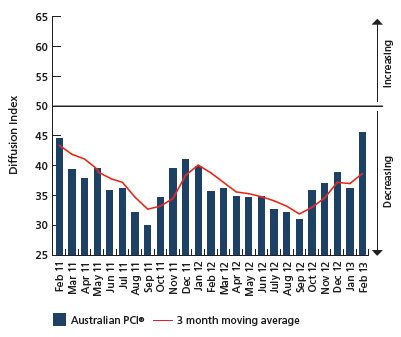
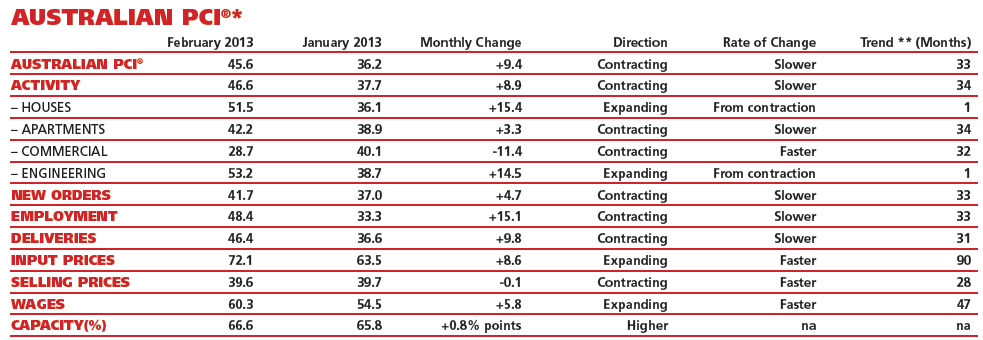
The seasonally adjusted Australian Industry Group/ Housing Industry Association Australian Performance of Construction Index (Australian PCI®) increased by 9.4 points in February to 45.6. While still below the critical 50-point level (that separates expansion from contraction), this was the highest reading for the index since June 2010.
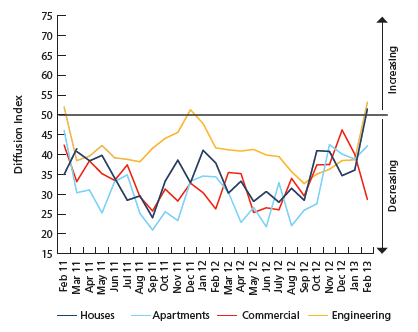
This largely reflected a substantial improvement in house building activity (which expanded for the first time since May 2010) and a solid rebound in engineering construction. However, apartment and commercial construction activity continued to contract sharply during the month.
February data signalled an easing in the rate of contraction in activity, new orders and deliveries from suppliers. This underpinned an improvement in the employment sub-index, which contracted at its slowest rate since growth was last recorded in May 2010.
There were encouraging reports from house builders indicating an increase in customer enquiries and an improvement in the uptake of new work in February. However, operating conditions remain extremely difficult with tight credit conditions, a lack of public sector building activity and weak investor sentiment seen as key negative influences on activity.
The index was driven by improvements in engineering and housing construction, both of which jumped into expansion:
Advertisement
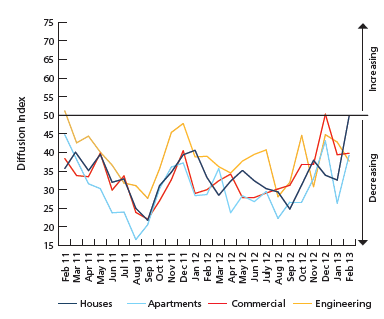
New orders looked good for houses too:
Here is the overall index:
So, clear evidence of some rebalancing underway in Australian economic demand. That’s three out of three for improvements in the AiG series. All still shrinking but less quickly.
Advertisement
However, I learned the hard way that these AiG indexes are a guide only. Top tier data is yet to register similar magnitude responses to rate cuts. For instance, house sales are still very weak and apartments are through the roof, which does not show up in this survey at all.
Nonetheless it’s good news. The first half of this year will be sound and at least some of the crushed sectors are coming off the canvass as we head into the mining investment fall and second half China challenges.
David Llewellyn-Smith is Chief Strategist at the MB Fund and MB Super. David is the founding publisher and editor of MacroBusiness and was the founding publisher and global economy editor of The Diplomat, the Asia Pacific's leading geo-politics and economics portal.
He is also a former gold trader and economic commentator at The Sydney Morning Herald, The Age, the ABC and Business Spectator. He is the co-author of The Great Crash of 2008 with Ross Garnaut and was the editor of the second Garnaut Climate Change Review.