
New home finance continues to recover

By Leith van Onselen

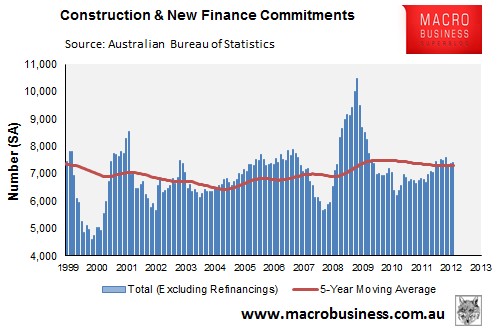
Yesterday’s housing finance data for January, released by the Australian Bureau of Statistics (ABS), contained some good news with the number of finance commitments for new dwellings and construction increasing by a seasonally-adjusted 0.6% over the month and by 9.3% higher over the year, to be tracking just above the 5-year moving average (5YMA):
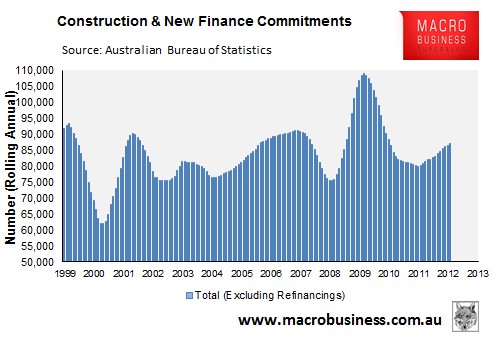
The recovery is even more obvious when the data is plotted on a rolling annual basis, which shows a clear pick-up in commitments over the past year (see next chart).
The recovery in finance commitments for new dwellings and construction appears to have been driven by big gains in Western Australia, although all states have experienced increases on a rolling annual basis (see next chart). Note, rolling annual figures have been used as the state-based data is not seasonally-adjusted, therefore, monthly comparisons are affected heavily by seasonality, which makes comparisons problematic.
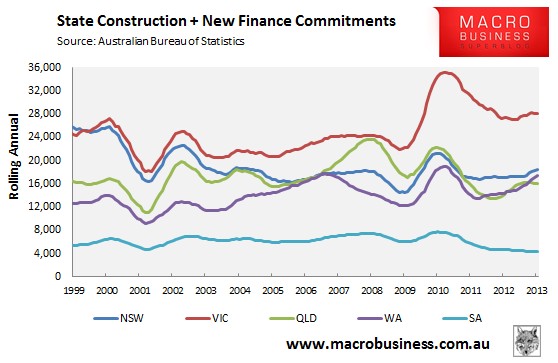
While it’s probably too early to tell, the changes to first home buyer (FHB) incentives in New South Wales and Queensland aimed at boosting new home construction appear to have had mixed success, with New South Wales registering a solid pick-up in finance commitments for new dwellings and construction since the changes were implemented in October, whereas Queensland has experienced small falls (see the above chart).

Overall, the data seems to conform with the recovery taking place with respect to dwelling approvals and new home sales, which are showing modest improvement from highly depressed levels.

unconventionaleconomist@hotmail.com

www.twitter.com/Leithvo


30 Responses to “ “New home finance continues to recover”

  1. Peter Fraser says:

    If there are no changes to the FHOG policies in NSW and Qld it will take until around August before we see a real pickup in those states.
    The lack of construction now in those two states will hurt supply in the future.

    • Janet says:

      …unless property prices fall to compensate to the lack of a FHBer grant? I’d wager construction would increase markedly if the cost of the land component allowed a lower cost finished item to market.

      • Peter Fraser says:

        Janet – the cost of subdivided lots can’t fall – it costs too much and the tax within those costs are too high.
        The price of land won’t fall.

      • Janet says:

        Of course it can! Insolvency being a good catalyst! Ask Craig McDermott…..There are a number of reason why land can and probably will fall in price. It’s just a matter of teasing them out.

      • Peter Fraser says:

        Insolvency can only release a limited number of lots at discounted prices, and then it raises prices as supply chokes.

        Helping a lucky few doesn’t help the market in the long term, it’s probably likely to be counter productive.

        McDermott was a builder BTW, has he gone bust yet again? He was never a good risk, a habitual high living non-payer.

      • Andy! says:

        “The price of land won’t fall.”

        Do you offer guarantor services Peter?

      • Peter Fraser says:

        Asking others for guarantees is a childish way of trying to make a point, but for what it’s worth the median price of land in Sydney will be higher in 12 months than it is now.

        Note that I have no interest in any land or property in Sydney.

      • Andy! says:

        Ok Peter my comment was a tad cheeky but there is a very serious side to it too.

        The guarantee I refer to is akin to a put option writer receiving a premium whilst assuming the downside risk.

        Probabilities aside, there exists a huge downside risk to purchasing at current prices, by virtue of those prices being so high.

        I would be a more willing buyer if my downside risk was mitigated, so given your strong belief that prices won’t fall I am genuinely interested in knowing if you (or other lenders) offer such services.

      • Peter Fraser says:

        Andy – interesting question. Let me make it clear that in the short term prices can fall, even for land, but land can’t fall below cost long term because the scope to achieve long term reduction in production costs just doesn’t exist without a change in government policy. State governments would have to change their income base.

        But it’s a good question about hedging risk. Do you know what a spreader program is? It’s when a commodities trader buys maybe 5 or 6 legs, where each leg is a commodity. They do that to offset risk – eg if they notice that gold reduces when oil increases – you get the picture?

        It’s not something that I have turned my thoughts to, but a spread of precious metals, food staples, utilities, energy might be somewhere to start your investigations. They usually do well when the economy isn’t.

        You can also insure yourself against loss of income. That and paying every last dollar that you earn off your loan is the simple hedge that most people employ, and of course you must buy well in the market, don’t pay too much for what you get.

        I’m sure that brighter minds than mine can think of some shares or commodities to use as a hedge.

      • bg0 says:

        Post of the century.

        Completely delusional!

      • Horizon says:

        That is the most absurd, self serving post imaginable, and deservedly can only be described as stupid – if only for the ease with which it is utterly discredited.

        One search on realestate.com.au for land with price reduced reveals pages and pages of entire subdivisions with multiple lots all with price reductions.

        http://www.realestate.com.au/buy/property-land/list-1?keywords=reduced&source=refinements

        That post Peter has removed a great deal of credibility.

      • Bob Sickle says:

        Deflation is an alien concept to some people, to say it can never happen (in land prices) is a very blinkered belief….

      • tsport100 says:

        Lot prices in Sydney have been static for a decade. Adjusted for inflation prices HAVE fallen. Add in the up to $40,000 worth of incentives on offer and you’d have to concede they’re actively being discounted.

      • Peter Fraser says:

        And is there a shortage? Are house prices rising in Sydney?

        That proves my point, thank you.

      • JohnsonM says:

        Australia is… different

  2. Peter Fraser says:

    Well guys that all very amusing, but unfortunately it’s not reality. It’s head in the sand denial.

    A land developer is really a suburban lot manufacturer. There are fixed costs in that manufacturering process that under current policy can’t be changed. Unlike other manufacturing processes, little can be done to reduce costs through technological change.

    Like any manufacturer, if they can’t manufacture and sell with a profit margin they will cease manufacturing.

    The harsh reality is that you can’t import suburban lots from China, so you buy them from local manufacturers with those inbuilt fixed costs or you just don’t buy them at all.

    If the land manufacturers sell at a loss they stop manufacturing, and then we get a shortage. Until you understand that process you will never ever understand property.

    • willynilly says:

      Peter
      Do you actually work at all? You really must not do many loans at all given your comments here and on other forums. I have passive income and can spend my days here and there, but I thought you were a working mortgage broker? Is business slow?
      I do not mean to insult you but I am having trouble understanding where you get the time to comment in multiple forums. Are you semi-retired?

      • Peter Fraser says:

        I’m effecient.

        Passive income? You told me that you manufactured and exported.

      • willynilly says:

        Peter
        When you make apps, you release them as sit back, and so I do. I am working on more apps but really only late night thinking time is required. My investments also return me a passive income.

        Efficient? Mmmm… a mortgage broker with time on his hands tells me something else.

    • Deo says:

      If the land manufacturers sell at a loss they stop manufacturing, and then we get a shortage. Until you understand that process you will never ever understand property.

      Well I think it is more complex than that Peter. Any producer may choose not to sell, but it does not mean it will always create shortage in the market. You need to think on the other side of the transaction i.e. the demand which is also subject to lots of factors.

      I can also say similar simple thing like that by saying that young FHBs low income and savings has priced-out them and hence not enough demand in the market, then there will be surplus of stock. And, until you understand that you’ll never understand supply v. demand ;-)

      • Peter Fraser says:

        Deo a young working couple actually have a good combined income.

        Your argument would hold if there wasn’t a genuine need for the product, or if another product could be used as a substitute, but that’s not the case.

        You need to brush up on your supply/demand theory – until you understand it you won’t understand markets.

      • willynilly says:

        Peter
        So what effects do you think the doubling of our death rates over the next 2.5 decades will have? They will certainly increase supply?

      • Deo says:

        Well actually as I told you the demand is subject to many factors. Though it is basic needs, housing demand is quite flexible if required.

        For example, if the price is so prohibitively high, the young generation can choose to:

        1) emigrate
        2) share house / unit
        3) live longer with parents
        4) live on the street and create social problem

        etc

        In any product market, even if it is basic needs like foods, energy – there is always some flexibility in terms of substitute or other means for consumers to cope with rip-off pricing.

        I don’t particularly share your opinion about young working couple having good combined incomes. And why should the young have to have combined income to buy housing whilst the prior generation only needs one income ?

        I think you’re the one who so out out of touch with reality and probably need to go back to Sales/Marketing 101. I think others in MB also share this opinion.

      • avexdevil says:

        I have to say, I don’t entirely disagree with Peter here. Why is it that everyone loves benchmarking house affordability to historical data?
        Sure it provides insight, but no one seems to be embracing the fact we are moving towards the speculative future.
        Sure back in the 70-80′s, a single stream income can buy you a home, but back then Australia was still pretty backwater, populating the land was an issue and there wasn’t an influx of immigrants or foreign investment.
        Look where we are now, a consistent 3 cents ahead of the greenback with plenty of rich chinese mainlanders searching for a new home in the great land downunder.
        Demand and competition for a limited supply of markedly increase in the past 2 decades, are you still harbouring the hope that will stay the same for eternity?

      • Deo says:

        More competition from migrants and economy situation does not count if the government can manage it properly by ensuring no favorable treatment to property speculation.

        MB readers have proposed many measures to control demand and manage supply better e.g:

        1) Abolish negative gearing
        2) Land tax
        3) Less restrictive zone planning and NIMBYsm

        etc..

        There is no excuse for a government and a country to let down the future generation just to ensure nice retirement of the old generation.

      • willynilly says:

        Well that lack of a response from Peter means he has not thought about what our increasing deaths will mean, or he is busy at work.

        We have a social contract to care for the aged, however any ‘free lunch’ must and will end as our emigration is peaking at 88,000 people last year.

        I am not so sure that the govt will ‘do anything’ to prop up house prices anymore as it becoming a bigger vote winner to talk affordability. As it should.

      • willynilly says:

        Recent Developments in the Australian Housing Market
        http://www.rba.gov.au/speeches/2013/sp-ag-140313.html

  3. avexdevil says:

    not gonna impose my believes; but here’s my opinion (mostly applicable to WA property) so take it with a large pinch of salt.

    that argument is a moot point, median house prices will inevitably soar due to the depletion of inner city/metropolitan land where demand remains strong due to the lack of supply. if people were more willing to live an hour away from the CBD, i believe there will be a steep decline in median house pricing. The problem is not so much with government policy than it is with Gen Y’s decision to shop exclusively where they grew up due to familiarity and convenience. I don’t know what the Eastern states are like, but over here in WA, there are plenty of sub $300k house and land packages available an hour out from the city, that’s roughly 33% less than the statewide median asking price – which is a fair figure, factoring in CPI and growing wages since houses were only 80k a pop back in the 80′s. Only problem? Nobody wants them.

    My opinion is that our interpretation of ‘premium’ property must change. That has far outgrown areas within or in the close proximity of the CBD. Where it was ground zero in 90′s to 00′s, that radius has extended to 10-20 mins away. Once again not too sure about the Eastern sates, but here in WA, most inner CBD houses are priced markedly higher but has seen minimal growth in value over the past decade while once cheap housing 30 mins out have seen big jumps in valuation.

    I do agree that these measures will do well to curb the effects of unnecessary price hikes, but has little to no place in solving the underlying problem that was the mining boom and a simple case of demand/supply for ‘cream of the crop’ housing. I’m not taking sides when it comes to the existence of a property bubble, but whatever it maybe, I know this: The government will attempt to sustain the property market at any cost, and unless we turn all prospective home buyers from bulls into bears overnight, the current trend is what it is, either you continue to blackhole hard earned income into a rental property or accept the new norm in this uncertainty while you can afford it so you won’t be debt-ridden at the ripe old age of retirement.