
Englobo II: Melbourne’s land banking racket

Please find below another interesting article from Prosper’s David Collyer on land banking. For David’s earlier articles on this issue, see here and here.

A fact-free defence of urban planners in The Conversation yesterday has left me fuming about how this group is immersed in process and blind to The Game being played around them.

The Game boosts land prices, creates serviced land shortages and impoverishes all who need shelter.

Planners are proud to quickly turn around conforming applications.  And they eagerly engage in futile debates around ‘red tape’ which miss the point entirely.

Let us start somewhere else by considering the role of vacant land in urban areas or held ‘englobo’ nearby ahead of subdivision.  Withholding vacant land from use displaces activity and drives up land prices – to the profound benefit of existing landholders.

Housing is madly expensive for only one reason: land prices. Buildings come and go, but the long-term value of property lives in the land and endureth forever.

I recently wrote about the ASX listed developers and their giant landbanks.

There is another devil deliberately driving up land prices.  When historians later write about The Great Australian Land Bubble, Melbourne chapters will be filled with the deeds of this sinner: the Victorian government.

As migration swelled the population of Marvellous Melbourne, government expanded its planning boundaries – a gift to lucky or well-informed landowners. This process is not unique to Melbourne.  It goes on under all governments who like to control things but are challenged by rising populations.

In September 2012, the Victorian government expanded Melbourne’s Urban Growth Zone (UGZ) by 90,000 lots. Citizens could reasonably expect this to add to the supply of land and therefore lower its price.

Sorry, but that just isn’t true.  The freshly zoned land is not what will be offered for sale in, say, the next decade.

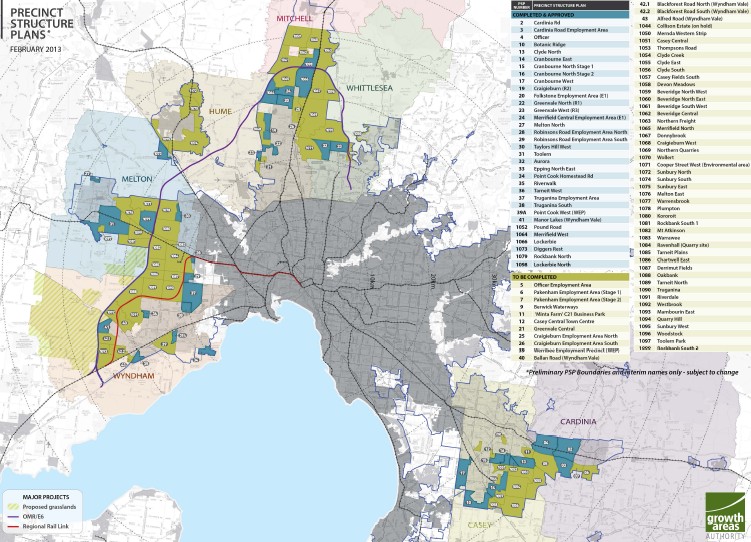
Why?  The Victorian government. Only farming and some limited development activities are allowed on UGZ land until a Precinct Structure Plan is created.  This lays out schools, parks, arterial roads, sewer trunks and commercial centres.

All very reasonable, until you look at the map of Melbourne’s completed and incomplete PSP’s.  The UGZ is huge; the PSP’s mere postage stamps. Note that only the areas colored blue are completed and approved.

For government, there is deep logic in restricting development to a few zones and limiting the infrastructure costs to government.  Schools, roads and sewers would cost more if development was allowed anywhere.  Heavy restrictions contain government costs even more, so heavy restriction it is.

Limiting buyer options to a handful of PSP’s has a profound effect on land prices.  Developers know buyers have nowhere else to go and exploit their market power mercilessly.

But wait! Landowners blessed by inclusion in the UGZ get steak knives too!

One would expect government to claw back some of the gift to landowners, the uplift in asset values from the right to subdivide for residential use.  The economic theory says State Land Tax obliges landowners to put their land to the best and highest use.

But the Baillieu government deemed land recently included in the UGZ as being used for primary production and entirely exempted it from State Land Tax, despite the massive capital gains forcibly thrust into landowner pockets.  They don’t even have to graze a sheep.

So englobo holders are both exempt and issued a get-out-of-jail card. A landowner can argue they are trapped outside the PSPs and cannot realize what they think the land is now worth.  Rural land values are suddenly irrelevant. They have joined a speculator oligarchy. There is no incentive to sell at current values for present uses.   The planners’ X years of supply just shrank dramatically.

Meanwhile, the net present value of rezoned land is determined by current subdivision lot prices less development costs and time. The price skyrockets – yet supply remains constrained.  Owners have every incentive to withhold land from use and speculate on future price rises. These misplaced inducements mean raw land in the UGZ trades for a million dollars a hectare, not $20,000.

This unaffordable market is limited to new housing lots of 330 m2 at twice the price of an equivalent house in an affordable market on 5,000 m2.

All this distortion, all this financial pain for homebuyers, just so englobo holders may play The Game and be spared a useful and positive tax responsibility.

Simon Tilford, chief economist at the Centre for European Reform puts the argument for tax reform clearly:

“A land tax would involve property owners paying a percentage of the value of their land in tax each year. If the value of their property rose, so would the amount of tax paid on it. This would achieve a number of things. First, local authorities would have a financial incentive to change land from agricultural to residential (and commercial) use as they would profit from the increased value of the land this would cause. Second, it would make it more expensive to speculate on future rises in land values, and some of those gains would be captured by the government. Third, construction companies would not be able to sit on large amounts of land (so-called land banks), and drip feed the market, maintaining prices at artificially high levels. Instead, land would have to be developed or sold, which together with the increased availability resulting from the freeing up of greenbelt land, would bring down the price of developing land and with it the cost of housing, commercial property and infrastructure. Lower land costs would also increase competition by reducing barriers to entry to the construction sector.”

Dr Ken Henry offered us a bargain: remove 125 very bad taxes and introduce just two – a Resource Super Profits Tax and a Land Value Tax.  The Rudd then Gillard governments were fools to pass over this fabulous opportunity.


102 Responses to “ “Englobo II: Melbourne’s land banking racket”

  1. Gunnamatta says:

    http://www.theage.com.au/victoria/geelongs-estates-set-to-capture-city-growth-20130311-2fwgx.html

    If you add in the land being released in the locations in this Age spruik of yesterday, you see even more expensive land being tossed to the market in locations a zillion miles from jobs at the moment – and Geelong faces economic obsolescence coupled with reliance on government spending (sort of a smaller version of Melbourne) – and in locations which will only add to pressure on the Westgate freeway or Geelong rail line (both crowded already)

  2. PhilBest says:

    Excellent analysis by David Collyer.

    This sort of situation will be found to exist everywhere that the venal advocates of growth containment planning, are claiming that they have “enough” supply of land zoned “to keep prices affordable”.

    The crucial factor re whether housing will or won’t be affordable, is whether land owners on the fringe are indeed acting as classical economic theory presumes they will be, allocating land to best “use” according to price signals; or whether they have been incentivised to act instead like speculators in an asset class like bullion. “Holding” rather than selling land so it can indeed be re-allocated by the market to “best use”.

    The mainstream economics profession is utterly blind to all this, and their underlying assumption, the classical land use theory assumption, is simply rendered irrelevant by “planning”.

  3. Peter Fraser says:

    Governments will always control supply, existing local community groups will always impose some development restrictions on the speed and quality of every development.

    Developer contributions and GST will always be passed on in the sticker price to successive buyers.

    • Janet says:

      Why? Get the Government to issue Residential Infrastructure Bonds, say 25 years duration, and spread the development costs out over whole-of-life, not just lump them on to the first buyer. When a developer finishes his project he is re-imbursed from the pool of issued bonds. The costs are spread (repaid by the all property owners over 25 years through , say, a modest Land Tax) and longer term investors (Life Insurance Companies, for instance) get a fixed rate for that period? Who knows. It may even lead to 25 years fixed mortgages!

      • PhilH says:

        The US system is essentially that. Unfortunately, it has resulted in local governments and their utilities being strangled by debt. E.g., Austin’s water utility spends 52% of its income servicing debt, which is why water costs in the city are so high; and the city itself owes some $5.3B, or around US$6,700 per capita. The city of Houston owes a total of US$13B, which is a lot for a city of 2 million people.

        US local government bonds are generally referred to as “munis”, and the interest income is tax-free, so the debt is subsidised by US taxpayers. The main problem with them is that they remove an important price signal from real estate transactions, and give politicians an incentive to defer funding problems to a (much) later date.

        Incidentally, 25-year fixed mortgages only exist in the USA, and even there, no sane bank would hold them. Instead, they write the loans and then immediately sell them off to Fannie Mae, aka the US government, which assumes the massive interest rate risk.

      • PhilBest says:

        What do water utilities exist for? What is so superior about having the costs lumped upfront into house prices and young first home buyers carrying debt instead?

        These costs lumped upfront into the prices of new houses, affect the price of all used houses as well. Imagine if we socked 200,000 kms of road user fees into the price of all new cars; that would make all used cars go up too, would it not? Same with houses.

        Funding infrastructure and paying it back out of ongoing taxes is far more equitable. The Yanks are smarter than us.
        Get over it.

        The point about Fannie Mae is quite right; notice that this is yet another perverse consequence of political meddling in markets.

    • Gunnamatta says:

      Yeah maybe, but the current government, the existing local community groups, and the in situ developers need to come up with some other plan fairly soon.

      Punters arent buying the new stuff – I dont blame them, and any price growth from specufestors for the already constructed stuff is dependent on increased indebtedness.

      And all the while, in Melbourne at least, there is a recession closing shops, closing down manufacturers, and increasing reliance on a government being starved of stamp duty.

      Ramping up the volumes being purchased by foreign nationals (of which nobody is presenting clear data except that there were circa AUD 20 Billion worth – across Australia – last financial year according to FIRB) is about the only real game plan being applied.

  4. Mav says:

    Great post, DC!! You forgot to add DBN in the end.

    While on the subject of land, if I were a dictator, I would rip up all the lawn bowls and golf courses within the city and zone them for high-rises :) They are effing useless, sedentary sport for all practical purposes.. *cough* mostly favoured by boomers *cough*.

    • Archie says:

      The “Don’t Buy Now” mantra is ridiculous.

      The only people it hurts are those who don’t buy and who once again get left behind as house prices take off. Look at what is happening around the country – prices have been rising since the middle of last year and are up a good 5% since then. Perth and Sydney are positively booming.

      DBN is extremely dangerous advice, very damaging for those who want to buy but hold off thinking they can have some effect on the market. They can’t – prices will just keep rising without them.

      • Pfh007 says:

        Archie,

        In most cases those who are not buying now cannot afford to buy now – unless they take on crippling levels of debt.

        All we are seeing now is those who should not be buying are not buying.

        Considering this is happening with record low interest rates simply confirms that those not buying now are probably making the right decision.

        There is a reason the property industry are turning to investors, particularly foreign, they are the only ones likely to be in a position to buy without debt and, especially foreign investors from China, be unconcerned about a worst case scenario of a 30-40% drop in prices.

        70% of capital remaining in Oz beats 0% in China if there is a meltdown.

      • Mik says:

        If people can not afford to buy then they will be left out forever, BUT to say that people would have to take on crippling levels of debt is wrong, if the banks think they can afford the debt then they are not crippling, people have always bought housing up to the highest price the banks say they could borrow, people would rather pay the extra for a larger house, larger block of land or a house thats closer to the CBD if they are allowed to, because these same people know that their investment would only increase so why not borrow what you can. After all prices only increase.

      • Mik says:

        Oh the only reason they are not borrowing now is that they are hoping that house prices fall and greedily thinking if they hold off long enough they can get a bigger, better house for a lot lower price, the problem with this theory is that if there is a sudden house price increase they miss the boat and then have to wait and see if prices fall back again, if it doesnt they have to eventually pull the plug and dive in and buy a house thats smaller and further away from what they wanted.

      • Mik, this is absolute drivel. Your deliberate attempt to exploit fears of future price increases does you no credit. Land prices have decoupled from both wages and rents. Australia is at the end point of a speculative land Ponzi scheme.

        Where would such price pressure come from?

        We have emergency/record low/highly accommodative interest rate settings that will have to be reversed eventually. The southern states are in technical recession and the construction phase of the mining boom is grinding to a halt. The high $A is crippling exporting and import-competing enterprise. Housing construction – a big employer – is persistently weak due to poor demand. Private debt levels are at eye-watering levels.

        And you expect innocent first home buyers to sacrifice their working lives just to keep this disgusting process going a little longer.

        Don’t Buy Now!

      • Archie, your claim house prices will take off is completely unsubstantiated. Please, toss me a fact or two that justifies this view.

        It is an observable fact that the majority of FHBs are priced out of the market. Young adults are denied access to land except on the most onerous terms – they face a lifetime of heavy principal repayment if they buy and exclusion if they don’t.

        Australia has indulged vendors for so long a powerful politico-housing complex has emerged, including paid thralls like yourself.

        In the USA and Europe, land price falls have destroyed the personal balance sheets of anyone who bought at recent high prices. Long-time holders and renters were largely unaffected. My advice to stand aside and save a giant deposit is rational and coherent. Whether we have a ‘slow melt’ or a land price crash is not up to you or me, but do not doubt that land prices will revert to the long term mean.

        Don’t Buy Now!

      • Peter Fraser says:

        David I don’t want a housing boom right now. I want rates to stay low and rises to remain at or below wage growth for a few years.

        However you have to recognise that the danger is certainly on the upside.

        Why you and your fan club can’t see that is beyond me. Archie doesn’t have to supply evidence – it’s right before your eyes if you care to open them.

      • tanmedia says:

        Fair enough. Double down on the “upside.” Nice one.

      • reusachtige says:

        wat are you going on about?

      • Janet says:

        You know my view, that the danger, Peter, is to the upside….but for interest rates! If one believes in “what goes up, must come down” or any other similar maxim, then property is in historic terms what and interest rates are what?!

      • Mav says:

        Archie, we all know who David Collyer is, with full disclosure on all his activities and interests.

        On the other side of the coin, who are you and what is your vested interest in pushing the “Buy Now Before It Is Too Late (For Boomers)” mantra?

      • Archie says:

        Does an argument become more or less valid depending on who presents it?

      • reusachtige says:

        Totally. David=cred. You=ignore.

      • russellsmith55 says:

        It helps to prevent sock puppeting. Not that anyone would here would ever accuse you of that…

      • jelmech@bigpond.com says:

        bona fides count at all Archie?

      • Mav says:

        It does to me, and I suspect.. a lot of your “target” audience.

        Besides, you haven’t presented much of an argument other than to say house prices have gone up for the last 6 months.. and therefore they are likely to keep going up in the future.

      • L says:

        It’s disturbing how Archie appears to shadow DC.

        However, I am aware of some in the property industry who are extremely unhappy with DC’s Don’t Buy Now campaign and would not stop at any lengths to discredit or marginalise him.

      • tanmedia says:

        Yes, the DBN mantra may seem ridiculous to most. Of course these people cannot influence the market by now buying houses. But if affordability is currently a concern for the would-be purchasers, they probably shouldn’t be purchasing in the first place. It is equally as ridiculous to make a decision because someone told you that prices went up 5% recently. Making the decision not to purchase can be easier than making the decision to purchase if it balances risk with potential negative and positive impacts.

      • drsmithy says:

        Not buying now makes perfect sense so long as it is cheaper to buy rather than rent.

        Right now in most of the country it’s 1/2 to 2/3 as much to rent rather than buy.

      • Archie says:

        Are you only looking at the first year cost, or the total cost over a lifetime of living in dwellings?

        If you only look at the first year cost, of course renting (anything) is cheaper. But since you will probably life in homes for the rest of your life, you need to look at the bigger picture.

      • drsmithy says:

        The more money I save now by not buying, the cheaper buying will be in the future because the less I’ll need to borrow.

        But since you will probably life in homes for the rest of your life, you need to look at the bigger picture.
        The bigger picture is that house price growth has outpaced wage growth for many years and this is an unsustainable situation.

      • Archie says:

        Quote DrSmithy “The bigger picture is that house price growth has outpaced wage growth for many years and this is an unsustainable situation.”

        No. Wages have increased just as fast as house prices for the last decade. There was a brief period in the late 90s to early 2000s where house prices grew faster than wages, but apart from that period, wages and house prices have tracked each other. Look at some charts from The Economist here.

        http://www.economist.com/blogs/freeexchange/2011/03/global_house_prices

      • reusachtige says:

        I pay 1/3 of what it would cost to buy the place I live in. Check out Strathfield as an example of how common this is in Sydney. And I actually do re-invest the difference so not buying is making me money rather than being sucked out and lost forever through servitude to the banks. I really do pity those who buy right now. They have been suckered in badly by the likes of Archie.

      • Archie says:

        So you are never going to buy a home? Ever? Have you calculated how much rent you will be paying when you retire, given rents rising at least at the rate of inflation, compared to living in a fully paid off home? Do the calculations over a lifetime and I guarantee you will be well ahead by buying a home.

      • reusachtige says:

        I may buy one day when I see value, and use the money I have saved and made to lesson, or totally remove, having to give any of it to the banks!

      • jelmech@bigpond.com says:

        I’m guessing you won’t buy where you currently rent reusachtige?

        What would you be requiring if you buy?

        None of my business I know, just curious.

      • reusachtige says:

        I don’t know, more than happy where I am for now. Will decide if/when the time is right, which is definitely not now.

      • Alex Heyworth says:

        ” I guarantee you will be well ahead by buying a home.”

        Is that an offer of free insurance if your promise doesn’t pan out, Archie?

      • reusachtige says:

        Don’t Buy Now is the best advice any young person could receive. Thank you David for saving many young people from debt servitude. The mantra has saved me, and I am very appreciative.

        Keep up the good fight David. History will be far kinder to you in the end than it will be to the spruikers like Archie et al.

      • Archie says:

        Yes, well if you consider debt as ‘servitude’ then maybe homeownership isn’t for you.

      • reusachtige says:

        No, a crippling mortgage used to pay over-inflated prices is not for me.

      • PhilBest says:

        Buying at inflated prices when renting is much cheaper, is just “renting from the bank” plus the risk of losing all your equity. You don’t own the home anyway, the bank does.

        The collapse in the proportion of the population who owns their home outright is the real metric we need to consider here, and also the proportions of the population still owing 90%, 80%, and so on.

      • SaCo says:

        There are probably two won’t buy now groups. Those that can’t and those for whom the numbers just don’t seem to add up. There used to be a rule of thumb that a mortgage should not exceed 2.5 x your yearly income. Is fair house prices where an average house = 2.5 x an average single income.

      • Peter Fraser says:

        That rule actually never existed. It’s a complete myth.

      • Janet says:

        Wasn’t it The Law, even in Aussie, back until the markets were de-regulated, ( or the late 70′a at least) that lending beyond 33% ( I think it was some similar figure) of household disposable income ( deemed to be solely the man’s back then!) was deemed Predatory Lending, and as such, any default by the borrower was to be borne by the lender not the borrower?

      • willynilly says:

        Yes Peter, like ‘houses always go up’ and ‘of course this is just a normal cycle’. Also both myths.

      • Archie says:

        Correct Peter. There never was such a rule. It is another myth perpetuated by people who aren’t willing to pay the going price for a home.

      • Peter Fraser says:

        Really – it’s spruik to tell you that there has never been a rule that limited house purchases to 2.5 times earnings.

        Are you serious?

        Show me where.

      • reusachtige says:

        It wasn’t a rule, it just was.

      • willynilly says:

        Peter
        Do you want homes to be affordable for the following generations or not?
        To want house price increases is morally corrupt and shows a complete lack of a social conscience, but then again, I suppose your pay packet depends on it. Well, good luck with that.
        The short bounce in prices will reverse when the Jan/Feb sales data comes to light.

      • Peter Fraser says:

        reusachtige – I used to process loans for one of the majors many years ago. We did use some guidelines. It was fairly primitive compared to the servicing calculators used now – it is in fact much better and more accurate now.

        There was absolutely never a 2.5 times limit. That is complete rubbish.

        We used a servicability guide of 30% of income as a starting point. Note that it wasn’t a limit, but a starting point. A lot more work was done to determine what people could afford, and there were no upper limits, other than what could be calculated as servicable with a surplus for living costs.

        The notion that 30% of income was a limit is absolute bunkum. If someone has an after tax income of $200K do you think that being encumbered with a commitment of over $67K per annum puts them at risk? Do you think that they can’t put bread on the table with $133K per annum as a surplus? Of course they can handle a much higher debt load, especially if the asset that they are buying adds more income.

        Whilst a low income earner on $27K per annum actually can’t afford to be burdened with a 30% commitment. It’s way too much for them given that they have to eat and pay normal living expenses.

        The calculations are much more complex than blunt percentages allow for. Does anyone here ever take rental income into account, or family allowance, or any other benefits received?

        The lack of sophistication in the analysis is staggering at times.

      • willynilly says:

        Peter
        It is also staggering that now the banks want dual incomes and the couples never to have kids.

      • Peter Fraser says:

        Well Paul the banks are just as bound by anti-discrimination laws as every one else. These were the laws that the community demanded, so in fact it is you who is out of step with the community, not the banks.

        The banks simply cannot refuse to take a females income into account based on gender – these are the communities laws – and after about 40 years it’s about time that people accepted them and made their plans accordingly.

        We can’t turn back the clock.

      • willynilly says:

        Peter
        Ant-discrimination laws? Really. can you show me any link that states a bank ‘must’ take into account the females wage?
        Banks should return to lending on the obvious, that females have babies and stop work for the most part.

      • Peter Fraser says:

        Paul – those laws have been in place for a long time. By law the banks cannot treat a womans income differently to a mans unless they have evidence that the income will not be ongoing.

        Would you have them perform pregnancy tests on female applicants? This is the 21st century, not 1925.

        Banks can’t be out of step with the community. Women receive an income when on maternity leave, and the overwhelming majority of women and couples ensure that they have the funds set aside to cover that loss of income. People are not stupid, hence the very low arresrs rates in this country.

        You need to accept the community standards for what they are, even if you don’t agree with them.

      • PhilBest says:

        Here is an absolute, hard and fast rule.

        Anywhere that there is no quota process for converting rural land to urban, house price median multiples are around THREE.

        Credit availability, fiscal policy, monetary policy, all irrelevant under these conditions. Median multiple three. Seldom much higher, seldom much lower. Take a look at the evidence. The annual Demographia Reports.

      • willynilly says:

        Peter
        So you are telling me that a bank can not ask if the female is planning to have a bay and stop work for a few/or more years? That sounds very very wrong indeed and part of the reason we are in the current mess we are in.
        Link to the law stating a bank ‘must’ use the female income please?

      • Peter Fraser says:

        Yes that’s correct Paul – banks are not wanted in bedrooms. How people plan their lives and families is entirely their concern. It’s not the banks, it’s not mine, and I suggest that it’s not your concern either.

        Contact the Qld Anti Discrimination Commission and ask them about it.
        http://www.adcq.qld.gov.au/

        I’m very certain that you will get the same answer.

      • willynilly says:

        Thanks Peter, I will call them now and report back.
        My simple question will be’ ‘can banks ask, when establishing a new loan for a couple, if the couple intend to start and family and if the wife intends to stay at home with the children for an extended period of time.’

      • willynilly says:

        Peter
        Talked to them and QCAT. 1300 753 228

        The bank can apply for exemptions due to other reasons. Since the questions are not related to sex but more to do with loan eligibility, then they may ask the questions. According to adcq, the banks could apply for such exemptions and it more than likely would be granted, but the banks probably do not even apply.
        The banks may also have to meet other legislation that would trump sex discrimination although the officer did not have more details than that.
        Waiting on a more senior officer at QCAT to call me back as well, so will report more soon…

      • willynilly says:

        Peter
        So why don’t you apply for an exemption to the discrimination act so you can better service your clients? My guess is that you simply do not want to know the answers as it may mean that the loan should not be granted and thus, you do not earn commissions.

        Thanks for giving me the contacts as I feel this is at the heart of the dual income/house price ration debate and needs to be explored more. Perhaps changes are required to the discrimination act and I will lobby hard in the halls for that if need be as ‘common sense’ should mean that banks do the right thing. If people want to lie about their future family plans, then so be it as they will only damage themselves in the long run.

        QCAT report that I should go and have lunch with a QC or seek some legal advice. They were not aware of any They really did not have a definitive answer and as such, I feel it is worth pursuing politically, which I will do.
        The laws are there to protect people from their own lack of self interest and in this case, that seems very clear indeed, especially if a young couple is planning on having a family and have the wife not work for an extended period of time, as this may put them into financial trouble.

      • Peter Fraser says:

        Paul – All banks ask if there is going to be any future changes to the income or commitment position of applicants, the question is posed to both male and female applicants. If they answer “yes” they must explain and the bank must take it into consideration in the servicability calculations.

        If they answer “no” then there is no allowance made. Naturally some people can have an unforseen loss of employment or an unplanned pregnancy – that’s life. I hate to break this to you but the girls are usually more financially responsible than the guys.

        Do we tell women they can’t have the same rights to buy a house as men because they “might” become pregnant, or that we men think that they are not intelligent enough to take precautions. They are unacceptable notions in this day and age, and you are not going to change the minds of 11 million women in Australia – it won’t happen.

        Banks do ask the question, but they can’t make detailed enquiries of a personal nature. That would be a step too far.

        I think that when we are talking about young couple without children it’s a given that one day they are likely to have children, but the bank has to leave it up to them to manage their own financial affairs and family planning.

        Paul we have an arrears rate of less than 1% so the girls are doing just fine – leave them be. They have waited 5000 years of recorded history for something resembling equality – they ain’t going back now and they don’t need paternalistic men interfering in their lives.

      • willynilly says:

        Peter
        1. So now you are saying they do ask in a manor? Well that is a turnaround.
        2. Using female rights in your arguments deso not hold as females should have the right to have children without a possible financial problem arising because of that decision. Kids or a house? is simply not fair to any female.
        I do not think that those mums at home who are currently financially stressed because of high mortgage debt, would agree with you at all.

      • willynilly says:

        Peter
        A few more points…
        1. We are talking planed events, not unplanned births or job loss etc. This has nothing to do with the issue or that they ‘might’ become pregnant. We are talking planned events.
        2. So more young couples, who want to have families would not get loans. Good, tighter credit would ensure house prices fall and eventually those young, single income families may actually be able to buy a ‘home’.
        3. Modern feminists have the right to be a stay at home mum.

      • Peter Fraser says:

        Paul – to get you what you want you propose to tax the bejesus out of the over 65 year olds who own a house but don’t earn an income, and you want women to stay at home and have children even if their wish is to pursue a career.

        Paul that’s just sad. I have no further comment.

      • SaCo says:

        Rule of Thumb. Not a Law. How can it at all be seen as normal that someone can be in the top 10% income bracket and only buy into a starter home. I am talking about proportionality. It is currently lost. An average household should be able to buy average shelter. It is a right not a privilege.

      • willynilly says:

        No Peter.
        I want women to have the choice. I said nothing about preferring them to stay at home, that was your words and yes, over 65′s who are outright owners and on full pensions, should be taxed more. No argument there and GST to 20% will do that.
        Glad you are finished and that’s for the heads up about banks not asking about family plans. It was most useful indeed and something I will pursue politically, regardless of your strawman arguments.

      • drsmithy says:

        The banks simply cannot refuse to take a females income into account based on gender [...]
        Your arguments in this discussion are absurd straw men.

  5. Archie says:

    The bottom line is this guys – house prices are rising, they have been since mid 2012. The cyclical correction (following the 2009 mini-boom) has ended and we’re back into the growth phase. It is being driven by investors for now, but the FHBs will jump in when they realise what is happening. The “Don’t Buy Now” brigade will be left cursing those who gave them such bad advice.

    • Janet says:

      Maybe they will. But they’ll still have wherever assets they have today,…or more, albeit property ownerless. Those who advocate buying now, like yourself, if proven wrong will destroy the assets, livelihood and futures of thousands of young & older Australians. Let me think? Would I be happier missing out, or losing everything…Hmmm…. decisions, decisions…..

      • Archie says:

        “destroy the assets, livelihood and futures of thousands of young & older Australians”

        Yes, very emotive. But in what way will all these things be ‘destroyed’ by people buying homes?

      • Janet says:

        Easy! Buy a house with 10% LVR. Property falls 10% or more…and you’ve lost your equity. For many, that’s all or more than they have…..

      • Archie says:

        And if they can still afford the repayments, what’s the problem? Prices always recover from falls. Always – there has never been a crash from which prices have not recovered.

      • willynilly says:

        The problem is 40% of our workforce as casual/part timers. One of the highest on the home planet.
        Your spruik of house always go up and its just a normal cycle shows your complete lack of understanding in the fundamental change in the structure of our economy.

      • Janet says:

        Never is a long time, Archie. 25 years? Is that ‘never’? It’s a long time in a human lifetime of work. If 25 years is ‘never’ then tell my friend in Osaka, an ex-pat Aussie from Melbourne, who bought an apartment in 1990, that property always recovers! It has done in Aussie so far, Archie, but it just may not this time. That’s what we don’t’ know. Here’s a secret to life for you – You have to be able to afford being wrong. For many, most, Australian property buyers, they can’t afford to have got it or get it wrong….

      • willynilly says:

        On the casualisation of the workforce..
        http://www.thewire.org.au/storyDetail.aspx?ID=10124

      • PhilBest says:

        Archie has numerous moral bedfellows who spruiked the great Californian dream house price bubble.

        How people can repeat the same immoral and unreasonable stuff after the lessons have been painfully laid out for us, shows what suckers humanity is for wishful thinking.

      • drsmithy says:

        Yes, very emotive. But in what way will all these things be ‘destroyed’ by people buying homes?
        By them throwing away a huge fraction of their lifetime earnings on interest payments.

      • PhilBest says:

        +1, Dr.

    • reusachtige says:

      Most potential first home buyers can no longer afford to buy Archie. There will be no boom in first home buyers. They are now locked out. You better hope you and your speculator friends can keep flipping houses to each other indefinitely, backed by China.

    • tanmedia says:

      Well yes. If these people can read the “cycles” and understand/believe the steady line of patter, there is nothing holding them back. However, if they have any kind of risk tolerance whatsoever, and that is firmly anchored to affordability and the impacts on its life for home purchasers, taking the option “not to buy” is a choice.

  6. Chris Becker says:

    Archie, willynilly (pauk), reusachitege etc

    Settle down. Play the ball, not the man and make some cogent arguments or you can have the day off.

    First and final warning.

  7. willynilly says:

    David
    Yes we need a land tax on all property as well as the ability for those that can not pay to use the equity in their PPOR to pay on the sale/death of the property. The accrued tax would be payable when the property is sold for those on low incomes/welfare.
    We also need GST to 20% to tax the over 65′s more, while we raise the tax free threshold for workers and welfare to compensate.
    The final tax needed is a death duty on estates worth over $1m at 25% as the sperm lottery is hardly a fair and equitable system and in the large part the PPOR capital gains has been untaxed.
    Finally we need asset test reform for the pension, as a pensioner, living in a $2 million PPOR owned outright and with little other cash or assets, should not get the full pension. Once again, reverse mortgages provided by Centrelink are required here as well.

    • Willynilly, I am no fan of death duties (which snare the poorly-advised) or a higher GST (mildly regressive). If the PPOR exemption from State Land Tax was removed PLUS Stamp Duty ended, our economy would deliver dynamically. There is too much Aussie capital lazily parked in land trying to capture ground rents. In reality, property investors competing for land just blew out capitalization and destroyed their own business case.

      • The Claw says:

        There is too much Aussie capital lazily parked in land

        What do you mean by capital? Any of this capital could be destroyed by the stroke of a govt pen. The total capital value of these houses is a number calculated by multiplying the existing houses by the price paid by one buyer for one house.
        What happens if young people decide not to buy now? The illusory capital will disappear in a flash.

        CAPITAL IS NOT PARKED.

      • willynilly says:

        David
        It is not just about house prices but how we are going to pay for an ageing nation. Increasing the GST will tax the over 65′s more and raising the tax free threshold for wages earners and increasing welfare accordingly will balance any regressive nature of the increase.
        The least of our fiscal worries really is house prices and more about who is going to pay the 80% of boomers who will require full or part pensions and free health.
        House prices will fall due to these headwinds, the banked land will tank as the city burbs that have had a decreasing population open up due to the doubling of our death rates over the next couple of decades.

        Why would the poorly advised get caught with death taxes?

      • Claw, your point is unclear to me. Many young adults are already priced out of starter homes and illusory capital has not disappeared ‘in a flash’. I believe it will, though (Don’t Buy Now!).

        Too many have crowded into property investment because they think they understand it better than the share market. They have bought the great lie of negative gearing – which only works in a strongly rising property market.

        willynilly, the GST reminds me of Britain’s Corn Laws, which taxed the poor man’s daily staple, bread.

        If we follow the example of Japan, USA and much of Europe in a well-earned land price retreat, the economic capacity to fund boomer retirement will be much less. Elevating one economic problem over others does not make the lesser go away.

        Death taxes: well advised wealth completely avoids death duties by strategic inter-generational asset transfers. Good schemes skip a generation and transfer grandpa’s wealth to grandchildren, the middle generation having already received their grandparents assets. These orderly wealth-protection schemes continue in the absence of death duties, just in case. Better to tax economic rents directly.

      • willynilly says:

        David
        1. GST to 20% and raising the tax free wage threshold to compensate, and perhaps some more due to lack of tax lodgements, would mean it is not regressive at all. Quite the opposite.
        2. Transfer of wealth are tracked and these loopholes would be closed as they should.
        3. Falling house prices will only put more pressure on the fiscal gap due to ageing, not less and so we must find ways, including the land tax, to tax those over 65 more. Simple as that.

  8. Gunnamatta says:

    With all due respect I think most of the discussion above is missing the point. Some people can afford and dont buy, some people cant afford and do buy.

    The fact is that Melbourne isnt within a bulls roar of having an industry which is globally competitive right now. A large part of that can be attributed to property prices.

    Property prices ultimately need some form of underlying economy to support them. In the absence of that the only driver they have is credit – HnH and others havent pointed out quite comprehensively that the capacity to grow the credit isnt there. The only other alternative is to bring in foreign buyers, and assume they can wear any potential correction.

    Sure, given the current rates and monetary policy settings (here and globally) maybe the price will (as the Kouk is touting) rise by circa 10% this year, but they can only be fuelled by further credit. And is is also highly likely that it will be just a speculator frenzy driving a smaller number of sales to higher prices, while larger sections of the market just sit back and watch. But if it does this for sure you be able to watch it all come down the other side. I suspect Peter Fraser is probably quite genuine in wanting moderate rises because if they become immoderate then for sure the risk of burnout exists.

    Expecting younger folk to take on mortgages of many times their earnings and place themselves in a lifetime of financial stress risk is no more realistic than expecting babyboomer investors who are servicing interest only mortgages in expectation of capital gain to acknowledge any potential for their payoff dreams to fail to materialize.

    I am with David Collyer on this. I think there has never been a more insane time to buy Australian property.

    That said I sure as hell dont expect any nicely choreographed effectively implemented policy to address both affordability and serviceability indebtedness issues on one side, and the return for the risk taken by property speculators (such as it is – and backed by government policy and banks) on the other. The far more likely scenario is that the whip hand will remain with the speculator set until such point as it is manifestly not in their hands any more. And when that point comes my money is on the process being traumatic and volatile, with governments, property industry interests, the media, and probably speculators, and maybe even buyers being behind the curve.

    • Deo says:

      given the current rates and monetary policy settings (here and globally) maybe the price will (as the Kouk is touting) rise by circa 10% this year, but they can only be fuelled by further credit.

      The lax monetary policies globally cannot run forever, the high inflation will kick-in in the future and that will be the end of it. When high inflation comes, the monetary policies will need to be reversed or if not, will risk social and economic chaos.

      Either way, the current relax credit regime will come to a nasty end and if you appreciate your life-long savings, you’d better stay away from any overpriced assets.

      • Mining Bogan says:

        Yep, exactly. The risk outweighs the dream. That is how my young cohorts are thinking.

      • Gunnamatta says:

        You betcha …..

        Risks outweigh dream by so much they arent even on the same playing field.

    • PhilBest says:

      Gunnamatta:

      “….With all due respect I think most of the discussion above is missing the point…..”

      Yes. Here is the real point:

      Anywhere that there is no quota process for converting rural land to urban, house price median multiples are around THREE.

      Credit availability, fiscal policy, monetary policy, all irrelevant under these conditions. Median multiple three. Seldom much higher, seldom much lower. Take a look at the evidence. The annual Demographia Reports.

      • Gunnamatta says:

        Sure Phil, I dont have a problem with that. But whatever the factors driving prices are, we are at the point where it has a significant economic effect, in circumstances where Australia’s economy isnt likely to be able to sustain the cost (particularly the Melbourne end) for much longer.

  9. Muzzer018 says:

    If selling houses is your game then why would the price matter if its not your property you’re selling.

    Surely selling twice as many houses for 30% less would still be a better earner.

    Unless the primary crowbar you have learnt to use is the prices ALWAYS go up, which as anyone can see could never be the case if the rate was out of step with real wages growth.

    I could buy but elect not to and it will take a very compelling argument to get me to move. The noise from the RE groups and BB desperately needing to liquidate assets for retirement is becoming shrill. All the more reason to think twice.

    Do not buy now.

    Pricefinder.com is a great start to see what your area is doing and once you see a house you’re interested in, look it up on onthehouse.com.

    If you don’t do your homework you deserve to over pay.

    • tanmedia says:

      Nice point. If your livelihood is driven by buying/selling of houses, the price is largely irrelevant if sales volume is greater at lower prices.

      However, the housing-finance-politico bcomplex is internally aware of the impact of house prices on balance sheets. Japan suffered a similar problem after the late 80s property crash. How banks hedge their risk on flat or falling prices, I don’t know. But it is a problem that they will want to avoid by any means necessary.

    • Janet says:

      “…why would the price matter if its not your property you’re selling.” Because most real estate agents, and the agencies’ cats , ‘own’ investment property themselves. They have their own survival dependent upon ‘property always going up’ . The commission factor? I often wonder how great a factor that is, when it’s spread out over the myriad of agents out their selling the same houses!

  10. Muzzer018 says:

    That’s what I was pointing at Janet.

    Its not hard to work out that they are not the objective industry professionals they present as.

    Who profits?

    A slow melt would require the RE parties to manage it down gently but from what I read here, they will go down kicking and screaming which all but makes a bust a sire thing.

    Time is on our side, I get almost 5% from my term, can a house do that risk free? Even if it could out perform, how much more would it need to be to satisfy my risk.

  11. [...] we want to know why and how government reform is benefiting the big end of town, Unconventional Economist in Australian Property  lays is out nicely for [...]

  12. [...] candidate David Collyer starts the Melbourne Airport Rail link Melbourne Englobo landholdings Telling the RBA like it is – Online Opinion Stamp Duty is Inefficient, Unreliable and [...]