RP Data February housing update

By Leith van Onselen

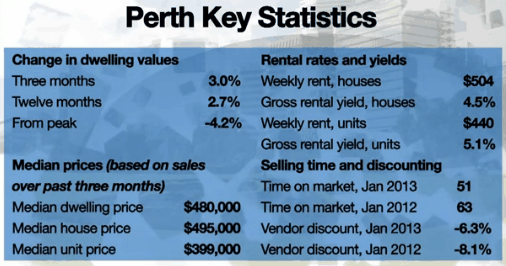
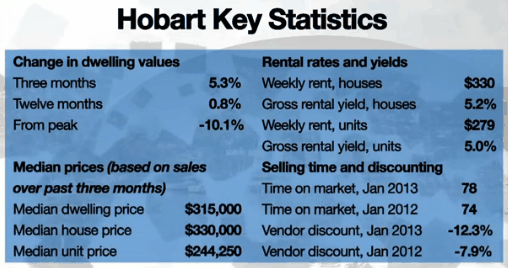
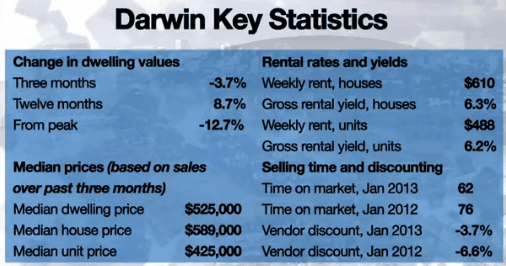
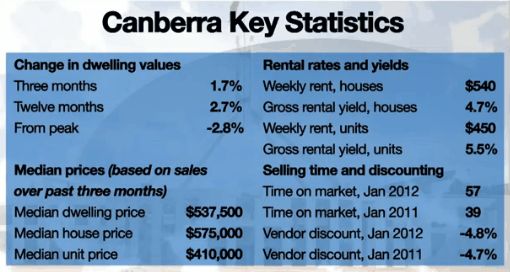
Please find above RP Data’s February housing market update, which discusses the state of the Australian housing market as at the end of January, following the 1.2% monthly increase in capital city dwelling values.

As expected, RP Data’s Tim Lawless is fairly upbeat this month arguing that a housing market recovery is underway. Lawless sees a number of improving vendor metrics, including:

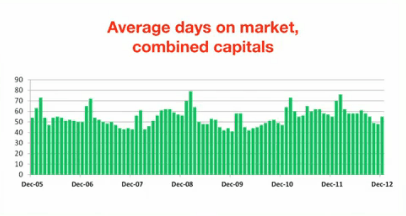
  • Falling days on market (notwithstanding December’s seasonal bounce):
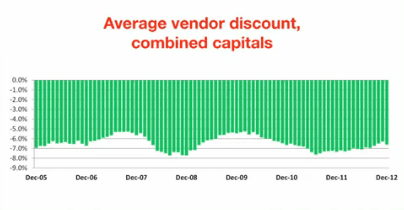
  • Falling vendor discounting:

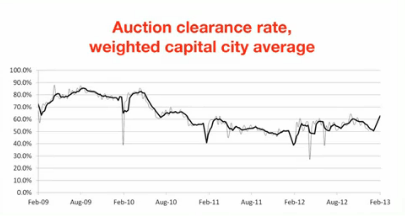
  • Improving auction clearance rates:

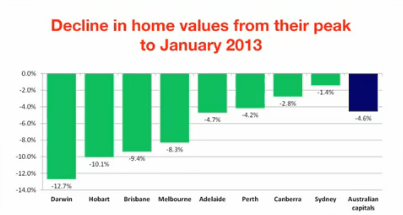
Nevertheless, Australia’s housing market still has a lot of lost ground to catch-up, with every capital still below its peak value:
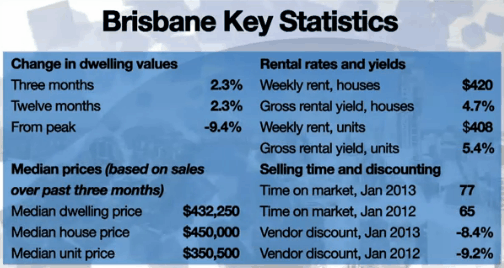
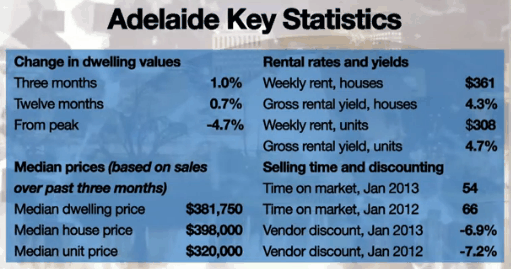
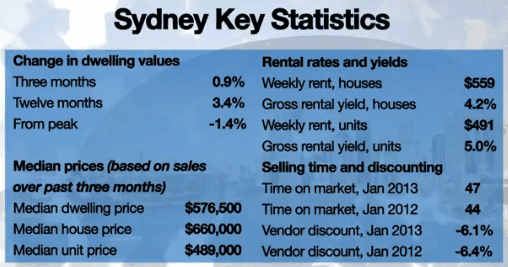
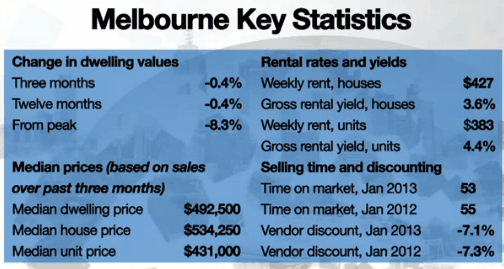
Summaries of the capital city metrics are provided below:
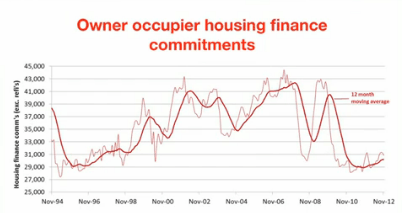
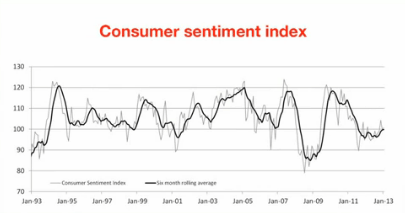
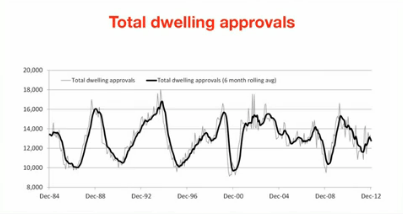
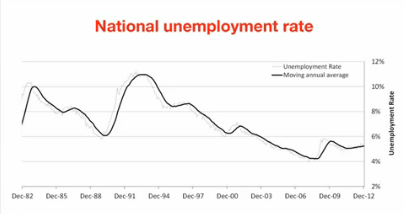
Despite the improving housing market conditions, Lawless believes that housing values will recover along “a modest trend” only due to subdued economic conditions, namely:

  • Soft housing finance:

  • Subdued consumer sentiment:

  • Weak dwelling approvals:

  • Labour market weakness:

unconventionaleconomist@hotmail.com

www.twitter.com/leithvo


22 Responses to “ “RP Data February housing update”

  1. reusachtige says:

    Every single uptick, in the overall downward path, will be celebrated by these spruikers and sung with eternal glee. Hence, I will rejoice loudly on the inside each time their party is crashed!

    • Peter Fraser says:

      The overall market is not falling, although in some areas it might be, whilst rising in other areas.

      • bskerr2 says:

        How can this guys data even be credible, first when it comes to Auction clearance rates the numbers don’t include the total number they start out with, second RPDATA’s numbers on buying vs renting, how they didn’t include tax’s, duties, maintenance etc… when doing their calculations. What a NOT credible company they are.

        And look at VIC, you have some 130,000 apartments under or about to go under construction from 2013 to 2016. That is roughly 43,000 per year, 3600 a month. Are we going to see 3600 people per month coming to VIC, as manufacturing, Retail hit the wall and the state losses approx 1000 jobs a day at the moment.

        The industry as a whole is going to hit the wall. Realestate is in a bad state. I guess the 2 biggest indicators are A, agents/developers offering up to 30,000 dollar gift cards and cars etc… just do they don’t have to drop the retail price, B, rent prices tracking wage growth/slides. Rental vacancies are growing, wages are sliding which means rent prices will/are dropping.

      • Peter Fraser says:

        The data is credible. It may change in the future as you suggest, but for now it is correct.

      • reusachtige says:

        yeah nah yeah

      • Pirate Nation says:

        It WILL be changing in the future!

      • bskerr2 says:

        You are completely wrong PF, if data starts with a grand total, then does not include that grand total when it gets evaluated then its corrupt and can’t be trusted. When agencies don’t notify PRDATA of a failed or passed in auction then the grand total needs to be scaled down, e.g. if 1000 auctions are listed for this week but agents don’t disclose 200 auctions, the RPDATA needs to revise it number and say 800 auctions were listed this week instead of fudging the figures. If finance companies did this sort of thing I am sure government regulars would sue their ass. The current way auctions are worked out means it’s always in favor of vested interests in the auction markets and makes the auctions look better than what they really are. RPDATA is corrupt and should not be trusted, and this goes for any other data reporting agency that does this practice of miss-leading.

      • Peter Fraser says:

        bskerr2 – you are confusing unreported auction results and future supply with past sales data.

    • Mik says:

      I have been reading about this great crash for around the last 7 years now.

  2. raveswei says:

    What I find interesting: REA claims for an average house rental yield in Sydney. I can find as many houses with yield significantly below 5% (even below 2.5%). It is very hard, almost imposable to find a house with rental yield above 7.5%. How’s possible than to have an average (median or average) yield of 5%.

    • DrBob127 says:

      Median or mean (both are averages) /pedant

    • gonderb says:

      Who claims 5% average yield for Sydney houses? RP-Data has it currently at 4.2%, which seems about right, especially given Sydney house prices rose last year. Units are at 5%, which also seems to fit with what you mostly see around in the market.

  3. Explorer says:

    Focussing on the market being below it’s last peak is a guaranteed way to miss a bottom and a increasing price trend.

    The graphs of YOY change or monthly or quarterly change seasonally adjusted are much more relevant to avoid missing a buying opportunity.

    As the mining investment boom peaks and begins to whither, interest rates could come under a lot of downward pressure, increasing affordability for the great majority of the population.

    To me the more interesting question is where are we in relation to the most recent bottom in each capital city?

    The charts on Blytic by Sold At The Top of the major US housing markets sowing the changes in Case Shiller values are the type of chart that I find most useful and interesting.

    You can see the acceleration and deceleration as well as the price history. Scroll down on the following link to see examples.
    http://www.blytic.com/StreamView.aspx?&streamid=2&search=&page=4

    For a less comlex chart up to November 2012 see this slow loading series:
    http://www.blytic.com/ReleaseView.aspx?releaseid=90

    • bskerr2 says:

      But the twist is if you drop interest rates you erode the profits on savings for people who are and about to become retired. They may then have a short fall and this won’t go down well with votes coming up to elections, not to mention the erosion of the average savers money as rates drop. Maybe we would also see flight of a lot of money to financial devices with better returns, or over seas.

    • McPaddy says:

      Love the upside down logic of the housing permabulls.

      “As the mining investment boom peaks and begins to whither, interest rates could come under a lot of downward pressure, increasing affordability for the great majority of the population.”

      Once the economy’s screwed we’ll really see prices take off!

    • DrBob127 says:

      “To me the more interesting question is where are we in relation to the most recent bottom in each capital city?”

      It is entirely possible for there to be many local minima as the slow melt progresses.

      To me, (speaking for Hobart, Brisbane, Adelaide and Perth – and sort of for Canberra) the 3 month % increase data looks to have been large enough to lift the yearly increase into the positive.

  4. The Patrician says:

    Labour market weakness?

    Is the UE rate weaker than the long term average? Nope

    Is the UE rate weaker than the OECD rate? Nup

  5. ceteris paribus says:

    I have been impressed and influenced by the argumentation and data of Keen and MB on house prices over the last two years. But there will come a time for a more definitive evidenced-based evaluation of the housing price performance in the current cycle.

    I was personally persuaded that a correction of perhaps up to 25% in real terms could occur- though I never bought the 40% drops of Keen or the 60% of Dent.

    So far, what has it been? Circa 10% nominal in Brisbane and circa 8% in Melbourne from the peak?

    I accept the argument that the cycle may not have yet run its course and the recent small bounceback in prices may well be illusory. But the Keens and the Dents can’t claim endless time to say their predictions have not been fully tested.

    Come December 2013, I do think we need to draw a line and have some evidence-based evaluation of their positions.

    • raveswei says:

      “So far, what has it been? Circa 10% nominal in Brisbane and circa 8% in Melbourne from the peak?”

      how much is that in real terms since 2010?

    • DrBob127 says:

      Prof Keen only ever claimed that house prices will fall 40% in real terms over ten to fifteen years.

      http://www.debtdeflation.com/blogs/2010/05/12/a-monkey-off-my-back/

    • Rusty Penny says:

      Keen’s argument is, proeprty is overpriced.

      We have had a rampant increase in the money supply which has belied the official inflation figures and increased productivity.

      So that means the hot money has been captured by something that doesn’t count towards official inflation… I’d say housing prices confirm this.

      So if houses have captured extraordinary gain, due to extraordinary circumstances, then all we need to ensure the prices remain the same and extraordinary conditions last forever.

      if not, their prices have to revert.

      His 40% figure was based on a rule of thumb based on japan’s experience and an estimates on varous valuation metrics.

      I would never place any credible claims to what Harvey Dent says, his record is pretty appalling.