The ABS has released the much awaited December quarter private capex figures, which offer us the best guide for the trajectory of mining investment and the RBA’s project for filling the gap it will leave behind as the boom ends. The news is both good and bad.
December quarter capex missed consensus of 1% gain by falling 1.2% but was still up 10% year on year.
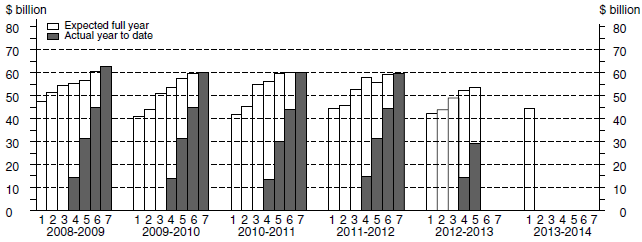
More importantly, the first estimate for expected capex for 2013/14 came in at $152.5 billion. Most pundits have seen $150 as the pivot between weak and strong:
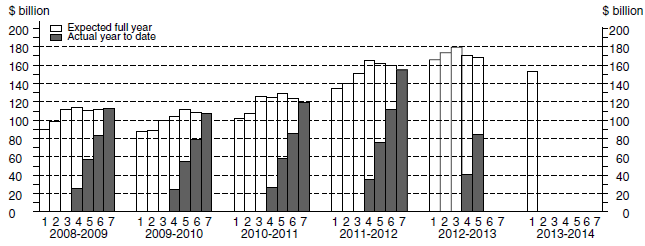
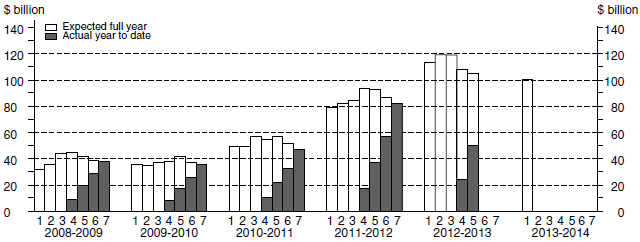
This is a decent result. The problem, if we can all it that, is it was driven by resilience in mining, not rebalancing. Mining fell 11.6% from the comparable estimate in 2012/13 but was still better than feared:
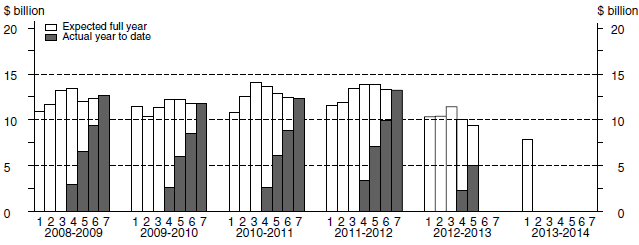
But manufacturing cratered, down 23.% from the same estimate last year and it howls hollowing out:
Other industries, which includes things like houses, grew 5.3% on last year. It is still low but is showing an encouraging rise in terms of the rebalancing needed:
Authorities will no doubt be happy with this result. There’ll be no rate cuts for a while on these figures.
But if I’m an offshore investor, I’m sticking my cash on a hair trigger. The Australian imbalance and the risk that goes with it is going parabolic.
Australian authorities want an economy totally reliant upon houses and holes and that’s what they’re going to get.


At least mining still has some kick in it going forward.
Leith, I am curious as to this Suppressed Data
“The ABS has suppressed the release of some data in the December quarter release of 5625.0. Tables affected include electronic tables 10A and 10B; Actual and Expected Capital Expenditure by Asset – Western Australia Current Prices, and Actual and Expected Capital Expenditure by Industry – Western Australia Current Prices”
Why and what does it mean?
Better hope so because we’ll have no other industry to take up the slack.
I know.
Hey – you removed my line – thought that would have been a good post title
Why and what does it mean?
Probably because those tables are so dominated by one or two items of expenditure that it risks revealing information that could be damaging commercially or to the State government (or both).
That was my assumption – along with speculation that it may be shown to be the single most important area for capex investment. Would be nice to know for sure.
The odd thing is that if you wanted to know the answer, you would just have to add up the other states and territories’ figures and deduct the sum from the Australian totals.
Lol – didn’t even think of that!
“Other” is a substantial contributor. The report indicates this group includes Electricity, Gas, Waste water services as well as Telecommunications.
I wonder how much in “Other” is related to the Gas infrastructure build out and NBN?
Agreed, manufacturing is being shunned.
Quarry Australia here we come!
Quarry is now! God help us if China hiccups.
Yep all our chips are on China. There is no Plan B.
We’re not quite a rocks-only economy yet — there are a few desperate souls still hanging on — but we’re getting closer every day. The hollowing out is accelerating.
Yep – we’ve definitely been lucky re China. Imagine the hollowing out is post GFC there was no China???
Stop lying, you shameless mining industry shill.
While we may have been in a worse economic situation in aggregate, the pain would have been much more evenly spread, and I dare say the non-mining trade exposed sectors would have been better off.
Seriously, I think its time to give 3d1k a week off.
Hey – why delete my response to Lorax – it was very fair.
Im I missing something? How is a likely 8%YoY fall in capex next financial year a good outcome? This is going to be a huge drag on growth.
Not to mention another poor Q4 GDP input for equipment spending, which looks at risk of being close to zero
Given mining only employs 2% of the workforce and we are low cost producers in the main and China’s cost structure is increasing not decreasing, this is not such a big issue other than for holders of resource shares (directly or through super).
A slump could affect the AUD negatively, but that would help our export industries including tourism and education and manufacturing.
While a crash would be disquieting, a wind back might have lower impacts than expected.
The wind back of construction activity for the resource/processing boom is likely a far bigger issue given the numbers employed and it looks like being ameliorated by dwelling building increases and possibly by immigrant workers leaving Aust.
2013-14′s forecast: $100 billion capex for mining Vs $7.5 billion for manufacturing.
WOW!
Ricardian Ambivalence re capex:
http://ricardianambivalence.com/2013/02/28/rba-forecasts-capex-droop-in-13-14/