
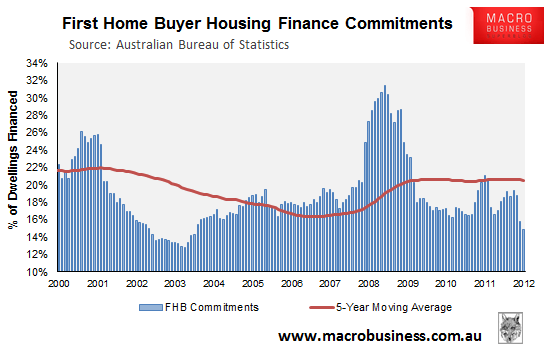
Publicly-listed Australian mortgage broking firm, Mortgage Choice, has taken self-interest to another level in the wake of the sharp fall in first home buyer (FHB) mortgage demand, whereby the proportion of mortgages to FHBs fell to the lowest level since June 2004 following the recent cancellation of grants to first-time buyers of pre-existing dwellings in New South Wales and Queensland (see next chart).
In an interview with Property Observer, Mortgage Choice CEO, Michael Russell, has insisted that state governments reinstate FHB grants to all buyers, as well as index it to rising property prices. He also attempted to argue that FHB Grants are not inflationary to property values. From Property Observer:
Mortgage Choice CEO Michael Russell says he is certain state governments are re-assessing their first-home buyer grant schemes following dramatic falls in their share of the mortgage market.
Russell quoted ABS figures showing that from July to December, the proportion of first-home buyers taking out home loans fell from 18.6% to 14.2%.
A year ago (December 2011) their share of the market 20.2%.
Russell told Property Observer this was a “significant deterioration” and an area of “genuine concern.
He says changes to first-home owner grant schemes are not having a “particularly favourable effect”.
Last year the Queensland and NSW governments withdrew the $7,000 first-home owner grant and replaced it with a $15,000 grant but only for those who buy or build a new home.
Russell says Mortgage Choice believes that all first-home buyers should be entitled to the first-home buyer grant.
“The notion of not indexing it it does not make sense.
“It needs to be indexed.
“I am sure it is being assessed at the moment, there will need to be action,” says Russell.
He added that he does not subscribe to the notion that the grant has an inflationary effect – the theory that the grant pushes up house prices so first-home buyer don’t actually get any benefit.
Anyone with even a basic understanding of economics would recognise that increasing FHB grants in the face of unresponsive supply is counter-productive and simply causes home prices to rise, making affordability for FHBs even worse, while costing taxpayers millions.
If Mortgage Choice was truly concerned for FHB welfare, it would argue for policies that remove speculative demand from the market, such as eliminating negative gearing, as well as freeing-up planning constraints, so that more affordable homes can be brought to market.
One wonders as well about what this says about FHB demand in February.
unconventionaleconomist@hotmail.com


“Mortgage Choice CEO Michael Russell says he has his fingers and toes crossed in desperation that state governments are re-assessing their first-home buyer grant schemes following dramatic falls in their ability to run a profitable private business with a growth model built solely upon generous taxpayer subsidies.
Michael Russell, rent seeker extraordinaire, is about to find out that government coffers are like Old Mother Hubbard’s cupboard and his will be likewise.
Yes – definitely a lack of imagination.
If mortgage brokers are worried about a drop in activity they should be out there pushing for action to improve supply.
The thing that is killing mortgage activity are high prices.
Trying to squeeze the last drops out of a lemon wrung dry is a mugs game.
On the other hand selling finance to new low cost houses will be money for jam.
Likewise selling finance to an even lower cost existing dwelling where the absence of a FHB grant is outweighed by the savings.
Plenty of people would move from rentals or their parents place to a new house or a low cost existing dwelling if the price was not prohibitive.
‘If mortgage brokers are worried about a drop in activity they should……go out and get a real job?’
They spawned an entire industry based on borrower laziness and finding intricate ways to get dodgy applications across the line. Now the lights are starting to dim on that party we taxpayers should backstop them?
That’s a bit harsh blaming borrower laziness. Brokers have, in the main, done a good job in getting the products of NBFI’s into the market place thereby giving the NBFI’s access to the retail residential market and at the same time enabling borrowers to access cheaper funds.
For those brokers that also managed to get marginal borrowers loans, about 90% (best guess) of those assisted have a capital gain on their home in excess of the excess costs of having bought compared to renting.
Whether that remains the case and for how long is a matter for speculation and conjecture but so far so good for most.
Capitol gain in excess of the extra costs my arse! What evidence do you present for that? Anecdotal I bet, and mine is the exact opposite.
“The thing that is killing mortgage activity are high prices”
Bingo!
Why are there thousands of shovel-ready blocks and new houses sitting vacant at Pt Cook/Hoppers Crossing/Truganina/Weribee/Melton with little or no buyer interest, while interest rates are at record lows?
P.R.I.C.E.
If you look at Google Earth, the amount of developed/under active development land in the in that area is about the same as it was in 2003. (Use view > historical imagery).
Anywhere there are large scale land releases has an area that looks like parts of Point Cook.
That is not to say that sales haven’t slowed or that prices haven’t come off, but remember the great majority of all the land prices listed in the outer ring developments are only back to June 2010 prices. All that has reverted (maybe so far) is the 3 month growth from June 2010 to Sept 2010 peak.
Sorry Ex, not following you.
What is your point?
..oh and the other reason is Big Teds REIV-friendly FHBG settings. TB may be vulnerable to a nudge from the HIA atm.
End the FHBG on existing dwellings Ted! Now!
Big Ted has other things to worry about…
http://www.abc.net.au/news/2013-02-22/jobs-cut-as-part-of-places-victoria-restructure/4533726?section=vic
More detail on the Places Victoria shambles
http://www.theage.com.au/victoria/troubled-places-victoria-cuts-jobs-20130221-2etwv.html
+100, Pfh007.
It is not just mortgage brokers, it is RE agents, house builders, and just about the entire economy that stands to benefit from sustainable-price growth in activity in RE and higher household discretionary incomes going forward for decades.
I’m curious to see what happens in Sydney, now that FHB grants are only available for new builds.
It has been increasingly obvious that fewer first-time buyers want to live on the outer fringe of the cities. Most people in their 20s prefer to live in established areas with good amenities, and are far less wedded to cars, home ownership and detached housing than their parents. Life in Narellan or Penrith just won’t appeal.
Consequently we might just be at the start of a shift in demand, away from detached housing in greenfields, and towards high-density infill development, and a lot more renting.
Lots would live on the fringes – most grew up nearby and actually like the burbs – it is just the price of living on the fringe is still far too high.
Yes, especialy when the wages of many are in fact much less than the median that the media/REParasites/builders etc etc see as being the minimum wage anyone cold possibly be on. The very outburbs were never considerd by median and above workers in previous years.
The FHB’s left out there, many Gen-X too, know a lemon and know that if there is any down turn these fringe properties will only be worth scrap value.
Agree with you SaCo
I think many people don’t realise that fringe property values are contingent upon the continued rise of the middle and high end properties. If places that are more attractive to live in start to fall, who is going to buy fringe properties?
Fringe properties will simply become the future Ghost Estates of Australia where the whole would can lean in and laugh at the buyers
I’d be happy enough to live on the fringes. But there’s just not enough jobs out there and the houses and units aren’t that much cheaper. They should be 50% less, but are more like 70%. Or just flat out the same when it comes to units. For instance you can get a pretty big unit in Castle Hill for about $500k, but you can also get something quite decent for that in Artarmon or Lane Cove.
Massive planning fail.
I grew up and live in the Hills District of Sydney. I work in the CBD of Sydney.
A new Build on the fringers is $600K + out near Rouse Hill. (The Ponds)
I currently rent a nice House in Baulkaum Hills which is slowly being taken over with medium density living.
The banks will lend me the coin to buy on the fringes, but the added commute/isolation/gridlock is not worth renting of the bank.
Easier to rent where you want to live, invest your extra money and be happy. Let the landlord fix the headaches that come with home ownership.
Wise man.
Sorry but you are about 15 years behind the times on infill development.
Most major industrial site along the Parramatta River have been remediated, rezoned for medium to high density an are many are fully built out.
Use Google Earth and the view > historical imagery and have a look at Breakfast Point and Rhodes as examples.
The same thing has happened on the brewery sites (Resch’s on south Dowling St and now the brewery on Broadway. Tooheys at central was redeveloped as offices probably 15 years ago).
The former British Leyland then Naval Stores at Zetland has been redeveloped to units.
The battle against rezoning of land around the North Shore Railway stations for high density has been lost 10 years ago.
Look at the population growth over 20 years or even just 10 years of areas like Canada Bay, Chatswood, South Sydney. It’s mainly medium to high density infill, not bigger families.
Yep – much more likely is relaxing the ability to subdivide quarter acre blocks into 3 terraces or 3 townhouses.
That alone would allow a tripling of dwellings in the existing low density Sydney sprawl with very little need for medium to high density.
I live in 1 of 6 townshouses built on 2 former suburban blocks and it is fine. Enough of a garden for a petite BBQ, off street parking and more room than your average 19th century workman’s cottage.
Note: this is not a substitute for allowing fringe development. Both are important.
I have posed the question before, why ever is it that “allowing increased urban density” never acts on the equilibrium point of supply and demand to lower prices?
A shallow assumption would be that “allowing double density” would be just as big an “increase in supply” as rezoning greenfields of an amount equivalent the entire existing urban area. But land markets just do NOT work this way.
I think the crucial difference is the value of the “alternative use” to which the site can be put. When the “alternative use” is farming, of course the price of the land for THAT site will be a heck of a lot lower than the cost of a site that is already IN URBAN use even at relatively low density. Besides the cost of the land in the existing urban area, there is the cost of redeveloping where there is already buildings (some of which will have to be removed and hence their value is like a sunk cost) and already a whole lot of economic activity going on that will be a source of mutual disruption.
So theoretically, our shallow assumption that “supply” has been doubled by allowing double the density, the PRICE of that “doubled” supply is many times the price of supply “doubled” by adding greenfields.
Mortgage Choice CEO Michael Russell is entitled to speak on behalf of his shareholders.
What he is not entitled to, is to speak on behalf of prospective first home buyers. We have too many self-appointed spokespersons for FHBs, including a resident merchant of debt, who mistake their own self-interest to that of FHBs.
+1
Beautifully phrased Mav.
I only hope that the governments are not bought, coerced or bullied into the FHOG again.
Australia is already in a hell of debt mess with the last decade of it.
Perfectly put Mav
“What he is not entitled to, is to speak on behalf of prospective first home buyers.”
I m pretty sure Michael Russell has the credentials to speak for first home buyers because most likely he or his family members, close friends or associates are waiting patiently on the side lines.
Having worked in the banking sector, I know as a fact that most real estate agents and their representatives do not own properties and do not plan to buy any in the short term future. Many of my real estate associates have never owned even ONE HOUSE.
An email I sent to Mortgage Choice:
I read with interest this morning that you are calling for First Home Owners Grants (FHOG) to be reinstated (and indexed) for purchase of established homes:
http://www.propertyobserver.com.au/first-home-buyers/state-governments-need-to-look-at-first-home-buyer-handouts-mortgage-choice
As one of the leading mortgage brokers in the country I am hoping you might be able to answer a query I have regarding recent First Home Buyer (FHB) statistics. You quote ABS statistics which show FHB borrowing activity (market share) is lower since removal of the FHOG for established properties (in some states). Presumably ABS is gathering these statistics via FHOG applications, so in the case a FHB purchases an established property in a state where they don’t receive the FHOG, then they won’t be recorded as a FHB for the purpose of ABS statistics. There could be many thousands of FHB’s still buying established homes that are not being added to the ABS record of FHB market share.
So my questions:
Do brokers in the Mortgage Choice network provide any other identification on a mortgage application that would confirm the applicant is a First Home Buyer (when the purchase is for an established property in a state where the FHOG has been removed for these buyers)?
If so can you please provide some information on how (the format) this information is recorded on the application?
If there is no identifier on a mortgage application that confirms the applicant is a FHB (except where they are applying for the FHOG) can you explain your confidence in the ABS statistics providing an accurate representation of the FHB market share?
This has got me angry enough to write an email to mortgage choice too. I’m just going to tell them that I will not be using there services when I seek to take out a mortgage for my first house.
Cool. Just don’t do what one of my fellow bogans did when Storm Financial collapsed…he threatened to burn their office down.
Got quite a bit of attention that did.
Or, if you do, try do it from an internet cafe that is not in the CBD, to many cameras and wear a big sun hat so cam’s on the ceiling can’t identify you. Whatever you do, don’t do anything from your own computer at home, or using your own computer at a free wifi service as you still have a computer fingure print that can be traced. Personally, I am looking at creating a website to publish addrses details of people who are against or hurt the public interest.
I wrote…
To whom it may concern,
Over the past two years, I have been looking to buy my first house with my partner. I was using Mortgage Choice (the mortgage broker’s name is above) to assist with seeking a good mortgage product, however I now have decided to take my business elsewhere.
This is as a result of Mortgage Choice’s CEO lobbying and commenting for reintroduction of the FHOG for existing houses.
I am outraged that the head of Mortgage Choice would so blatantly go after the interests of his brokers to the detriment of his customers (potential FHB) such as myself. It is clearly documented that the FHOG merely serves to increase house prices and put them further out of reach of FHB, and I find it shocking that the CEO of Mortgage Choice chooses to ignore (or lie) about this fact in his comments.
Noting the above, I will no longer proceed with taking out a mortgage through your company and will look elsewhere. I hope that my actions (and that of my fellow FHB friends who are also heading elsewhere as a result of his comments) go some way towards teaching your CEO to watch his words, and avoid blatantly lying and going after his companies interests ahead of that of his customers’.
Regards,
XXXX XXXX
The eight big kisses at the end might confuse them.
I also just posted it on their facebook wall:
http://www.facebook.com/MortgageChoice
They’ve deleted my post from their facebook wall already.
Kisses freaked them out
They keep deleting it! Anyone else want to try posting something?
You’d be better off starting an Anti-Mortgage choice group and linking it to mortgage choice’s page and others pages like Collyer’s Don’t Buy Now.
Haha SoulNigga Chips
Instead you should tell them “Not only will I not use Mortgage Choice in the future but soon nobody will need a mortgage when housing reverts to the mean!”
” Presumably ABS is gathering these statistics via FHOG applications, so in the case a FHB purchases an established property in a state where they don’t receive the FHOG, then they won’t be recorded as a FHB for the purpose of ABS statistics. There could be many thousands of FHB’s still buying established homes that are not being added to the ABS record of FHB market share.”
this is a distinct possibility, is there any way of verifying if this is the case??
Probably could be confirmed with ABS. I did email them some time ago, but got a default response “your query is too complicated, please call us” and haven’t bothered yet.
I questioned a SMH journalist on the validity of the data and his response was his information source was reliable – guess I need to find another paper to read.
You’re out of luck. Oz version of the Guardian isn’t here yet.
I’m assuming you do want one that employs journalists?
FTB’s still receive a stamp duty concession unless it’s for an expensive dwelling or an investment dwelling, so the majority would still be captured by the OSR in the stamp duty transaction.
Here is the core of the response I received from Mortgage Choice CEO (Michael Russell), posted with permission:
“I am not an advocate of the various boost schemes that have been applied to the FHOG in recent years, believing these do have an inflationary effect by artificially bringing forward future first home buyer demand. I believe however that one consistent ongoing FHOG will not bring forward future First Home Buyer demand and as such will not have an inflationary effect on property prices over the long term.
Finally, home loan applications are not required by home loan lenders to identify a First Home Buyer not claiming the FHOG. However I can confirm that in our customer database our brokers do record all first home buyer commitments and these records do show a steady decline since September.”
WE NEED SUBSIDIES!
This article is unbalanced with PF’s comments.
This CEO needs to face reality and find himself a new, non-taxpayer funded, business model.
Free markets, f@#k yeah!
Mortgage Choice, you have some choice in how you pay Ferrari prices for a Daihatsu Charade!
That Daihatsu in fact is a dressed up 50cc scooter.
This is very simple. Looking at the relationship between grants and house prices since 1951 leads to the very quick conclusion that grants push up the mean house price well in excess of the paltry grant offered (thanks Prof Keen!). Thus, the FHB grant is also known as BAIT. Funny how this is one time the eCONomists don’t want to use statistics.
Table 1: The First Home Vendors Grant and quarterly change in inflation-adjusted Australian house prices since 1951
Change per quarter (mean house price)
Before Grant – 0.07 per cent
After Grant – 0.81 per cent
All data – 0.42 per cent
During grant – 2.18 per cent
Between grant – 0.26 per cent
Doubled/Tripled grant – 3.10 per cent
http://www.businessspectator.com.au/bs.nsf/Article/property-housing-first-home-buyers-grant-market-pd20130121-45R9V?OpenDocument
Does everybody notice the last line? Can it be any clearer?
The reason this particular vested interest is screaming is that the great ozzie ponz falls over when the chumps don’t enter the meat grinder at the lower rungs at a steady rate with ever increasing levels of Ponzi financed debt. They knew full well that grants leverage up the amount of Ponzi finance offered by the merchants of debt and suck in dumb money, hence their demands.
The bears have been pointing out for years that in asset markets running on Ponzi finance, values could only be sustained by a steady stream of chumps entering the meat grinder. Well, it now appears we are getting short on lemmings.
Housing prices in this market have little to do with fundamental supply and demand – although supply factors may aggravate the situation in certain circumstances due to artificially constrained markets – and more to do with ponzi financing (see Minsky – Financial Instability Theory).
In an imploding once-in-a-generation asset bubble, no one can hear you scream…
any chance of providing a link that doesn’t require a subscription?
Just google the article title “Built on the backs of first home buyers” and hit the first link in search results and you should get to the article without sub required.
Cheers Baron,
I use this technique to access articles in the Australian but have found that it doesn’t work with the Fin. Review.
I should have tried it with the BS article but lazily just asked for a link when I ran into the subscription problem.
It’s free to subscribe to BS.
Just clear your cookies, Doctor.
Great article by Steve Keen. Am I glad that I bought my house in 1989.
We have “emergency low” IRs and these guys still need to hit up the tax payer… FFS!
Also, how can anyone say FHBGs don’t have an inflationary effect and provide zero reasoning as to why – what is it, the vibe?
With the growing number of part time youth workers, how do they afford a mortgage?
http://www.abs.gov.au/ausstats/abs@.nsf/Latestproducts/6265.0Main%20Features3September%202012?opendocument&tabname=Summary&prodno=6265.0&issue=September%202012&num=&view=
For many over the past decade their baby boomer parents put up the deeds to the family home or investment property as security for a few years until capital gain brings the LVR to acceptable levels and inflation and eventual full time job and a promotion or two provide the income to be self sustaining.
Some here will argue that won’t work any more and could be correct. In which case those BBers could be in trouble if they are retired.
Unbelievable!! I know quite a few young people that are still under water from the last con job by Rudd.
Lets hope the message is getting through to the the youngsters – buy using a FHB grant and you are just being turned into a debt serf to fund some boomers retirement. Do it in the boon docks and you could end up holding nothing but debt.
Hey UE what’s with the all seeing eye in the pic?
I you’re not implying there’s a Masonic connection to this mess?
A 2% drop in house prices is more than the FHOG anyway.
Maybe the non-property owning youth just doesn’t feel like subsidising the boomers’ retirements anymore? Or they can see the writing on the wall for the global economy, or their own job prospects?
There have been many interesting comments but it seems most commentators overlook the real point of having a Grant for First Home Owners which, should really be to assist young families to get secure accommodation.
With all the Regulation and Taxes imposed on buying/building and owning property it can be difficult to overcome that fist step. I know the grant i recieved in 1984 was small but of great assistance, since GST the grant increased and without it my son would not have qualified for a loan.
people coment that this is a cost to the taxpayer however it is more the case that taxes for GST and stamp duty are given as a cash up front payment and taken back simultaneously in the purchase transaction.
Keep it going for the young people I say and work out a better way to smooth the boom bust cycle
There have been many interesting comments but it seems most commentators overlook the real point of having a Grant for First Home Owners which, should really be to assist young families to get secure accommodation.
Then you must not be paying attention to what people are saying. No one overlooks assisting young people securing shelter.
But they observe this policy is the total antithesis of such a proposal. It hinders their ability to secure shelter.
If that is what occurs, then it should be abolished as to assist their ability to secure shelter.
With all the Regulation and Taxes imposed on buying/building and owning property it can be difficult to overcome that fist step. I know the grant i recieved in 1984 was small but of great assistance, since GST the grant increased and without it my son would not have qualified for a loan.
Then in the absence of his grant, your son would have been locked out at such prices, as well as a swathe of others. That would have meant builders, manufacturers of the product, would have to drop their prices to meet the market, just as all other producers do.
people coment that this is a cost to the taxpayer however it is more the case that taxes for GST and stamp duty are given as a cash up front payment and taken back simultaneously in the purchase transaction.
No, houses are a leveraged asset, the payment made by home buyers is multiplied due to this leverage.
Keep it going for the young people I say and work out a better way to smooth the boom bust cycle
The best way is to have a bust so hard, so punishing, so crippling, that those who participated in this boom with be petrified of ever doing it again.
Still in support of the FHOG, I did not think that the reimbursement of government taxes (esentially what the FHOG is) is actually the cause of the price rises. Yes prices rise because FHO’s utilise the grant but essentially that is because of supply and demand, there are not enough homes for people.
I agree that to deal with housing “shortage” there needs to be polices to rectify that however FHO’s still need a little advantage over investors otherwise investors would still purchase the available homes before the FHO’s
Any sharp price correction or bust will disadvantage the last people to buy, the people who are leveraged the most (borrowed the most)which has little to do with my point about taxes imposed on home purchasers’. but even so only the unleveraged part of the property is an asset and FHO’s even after the assistance provided usually have little in the way of asset in the home for a few years.
I am not in favour of denying food to the starving so that the next generation that comes along can eat, let’s look after both generations.
Why should the disadvantaged be punished for wealthier and “smarter” peoples’ policies and actions, they are only after what most people want the security of their own home for their family. Instead we should continue to support FHO’s with financial support, even if it only relief from unfair taxes imposed on people who purchase property (or renters who pay the cost of often leveraged unfair taxes back to investors)
Prices rise because people want property, if there were more properties available prices would be cheaper, there would be more available property if there was more land developed and the taxes imposed on home building and purchasing a home are abolished.
Consider that these taxes being used to support the wider community, most who already own or largely own their own homes and were not burdened with exorbitant taxes when they purchased property. Now purchasers who buy for the first time or buy because they have to relocate for work (or whatever reason)or buy for investment and to pass the cost on to renters (an even greater disadvantaged group) are subsidising those who already have property.
Why should a home purchaser or renter have to pay for everyone elses standard of living?
Lets get it right, impose fair taxes in the first place, on the community in general by way of rates, equitable consumption tax or income tax. As mentioned above it is unreasonable that the minority who need to make a property purchase are forced to subsidise the community. Until we can get it right at least don’t charge the first home owner the unfair taxes, reimburse them by way of a FHOG beause as renters they have already being paying the cost of the taxes with interest back to investors for years
“FHO’s still need a little advantage over investors otherwise investors would still purchase the available homes before the FHO’s”
This is part Australians don’t understand, so what if a greater fool outbids you? They are only taking up a greater loss.
“Any sharp price correction or bust will disadvantage the last people to buy, the people who are leveraged the most (borrowed the most)”
Nope, you are a classified as a greater fool not only for being the last guys to the ponzi scheme but also the people who were not intelligent enough to sell an overvalued dud asset that should never be trading at these infinite multiples. Australia has lots of these greater fools, far more than the “last to the party” crowd that you claim.
“Prices rise because people want property”
Yes and to add to your sentence. Prices rise because people want property to gamble with thinking its guaranteed capital gains in the future… until the music stops
“Why should a home purchaser or renter have to pay for everyone elses standard of living?”
The only comment you got patially right was this. Right now Australia families have 2 choices. To “subsidise” a small fraction of some great fool’s mortgage repayments with rent OR to spend the next 20-30 years of their working lives paying off some baby boomer’s 30 year retirement.
Its a simple choice for potential home buyers really if you ask me
Also I think it would be worth writing to our local state and federal members rather than crying at these out of touch CEO’s.
I’m sure they won’t be fretting their way home in their merc to a paid off mansion.
We do need to drive a wedge between them and our pollies though. Big money or not they still only get one vote. What we need is to empower the likes of Keen and David Collyer. Bright intelligent people to articulate our position.
Then hybrid them with Max Kaiser to punch the message home with the anger it deserves.
I’m sure Howard was quoted as saying “you’ve never had it so good” that maybe true for the BB but now its time to pay the piper. Do we let them pass the cheque to gen X and Y who didn’t even get to sit at the table?
I think not ladies.
Do NOT buy now!
Also I think it would be worth writing to our local state and federal members rather than crying at these out of touch CEO’s.
Unless there is a critical mass of protest, it is meaningless.
And the last protest we had in regards to mis-allocated capita, occupied some streets, was ridiculed and peterred out.
It’s not going to happen, we are given enough bread and circuses, stop placing so much faith in your fellow Australians, who are thicker than most.
I’m sure they won’t be fretting their way home in their merc to a paid off mansion.
Whcih is why they will ignore your letters, someone else enables their house and merc purchase, and they are their to keep them happy, not the handful who write sternly worded leters.
We do need to drive a wedge between them and our pollies though.
Well find yourself a grassy knoll in Canberra and spread the fear.
Big money or not they still only get one vote.
They also get the media, and that shapes more votes than you, and to the point where we see scores of useful idiots defending them.
What we need is to empower the likes of Keen and David Collyer. Bright intelligent people to articulate our position.
What we need is to storm the bastille, but it seems pretty foolish to do that by yourself don’t you reckon?
Then hybrid them with Max Kaiser to punch the message home with the anger it deserves.
I’m sure Howard was quoted as saying “you’ve never had it so good” that maybe true for the BB but now its time to pay the piper. Do we let them pass the cheque to gen X and Y who didn’t even get to sit at the table?
Well yes we do pass the cheque, beause in amongst watching my kitchen rules and FIFO on a 2/2 roster, they are not informed enough, and don’t care to be informed enough.
That is the point we are facing, structural stupidity. It is the decline of all civilisations, and now is our turn.
Societies don’t fail because of a handful of welfare recipients, they fail because everyone becomes a rentier, then uses their non-dialectic (read: feminists) methods to argue the virtue of their position.
It won’t change, because those that lift society aren’t regarded in high enough esteem.
Let it fall, let it burn andperhaps you can see rejuvenation in your life time.
Fight it, and it will be death by a 1,000 cuts, and span 200 years like the Austro-Hungarians.
So let it fall, it’s not worth saving, and enjoy the decline.
I think not ladies.
Do NOT buy now!
Don’t consume now!
Don’t marry now!
Don’t work now!
Don’t vote now!
Don’t protect now!
Don’t be a responsible citizen.
Oligarchies get their power from MONEY, so starve them of yours.
While we can’t opt out of this society, the only thing you can really control is what you eat and where you spend your money (mostly). So if you hate the oligarchies (Banks, Woolies, Coles, Sony, etc), don’t spend money with them, or at least minimise it.
So when you say dont buy now, I agree, but for me it is about keeping your money away from banks. Only spending habits will change the status quo.
The question we should be asking is, who owns that brand? Much more powerful in my eyes.
No need to worry npi_tweet
Having worked in the banking sector myself for several years now, our banks have never seen such poor lending rates. Our FHB loans have fallen massively. A recovery is nowhere in sight for the housing market.
Oooops dont say this to a bank manager… I might be fired tomorrow… and won’t be able to buy a house
A bit neg but sadly you’re probably right.
As for the grassy knoll, that was my last job for more than my fair share of tours.
When this does go the way of the pair I would expect to see a few folks up in the cllock towers over looking their local Remax and Dixon homes office.
Is it just my cynical mind but I read Dixonhomes as Dicks in Homes!
Freudian you think?
Always interesting thoughts RP. “Panem et circenses” has a lot of explanatory power.
Plus, once the masses get a taste of easy economic rents via massive unearned capital gains on residential land and Howard’s tax concessions – then they are hooked for life. No doubt this was part of the design to keep rentier power structures well and truly established in society.