Fitch has released its quarterly arrears figures for RMBS and the results are an unsurprising improvement generally, with holiday regions lagging significantly:
- Delinquencies Down: Delinquencies across Australia decreased to 1.20% at the end of September 2012, down 40bp from 1.60% at end-March 2012. The current rate of delinquencies is significantly below the five-year average of 1.56%.
- Monetary Policy a Boost: All Australian states saw improvements in mortgage performance. Improvements were driven by the Reserve Bank of Australia’s (RBA) decision to further reduce the cash rate by 50bp in May 2012 and 25bp in June 2012, and the subsequent reduction in mortgage interest rates. Regions southwest of Sydney, west of Melbourne, and south of Brisbane – where serviceability is key to mortgage performance − benefited most from the cuts.
- Affluent Regions Best Performers: Lower Northern Sydney in New South Wales (NSW), Inner Brisbane in Queensland (QLD), Northern Middle Melbourne in Victoria (VIC) and Central Metropolitan Perth in Western Australia (WA) were the best performing regions in their respective states, by both mortgage value and number of mortgages in arrears.
- Worst State: Queensland remained the worst performing state, with a 30+ day delinquency rate of 1.41%, although its performance had improved significantly − it was down from 1.86% at end-March 2012. Most of Australia’s 10 worst performing regions were in Queensland. Gold Coast East Worst Region: Gold Coast East (QLD) replaced Fairfield-Liverpool (NSW) as the worst performing region in Australia, with a 30+ day delinquency rate of 2.44%, and 16 out of 1,000 borrowers in arrears. The level of 90+ day arrears is 1.14%, above the Australiawide average of 0.50%.
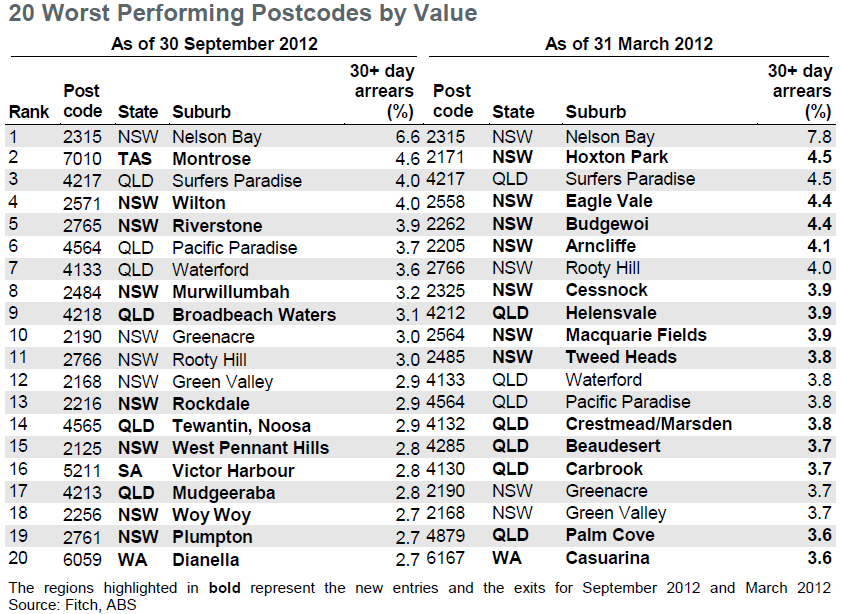
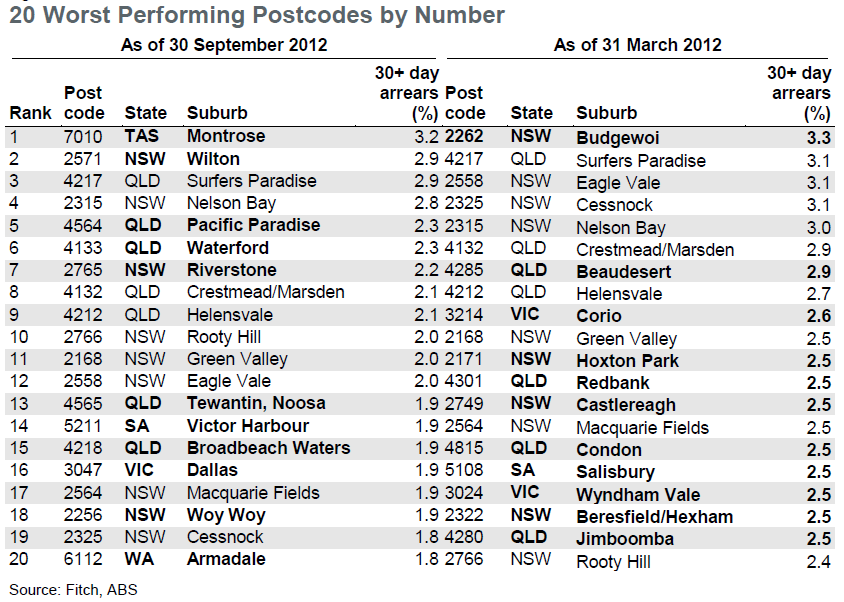
- Tourist Areas Benefit Least: Gold Coast West (QLD) and the Sunshine Coast (QLD) were the second and fourth worst performing regions in Australia, respectively. Coastal regions that rely on tourism are less affected by monetary policy and more by the high Australian dollar, housing prices, occupancy rates and rental yields. This is evidenced by popular tourist destinations being among the worst performing suburbs.
Here are the worst 20 postcodes by value:
And number:
The poor performance of holiday regions is matched by a concentration of poorly performing investment loans:
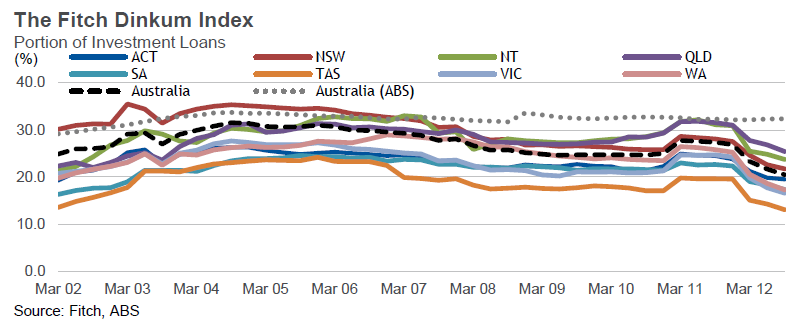
- Investment Loan Delinquencies Higher: 90+ day arrears of investment mortgages were on average 1.51x higher than owner-occupied mortgages at end-September 2012; this follows a 10-year average of 1.16x. However, 30+ day arrears have been more or less the same for investment mortgages and owner-occupied properties over the 10-year period.
- Inner Metro Most Popular: Inner metropolitan postcodes have a higher-than-average concentration of investment loans. CBDs and inner-city regions of all major metropolitan areas are among the top 20 regions/postcodes measured by concentration of investment loans. The region and postcode with the highest concentration of investment loans in securitised portfolios are Inner Brisbane and Sydney CBD at 39% and 57%, respectively, at end-September 2012.
- Tourist Regions Also Popular: The Gold Coast East, Gold Coast West and the Sunshine Coast were among the top 20 regions by concentration of investment loans. Surfers Paradise and Noosa Heads in Queensland, and Nelson Bay and Byron Bay in New South Wales were among the postcodes with the most investment loans − more than 40% securitised mortgages.
- Metro Delinquencies Low: Investment loans backed by properties in inner-metropolitan areas have low levels of delinquency rates. For example, investment loans in Inner Sydney and Inner Melbourne were performing well, with low 90+ day arrears at 0.50% and 0.29%, respectively, compared with the Australian average of 0.68%. However, Inner Brisbane delinquencies were higher at 1.04% due to a few delinquent multi-million-dollar mortgages. Overall, owner-occupied mortgages have performed better than investment loans in metropolitan areas.
- Tourist Areas Arrears High: Tourism and/or coastal urbanisation areas tend to have above-average 90+ day delinquency rates. Among the 20 worst performing regions by 90+ day arrears for investment loans are South West Western Australia (1.53%), the Sunshine Coast (1.10%) and Gold Coast East (1.24%).
- Concentration not Driver: The presence of investment loans in any particular area is not itself a driver of mortgage performance. However, where investment loans account for a high proportion of mortgages in a region or postcode, they tend to perform much worse than owner-occupied mortgages in the same region or postcode.


Please could you kindly post a link for the full report. Thanks
not available for public consumption…
Thanks HnH
Not having a shot at you but why does it take 4 months to get these numbers?
Buggered if I know.
There is an emerging firm that will be doing it in real time, called Morgij.
It doesn’t take four months to get the data. Much of the high level data is available almost immediately after coupon payments on the underlying RMBS. Roughly a two week lag but you have to do the consolidations yourself.
Although arrears had improved through to September (and this is evident through the Moody’s, Fitch and S&P measures), the component attributable to lower rates is debatable but I’m guessing that there is some benefit.
There are strong seasonal effects evident in arrears data. Deterioration in the fourth (lesser) and first (greater) quarters and steady recovery through the second and third quarters. Anecdotally, this is attributed to festive season madness and a rapid sobering up as the bills roll in.
I’ve estimated arrears have increased by around 10bps at aggregate level over the December quarter. But it is important to note that this if for RMBS (a small sample of the overall mortgage market). However, arrears based on RMBS may not be too bad a representation of the overall market as major bank 90+days arrears are consistent with RMBS levels, as are arrears measures from the LMIs.
Morgij are doing some interesting work and it is worth noting that Greg McKenna recently published on the Morgij blog and cross-posted to MacroBusiness.
The Victorian numbers are surprising, given its being touted as the epicenter of Australia’s housing armageddon.
“Touted”?
touted past participle, past tense of tout (Verb)
Verb
1.Attempt to sell (something), typically by pestering people in an aggressive or bold manner: “Jim was touting his wares”.
2.Attempt to persuade people of the merits of (someone or something).
Investment units in holiday areas on long term pooling agreements will continue to struggle, but many are being sold off at discounts to more cashed up investors who can trade short term rental income for long term capital gains.
That won’t change until our dollar falls, it has little to do with the broader residential market.
That’s not entirely true. The Sydney and Melbourne holiday markets remain weak. I suspect this is because of general deleveraging and greater caution as baby-boomers retire, not tourism.
Well to verify that you should look at net rental returns for the apartment owners. On the GC most apartments in a complex are part of a pooling agreement reinforced by a registered lease.
The units still rent out and earn money, but the manager takes first cut to cover his needs and the holding costs suc as BC fees, rates etc. I have seen $200K units that net just $1500 pa and of course the owner can’t hold that unit if there is finance in place – so they sell at a reduced price to someone with cash – the lowest that I have seen a 1 bed sell for was $30K which is staggeringly cheap – but it has almost no income for 10 years.
I’m not a great believer in the big boomer sell off theory – most boomers are still quite young – why would they sell now? Maybe later, but even then many will be counting on the rental income. They saw their parents lose big time during the high inflation years and don’t want to repeat their parents mistakes by holding all cash.
Hard to say, but I’m not in the 100% convinced camp, and it’s unlikely I will ever be without concrete evidence. At this point it’s theory at best.
Correction – “who can trade short term rental income *in the belief that there will be* long term capital gains”.
OK, there will always be some capital gains in the long term (10+ yrs) but not that likely to be significant without a much much lower dollar.
Mr PF
63% of property investors negative gear. How does one plan to subsidize a loss making investment without a job in retirement?
1 of 2 thing will happen.
1) As more people head into retirement they need to sell the loss making investment to realise capital gains or losses as weekly payments to subsidize the investment are not possible without a job or a high level of income from other investments. (currently, something like 80% of retires earn less than $22,000 a year)
2) Baby boomers will retire later in life keeping their job to let that negative cash flow turn into positive.
If option 1 happens we will have the sell off. Simple Supply vs Demand will take place and we will see a fall in prices.
If option 2 happens I see issues in the unemployment level. As more people have their finger in the jobs pie there will be less jobs to go around for the new kids coming out of uni. If unemployment rises our delinquencies will increase and prices will fall.
Or as it s actually happening, rates drop to zirp or close for a decade or more, rents keep increasing at cpi rates, repayment diminish or stay constants, properties owned by BB get all CF+.And these BB retire happy enjoying a stream of income protected from inflation.
Magic pudding anyone?
Nice fantasy.. ZIRP and all.
Well low rates for a decade are possible.
More likely scenario:
The ongoing slow melt translates into a Minsky moment i.e. “OMFG we are never gonna get a capital return on this s***hole that we keep piling money into week after week with pissy rental income and very high holding costs (negative gearers all). Plus we owe a ton of money to the merchants of doom!
I don’t think we should facebook update about this honey!
Panic ensues. There is a run for the door simultaneously. The herd in its manic state cannot be stopped. It will crush and maul who stand in their way.
The almighty credit bubble implodes as no third parties can be found to meet the ridiculous prices on offer. The Great Oz Ponz Land bubble ceases to be and deflates HARD.
Cue much wailing and gnashing of teeth from all vested interests as the pile of cards collapse and the financial sector is shown to be wearing no clothes, given ridiculously over-valued real estate assets on their books and ludicrously thin capital ratios based on dodgy internal risk weightings (thanks Deep T!).
End result: land bubble crashes; ZIRP does sweet FA (like everywhere else) and sweet, hard, long, cottages and crevices style deleveraging means debt deflation ala Irving Fisher (thanks Irving, we haven’t forgotten you!). Real debt ratios rise as debt deflation takes hold and house prices fall faster than debt can be paid down.
Ain’t debt deflation grand? If we’re lucky we might even get ‘biflation’ (look it up my precious Dam).
Game over man, game over…
Labrynth, what if your assumptions are just plain wrong – what then?
You keep trying to assume that all BB’s have high debts on IP’s – what if they don’t, what if they are positively geared and almost paid off – what happens to your theory then?
You and others here concentrate on making the narrative fit your preconceived beliefs with little or no evidence other than aggregate numbers.
I expect most boomers with IP’s to hold them until at least their mid seventies. For a mid range boomer born in 1955 that means the year 2030 – how does that fit your narrative?
Understand that people are not decrepit at 65 years of age, they still know how to collect cheques. There needs to be an economic imperitive to entice them to sell. Maybe there will be, or maybe there won’t be, but assumptions based on nothing but presumptions are dangerous.
“You keep trying to assume that all BB’s have high debts on IP’s – what if they don’t, what if they are positively geared and almost paid off – what happens to your theory then?”
I can answer that as I and some of my associates are in that situation.
The portfolio of properties get analyzed and the ones that are not returning an appropriate return are sold.
Appropriate return is based on net income after all outgoings (yes land tax is a killer for many of us) and expectation of future capital gains.
Some of us are selling a significant proportion of our IPs (my case about half of them) and moving into other investments. (we cant move our IPs into our self managed supers in general.
The other problem we face is balancing how fast we sell now redundant IPs because of the significant income tax we would have to pay on the Capital gains. We are usually therefor only dribbling them onto the market.
Fully owned IPs are therefor also coming onto the market but usually at a slower rate so as to keep income tax in check.
thanks sydbod – it sounds as though you have it under control. No you can’t move them into your SMSF.
Your structured exit plans rather contradict Bobby’s fanciful minsky moment fantasy above.
Of course BB IP owners will exit the market, but it won’t be a rush for the doors, it will be purposeful and over a few decades. Why would it be otherwise.
Seriously davel you know quite well that in 10 years time house prices will have risen considerably. To pretend otherwise is just foolish.
Peter,
That prices will increase in 10 yrs as a given is just as foolish, I had 2 units for 8 yrs that went almost nowhere as well as a sister who’s home (general area as well) that was flat for close to a decade.
PF, To listen to your advice is not only foolish but a waste of time!
Christiaan – I would prefer that you remain uninformed, so please don’t listen.
DNE – yes that can happen, but perhaps you just didn’t buy well. There are always scenarios that move against the trend and I can’t explain every single one of them without all of the details.
Peter,
You’re right, it is perfectly explainable. I bought at the peak (89) and sold for a marginal CG in 95. My sisters whole suburb (Ballajura) was flat for close to a decade. The point is most would not have made money during that period regardless, so holding RE for a decade will not ensure a descent return. I recognise now that I was a bunny as MOST RE so called investors are.
sorry, not that it matters, 96.
DNE – sorry that you didn’t do well, but if you had held for the decade instead of just 6 or 7 years you would have done much better.
There are no guarantees, but in general most buyers have done ok as long as they hold a full decade or more.
How would you have done if you still owned those properties?
Anyone know what happened in Montrose Tasmania ? Seems to be an outer suburb of Hobart.
I know it is a bit pediantic but I thought the most popular Gold Coast/Sunshine Coast tourist areas were in the East not the West, ie. the beach on the East coast.
The difference in % ages between no. of delinquencies and the $ of delinquencies suggest the problem is with the lower end of the market.