The fact that the world’s attention is currently fixated on the goings on in Rome may not be such a bad thing for the Eurozone because the news from everywhere else certainly isn’t getting any better.
I posted earlier in the week that Portugal has already revised down its economic target for this year, but it certainly isn’t alone. As I mentioned back in December Spain was at risk at missing it already upwardly revised deficit target of 6.3% for 2012, it was initially 5.3%, and overnight Mariano Rajoy verified the miss:
Speaking in parliament Wednesday, Mr. Rajoy said the government planned to send the spending data showing the 6.7% deficit to Brussels. Last week, he said the deficit would be below 7%
Spain was targeting a 6.3%-of-GDP budget deficit last year, but top officials had already said the deficit would be closer to 7%–a small overrun that the European Commission may find acceptable, according to recent comments from European Union officials.
The euro zone’s fourth-largest economy is slowly cutting a budget deficit that stood at around 9% of GDP in 2011.
Spain’s budget estimates don’t include 39 billion euros ($52.09 billion) received from the EU last year for the banking sector bailout. Including these costs, the European Commission recently estimated that the deficit will be 10.2% of GDP in 2012.
The country’s budget ministry has said it will release its first detailed estimate of the 2012 budget deficit later this month.
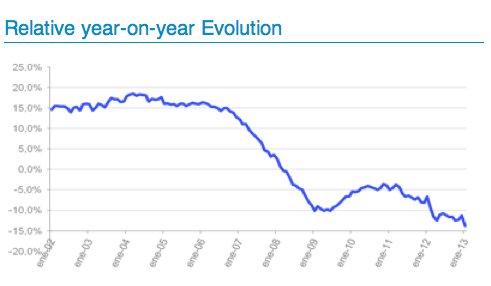
As I’ve spoken about many time previously, attempts at government sector austerity amid a retrenching private sector are simply creating self defeating balance sheet recession dynamics that are leading to further economic retrenchment and therefore ever lower government revenues. This is manifesting in a number of ways, including higher unemployment, rising bad debts in the banking system, lower industrial production and falling asset prices. Of note in that regard is the latest report from Tinsa that once again showed an acceleration in the downturn of Spanish house prices in January:
Advertisement
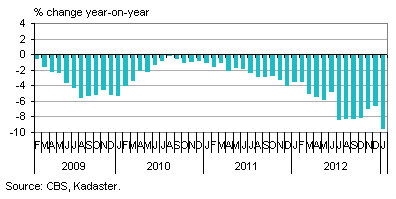
It’s not a much better story from one of the other European countries on my watch list, the Netherlands, as Dutch house prices also continue to fall:
According to government figures from Statistics Netherlands (CBS) the price of homes fell slightly less at 9.1%, when adjusted for inflation, in the year to November.
They say the biggest house price falls were felt in Amsterdam (-11.2%) and Apeldoorn (-9.7%).
Whichever figure an investor chooses, the property market in Holland is in serious trouble.
The NVM say the average house price in Holland is now £178,000 and the number of sales is also dropping too – down 7.2% between January and November to 99,897.
Advertisement
And then there is France, which as we already know from the PMI data is very quickly looking to take up its position behind members of the European periphery. Overnight the last unemployment data was released and the numbers were the worst in well over a decade:
Unemployment numbers in France rose by 43,000 in January to 3.16 million, an increase of 10.7 percent from last year, the labour ministry revealed on Tuesday. The figure is at its highest since January 1997, when it reached 3.19 million.
The number of registered French unemployed rose by 43,000 in January to 3.16 million, the labour ministry said Tuesday, to just shy of a 16-year record.
The ministry said the number of registered unemployed rose by 10.7 percent from last year.
Unemployment in the eurozone’s second largest economy hit its modern day record of 3.19 million reached in January 1997.
Advertisement
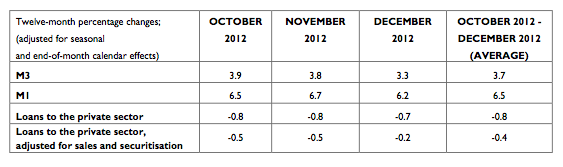
Overnight we also had the latest Monetary data from the ECB which again showed lending to the private sector continues to contract across the zone which points to a further slowing in economic activity in the coming months.
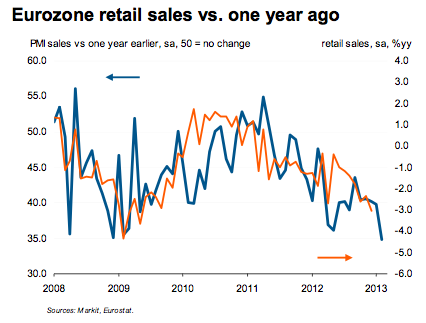
And if all that wasn’t dour enough, retail sales data for February basically just stank:
Advertisement
Markit’s Eurozone retail PMI® data for February signalled a record year-on-year fall in retail sales revenues in the single currency area. Sales were also down sharply compared with January, as signalled by a PMI reading of 44.5, down from 45.9.
The Eurozone Retail PMI is a seasonally adjusted indicator of changes in the value of sales at retailers. Any figure greater than 50.0 signals growth compared with one month earlier.
Commenting on the data, Trevor Balchin, senior economist at Markit and author of the Eurozone Retail PMI, said:
“February’s retail PMI provided more bad news for the Eurozone economy, falling to 44.5 and extending the current run of sub-50.0 readings to a survey record-equalling 16 months. Moreover, unlike the trend in manufacturing and services, where the worst phase of the current downturn may have passed, the retail sector remains some way from stabilisation.”
“The record year-on-year fall in sales in February as signalled by the PMI data indicates that the official figures will deteriorate further from the latest- reported 3% annual drop registered for December, which was the worst outcome since May 2009.”
Italy’s trouble aside, 2013 is turning into a truly tough year for the Eurozone, and with further austerity coming to many countries already in serious trouble its difficult to see an upside coming any time soon.