

Housing transfers still depressed

By Leith van Onselen

Yesterday, I showed how the recent uptick in Australian house prices had been weak compared to previous interest rate-cutting cycles, with national capital city house/dwelling prices experiencing little to no growth in values since the RBA first cut official interest rates in November 2011, according to both Residex and RP Data-Rismark.

Well, it appears that the weakness has also extended to housing transactions, with the number of housing transfers in Australia’s four biggest states – New South Wales, Victoria, Queensland and Western Australia – tracking well below decade ‘norms’, according to the various state government data (see below charts).
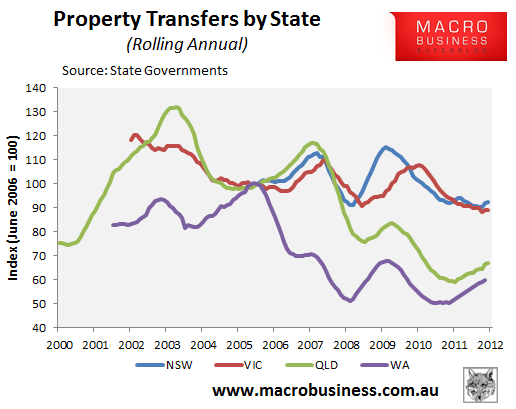
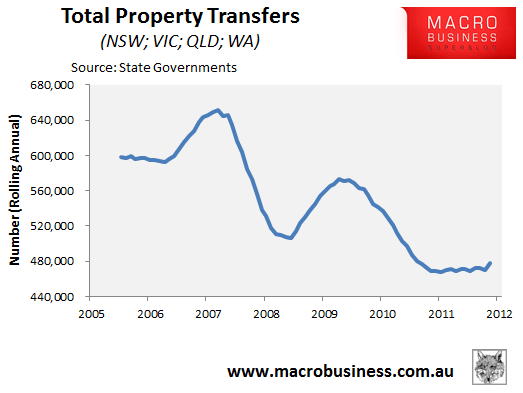
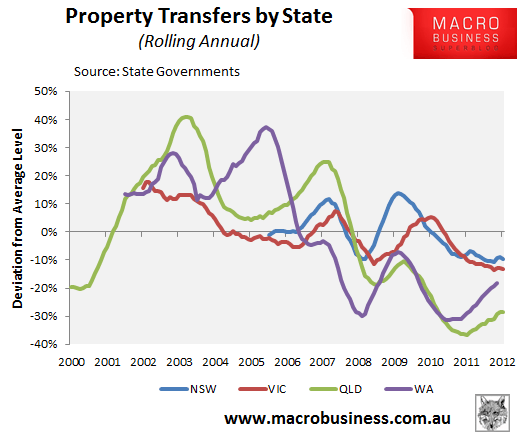
According to the latest available data, which varies in timeframe across states, the annual number of housing transfers were running some -10% below average levels in New South Wales, -13% below average in Victoria, -28% below average in Queensland, and -18% below average in Western Australia (see next chart).
PS: If anyone knows where I can obtain property transfer data for South Australia, Tasmania, the ACT, and NT, can you let me know?

unconventionaleconomist@hotmail.com

www.twitter.com/leithvo


19 Responses to “ “Housing transfers still depressed”

  1. Archie says:

    Rising prices on lower volumes is the new normal.

  2. The Patrician says:

    Goodbye stamp duty.

    Hello broad-based land tax.

  3. stacks says:

    How Can AFG write a record number of mortgages with house transfer numbers at these levels?

    More new builds, less existing sales?

    • stacks says:

      But reading on:

      “Last week’s new home sales data, released by the Housing Industry Association, showed that new detached house sales hit fresh 16-year lows in annual terms in all mainland states, except Western Australia”

      So less new builds of existing houses, less selling of existing houses but still record mortgage numbers?

      • bg0 says:

        Something is moving that is not new houses or existing houses.

        I would suggest that the two likely contributors are:
        - AFG’s market share has grown (10% is clearly a rough estimate, it may have grown from 8% to 11% in the last few years, for all we know)
        - Refinancing portion growing (admittedly the available figures for the last 24 months don’t really show this, but perhaps on a longer time frame this would be apparent)

      • stacks says:

        Units…. lots and lots of units