Find below the iron ore complex price table for February 26, 2013:
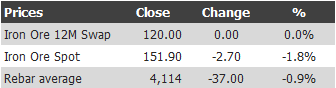
That’s bearish and for good reason. With the Chinese inventory draw down bottoming, plus its declaration that it will prevent rising house prices with obvious knock on effects for real estate development (which accounts for between 15% and 30% of steel consumption depending upon who you ask) the one-way bet on iron ore has suddenly reversed itself.
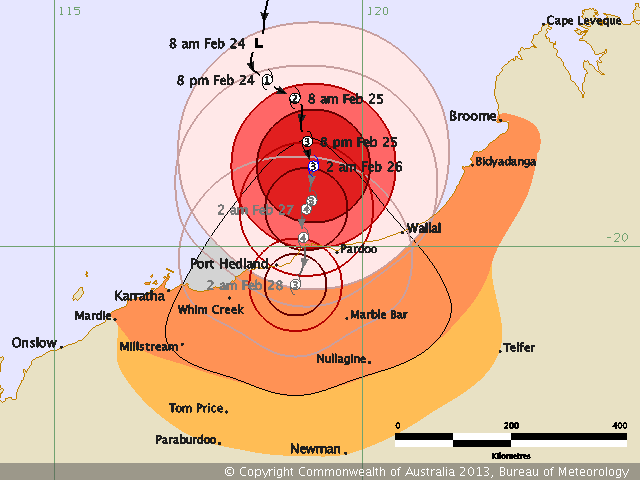
That prices can also ignore Cyclone Rusty, which is now Category 3 and expected to build to Category 4, and is bearing down on iron ore heartland shows the iron ore bid has quite dried up:
Add in a suddenly shaky broader environment and the only way is down. I would not be surprised to end back in the high $130s shortly.


Hopfully though next months expected demand will put upward pressure on prices rather than
the downward pressure of any increased supply.
Capesize Rates Seen Doubling on China Iron-Ore Reserves: Freight
By Isaac Arnsdorf and Rob Sheridan on February 25, 2013
Shipping rates for iron ore are poised to double next quarter as Chinese steelmakers import extra cargoes after stockpiles at the nation’s ports collapsed to a three-year low.
Daily earnings for Capesizes hauling 160,000 metric tons of cargo will jump to $11,250 in the three months ending June 30 from $5,088 now, according to the average of eight analyst estimates compiled by Bloomberg. While that’s 30 percent less than owners need to break even, investors may profit with forward freight agreements, swaps used to bet on, or hedge, future shipping rates, which currently anticipate $8,279 in the same period.
Shipments this year were curbed by storms in Australia and by Chinese traders that have the smallest ore stocks at ports since January 2010, according to data compiled by Bloomberg. Higher rates would help Tokyo-based Nippon Yusen K.K., which has the biggest fleet, while adding to costs for producers including Vale SA, the world’s No. 1 miner of the commodity, and Rio Tinto (RIO) Group, the second-biggest supplier.
“I definitely expect an increase in iron-ore buying and Capesize rates in the second quarter,” Jeffrey Landsberg, managing director of Commodore Research & Consultancy in New York, who correctly predicted the rates would rally in October and January, said by phone Feb. 21. “At present, stockpiles are very low and there’s going to be an increase in steel production.”
Iron Content
Ore with 62 percent iron content surged 75 percent to $151.90 a dry ton from September’s low, according to prices from The Steel Index Ltd., a London-based unit of McGraw-Hill Cos. The price will slump to $132.50 in the second quarter as the supply of cargoes increases faster than demand, according to the average of 10 iron-ore analysts in a separate Bloomberg survey.
Chinese port inventories declined 2.5 percent this year to 68.8 million tons, according to Beijing Antaike Information Development Co., a state-backed research company. China needs to rebuild those stocks toward last year’s levels as high as 100 million tons, Sam Walsh, chief executive officer of London-based Rio Tinto, said on a Feb. 14 conference call.
Mills in the world’s second-largest economy will increase demand for cargoes starting in March after curbing purchases this year because prices were too high, Chen Zhenxing, a Shanghai-based analyst at Mysteel.com, China’s biggest iron-ore researcher, said by phone Feb. 22.
Capesize Cargoes
China has increased crude-steel production in the second quarter of every year since 1990, according to data from the National Bureau of Statistics. Iron ore accounts for 75 percent of single-voyage Capesize cargoes, estimates Arrow Capesize (U.K.) Ltd., a London-based shipbroker that specializes in the vessels. The rest are coal. Demand for shipments of the fuel has been curtailed by a strike at Colombia’s Cerrejon mine, making more ships available, said David Webb, a broker at Arrow.
Any increase in cargoes won’t be enough to erase the glut of vessels. The fleet more than doubled since 2008, when rates were about 45 times higher than now, according to Clarkson Plc, the world’s largest shipbroker. It will swell another 6 percent this year, slower than the 11 percent expansion in 2012, Clarkson estimates.
Earnings for Capesizes dropped 72 percent from a 10-month high of $18,388 on Oct. 23, according to the Baltic Exchange, the London-based publisher of freight rates on more than 50 maritime routes. The 1,000-foot-long ships need about $16,000 to break even, estimates Pareto Securities AS, an Oslo-based investment bank.
Largest Owners
The largest owners are Nippon Yusen (9101) and Kawasaki Kisen Kaisha Ltd., according to Clarkson. The Tokyo-based companies also own oil tankers and container ships. NYK will post net income of $304.1 million in the year starting in April, up from $70.2 million in the year ending in March, and its shares will rise 1.2 percent in 12 months, according to 16 analyst estimates compiled by Bloomberg. Kawasaki Kisen will earn $152.8 million, 33 percent more than the previous period, and its shares will decline 11 percent, 18 estimates show.
Rising freight rates normally add to costs for miners who charter ships, said Frode Moerkedal, an analyst at RS Platou Markets AS, an Oslo-based investment bank. Gains in shipping rates often reflect strengthening demand and higher prices for iron ore, said Arjun Batra, group managing director of Drewry Shipping Consultants Ltd.
Vale owns and controls a fleet including the biggest ore carriers, each able to hold about 400,000 tons and nicknamed Valemaxes. The Rio de Janeiro-based company owns vessels that can transport about 7.5 million tons and has additional ships on long-term charters, data from London-based Clarkson show.
previous12 next