

Average weekly earnings record solid growth

By Leith van Onselen

The Australian Bureau of Statistics (ABS) has just released the Average Weekly Earnings (AWE) data for the six months to November 2012. A breakdown of the key changes is provided below:
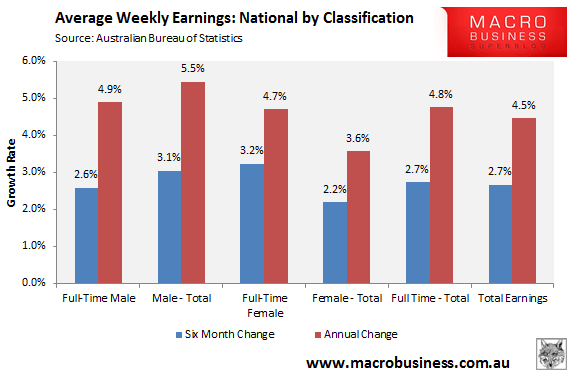
According to the ABS, on a seasonally-adjusted basis, national total AWE increased by 2.7% in the six months to November 2012, to be 4.5% higher year-on-year.

A time series of annual average wages is shown below. According to the ABS, the average Australian earned $56,228 per annum as at November 2012, with the average full-time worker earning $75,650:
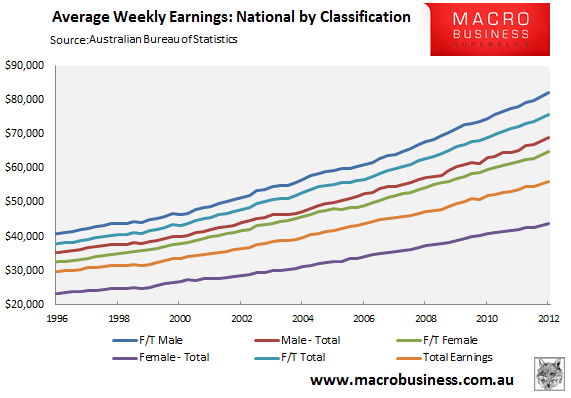
You can see from the above chart that males earn significantly more on average than females. As at November 2012, full-time male earners earned 27% more on average than females full-time workers, whereas total male average earnings were 58% higher.

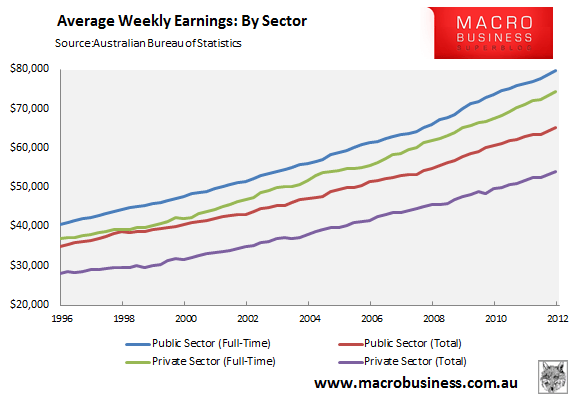
The disparity between the private and public sectors is also striking, with public sector workers earning on average 21% more than private sector workers, and public sector full-time workers earning 7.0% more:
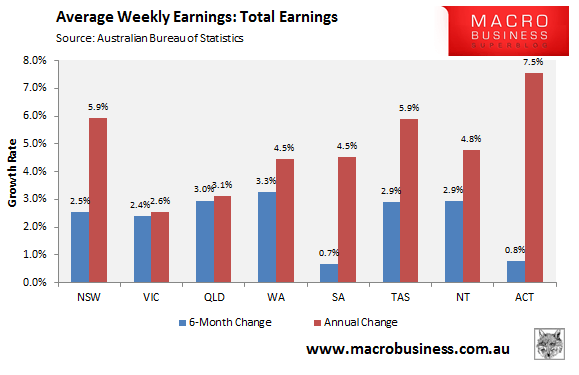
At the state level, wages growth was solid in the six months to November in all states and territories except South Australia and the ACT.

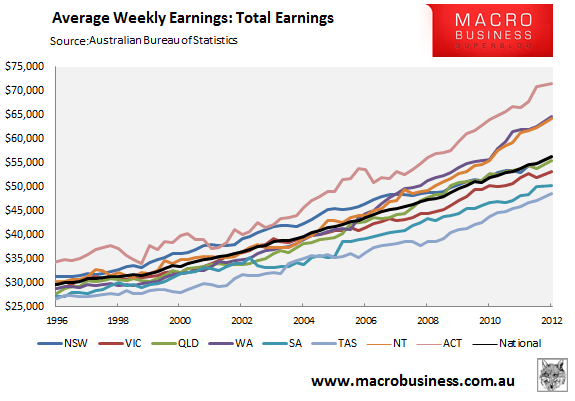
Over the year, however, the ACT (+7.5%), New South Wales (+5.9%) and Tasmania (+5.9%) were the standout performers, whereas Victoria (+2.6%) was the lagard:
In dollar terms, workers in the ACT, Western Australia, and Northern Territory get paid the most on average, whereas those in Tasmania, South Australia, and Victoria are paid the least:
unconventionaleconomist@hotmail.com

www.twitter.com/leithvo


10 Responses to “ “Average weekly earnings record solid growth”

  1. tobyoptimum says:

    So WA, with all the prosperity and income opportunity of the biggest resource boom in Australian history, still cant match the ACT with its public sector employees.

    Dont get a job in mining youngsters, become a public servant instead!

    • waltK says:

      Not sure if WA CUBS (cashed up bogans) are ready for daily lattes and wrestling copy machines.

      I know many Perth kiddies (18 to 21) earning well over $140k within various mining related industries in WA. In fact I knew of a 19 year old Kiwi bloke from Christchurch earning well over $180k driving trucks in and around Karratha.
      His plan was simple; 5 years in WA = retire in NZ.

    • Lef-tee says:

      The ACT would be home to a disproportionately large number of high level public servants per head of population.

      And as I’ve said many times, there should be no surprise given that the public sector heavily employs professional people becasue of the nature of what governments do (teachers, doctors, nurses, engineers, uni lecturers, scientists etc). The private sector by contrast employs such people as well but unlike the public sector it also employs millions of people to flip burgers and stack shelves in shops, which surely serves to drag down the average.

      “According to the ABS, the average Australian earned $56,228 per annum as at November 2012, with the average full-time worker earning $75,650:”

      In my work environment, the average full-time public servant without a uni degree earns more like the first figure than the second.

      • Wing Nut says:

        Can’t find where I saw it but there’s a disproportionate number of professionals in the ACT when measured against the rest of the country. What puzzles me though is the high wage growth when the APS and ACT PS received on average a 3-4% pay rise. Not sure where the 7.5% comes from.

      • 3d1k says:

        Adam Creighton on the well-paid public servant.

        “A more blatant example of upper-class welfare is found in Canberra, among the bloated senior ranks of the public service. Thousands are paid exorbitant sums grossly disproportionate to the social value of their output. Taxpayers lavish salaries between $200,000 and $750,000 a year on almost 2900 senior public servants. Another 13,230 are paid about $150,000 a year.

        Whole suburbs of Sydney and Melbourne pay tax to support this artificial, taxpayer-created upper class, whose incomes dwarf similarly employed public servants in London and Washington DC.”

        http://www.thepunch.com.au/articles/forget-middle-class-welfare-its-the-upper-class-on-the-test/

      • Wing Nut says:

        Yeh, but remember Canberra is the “corporate HQ” of government departments and there for will have a larger concentration of well paid public servants, mind you, won’t argue about the pay scales – there are many who should feel guilty about drawing breath let alone a pay cheque. Also, military personnel make up a sizable number of the second tier pay scale as a majority of the O4-O5′s positions in each service are based in Canberra. Then there’s the argument “whose incomes dwarf similarly employed public servants in London and Washington DC.” – how many truck drivers or tradies in the US earn $130k a year?

      • drsmithy says:

        Thousands are paid exorbitant sums grossly disproportionate to the social value of their output.

        So is this your new measure of how salaries should be judged ?

  2. hubris_and_hyperbole says:

    Any median data?

  3. Magpie says:

    Judging by the Explanatory Notes, the dollar figures do not seem to be adjusted for inflation.

    Another thing that puzzles me is that ABS reports data by industry, but not by occupation. Would it be so difficult to get data classified by ANZSCO occupation standard?

    After all, many other data they get are also classified this way.

    Oh, well.