

From Property Observer comes news today that AV Jennings has posted a -$19.1 million loss for the first half of the 2013 financial year compared to a $3.3 million profit a year ago. This follows news earlier in the week that Becton had fallen into receivership as well as the first half loss booked by Stockland earlier in the month.From Property Observer:
The home builder AVJennings has posted a $19.1 million loss for the first half of the 2013 financial year compared to a $3.3 million profit a year ago. But it has advised that consumer confidence remains the key issue and until there was a positive change, market conditions will continue to remain challenging.
The value of its residential projects has had a 5.3% cut, slashing $16 million from its result.
Total lots under control sits at 10,581 for the group whose history stems back to 1932 when “proud old builder” Albert Jennings founded Australia’s most famous house building company which is now publicly listed.
Almost 80% of the impairments related to its troubled Queensland projects…
But the main reduction in revenue occurred in Victoria.
“The Victorian market was overheated during 2010/11 and conditions have since softened considerably.
“Revenues declined by $31.8 million for the reporting period from December 2011 figures, however, margins on Victorian projects remain acceptable and sales performance over the December 2012 and
January 2013 period improved and indicate that market conditions in Victoria appear to have stabilised.”
The company cut the value of a Victorian project, noting that the downturn in that state had “required a more aggressive pricing structure” on the project.
It also cut the value of its Cobbitty, NSW project where bureaucratic red tape had been costly, according to the market update…
“Residential property market conditions during the reporting period were adversely affected by weak consumer confidence which has subsisted for some time now,” Peter Summers said.
“There are signs that some markets are starting to improve although this is taking time to translate into transactions.”
“Consumer confidence remains the key issue and until there is a positive change, market conditions will continue to remain challenging.”
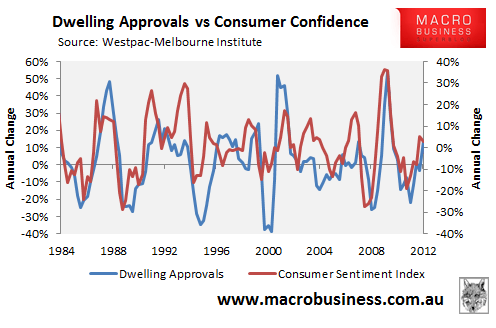
AV Jennings will be happy to know that consumer sentiment has indeed picked-up and is now running above the long-run average (see next chart).

Moreover, increases in consumer confidence typically translate into increased housing activity (see next chart).
unconventionaleconomist@hotmail.com


So when will these land-bankers begin to “liquidate” their holdings? Time to get rid of incentives and lower their price to actually get sales! Or fail.
They will struggle with that concept because their development debt finance is based on the full “value” of the development. Chop prices too much (and that may be not much at all) and loan covenants get breached.
Rock, meet hard place.
Unless the confidence fairy comes and blows pixie dust all over the place…
The listed developers have surprisingly low gearing ~25%, so don’t count on bank-forced sales. They have had 5 years to clean up their act. Overall, the banks are very wary of lending against non-income producing land.
The value of their land holdings will decline a lot. But the pain will fall on committed/sunk equity (shareholders). With sales volumes down and land prices down, the REITs may be the property short opportunity many are seeking.
Don’t Buy Now!
Hey DC,
Why didn’t AVJennings make your list of listed developers?
Their 10k+ lots puts them ahead of Sunland and FKP.
Yes, Patrician, my error. I will update. We need to see that debt/equity comparison too. DBN
Why do you see REITS as a property short
I don’t short. There is global interest among shorters in exploiting the end of The Great Australian Land Bubble. They ring me all the time.
The shorts can see the developers’ open veins – falling rents, falling profits, falling sales revenue and falling land prices. They want to get set before the current trend accelerates.
Does anyone know when the PEET half-year result is due out? I can’t find any mention on their website or elsewhere.
There are some companies with positive results.
The Mirvacs and Stocklands are subject to new CEO’s impairing land estates bought poorly at a time Governments and banks handing out credit too easily.
The winners here being the previous landowners.
Commercial and industrial land has been adjusted down 40%+ during the GFC, residential however was a sacred cow and propped up.
Banks and Governments will never let large volumes (ie across the board as opposed to new oversupplied estates)of residential land values to fall significantly, particularly as the banks are valuing their own asset, and control the amount of credit released in the market. Banks hold both ends of the stick. http://www.macrobusiness.com.au/2010/11/deep-t-the-capital-rort/
+1 Agree. But there is a limit to how much banks can squeeze out supply and boost demand. I think we have reached that point.
You have rising unemployment in Australia, a change in 457 visa laws and property developers losing money.
Was anything in the US like this when the sub-prime burst, I mean, is the lead up in Australia the same as the lead up to the popping of the bubble in the US when it came to property developers ?
“The company cut the value of a Victorian project, noting that the downturn in that state had “required a more aggressive pricing structure” on the project.”
The Victorian projects are at Portalington, Pakenham and Epping
“The value of its residential projects has had a 5.3% cut”
Sounds false compared to the -20% $1/4 Billion write-downs by other Landbankers recently.
Here’s a thought on AVJennings
They say they have lost 5.3% on the value of their residential holdings causing a $16m loss
They say they currently have 10581 lots in their landbank. At a conservative $200k per lot that would be a total value of lots at $2.1b. A 5.3% loss on that value would be $112m.
Am I missing something?
It’s all about the debt service & interest cover ratios folks – it can’t fall below 1:1 without renogitation of the banking facilities. That’s the key for property developers.
Hence the developer’s sale incentives on the side (Free Car, Free BJ, Free Beer, Free Tibet) but no real discounting.
Don’t buy now – indeed…
…and still no mention in the reporting about how the “gifts and rebates” are being paid for.