ABS house prices leap in December

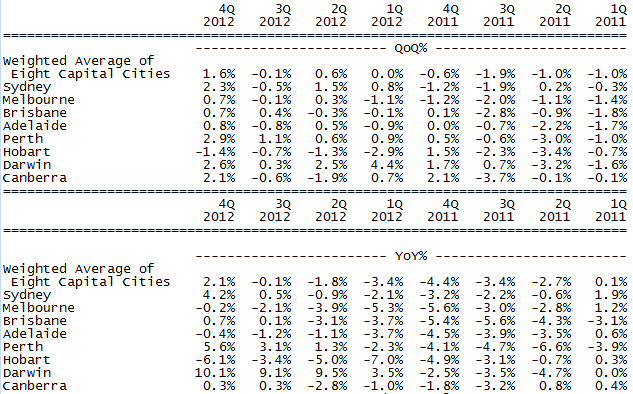
The ABS eight city house price index is out and accords with APM’s house price movements announced last week of a 1.6% increase in the December quarter:

And 2.1% on the year:

Rises were led by Perth and Darwin and Sydney was also solid:

These results are at the stronger end of the spectrum of different provider results. No doubt about it, stimulus is slowly having an affect on prices despite the absence of a credit bounce.

The New Zealand phenomenon of mediocre credit growth tipping into low volumes and price rises may have arrived here too.


120 Responses to “ “ABS house prices leap in December”

  1. manfin says:

    Didn’t Hobart supposedly jump 4.7% by APM’s figures?

  2. dam says:

    Color me surprised ;-)

    Look like 2013 is going to be a great year for pretty all assets, Shares or Properties, the tide rises all boats.

    • raveswei says:

      yeah … it looks that investing in literally anything brings huge returns

      So, there is no need to work or produce anything in this country when we can all take more debt, invest the money and live like kings.

      • Archie says:

        Australia is one of the wealthiest countries in the world, and also ranks very highly on the UN development index. We do live like kings compared to most of the world. We’re very lucky here.

      • rich42 says:

        I think Archie, we’re living like kings at the huge expense to the way our kids will live. We’ve consumed both yesterday’s and tomorrow’s money in the past thirty years. Sold way too many assets, gotten in way too much debt, earn way too much compared to our competitors, and populated way too much. This is not sustainable and will not end well.

      • GSM says:

        “I think Archie, we’re living like kings at the huge expense to the way our kids will live.”

        This is partially true. Moreover though, our kids are very unlikely to inherit the abundant good luck up until now showered on previous generations of Australians (although I fervently hope they do!). I suspect that we will see kind of a return to the 50′s and 60′s type of Australia wherein unless you are a hard grafter, very well educated and/or prepared to sacrifice for a more propserous future then yes indeed you may well get left behind.

        In essence, your fortunes much moreso than in prior decades will be increasingly dependent on the individual and not Govt or the natural bounties flowing into society.

        If we don’t go that route, I suspect then that Govt will become a huge part in our kids lives, bigger than ever seen in our history. I don’t see a lot of anything in between. And that is where the majority of most kids are.

      • Rusty Penny says:

        ,i> suspect that we will see kind of a return to the 50′s and 60′s type of Australia wherein unless you are a hard grafter, very well educated and/or prepared to sacrifice for a more propserous future then yes indeed you may well get left behind.

        A return to Keynesian, full employment politics..

        You finally got something right there brother.. thumbs up from me!!

      • Alex Heyworth says:

        Australia in the 50s and 60s was indeed characterised by full employment, but Keynesian? Not so sure about that. Full employment probably depended mostly on protectionism and on a large proportion of the potential work force (married women) being largely excluded. Government fiscal policy was mostly focused on paying down the debt from World War II.

  3. Archie says:

    I know I got hammered here for suggesting this yesterday (based on Residex and APM results) but this data backs up the fact that Sydney house prices have surged to a new all-time-peak (Dec 2012 ABS index for Sydney is higher than the previous record set in 2010).

    • Property surged to new highs after the 2008 stimulus & rate cuts as well, but the euphoria didn’t last long. Chances are this recent surge will leave an equally bad taste in the mouths of those who scramble to pay higher prices and get burnt as prices fall back later.

      I’ve even heard suggestions from the crazy permabulls that we could approach a million dollar median house price in Sydney by 2015… just silly nonsense.

      • Peter Fraser says:

        BB – that euphoria lasted two years and sent property prices to levels that still haven’t been retraced. Very few of those who bought in 2009 have any regrets – why would they?

      • Depends on where.

        I sold at the end of 2009 and while the peak in that Adelaide suburb did come a few months after I sold, prices there now are lower than when I sold and I’ve saved tens of thousands in interest renting since. I have no regrets.

      • gonderb says:

        Well for Adelaide that decision still looks OK – the ABS index for example was 157.6 in Q4 2009, and it’s still below that level now (155.3). Similar story for Brisbane and far worse in Hobart.

        Not the case though for people in Sydney, Melbourne, Perth or Darwin, where prices have all risen quite a bit since then on ABS stats. In fact the ABS index has Sydney at a new all time new high in this print.

      • JPK says:

        I sold in Melbourne at the end of 2009 and bought again in a better suburb in September 2012. The prices in my old suburb are lower now and so are the prices in my new suburb (median some 15% below the peak).

      • Archie says:

        Interesting angle….. so rising Sydney house prices is a bearish signal? I haven’t heard that one before.

        $1M median for a Sydney house? Sounds a bit far fetched, I’d expect maybe low to mid 900s at best by the end of 2015 if these gains continue.

      • reusachtige says:

        lol. paid by whom and with what?

      • Byron says:

        Haven’t you heard? Double income house holds are old news welcome to the triple income house hold. They’re also lowering thd working age to help first home buyers.

      • reusachtige says:

        ^ Multiple wives are ok now I hear. That’s just extra trouble though.

      • The Patrician says:

        Heh, it’s a poligamy led recovery.

        The Mormans were on to something.

      • Stomper says:

        and there-in lies the problem!!!

      • energywonk says:

        bahhaha. thats definately one of the funniest things i have ever read. 900k median?!?!? wtf? your pulling our legs right? what planet are you from. 900k thats pure gold. so with average wages at 67k or so, i get 13x wages. but i guess if houses are going to 900k wages will go 100k. i cant wait for my wages to nearly double in 2 years. im going to buy 2 porsches.

  4. flawse says:

    Can we go back a few months and revisit the ridicule and angry pasting a few of us got for suggesting that this was certain to happen as a result of lowering interest rates?

    Do we still all think that lowering interest rates is the solution to our problems?
    Along with the housing where are all the factories, science labs, software centres that were to magically spring up to sell high tech stuff to the uneducated Asian hordes?

    Now we’ve got house prices accelerating again, imported ‘Prestige cars and SUV’s walking out the doors, and retail holding up, then we’ve obviously got growth, lower savings, and the CAD and foreign borrowings on the rise. How is the economy now easier to reform ?

    • The Patrician says:

      Spot on flawse.

      Like using a jerry can of fuel to start your camp fire. Dumb but if have to, make sure the kids are out of the way first.

    • The Patrician says:

      Spot on flawse.

      Like using a jerry can of fuel to start your camp fire. Dumb but if you have to, make sure the kids are out of the way first.

  5. PETER_W says:

    Low turnover & compositional changes in data sample. Upper end dwellings could be down 20% but if more of them are selling it looks like rising prices

    • Revert2Mean says:

      Bingo.

    • Stomper says:

      +1

      Upper end is NOT selling – in my area of interest (Northern Beaches, Mid-North Shore, inner-west Sydney) – prices are well down on 2007 with stock on market moving at a heavy discount or not moving at all.

      Rental prices are between 2.5 – 4% with an inverse correlation between quality of property and % rental return.

      A great example is this property:

      http://www.realestate.com.au/property-house-nsw-haberfield-111716771

      Purchased in October 2012 for $2,375,500

      Now renting for $1,250 per week

      http://www.realestate.com.au/property-house-nsw-haberfield-409608967

      Gross return of 2.74%

      Northern beaches is a blood-bath – I read somewhere stock on market in Bayview is closing in on 12 months – even with the deep discounts to 2007 prices.

      I’m CONFIDENT on a slow melt OR a fiscal crisis that will return the Sydney market to fair value in the next 12-24 months.

      Don’t say you haven’t been warned.

  6. Peter Fraser says:

    Much stronger rise than I was expecting. I was expecting this 1st Quarter in 2013 to show a big jump up in prices – perhaps it still will.

  7. Phroneo says:

    I’m still not buying. Even a 20% rise this year wouldn’t scare me. The fact is, the world all over is on the edge one way or another. This QE supported illusion won’t last forever and I think that within 2 years, something unfixable will blow and cause this nation-destroying bubble to finally correct.

    In the meantime, I’m sure that foreign buyers of apartments have done their job at getting our most expensive housing out of its ‘slump’.

    • Stomper says:

      +1

      IMO the headline numbers do not reflect what is happening out in the broader RE markets.

      Like for like dwellings are not selling for anything but 2007 prices. Buyers are few and far between resulting on lower sales volumes.

      Vendors are withdrawing stock from market rather than sell at a “discount” – and you only have to look at the post 2012 volumes to see supply starting to creep up.

      The first big shock in 2013 will drive any residual confidence from the market.

      It’s only a matter of time..

      • aiecquest says:

        +1 Have been discussing elsewhere in another field i.e. “immigration” and “population” the lack of clear thinking, statistical literacy and analyis by supposed “researchers” and media (medium?) who have a barrow to push, or something to spruik.

        Basic issue is where headline statistics, without any qualitative research or analysis, are used to make correlations with e.g. a single variable, which are at best vague, but then translate into direct causal links.

        But those who are understand or have clear thinking abilities are limited, while intended audience accept at face value.

  8. TheRedEconomist says:

    Easing Bias of the RBA is dead and buried now surely

    • Not necessarily. The growth hole is still there. This is a low volume price bounce with no construction follow-through.

      They were always going to need prices to move before construction would.

      • Peter Fraser says:

        True, but they need policy changes from Canberra which need to flow onto the states – have you heard any whispers from the Abbot team?

      • reusachtige says:

        What H&H? People aren’t buying new houses at existing prices. Developers can construct as much as they want at higher prices but unless they actually lower prices it aint selling too well. That comment just doesn’t make sense. It may be what developers want but it’s not the reality.

      • Rusty Penny says:

        Not necessarily. The growth hole is still there. This is a low volume price bounce with no construction follow-through.

        Ok, but by now they have to realise their response, in either directin, can’t impact things.

        It’s like a plumber coming in, tearing up my bathroom, then tearing up my laundry, then lastly tearing up my kitchen saying “I just can’t get the light switch to work”.

        It’s not a monetary policy issue we experience, that’s has to be clear, it is surely fiscal, namely the tax distortions and incentives to non-productive jobs.

        The RBA’s course of action is to wave its hand and say “we’re spent… there’s nothing mroe we can do”

  9. The Patrician says:

    A more accurate headline.

    “Record low interest rates drive house price inflation”

    Stop cutting rates.

    • The economy needs lower rates or it will tank.

      You’re a one issue wonder.

      • barry says:

        True but we need two central banks. One for WA and one for the rest of you.

        Current rates are far too low for WA hence 5.6% yoy growth in house prices.

      • raveswei says:

        what economy needs lower rates?

        there are only two sectors of economy in this country and neither of them needs lower rates

        This country is “one issue wonder” and that issue needs to die before people start thinking about real economy.

        Our economy will not recover by providing more cheap money to people because all that money ends misallocated into non-productive assets. Cheap money got us into this position and now you are suggesting we need to do the same and expect different result?

      • AS I have argued for 18 months and again today, we need lower rates to lower the dollar and new tools to prevent a credit surge.

        I get up with an endless bearish reiteration of no rate cuts.

      • Gunnamatta says:

        Yeah, but at the moment there on the leeward side of 175 bp of rate cuts (without any MacroP stuff) then anyone looking at the market is incredulous at the prospect of a price spike fuelled by an elnarged debt spike.

        Dont get me wrong I am not having a pop at you and understand your point (and the point you keep making about the need for macro tools)

        But I also understand Patricians point that without the Macro stuff if all we are getting is rate cuts then policy has departed the realms of credible.

      • The Patrician says:

        How about we get the macro-tools in place first, HnH?

      • Good idea. And let the dollar cruise through $1.50 too.

      • Alex Heyworth says:

        ” we need lower rates to lower the dollar and new tools to prevent a credit surge.”

        What we really need is higher interest rates in other countries to lower the dollar.

      • raveswei says:

        I agree with you that low rates combined with new macro-prudential policy would be the best solution. Everyone knows that we will not get “new tools to prevent a credit surge” any time soon, and clearly not before economic collapse caused by credit bubble burst. You are just ignoring this fact – we will not get a new macro-prudential policy before catastrophic economic failure of the existing policy.

        So, the only way to get better macroeconomic situation in this country is not to give life support to the system that got us into this position. Lower rates (with no policy change)and credit driven housing economic “recovery” will just make economy worse and delay inevitable crash.

        We need realistic, not idealistic solution and what you are offering is, I’m afraid to say, just ideology.

      • flawse says:

        That’s straight baloney HnH…..please reveal to we ignorant good for nothings how a booming housing market, especially with lots of construction and more of the nation’s resources than ever before directed into it, with more imports, a higher CAD, more and accelerating debt as a result of increased consumption expenditure, makes the economy in a better position?
        Then please explain to we totally ignorant ‘one-trick wonders’ how this makes the economy stronger and easier to reform?

      • Not talking to you. Patrician stomps his foot like a juvenile recessionista every time there is a rate cut.

        He is not interested in the CAD.

      • The Patrician says:

        “He is not interested in the CAD.”

        But I am.

      • Peter Fraser says:

        flawse low rates are here to stay for some years. At least that is the analysis of the major banks, and they usually have a good handle on that.

        HnH doesn’t appear to be arguing for a housing boom, in fact the opposite from my POV. He wants LVR and other controls to restrict lending and keep a lid on it.

        It’s not my POV but certainly it will work.

        I don’t see the connection between that and having a higher CAD. If credit growth is managed correctly it just won’t get out of hand as you suggest. Lower interest rates and a lower dollar are not necessarily going to promote wild credit growth with the right tools in place.

        As I said it’s not my POV but he isn’t wrong, the plan would work.

        A lower dollar would help a lot of industries.

      • flawse says:

        Peter
        We need that wine and you need to stop reading Bill Barnacle. He doesn’t think through problems and in this case neither is HnH. Lower interest rates not only mean credit creation by Banks. (read Ray Dalio)HnH is advocating lower interest rates even in teh total absence of all those new rules and LVR’s.
        Lower interest rates mean credit creation across the whole economy. In our economy this means more consumption spending.

        As I’ve said before your hero talks about vertical and horizontal money. Sure there is a small difference for one transaction. On the passing of that transaction it just becomes what it is…money..which is spent on consumption.

        In our nation as soon as you spend money on consumption you get an increased CAD. We make Sweet fanny adams of anything and we’re making less every day.
        In the absence of a reformed business environment, which is now totally impossible, we will never make anything.

        Yes we need other macroprudential tools but as raveswei, patrician pfh et al point out we don’t have them and we’re not getting them. In their absence lower interest rates, the path by which we got into this parlous state, are being used to decrease and destroy savings, increase credit creation and debt. That debt WILL show up in the external account as sure as day follows night.

        Peter…nominate me one Bank in this country that predicted the GFC? Maybe just one economist in one bank?
        Now tell me how their prognostications on interest rates should be taken seriously. Further, obviously it is in their interest to have low official rates and they don’t give a RA about the good of the nation…just their own damned profits. So why should we presume they have some superior wisdom that the rest of us don’t get? Their greed and self-interest at the nation’s expense has been obvious for 30 odd years.

        Slightly off topic but relevant, the ironic part of all that is that in these pages it is the miners who are the evil doers and get all the hate mail.

      • flawse says:

        “Not talking to you” Maybe but you have made exactly that same remark to me quite recently. That’s not important.
        What is important is that the problem gets thought right through and that is what you don’t do.

        You adopt the good old social conscience thing that anything that causes any hardship has to be avoided at all costs. The cost is the future.Lower interest rates are just making our future problems worse. We are financing our lower interest rates by more indebtedness.

      • flawse says:

        P.S. Peter
        I’m not arguing we won’t have lower interest rates for years. I’m sure that all political parties, Banks, Unions, the PS, RBA, media, RE agents, etc are ALL in favour of financial repression. That current is hard to swim against. Further, if we have the current policy of continuing to sell off our assets to foreign interests to fund our consumption we can keep going with this madness for a few years yet.
        Further as long as we ignore inflation and are happy to head off into mayhem we will continue with low interest rates.
        What some of us are arguing, quite rationally and thoughtfully, is that we SHOULD adopt a different approach. That different approach is occasionally discussed and agreed with here. However as soon as push comes to shove we head off into the lower interest rate tunnel.
        Lowering interest rates in the current environment is just damaging our future and worsening the distortions in the economy.

      • Peter Fraser says:

        flawse they all knew it was coming but they weren’t going to yell “fire” in a crowded auditorium, that would have been counter productive. They weren’t involved in lending in the USA and so couldn’t possibly know the standards there, but they knew well in advance, as did many.

        I worked in the banking system when LVR restrictions applied, they work very well and they also heavily favour the wealthy as banks become ever more selective in their lending targets, which is my gripe with using LVR’s to filter lending.

        I know that lower interest rates will stimulate the economy, I don’t need Ray Dalio to tell me that and I don’t read Bill Mitchell.

        Yes we should have that bottle of wine, perhaps next week would be good.

      • GSM says:

        “they also heavily favour the wealthy as banks become ever more selective in their lending targets, which is my gripe with using LVR’s to filter lending.”

        Yep, we need banks to lend to the financially challenged and insolvent so that we can keep this ponzi RE Business model going. Must have more suckers coming in the door . Where else will the greater fools come from.

        Sickening.

      • Peter Fraser says:

        GSM – no that isn’t what I was inferring. Try a banking system that heavily favours the sons and daughters of the wealthy at the expense of hard working credit worthy people because banks prefer the support of the credit funds and the business income generated by wealthy families.

        Indeed it was sickening at times.

      • raveswei says:

        “they also heavily favour the wealthy as banks become ever more selective in their lending targets, which is my gripe with using LVR’s to filter lending.”

        Peter, that doesn’t favour the wealthy, it favours savers. If rules gets introduced, prices will fall and 20% deposit will become equal to 10% of these elevated prices. Everyone who cannot save that money over 5 or so years is likely to default on that mortgage anyway.

        Wealthy do not need mortgage, they buy homes for cash because homes are just fraction of their wealth.

      • Peter Fraser says:

        rav – in the end it makes no difference – supply adjusts to a lower demand and prices rise again, although we may see a period of 5 years, or a max of 10 years when it would work by masking the problems. At the end of that period the problems would be worse and getting back even to where we are now will be a difficult task.

        Why would anyone want to artificially suppress demand when supply is the problem.

        The issue that I raised about wealthy families getting advantageous treatment – well of course that already exist but not to the great detriment of others. In a period of heightened selectivity, sons and daughters of profitable bank clients have a great advantage over others.

        Having a deposit, a good job, and the ability to make repayments isn’t enough under that lending regime – I’ve worked in those conditions – it won’t concern me personally, but it will not work out as you think, the unintended consequences will beat you.

        It will depend on how well the tools are used – but I have some concerns.

      • Rusty Penny says:

        The economy needs lower rates or it will tank.

        Tanking is what the economy needs.

      • Peter Fraser says:

        Name one collapsed economy anywhere whose citizens are crowing about their good fortune.

        That level of stupidity is difficult for sane people to fathom.

      • Rusty Penny says:

        Iceland.. you can leave now

      • Peter Fraser says:

        You are digging a hole for yourself – they are not crowing and they suffered pain as well as inflicting pain on anyone who had money in their banking system.

        http://topics.nytimes.com/top/news/international/countriesandterritories/iceland/index.html

        But you did maintain a consistent standard.

      • Rusty Penny says:

        it looks like you attempted to have google do some thinking for you, instead of locating a item you knew about.

        Where does your article mention anything regarding long term suffering there?

        This is one of the paragraphs in amongst it…

        “By 2012, Iceland seemed to be doing surprisingly well for a country that just four years earlier had plunged into a financial abyss. It repaid, early, many of the international loans that kept it afloat. Unemployment was hovering around 6 percent, and falling. And while much of Europe was struggling to pull itself out of the recessionary swamp, Iceland’s economy was expected to grow by 2.8 percent in 2012.”

        Icelandic citizens now have a more psotive future to look forward to, especially in light of many growth impediments being cleared out of the way.

        Anyone who … *ahem*..suffered from their banking system… bank deposits are still investment. Investments are meant to fail if they are improper. No investments is meant to be prevented from failing on its own merits.

        Also more here…

        http://www.zerohedge.com/news/2013-01-26/only-3-minutes-worth-listening-davos

        You simply must not have a humiliation gland.

        You are made to look stupid and lacking knowledge every time you challenge my clearly superior views to yours.

        Now scurry along to your cesspool of ignorance, you make us all more stupid by having to endure your crap.

      • Mav says:

        +1 RP. But then, post-GFC Iceland is a Debt merchant’s worst nightmare come true. Some banks were allowed to fail, the super-sized FIRE sector was allowed to shrink and they went back to the basics – fishing, energy & aluminium smelting.

        Do you seriously expect PF to go back to making apple juice for a living?

      • Peter Fraser says:

        Oh Goody – two second rate comedians for the price of one.

      • reusachtige says:

        Good stuff boys! PWND the spruiker.

      • Peter Fraser says:

        Sorry guys but aggressive denial of what is, is no insulation from it.

        And you know that.

      • Mav says:

        aggressive denial of what is, is no insulation from it.

        Trying your hand at Pop psychology/philosophy as an alternative profession, eh? Good on ya, See! you are making progress already!

        But, do you want to explain what was “aggressively” denied? Otherwise, your home-spun pearl of wisdom makes no sense.

      • AF says:

        That is absolute BS

    • Gunnamatta says:

      +1 Thats about the sum of it.

      But this is an Indian summer phenomena here, no market just glides permanently south and RE has been downhill for a while.

      I find myself wondering whether a resurgence in deflationary impulse/deleveraging (and look at where we are debt wise – 145% of disposable income, mortgage debt circa 85% of GDP) will see rates cut again this year – and further spike a climb in speculation (RE prices) without spurring construction.

      • Archie says:

        You could just as easily say no market just glides permanently north, and RE was on an uphill for a while (past 6 decades?) until the recent temporary correction.

      • Gunnamatta says:

        and we just keep growing that debt…..

        At some point the lenders ask if borrowers are good for it.

  10. squirell says:

    as I’ve said many times, don’t understimate the ability of policy makers to socialise losses. There certainly are parallels with NZ except for the following:
    - only Akld is experiencing strong growth again (… so far)
    - NZ property had a 10-15% correction after the GFC, Aus had a 30% rise. Aus rental yields are pitiful compared to NZ (event though NZ’s yields are not flash)
    - NZ’s earthquake has led to lower for longer rates, and also a shortage of homes in Chch and a uptick of migration to Akld.

    … so what to do? I’m in Melbourne which thankfully is not seing any groupth. dont see huge growth going forward, and almost certainly wont be enough growth to offset the massive discrepency between rent v buy.

  11. overflow says:

    I am angered and saddened and disgusted by this news. We have the most expensive houses in the world and prices should have crashed by now.

    Where does this data leave the crash or “slow melt” thesis? Is it still intact, or do we collectively need to have a rethink?

    Our collective thought process said prices should be falling hard. What did we, as a group, miss?

    • squirell says:

      the mistake made is one that is repeatedly made. Dont think for one second there is a housing market in Aus, its a govt sponsored ponzi scheme. Like Holden / Ford subsidies, farming subsidies etc etc etc this can keep unsustainable industries alive for some time – the demise will either be forced on us by external events OR voted on by an educated public. I’m thinking the former, sad but true.

      • Stomper says:

        …. and I cannot understand why politicians believe rising housing prices is a good thing?

        Surely, price stability relative to income combined with construction volumes which meet the needs of urban growth – should be achievable goals rather than maintaining unsustainable high prices with highs and lows in construction activity?

        Or do homeowners represent such a large block of voters that it would be political suicide to correct what is wrong?

        The question I would ask any politician is how is it equitable for middle (and lower) income families to be denied affordable housing close to their places of employment? Where are the next generation of teachers going to live if affordable housing is not made available?

      • jimbo says:

        ‘…. and I cannot understand why politicians believe rising housing prices is a good thing?’

        They own and in many cases have portfolios of IPs to boot. Apparently, lifetime indexed super schemes initially worth well into the 6 figure bracket are just not enough!

        I think it’s safe to say they will do everything in their power to keep the bubble inflated despite the drag on the rest of the economy.

      • Trickster says:

        What “farming subsidies”? Australia would have some of the least subsidised, and most productive, agriculture in the world.

    • FactOrFiction says:

      Maybe you missed the reality, hanging on to a fixed view how “things should be” rather than accepting that markets are constantly changing?

      The signs are everywhere but just a couple of examples:
      . Nathan Webb’s analysis of AFG data (published on MB: http://www.macrobusiness.com.au/2013/01/seasonally-adjusted-afg-points-to-rising-house-prices/), or

      . Steve Keen’s Credit Impulse – rising since Dec-2011 and now in positive territory.

      The trend will change again, no doubt about it, but for now it is up…

    • The Patrician says:

      “What did we, as a group, miss?”

      3% OCR with no macro controls

    • Black8 says:

      I guess its a combination of IR falls and also seasonal factors. On the quarterly chart there is an untick in the last quarter of most years.

      I think there is also an element, as with the recent stock market rises, of people getting fed up with being sat on the sidelines waiting!

      My own personal experience of this is that while I’m trying to avoid buying the top of the market and prepared to rent and wait, my wife is losing patience with this.

      With no clear evedence of a crash happening, it feels more like an article of faith that one will happen!

      • Stomper says:

        Black8 – welcome to my nightmare.

        I’ve been juggling the “fiscal responsibility” v “happy wife / happy life” paths for three years.

        Yes, it would be nice to own a house without the nuisance of landlord neglect / Interference.

        Yes, it would be nice to have permanency of accommodation.

        BUT

        Our rent is cheap and we live in a good area.

        We save and invest the difference – over the past three years the difference has been over $100k

        Today’s property prices do not reflect fair value – and I believe the market is slowly beginning to understand the fair value proposition.

        The costs and risk of property ownership outweighs the benefits at today’s prices IMO.

        In the longer term we will purchase property – but it will be when property does reflect fair value and/or we have saved a sizable chunk of equity so my investment is not highly leveraged.

        My advice in the short term – rent and save – AND buy your wife lots of flowers!

      • Trickster says:

        Ditto here. Have even started going to Open Houses so the wife thinks I want to buy!

    • Fabian Aldersey says:

      For me, it’s not about a collective decision. It’s an individual decision.

      If house prices are currently too expensive for me, and I can’t afford to buy, then having them go up in price doesn’t make me re-evaluate and say “now they’re more expensive, now I can afford to buy”.

  12. Maz says:

    Dammit $^&% &*(^ !@##

    Is Perth *ever* going to slow down?? Grrr

  13. reusachtige says:

    Clearly, lower interest rates ARE NOT good for our country.

  14. squirell says:

    and have some cheer guys, arent int rates supposed to rise again later this year?

  15. Janet says:

    Cheery news from New Zealand’s biggest property market, Auckland…”….new listings more than doubled in January from December while the average sale price fell…” I wonder what that means?!

    • Black8 says:

      At least your politicians are coming round to the idea that “affordable housing” might be a goal worth aiming for. I fear that is an alien concept to australian pollies on both sides.

  16. RandomDude says:

    …and there goes my marriage, I resisted for 5 years… won’t be able to do it much longer I think.

  17. Mav says:

    Rising prices lead to positive sentiment leads to rising P…………

    …Ponzi financed bubble? Thanks for illustrating how flimsy is the ground on which this house of cards is built on – CONfidence and sentiment… as against productivity and profitability.

  18. flawse says:

    Random…sounds like a few of us in that boat!!!!!!

  19. Rusty Penny says:

    Immigration is a red herring when it comes to housing prices.

    If more come, all you have to do is build more.

    We had a much greater wave of immigration in the 1940′s and 50′s, and housing prices didn’t blow out.

    • dam says:

      in addition Australia was less urbanized then, it was easier absorb this immigration in the outback.

      nowdays most immigrants are coming from an even more urbanized background than OZ and only want settle very close to CBD, and beside few high rise, we dont make much land close to CBD, we build far from everywhere, far from infrastructure, in failing Estates.

      Immigration could have a greater impact now IMO.

      • Rusty Penny says:

        heheh.. how would you know.

        We still had most of the population in Sydney, Melbourne, Brisbane.. and then Adelaide coming in 4th, with Perth and Newcastle being sizable.

        Australia has always been urbanised.

        I would suggest however urban living occupied 0.4% of the land mass instead of the 0.7% it does now.

        I don’t think land mass is material, and they definately weren’t living in the outback.. then nor now.

        Most immigrants came into the capital cities, and as opposed to your flight of fancy.. the didn’t elect close to CBD areas, they picked fringe urban boundary land, or even close-to-city farming areas such as Quakers Hill, Edensor park, etc in Sydey… Spearwood and Wanneroo in Perth..

        I’m sure other can name similar old scholl ethnic areas in other cities.

        As far as wanting to live in the CBD…. Hong Kong and Singapore have shown floor space is easily accessable.

        The things causing high prices are too… social constructs… a wealth distribution mechanism so that those that are work-shy.. such as mortgage brokers who want trailing commissions, can make a bigger clip off those having to access a large mortgage to buy.

    • Rusty Penny says:

      Well you have picked a distorted starting point.

      1949 was the last year of the WWII rent-controls.

      Try 1952-1962, then compare to wages of the time, then compare as a ratio of average wages

      http://www.rba.gov.au/statistics/xls/op8/4-17.xls

  20. DT says:

    There’s a difference between what is happening and what many of us feel needs to/will happen. The fact that they went up just means the fall on the other side will be harder. The market can stay irrational for a long time.

    The fundamental problem with ever increasing house prices is that they are driven by increasing debt. That can’t last forever and it won’t end well. No amount of immigration or government intervention will stop it if and when it hits the wall.

    • dam says:

      yeah long long time

      Debt is not increasing much at this moment, less than 5% and still prices are rising at an accelerated rate (Which make the premise of “house prices linked to debt acceleration” moot ). Obviously there is a bit of equity there ;-)

  21. Idle Wanderer says:

    Interesting to see so many Stubborn Bastards out there. But you may not be as far in front financially as you think.
    Here’s our SB story:
    Sold our home, Sydney Northern Beaches early 2012 to a nice expat in Europe who wasn’t going to live in it for a few years. We actually like our home very much but knew we were going to have to move in a couple of years for health reasons [too many stairs]. So, sell before the bust and downsize. Anyway, we rented it back for a couple of years from our nice expat landlord.
    His gross return [from our rent] is exactly 4%. Meanwhile, we took all the money, no mortgage to discharge, and squirreled it away in various banks, each account below the Govt. guaranteed level for safety. Well, where else would you expect us to put it, into the Stock Market Casino?
    So we are making approx 5.5% fixed, on average. Sounds good, eh? Must be ahead! Problem is the 30% tax on the interest. Brings us back very close to 4% return.
    Meanwhile our landlord has a whopping great mortgage, so he’s well and truly negatively geared. As he’s an expat, I’m sure that gives him his own problems.
    Who made the right choice? Seller or buyer? Won’t be able to tell for another year or two until we find out whether it turns out to be capital appreciation in our area or a deflating bubble.
    Even I’m beginning to weaken and starting to think maybe we should jump back in and buy. But I’m pretty sure we’re just in the capitulation phase, when even the Permabears crack and lose all hope. See posts above. [When, Macrobusiness Bears start throwing in the towel, that HAS to be capitulation!]
    Did anyone else notice the big spurt of activity last December in Sydney? Houses selling all over the place right up to Christmas. I’m thinking that was the knock on effect of the last flurry of the old NSW First Home Owners Scheme claimants taking out existing stock in a rush late last year and then the owners of that stock trading up, in fact being forced to find a new place in a hurry, possibly paying more than they wanted to.
    An awful lot of new listings have arrived onto the market again in the second half of January, at least in Sydney. They’ll become disappointed in a few months and after a lag will be selling for less than present asking.
    Just another point for consideration: a gradual rise in house prices is to be expected in many markets as a lot of the existing stock gets renovated and extended over time. It’s not strictly like for like. I don’t think there has been any significant period in the last ten years in our street when somebody hasn’t been doing a big reno. We don’t need alarm clocks around here. The tradies cranking up their circular saws and nail guns at 0700 have been doing it for us for years. All that money spent ends up back in the selling prices, sooner or later.
    Just my 2c.

    • I’d say you’re the winner here.

      5.5% fixed rate is pretty decent, even if you average MTR was 30% you’re still walking away with 3.85% nett. And with much less risk, much more flexibility (if you need to move tomorrow, you presumably could).

      Meanwhile a 4% gross return, less rates and even with very low maintenance and he’d probably be lucky to be clearing 3%. If he’s borrowed to buy, then that’s even worse….borrowing @ 6%+ for a 3% yield doesn’t make sense. To break-even the property needs to increase in value by a rate equivalent to (or more than) and after-tax sum total equivalent to cash flow plus opportunity cost.

      The “upside” that is most often argued is that the property should increase in value; more correctly we should say that the land value should increase at approximately the rate of inflation over the very long term.

      Meanwhile the value of the structure will depreciate. Most homes have a “life” of 40 – 50 years built into them. The Metricon-style McMansions will probably be lucky to get to 30 years.

      Simple maintenance is a major reason why the tradies and weekend DIY-ers are kept busy. Re: the “upgrades/improvements”, you must bear in mind that as far as I know most tradies still need to be paid for labour, materials etc….pretty easy to throw $50k into a renovation without blinking…. it’s just another $50k that gets throw into the “depreciating asset” pile

      For every buyer there is a seller. Usually both think they have the upper-hand. If you (or anyone) wants to provide the opportunity to a seller, buy buying, then best of luck to you.

    • Stomper says:

      Idle Wanderer – I agree with Insight Wealth – although with hindsight you should have:

      1. Negotiated a better rental rate – 4% is at the high end of returns – Current market rates at the high end are closer to 3%

      2. Sold in 2007 – you’ve had 5 years of stagnant (or declining) property growth.

      Overall you should be in a far better position and in reality the Northern Beaches property market is in a slow death.

      Could it be that decades of development without ANY infrastructure is finally catching up? Commute times anywhere north of the Spit Bridge are at 3rd world standards and being non-marginal strong Liberal voting means will stay that way for eternity.

      Stock on market is increasing and there are deep discounts to be had from 2007 prices – I can’t see property prices going anywhere soon, – other than further decline.

  22. aj. says:

    I am increasingly convinced that managing speculation in housing is the answer – how to get to that point and unwind all the existing speculation is problematic of course in practice.

    There is simply buckets and buckets of cheap money washing around the globe and way to much of it gets to housing. The two major solutions that are flagged are leverage limits and supply (more land) – but it’s just simply too hard for these to do much in the face of an overwhelming amount of money with not many places to go. The former really does just accentuate the capital/no capital divide, and the latter seems to struggle to outrun the sheer volume of money and struggles in places where quality is not homogenous.

    If someone wants to invest in residential property then it needs to be a fair-dinkum investment. 1. They should be required to improve it significantly (including land taxes to further weed out the passive) and 2. Loses should be quarantined to income from the asset (lose the negative gearing).

    Until we as a community are prepared to address this then debate will rage on, and the rentier classes will continue to try to make a living from doing nothing other than having access to cheaper or existing capital, and those seeking to escape this track will be pushed into debt servitude and the mind numbingly stupid feedback loop between these two groups will continue to blur as the rewards from speculation flow.

    As we head into a new election I have not heard one word from the major parties that could even be considered a move to addressing this as an issue for debate.

    House prices to rise.

  23. Idle Wanderer says:

    Thanks for the analyses, Insight Wealth and Stomper. Appreciate your input. I’d be a lot more sanguine about the outcome if there weren’t so many prospective buyers at every ‘open home’ I go to, particularly around Manly. I think the Northern Beaches market might have fractured into “Close to the Manly Ferry” and “The Rest” for whom the Spit and Roseville Bridges are increasingly problematic, as you say. Lots of Eastern Suburbs young families evacuating to the Manly area, it seems. They all think Manly is cheap by comparison, from what I overhear.