

The Real Estate Institute of Victoria (REIV) yesterday published an article claiming that Victorian residential property values surpassed $1 trillion for the first time in 2012:
Property is a significant part of the Victorian economy and holds a large portion of the state’s overall wealth.
This is documented every two years by the Victorian Valuer General as part of the rating process for every Victorian property. The values that are established allow municipal councils to determine properties rates and the state government to set land tax liabilities.
In 2012 the Valuer General found that the combined value of the states’ 2.3 million residential properties was $1.083 trillion. This represented an 11 per cent increase on the $978 billion recorded in 2010 and was also the first time the trillion dollar mark had been passed…
So according to the Victorian Valuer General, the average residential home in Victoria is valued at around $471,000 in 2012 – an expensive proposition given that this figure includes some 27% of households living in regional and remote locations.
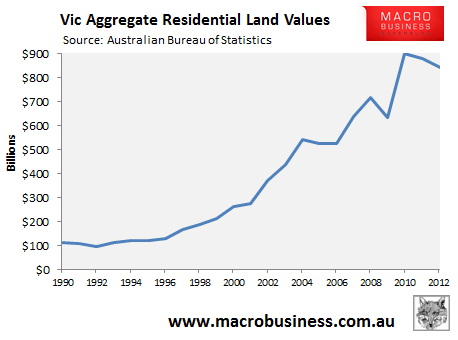
Another interesting aspect of the Valuer General’s report is that it contradicts the Australian Bureau of Statistics land valuations, which estimated that Victorian residential land values peaked at $897.9 billion in June 2010 before declining by -6.4% to $840.0 billion as at June 2012 (see below chart), as well as the steady decline in housing prices over this period.
The Valuer General wouldn’t provide an inflated valuation in order to support local councils’ bid to raise property rates, as well as enabling the state government to raise land taxes without adjusting thresholds would it?


Is the same thing happening in NSW?
Undoubtedly. How coulda thought our little brick veneer sh¡tboxes woulda reached $1T in value, huh?
With state governments, banks, realtors, mom’n'pop investas, newspapers, hangers-on (all the “property data” companies), and more all cheering from the stands, is anyone surprised?
Then the rational response should be to build 5 times as many houses….
That’d be $5 trillion !! How wealthy would we be then?
Great spot LVO, We shouldnt forget there is the administrative/political side of the real estate ponzi…
May also explain why some potential punters (as per Chris Vedalago’s piece in the Age pre Christmas) are signing up at developer prices, heading off to banks who are backing away from the valuations.
Quelle surprise!
The same thing is happening in America where rates on properties are going up even as values come down. Local/muni govts got to EAT!
In a way it is also simply more support for a proper land tax which would remove the boom/bust stamp duties.
Apparently the Victorian V-G’s valuation is for 1 January whereas the ABS figure is for 30 June.
Moreover, considering that local councils work backwards from a total budget to a rate in the dollar, and considering that any increase in valuations for land-tax purposes is usually accompanied by an increase in the threshold to compensate the poor landowners who are suffering because their assets have increased in value (sob!), I don’t think there’s much incentive for the State to inflate upward revaluations, although their might be some incentive to avoid downward revaluations.
However, because all Victorian councils now rate on the combined values of land and buildings, they have nothing to lose (in the aggregate or on a single property) by apportioning too much of the combined value to the building(s). Property owners stand to gain by this because they can depreciate buildings but not land. Centralizing valuations at the State level, where there’s a tax on the land value alone, may help to prevent such malapportionment.
Uh, that should be “although *there* might be…”
This really doesn’t surprise me. I know of a property (vacant land) with a rating valuation as at 1/1/2012 of $3.43 Million which sold in August 2012 for $1.63 Million. There was also this article in the Heraldsun back in November on this issue http://www.heraldsun.com.au/news/victoria/homeowners-get-a-rise-out-of-council-rates/story-e6frf7kx-1226519134127
Is it possible to contest the value?
I know alot of people that wouldn’t, a friend of mine came up to me, telling me that he got an awesome bargain on a piece of land, ‘its already gone up $80k according to the council’.
i was proud of myself for saying ‘nice one’ instead of ‘i wonder how your rates are calculated’
the point of my awesome story is that these inflated valuations also make the owners feel good and probably remain bullish on house prices
I had an in-law mention something similar a few months back.
When I pointed out the valuation was purely a mandate to charge you higher rates it wiped the smile off his face.
Yes, the council value can be contested (and is often fairly easy to get a value changed)but there is a set time limit from when the valuations are published to contest them. I can’t remember what that is from the top of my head but a call to your council would sort that out.
The following link outlines the process and time frames for lodging an objection reasonably well.
You can also contact a local valuer and they can help you with the objection process and provide comparable sales. http://www.sro.vic.gov.au/sro/SROnav.nsf/LinkView/3E93C7E592C08E2BCA25799900031B11A6FAB6BE64979127CA2575A100441FA4
glugs of gosh
Adam Smith had it worked out in 1776 (“The Wealth of Nations”). Houses are NOT “wealth”, PRODUCTIVE CAPITAL IS WEALTH. “Dwelling places” are merely a necessary expense like clothing – they just take longer to wear out than clothing.
What the ……. have OUR so-called “experts” LEARNED in all those fandangled degree courses they’ve spent years in?
Full quote from Adam Smith HERE:
http://www.macrobusiness.com.au/2012/04/melbournes-enormous-property-over-supply/#comment-142944
What the ……. have OUR so-called “experts” LEARNED in all those fandangled degree courses they’ve spent years in?
They’ve learned to articulate convincing arguments to put forward to useful idiots that preserve the economic rents to the paymasters of these fandangled degree holders.
From “The Wealth of Nations”, Adam Smith, 1776:
“……..The general stock of any country or society is the same with that of all its inhabitants or members, and therefore naturally divides itself into the same three portions, each of which has a distinct function or office. The first is that portion which is reserved for immediate consumption, and of which the characteristic is, that it affords no revenue or profit. It consists in the stock of food, clothes, household furniture, etc., which have been purchased by their proper consumers, but which are not yet entirely consumed. The whole stock of mere dwelling-houses too, subsisting at any one time in the country, make a part of this first portion. The stock that is laid out in a house, if it is to be the dwellinghouse of the proprietor, ceases from that moment to serve in the function of a capital, or to afford any revenue to its owner. A dwellinghouse, as such, contributes nothing to the revenue of its inhabitant; and though it is, no doubt, extremely useful to him, it is as his clothes and household furniture are useful to him, which, however, makes a part of his expense, and not of his revenue. If it is to be let to a tenant for rent, as the house itself can produce nothing, the tenant must always pay the rent out of some other revenue which he derives either from labour, or stock, or land. Though a house, therefore, may yield a revenue to its proprietor, and thereby serve in the function of a capital to him, it cannot yield any to the public, nor serve in the function of a capital to it, and the revenue of the whole body of the people can never be in the smallest degree increased by it. Clothes, and household furniture, in the same manner, sometimes yield a revenue, and thereby serve in the function of a capital to particular persons. In countries where masquerades are common, it is a trade to let out masquerade dresses for a night. Upholsterers frequently let furniture by the month or by the year. Undertakers let the furniture of funerals by the day and by the week. Many people let furnished houses, and get a rent, not only for the use of the house, but for that of the furniture. The revenue, however, which is derived from such things must always be ultimately drawn from some other source of revenue. Of all parts of the stock, either of an individual, or of a society, reserved for immediate consumption, what is laid out in houses is most slowly consumed. A stock of clothes may last several years: a stock of furniture half a century or a century: but a stock of houses, well built and properly taken care of, may last many centuries. Though the period of their total consumption, however, is more distant, they are still as really a stock reserved for immediate consumption as either clothes or household furniture.The second of the three portions into which the general stock of the society divides itself, is the fixed capital, of which the characteristic is, that it affords a revenue or profit without circulating or changing masters. It consists chiefly of the four following articles:First, of all useful machines and instruments of trade which facilitate and abridge labour:Secondly, of all those profitable buildings which are the means of procuring a revenue, not only to their proprietor who lets them for a rent, but to the person who possesses them and pays that rent for them; such as shops, warehouses, workhouses, farmhouses, with all their necessary buildings; stables, granaries, etc. These are very different from mere dwelling houses. They are a sort of instruments of trade, and may be considered in the same light:Thirdly, of the improvements of land, of what has been profitably laid out in clearing, draining, enclosing, manuring, and reducing it into the condition most proper for tillage and culture. An improved farm may very justly be regarded in the same light as those useful machines which facilitate and abridge labour, and by means of which an equal circulating capital can afford a much greater revenue to its employer. An improved farm is equally advantageous and more durable than any of those machines, frequently requiring no other repairs than the most profitable application of the farmer’s capital employed in cultivating it:Fourthly, of the acquired and useful abilities of all the inhabitants or members of the society. The acquisition of such talents, by the maintenance of the acquirer during his education, study, or apprenticeship, always costs a real expense, which is a capital fixed and realized, as it were, in his person. Those talents, as they make a part of his fortune, so do they likewise of that of the society to which he belongs. The improved dexterity of a workman may be considered in the same light as a machine or instrument of trade which facilitates and abridges labour, and which, though it costs a certain expense, repays that expense with a profit.The third and last of the three portions into which the general stock of the society naturally divides itself, is the circulating capital; of which the characteristic is, that it affords a revenue only by circulating or changing masters. It is composed likewise of four parts:First, of the money by means of which all the other three are circulated and distributed to their proper consumers:Secondly, of the stock of provisions which are in the possession of the butcher, the grazier, the farmer, the corn-merchant, the brewer, etc., and from the sale of which they expect to derive a profit:Thirdly, of the materials, whether altogether rude, or more or less manufactured, of clothes, furniture, and building, which are not yet made up into any of those three shapes, but which remain in the hands of the growers, the manufacturers, the mercers and drapers, the timber merchants, the carpenters and joiners, the brickmakers, etc.Fourthly, and lastly, of the work which is made up and completed, but which is still in the hands of the merchant or manufacturer, and not yet disposed of or distributed to the proper consumers; such as the finished work which we frequently find ready-made in the shops of the smith, the cabinet-maker, the goldsmith, the jeweller, the china-merchant, etc. The circulating capital consists in this manner, of the provisions, materials, and finished work of all kinds that are in the hands of their respective dealers, and of the money that is necessary for circulating and distributing them to those who are finally to use or to consume them.Of these four parts, three- provisions, materials, and finished work- are, either annually, or in a longer or shorter period, regularly withdrawn from it, and placed either in the fixed capital or in the stock reserved for immediate consumption.Every fixed capital is both originally derived from, and requires to be continually supported by a circulating capital. All useful machines and instruments of trade are originally derived from a circulating capital, which furnishes the materials of which they are made, and the maintenance of the workmen who make them. They require, too, a capital of the same kind to keep them in constant repair.No fixed capital can yield any revenue but by means of a circulating capital. The most useful machines and instruments of trade will produce nothing without the circulating capital which affords the materials they are employed upon, and the maintenance of the workmen who employ them. Land, however improved, will yield no revenue without a circulating capital, which maintains the labourers who cultivate and collect its produce.To maintain and augment the stock which may be reserved for immediate consumption is the sole end and purpose both of the fixed and circulating capitals. It is this stock which feeds, clothes, and lodges the people. Their riches or poverty depends upon the abundant or sparing supplies which those two capitals can afford to the stock reserved for immediate consumption.So great a part of the circulating capital being continually withdrawn from it, in order to be placed in the other two branches of the general stock of the society; it must in its turn require continual supplies, without which it would soon cease to exist. These supplies are principally drawn from three sources, the produce of land, of mines, and of fisheries. These afford continual supplies of provisions and materials, of which part is afterwards wrought up into finished work, and by which are replaced the provisions, materials, and finished work continually withdrawn from the circulating capital. From mines, too, is drawn what is necessary for maintaining and augmenting that part of it which consists in money. For though, in the ordinary course of business, this part is not, like the other three, necessarily withdrawn from it, in order to be placed in the other two branches of the general stock of the society, it must, however, like all other things, be wasted and worn out at last, and sometimes, too, be either lost or sent abroad, and must, therefore, require continual, though, no doubt, much smaller supplies.Land, mines, and fisheries, require all both a fixed and a circulating capital to cultivate them; and their produce replaces with a profit, not only those capitals, but all the others in the society. Thus the farmer annually replaces to the manufacturer the provisions which he had consumed and the materials which be had wrought up the year before; and the manufacturer replaces to the farmer the finished work which he had wasted and worn out in the same time. This is the real exchange that is annually made between those two orders of people, though it seldom happens that the rude produce of the one and the manufactured produce of the other, are directly bartered for one another; because it seldom happens that the farmer sells his corn and his cattle, his flax and his wool, to the very same person of whom he chooses to purchase the clothes, furniture, and instruments of trade which he wants. He sells, therefore, his rude produce for money, with which he can purchase, wherever it is to be had, the manufactured produce he has occasion for. Land even replaces, in part at least, the capitals with which fisheries and mines are cultivated. It is the produce of land which draws the fish from the waters; and it is the produce of the surface of the earth which extracts the minerals from its bowels.The produce of land, mines, and fisheries, when their natural fertility is equal, is in proportion to the extent and proper application of the capitals employed about them. When the capitals are equal and equally well applied, it is in proportion to their natural fertility.In all countries where there is tolerable security, every man of common understanding will endeavour to employ whatever stock he can command in procuring either present enjoyment or future profit. If it is employed in procuring present enjoyment, it is a stock reserved for immediate consumption. If it is employed in procuring future profit, it must procure this profit either staying with him, or by going from him. In the one case it is fixed, in the other it is a circulating capital. A man must be perfectly crazy who, where there is tolerable security, does not employ all the stock which he commands, whether be his own or borrowed of other people, in some one or other of those three ways……”
Wow that’s certainly a reply!
Local councils are a disgrace, pushing up rates at 7-8% a year to feed massive wage increases for the pen pushers who work for them. They need a clean out of 10% of employees at least.
50% at least.
.
They are bloated with unproductive hangers on.
.
Look no further that your local council’s planning department, they take months to do what any motivated person could achieve in a day.
Mine have gone up by 16% this year in spite of our mayor telling the paper that rate increases have been kept to an average of 1.5%…I must be only silly d#$khead to have copped an increase because it doesn’t take too many households of the total 16k with increases like mine to push the average above 1.5% pretty quickly.
Still fighting it at present. CIV has always trailed bank valuation by a significant margin as prices inflated (over 10 years now) but now the gap has narrowed. Neither of them reflect the price I would actually get presuming I could find a buyer in the first place so it’s all a bit academic.
Yeah, about 6 years ago I wanted to put up a new bigger garden shed…not a garage but shed. Baulkham Hills council here in Sydney wanted about $700 in various fees and charges, the shed was costing about $600…and people had to actually make the steel and fabricate it etc…manufacturing it’s called! Btw still got the old more rusty shed
So we are all rich then. Woot woot!!! Tell me again how does the price appreciation of a non productive asset add to economic utility?
You borrow against and keep our largest employment sector, retail ticking along as well as the largest component of the economy (>60%), ‘services’.
Treat it like an ATM (equity mate).
Failure to do so and asset deflation and you end can end up like Spain.
Why is it such a surprise that those that need property values to be ramped do so? This has been going on for years! The nation & all of us residents receive lots of our services financed via tax on property values, so what do we actually expect? The services are still required or demanded & they have to be funded with cash eventually so we pay. We pay via taxes or borrowing, (same thing in the long run) & one way is to tax property values or transactions relating to property. So if that’s what we do we fudge the value or raise the rate or maybe both! Not a great surprise really.
Sool,
You really know how to ruin the mood, don’t you?