
The Australian Bureau of Statistics (ABS) this morning released the retail trade data for the month of November.
In seasonally adjusted terms, retail sales fell by -0.1% and rose by only 2.9% year-on-year. Analysts had predicted a rise of 3.0% for the month of November.
Below is a chart summarising the monthly and annual growth rates by industry on a seasonally adjusted basis:
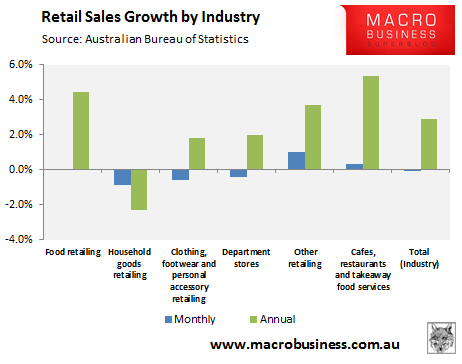
As you can see, other retailing (+1.0%) and cafes, restaurants and take away food (+0.3%) were the only segments to record positive sales growth over the month. By contrast, household goods retailing fell sharply, down -0.9% over the month and by -2.3% over the year.
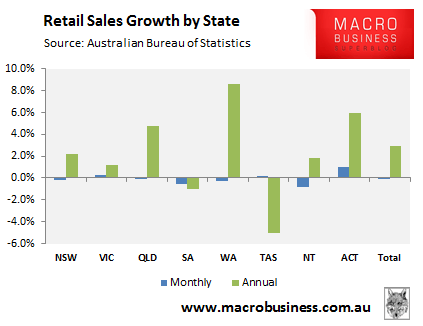
At the state and territory level, it was a mixed bag, with increases in sales in Victoria, Tasmania and the ACT more than offset by falls in the other states and Territories (with the exception of Queensland, where sales were flat). Over the year, Western Australia (+8.6%) continues to dominate retail sales growth, whereas sales growth in Tasmania (-5.0%) and South Australia (-1.0%) are in the doldrums:
In annual terms, retail sales growth is trending down once again following the spike induced by one-off compensation payments for the introduction of the carbon tax:
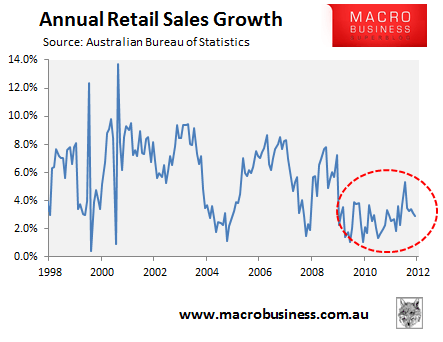
Viewed in isolation, this release is a very weak result, and shows that there has been minimal pick-up in retail spending following the -1.50% of cuts to official interest rates since November 2011.


“Analysts had predicted a rise of 3.0% for the month of November.”
Really? Do they ever actually visit shops (ones still open) and malls to see what is happening?
Expectation, a virtue and vice of fools, and a major part and theory of Statistics. More nobly titled as an Analyst.
Went down High Street Armadale over the Xmas break for a browse, nothing more.
Saw plenty of items (supposedly listed for sale) and yet they were at a higher price than I remember seeing them before the so-called sale.
Ahhhh, the illusion of making a saving!
Welcome to the new normal. With inflation at say 2.0% and population growth say 1% why should retail sales be growing much faster than 3%?
The days of the house ATM and credit funding consumption at twice to three times the rate of inflation + population growth were an aberration that has now passed (for a while anyway).
Things might ease if our banks get to a stage where they are not overdependent on overseas funding and the RBA lets the ratio of deposits to debt stabilise as then deposit and borrowing rates will fall more in alignment with RBA cuts to the cash rate.
With median house prices falling (from their peak) for about 80% of the population, confidence in borrowing for consumption is very low. If vacancy rates fall for residential rentals rise due to lower construction rates and the rents get bid up, then retail could remain constrained for a while.
Interesting side point.
My Bank manager was furiously busy in November and December. He was looking a little ragged around the edges too.
He was having trouble keeping up with mortgage applications.
Not for property here in Darwin but from people living and working here buying “down south” because its better value.
“The days of the house ATM and credit funding consumption at twice to three times the rate of inflation + population growth were an aberration that has now passed (for a while anyway).”
Good point. I think the figures on changes in home equity loans for Australia might be illuminating.
Read somewhere recently that in 2011, US households took $1 trillion dollars less in home equity loans than they did in 2007. Take a trillion dollars of consumption out of an economy and the damaging effect to retail (and flow-on effects to the rest of the economy) becomes obvious. Pretty obvious why govts want to re-inflate housing bubbles too.
Inflation at retail level is probably close to zero I’d have thought. Look at the tradable goods inflation…zero inflation. This reinforces your case re 3%.
“Things might ease if our banks get to a stage where they are not overdependent on overseas funding and the RBA”
How can that happen? It’s impossible while running a CAD unless, as now, the Govt runs a deficit and funds it from overseas.
NT is experiencing population loss at moment due to a radical increase in the cost of power (40%) the high cost of living and the seasonal climate driven exodus.
The state government freeze on hiring is not helping either.
I expect the NT December retail figures to be pretty poor too.
Don’t the analysts read MacroBusiness?
Perhaps the analysts could have predicted strong growth in food retailing, restaurants/take-aways and so on if they revisited this politically incorrect fact – we are a nation of porkers.
Here’s Monash Uni to remind us of this fact:
http://www.modi.monash.edu.au/obesity-facts-figures/obesity-in-australia/
- Fourteen million Australians are overweight or obese.
- More than five million Australians are obese (BMI ≥ 30 kg/m2 ).
- If weight gain continues at current levels, by 2025, close to 80% of all Australian adults and a third of all children will be overweight or obese.
- Obesity has overtaken smoking as the leading cause of premature death and illness in Australia.
- Obesity has become the single biggest threat to public health in Australia.
- On the basis of present trends we can predict that by the time they reach the age of 20 our kids will have a shorter life expectancy than earlier generations simply because of obesity.
- Aboriginal and Torres Strait Islander Australians are 1.9 times as likely as non-indigenous Australians to be obese.
So, based on these figures, it appears that Australia has a broader eating problem.
Would it be completely wacko to suggest that perhaps eating patterns (increases in eating out, take-aways etc) are more of a behavioural response to bad economic times i.e. it is a stress response much like the rise you often seen in vices such as drinking, gambling, smoking etc?
Seen those $10 buck deals you can buy at Macas? And the people love it. You can’t buy (all 4) ingredients for a home made salad for that price.
Amazing to see Australia from the 70s to now. Even Sydney City. I don’t know if the article and stats are acurate, but gee! There are porkers a-plenty around.
Maybe Macas all this time, has been a Russian plot to destroy the West, I jest.
Fat + Carbohydrate (Fructose Sugar) + Oil, apparently is very addictive. And they add corn syrup to that mix too.
Would it be completely wacko to suggest that perhaps eating patterns (increases in eating out, take-aways etc) are more of a behavioural response to bad economic times i.e. it is a stress response much like the rise you often seen in vices such as drinking, gambling, smoking etc?
I’d be more inclined to suggest it’s a response to longer working hours and commute times, leaving less time for a) proper shopping and b) preparation.
Skyrocketing costs of living are also making eating out for the astute/lucky punter (ie: live near a bunch of pubs with meal specials on different days) damn near as cheap as eating in, in terms of capital outlay. This is before even getting to the truly cheap stuff like McDonalds and KFC.