RBA fires another blank at soft confidence

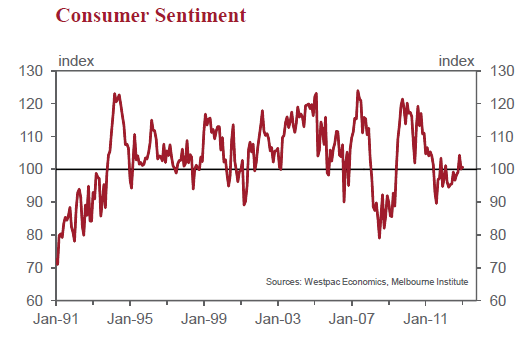
The Westpac Melbourne Institute Index of Consumer Sentiment rose by 0.6% in January from 100.0 in December to 100.6 in January. According to Bill Evans:

This is the third consecutive month when the Index has been at or above the 100 level. That compares with 14 of the previous 16 months when the Index had registered below 100. However, having said that, it remains disappointing that despite a total of 175 bp’s of rate cuts from the Reserve Bank since October 2011 the Index is only 3.5% above its level at that time. Indeed, following the first rate cut in November 2011, the Index surged by 6.4% to 103.4 in November 2011. Consequently the Index remains 2.7% below the level in November 2011 despite 150 bp’s of rate cuts from the Reserve Bank.

The Reserve Bank Board did not meet in January so there has been no fresh news on the interest rate front since December. However, other factors which would normally have been expected to impact Confidence have had little effect. For example the Australian dollar has risen from USD 1.046 (average over previous survey period) to USD 1.053 (average over current survey period).

The Australian share market has risen by 4.1% and, as a proxy for global economic conditions, the US share market has increased by 3.8%. News generally from offshore has been positive with sentiment towards China’s growth prospects being particularly buoyant. Perhaps a guideline in that regard has been the 30% increase in the spot iron ore price since the last survey. Finally there was encouraging news on the employment front with the unemployment rate being reported to have fallen from 5.4% to 5.2%.

Clearly these positive news events have failed to move respondents.

On housing, the results were mixed:

On the other hand, a special question which was included in the current Survey around the outlook for house prices shows 45.6% of respondents expected house prices to rise over the next 12 months while the same question a year ago showed a slightly higher 46.9% of respondents expecting prices to increase despite the cash rate having fallen by a further 125 bp’s.

Official data for new lending for housing indicates that upgraders and investors are responding to the lower rates in a broadly comparable fashion to 2009. However, unlike in 2009, First Home Buyers have been reluctant to return to the housing market. This is certainly partly due to less generous government subsidies but may also be impacted by weaker overall confidence around finances and job prospects.

And maybe they just want lower prices.


37 Responses to “ “RBA fires another blank at soft confidence”

  1. Ortega says:

    “…maybe they just want lower (house) prices”.

    And the longer the FHB’s hold out, the more likely they’ll get it.

    • dam says:

      FHB do not matter anymore, Investors are by far the main buyers at the lower end.

      • Ortega says:

        You think investors flipping houses among each other can sustain and even grow prices from here?

        Without the ‘new blood’ FHB’s I think the game’s up.

      • dam says:

        It s what happening, upgraders are selling to investors and the houses are rented to would be FTB.

        going on the way to UK, with few owning most of the houses and the others getting the slack and rent increases.

        not a good thing, it s ridiculous but between the immigration to the roof, Chinese money, the low construction rates, the distance to CBD and the investors, locals who cannot buy are screwed.

      • Christiaan says:

        Nice to know you are propping up the market single-handedly dam.
        ;-)

      • dam says:

        yeah big Job Chris but I have to do it “someone is wrong on the internet” ;-)
        http://imgs.xkcd.com/comics/duty_calls.png

      • sydbod says:

        “not a good thing, it s ridiculous but between the immigration to the roof, Chinese money, the low construction rates, the distance to CBD and the investors, locals who cannot buy are screwed.”

        It would be interesting to see the financial break down of total investments of these so called IP holders.

        From my very limited area of view (people I know that are over 55 y age), they don’t give a dam about what the price is doing for IP’s, They are just using the investment properties as a means of broadening their investments over a wider base.

        Many older people that I know (baby boomers) have greater than $1,000,000 in shares and also have maybe 2 or 3 flats in the outer western suburbs or one good flat in an upmarket location just for diversity.

        I know this may just be relevant to the small demographics that I happen to mix in, but it would be interesting to know how many IP holders are mainly ONLY tied to IP investment. This may be another small reason why IP sales are not flooding the markets, causing prices to collapse.

      • sydbod says:

        Sorry for the double post.

        An associate of mine decided to dabble with negative gearing with his first IP.

        He is now mightily pissed off with the current government because of the drop in interest rates. :) . He only managed to be negatively geared for 1 paltry year.

        Oh well even the better off have to suffer at times. :)

      • dam says:

        @sys

        yes another 1% interest drop and every single investor will be positively gear, what not to like, and with the FTB out of the way and rate to the floor for at least one or two generation, it s just party time.

      • Arrow2 says:

        Dam, property investors in Australia are making more losses every year.

        http://www.businessspectator.com.au/bs.nsf/Article/residential-property-house-prices-housing-mortgage-pd20130115-3Y4BY?OpenDocument&src=sph

        “Aggregate net rental returns are negative, with losses escalating from $1 billion in 2000-01 to $5 billion in 2009-10″

        Some will do the rational thing and get out. But I’m sure as you suggest, some will no doubt continue to “do their duty” and cop their losses.

      • dam says:

        @arrow

        you do realize that your data is from 2009 where the interest rates were around 8%, now we are going to probably 4.5%.
        Investors are going to find bloody difficult to be negatively geared at these rates, they will all be positively geared if the purchase was right or made before 2010

      • Arrow2 says:

        Wrong, Dam. Interest rates in the second half of 2009 (the GFC years) were the same as they are now.

        And investor losses were $5 billion.

      • dam says:

        @syd,

        i am not sure could could have gotten a bank rate below 7.5%-8% in 2009-10, especially from beginning the second part of the financial year, it s probable that investor will be at half of it this year or next year.
        they ll be totally fine ;-)

      • drsmithy says:

        He is now mightily pissed off with the current government because of the drop in interest rates. . He only managed to be negatively geared for 1 paltry year.

        So, basically, your friend is not only mathematically illiterate, but would prefer to give his money to a bank than his country ?

      • Arrow2 says:

        Dam – gold – “all investors are now positively geared” now interest rates are low.

        Gearing will be overwhelmingly determined by the size of your debt, not the interest rate. If you are an “investor” who only had a 10 percent deposit (there are plenty out there) you will be negatively geared, almost without exception.

        If you had a 90% deposit, you’d almost certainly be positively geared, but your return on investment would still be woeful compared to if you’d invested in shares or cash.

      • sydbod says:

        @ drsmithy

        “So, basically, your friend is not only mathematically illiterate, but would prefer to give his money to a bank than his country ?”

        You might have noticed the :) in my post. It was there for a reason.

        I must say I was expecting a reply like yours, and you did not let me down. Thank You.

        It may be interesting to note that NOT all IP’s are purchased JUST to make money from.

        This particular person purchased his IP with also the intention to move into it when he retires, to see if the location and life style will suite him. He still has 10 years to wait before he retires.

        Likewise one of my IPs happens to be my holiday property and I have no intention to sell it no matter what the prices fluctuate to.

        I also know one (I suspect not very bright) single lady that owns 2 investment properties because it makes her feel that she is in the top 5% of people ( I still cant understand 5% of what exactly).

        BUT … most of the IP owners that I know just use it as a risk spreading exercise for their investments.

        I do take your point that there must be many stupid IP owners out there, it is just that I for some reason do not come into much contact with them.

      • Christiaan says:

        “Without the ‘new blood’ FHB’s I think the game’s up.”
        .
        .
        Ponzi 101.
        .
        The shortage of greater fools is becoming more obvious with each passing week.

      • Byron says:

        sydbod, http://www.macrobusiness.com.au/2011/04/negative-gearing-on-the-nose/

        78% if IP owned by people earning less than 80k.

        its not a pretty picture these people cant hold these losses forever…

      • forty-niner says:

        “78% of IP owned by people earning less than 80k.”

        I think that indicates that most investors are very much focussed on tax breaks when they invest in property, i.e. they purchase with the intention of keeping income < 80K (because that's where one tax bracket ends – currently end of 32.5¢ tax rate). It suggests the value of most IP portfolios is dictated by negative gearing, with the majority of investors settling on the ≤ 80K bracket as a "fair" rate of tax to pay (and a fair income to live on).

        So, many have probably chosen to live on an income of around 80K and possibly can manage to constrain that some more if their income from other sources doesn't fall dramatically. Also, falling interest rate on IP mortgage would help.

      • sydbod says:

        “So, many have probably chosen to live on an income of around 80K and possibly can manage to constrain that some more if their income from other sources doesn’t fall dramatically.”

        You may have a point there.

        I and the wife just happen to live on a little under $20K last financial year (yes less than the old age pension if we could get it) and still did all we wanted to. I wont bore you with what my investment income happens to be.

        You are correct, stated income and income required to live are two totally different things for many people.

      • Pfh007 says:

        The ‘investors’ are clearly a little concerned which is why we are seeing attacks on the policies in NSW of less or no grants for purchasers of existing dwellings.

        That the clueless NSW ALP are joining the debate is bizarre but then there is a reason they can now hold caucus in a bus stop.

        There are a clear signs that that State govts are waking up to the impact of 30 years of failed urban development policies and weakened receipts from land price ponzinomics.

        More supply than we have seen for decades is a real ‘risk’ over the next 1 – 5 years.

        Mouldy old rental properties might be a lot harder to rent and sell.

        Good for families and good for Australia.

      • Tarric says:

        “That the clueless NSW ALP are joining the debate is bizarre but then there is a reason they can now hold caucus in a bus stop.”

        Bahahahaha,Buuurrrnn.

        Its not like the NSW ALP have much to loose at this point. Even if they claw back a huge number of votes at the next election, they are likely at least 5-6 years away from ever having deliver on their rhetoric.

      • jelmech@bigpond.com says:

        You as an investor dam, will negotiate prices down.
        Other investors also.

      • dam says:

        yes, only ftb pay silly prices when pushed.The investors will support the market but just that, put a floor, with no or little price increase as they look for value, but rents will go up and the whole thing will be sorted out.

      • jelmech@bigpond.com says:

        A slow melt scenario then?

      • Hewell says:

        dam

        What’s your view on unemployment rate going forward? And what’s that gonna do to prices, rents, demand, etc?

      • dam says:

        so far unemployment is not going anywhere but even if it goes up, it will be balanced by the pressure from high immigration rate and struggling construction rate. I frankly hope unemployment is not going to increase as many would feel the pain (not investors, are rents up and rates would go down dramatically).

        but so far so good, unemployment is still really low , i am from a country with multiple this rate of unemployment and in borderline recession/trouble since 1972, that gives me another perspective about this “pain”

      • Hewell says:

        I too hope unemployment rate wouldn’t go up. But I’m afraid all those news of job cuts, e.g. Crazy Johns, Boral (today’s news only) paint a bleak picture of things to come.

        Unemployment up -> rents up? how does that work? Mind to elaborate?

        Rates can go down a bit further. But there’s not much room left. As others mentioned, RAT is already negative.

        Just wondering, does the country where you came from have ridiculously high house prices as Australia?

      • dam says:

        rents up because of scarcity (not everywhere, not in the outskirt)

        France, yes houses prices (and rents) have increased enormously despite being in pseudo recession and having a 2-3 times higher unemployment rates than OZ.

      • Arrow2 says:

        Comedy gold – rents up because of scarcity?

        People losing their jobs does not make houses disappear. It just makes people go into cheaper housing options (sharing, moving back into parents place, etc) Same number of houses. Just more people per house, and thus less overall demand for houses.

      • Christiaan says:

        Dam,

        I seriously am loving reading your posts on MB. If nothing else it highlights the idiotic mentality of the current property investor!
        .
        Thankyou! :-D

      • dam says:

        you re very welcome, it s the least I can do for you ;-)
        i like property/land
        you like shares ( i guess )

        all fine, me personally i am not into an investment that loose 50% every 5 years ;-) and return very little on the long term.

      • Quality Focus says:

        Dam, if unemployment is rising, high immigration is unlikely to continue. And many of those people on 457 visas will get made redundant and sent home…

  2. Explorer says:

    There’s nothing like a recent history of price falls (and looming oversupply in some markets) to give a proportion of buyers the idea that they can get it cheaper next month.

    As many have pointed out, the mere lack of capital gain makes renting a possibly good idea for all the young’uns, particularly the single or without kids who can move using a mate’s ute and a hire trailer doing only a couple of trips.

  3. Tarric says:

    I am beginning to realise that the rate cuts have had their desired affect at least in part. The march toward our own version of ZIRP has left many investors positively geared, many for the first time, many first home buyers can now afford to go off interest only repayments and start to paying down the principal in some small way, anecdotally speaking.

    While this hasn’t reignited the growth of the housing ponzi it has however arrested the possible collapse or serious detioration of the Australian property market.

    Every day the RBA buys where prices stagnate or slowly decline is making the inevitable crunch a bit more manageable for both the Australian financial system and the Australian people as a whole.

    However this pre-emptive damage control is very risky and incredibly difficult to balance in the long term, eventually they will make a mistake or it simply wont work any more.

    Judging by some of the graphs of how the housing market and morgage growth has reacted to the latest series of rate cuts vs how the market behaved historically would seem to at least somewhat support this theory.

    What we have to realise is the fact that the housing market is declining in the face of huge rate cuts despite the fact that previously it was housing to the moon even in the face of the GFC. Something has fundamentally changed in the Australian public’s psyche at least temporarily.

    When the RBA hit our own version of ZIRP in 0.75-1.25%’s time, that is when the true test will come.

    • DrBob127 says:

      Very sensible.

    • Ortega says:

      I agree, there’s been a shift in people’s thinking. The shift is difficult to quantify, but there’s some evidence out there already in the MSM with a few “happy to rent” / “who wants the mortgage ball and chain?” articles appearing last year.

      And it simply stands to reason that with ever more job uncertainty comes an aversion to buying large amounts of debt.

      Its self evident.