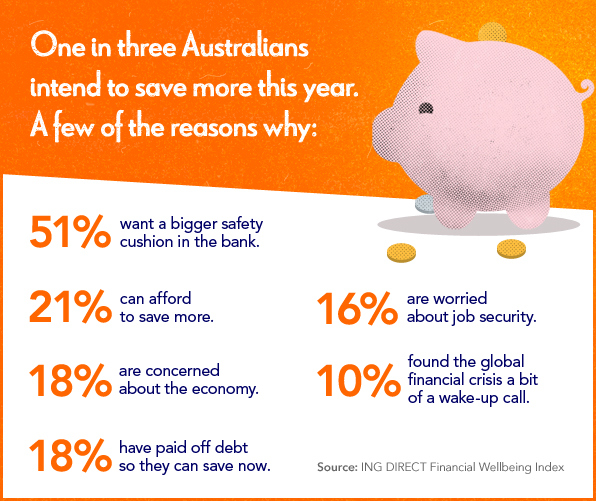
ING Direct runs a quarterly survey of consumers to fathom their appetites for savings. The January result sees a New Year’s resolution to tuck away even more than we have been:
The survey, conducted in January 2013, discloses the median savings level is now $11,798 – an increase on the previous high of $9,735 last quarter.
It also highlighted that Gen Y are the most enthusiastic savers, with 8 in ten intending to save more or get out of debt in 2013 compared to 7 in ten overall.
So why are we saving? Having a savings buffer in case of emergency was the biggest incentive for over half of respondents – with one third of households aiming to bank the equivalent of three months’ income in rainy day savings.
Financial insecurity also played a part, with one in 10 admitting the Global Financial Crisis was a bit of a ‘wake-up call’ and two in five still harbouring concerns about the state of the economy.
For some, it’s a case of just being in a better position financially. A third of households disclosed they are better off compared to 12 months ago, with four in ten revealing their financial situation was about the same. One in five said they could now afford to save more as they had more money at their disposal, whilst 18% had paid off their debts and could use the excess to save.
On the downside, a quarter of Australians admitted to being worse off compared to a year ago, with 15% having no savings whatsoever. Yet, less than one in 10 had difficulty paying household bills.
Stricter budgeting is on the cards for 41% of savers, with 39% planning to cut back on luxuries and discretionary spending including dining out (27%) and holidays (15%). One in five intends to set a savings goal and a third plan to transfer money regularly on pay day
The survey is based on 1016 households and conducted by Galaxy. The results are consistent with national accounts which show a persistently high savings rate. But it does contradict falling term deposit rates of growth clear in APRA data and a declining savings pulse in consumer confidence data. Maybe we are just unable to save quite so much as we have in the past few years as conditions have eroded.
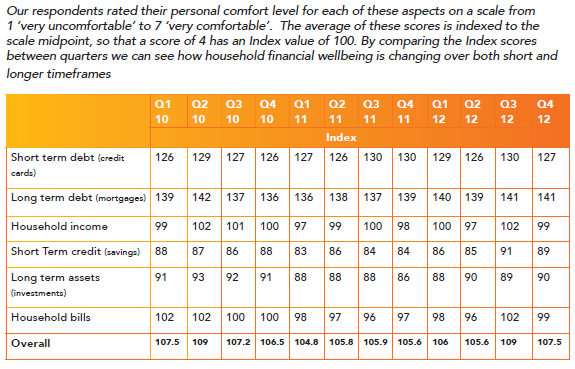
Interestingly the internals of the index show virtually no change from two years ago, although mortgage comfort has dipped then rebounded in the interim:
David Llewellyn-Smith is Chief Strategist at the MB Fund and MB Super. David is the founding publisher and editor of MacroBusiness and was the founding publisher and global economy editor of The Diplomat, the Asia Pacific's leading geo-politics and economics portal.
He is also a former gold trader and economic commentator at The Sydney Morning Herald, The Age, the ABC and Business Spectator. He is the co-author of The Great Crash of 2008 with Ross Garnaut and was the editor of the second Garnaut Climate Change Review.