
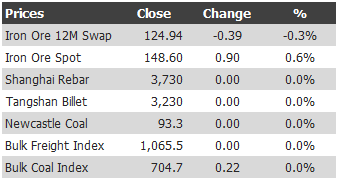
Find below the iron ore complex price chart for 24 January, 2013:
And the chart:
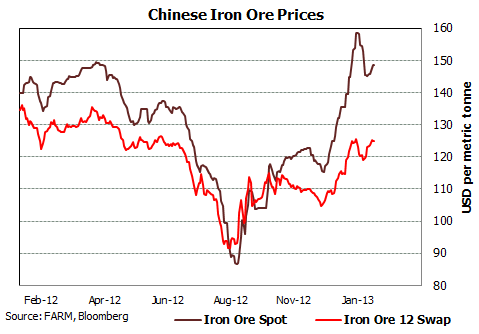
Another slow day on the hustings with swap balking at its former high and spot still showing strength, apparently on Pilbara weather and some strength in Baosteel contract prices.
In news, today’s point of interest is the shorts of David Einhorn, hot-shot hedgie, who described iron ore as a bubble last October but has since suffered indigestion from his bet. From the WSJ:
“Our bearish thesis on iron ore is new, and we have shorted a number of stocks in the sector. Our view is that after a decade-long bull market, supply is now exceeding demand. On the supply side, the miners have spent billions preparing to expand supply, which is poised to grow about 15% in each of the next couple of years. At the same time, iron ore is used to make steel, and global demand for steel is currently growing at just a couple percent per year. The marginal cost of the new iron ore supply coming on line is very low. We expect that some of the large investments the miners have made will yield disappointing results as the price of iron ore falls. In the fourth quarter the price of iron ore and the related stocks rallied sharply. Given the considerable downside in the stocks, we are willing to be patient here.”


I’m always a little wary of hedge fund managers talking book.
Anyway, word has it that some have been badly burned by the recent i/o revival so patience may be the only option.
Is that some pot-kettle iron smelting in the background …
Einhorn is a smart cookie, but you can’t win them all.
I don’t see how iron ore can experience a run up in prices without solid demand – it’s hardly a sex product like a diamond or a Lamborghini that you would show off to the neighbours.
Peter Schiff has been torched, and Kyle Bass isn’t doing too well with his “The Yen will explode” mantra.
Perhaps yesterdays hedge fund managers are in a bubble.
Of course it can experience a price run-up beyond what supply/demand might normally dictate. Its a traded commodity so expectations of the future supply/demand characteristics are built into the price. So if theres an over-rosy view of high future demand and/or low supply, then the price is too high.
Then theres the effect of QE plus people trading it or derivatives as way of gaining China/Asia exposure (versus actually holding the commodity itself).
Peter Fraser v Peter Schiff
Now that is a match-up I would pay to see.
HnH, could you organise that?. MB pay-per-view. That’s where the money is.
Peter Schiff has got a lot right and a lot wrong.
Kyle Bass on the yen, he has clearly stated that the end of a 70 year debt super cycle is hard to predict the end of but suggesting collapse in the next 18 months to 2 years. Unless you are referring to older commentary in which case care to provide a link?
whoops that should have been “sexy”
let’s not analyse my faux pas.
The big question is how do you trade it? How do you express a longer term view which affords you patience? Something about irrationality and solvency…
What Bloomberg ticker are you using?