

And why wouldn’t they? The RBA/Treasury plan to fill declining mining growth with more houses is not going well. New home sales have tanked since rate cuts started:
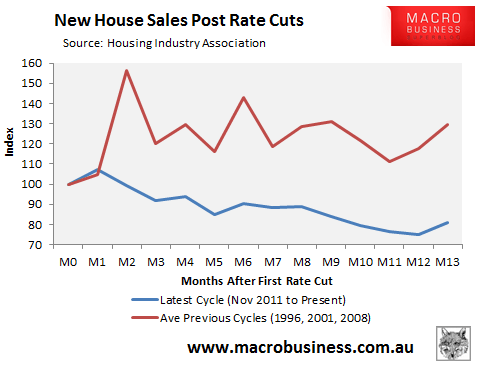
The AFR lines up quotes from building materials executives today:
The building industry is cutting costs and shedding jobs amid predictions that construction in Australia faces permanent structural change caused by the strong local dollar and a greater number of apartment developments.
From Boral:
…“The reality is Boral cannot continue to sustain the overhead structure that has built up over time and has burdened the group, and become increasingly evident at the bottom of the cycle,” said Boral chief executive Mike Kane.
From Hills Holdings:
“Anyone who thinks building approvals will get an uptick and that it will all be the same as it was seven years ago, I don’t subscribe to that view,” Mr Pretty said. “The market and its structure have changed. It is more competitive, therefore business models have to change.”
From Brickworks:
“I don’t think we’re going to see any 180,000 to 190,000 housing starts anytime soon. My general feeling is the entire industry is scaling down to around 160,000 [housing] starts at a peak,” he said. “Our shareholders want returns and we’ve got to make money on the right level of capacity to meet the market demand That’s what’s caused all this incredible restructuring over the past 18 months across the industry.”
From Master Builders:
“We need a restoration in confidence. We need short-term stimulus measures, not only to stop the red ink in the building industry,” he said, “but to take out insurance for the general economy to sow seeds for revival in non-mining sectors as we lose mining’s contribution.”
From Mirvac:
“While conditions remain challenging across the country, there are clear signs of an improvement, particularly towards medium-density accommodation. We expect residential markets with exposure to metropolitan outer-growth corridors to be more challenged,” he said.
Correct.
Replacing mining growth with more houses is a forlorn hope. First home buyers do not want to live in McMansions on postage stamp sized blocks on the urban fringe that are priced well above market value. I mean, sheesh, they’re not idiots.
The solutions being offered by policy-makers?
The Opposition has none:
“Labor’s deliberate policies of more red tape, higher taxes and increased business burdens have slugged manufacturing businesses like Boral, making it more difficult for them to remain competitive,” she said.
The Government wants to make it worse. Having failed to address the macroeconomic problems associated with the mining boom,it is fiddling with microeconomic planning (from The Oz):
RESOURCE and infrastructure giants will be told to spend more heavily with local manufacturing companies in a Gillard government plan due within weeks to aid struggling industries amid fears of a wave of further job layoffs.
Big investors will have to prove they support Australian manufacturers in a new directive from Canberra that adds to existing rules aimed at increasing demand for local steel, building products and other materials.
I can’t support this on the principle alone that it’s a backdoor mining tax that reeks of direct government mis-intervention in good business practices. Let alone practical issues such as how is it going to be policed? It will be either a bureaucratic nightmare or a failure. I might add that mining investment is about to begin falling. The super-cycle is winding down. We need to replace that falling growth with something new.
This is all supporting the unsupportable. Stick to the macro. Doyen economists have suggested Tobin taxes and printing AUD. Address the dollar.


The Govt comes up with yet another plan that it has no hope executing, is completely flawed, wont achive any desired outcomes but will sound like a Keynesian wet dream to the progressives.
Nothing new here.
“..wont achive any desired outcomes”
Nonsense. It will win votes. That is the desired outcome.
You’re not keeping up GSM
““Labor’s deliberate policies of more red tape, higher taxes and increased business burdens have slugged manufacturing businesses like Boral, making it more difficult for them to remain competitive,” she said”
Not the root cause of these ills for sure. But no doubt at all, the statement is accurate. If Govt got out of the way, Business would be able to be more flexible in adapting to these changing conditions.
Errr, this debate is being triggered by building job losses. That’s flexibility.
In the case of the closure of Boral Geelong it was a clear cut case of the high dollar wreaking a local manufacturing industry. It was cheaper to import concrete base that it was to keep making it here – end of story.
Not that I blame Boral for closing the plant – they’re not a charity and they don’t get buckets of government money to keep a loss-making operation going (unlike Alcoa).
CO2 (derivatives)
schemescam unlikely to have helped there.Indeed, and undoubtedly without those pesky regulations they’d “adapt” by cutting workplace safety, polluting more, rostering fewer workers on longer hours (without any additional remuneration), preventing people from taking holidays and firing women who were pregnant or on maternity leave.
All while maintaining executive salaries and bonuses, of course.
The technical name for this is grasping at the supporting structures of grain crops.
Asset prices must be allowed to adjust or it will be a decade before we see real activity in the housing construction industry. Sure that will place pressure on the Merchants of Debt and their accounting entries but that is all we are talking about.
There is an enormous potential for building activity. Catch a train from Sydney to the Blue Mountains and you will see thousands and thousands of 50-60 year old fibro and weatherboard houses desperate for re-building or sub-division(horizontally or vertically).
But it is not going to happen when you need to spend 300-400k to buy one.
Good point,well made Pfh.
Precisely!
.
It needs to be a painful crash so the powers that be dont try to re-inflate it again any time soon.
.
Like a child touching a hot-plate, one must be burnt in order for the lesson to be truly learnt.
I love this sort of talk where people wish for recession, job losses, loss of family homes, homelessness which will mainly affect workers in the construction industry.
That is the necessary implication of your call for a *painful* crash.
That’s capitalism.
Mass unemployment isn’t anything new; people move in and out of industries all the time depending on what skills are in demand etc. I hear what you are saying about the ‘pain’ but short of a centrally-planned economy there’s nothing anyone can do about it.
Yes – there is no need for pain. There is plenty of potential for real and useful economic activity to keep people employed and housed and fed.
It all depends on whether we are prepared to take bold action re the Merchants and debt and their accounting entries or allow them to ruin us.
The major problem is that the Merchants of Debt and their pet theorists have most people fooled that the way forward depends on keeping them fat and well fed.
Whatever can done with debt can be done with equity.
+1.
The way I see it, if it isn’t painful no lesson will be learnt.
Great point – there is so much potential for re-construction but land prices are just way too high. Struggling land banking developers could lead the way by slashing prices to get things moving again.
If they don’t, it will eventually be enforced upon them when they aren’t prepared. May as well get ready and go for it!
I don’t see prices falling anytime soon. Too much potential intervention could occur before developers/investors give in. People will hang on until they can’t.
To address the $A, we must address offshore borrowing which means the CAD as well. Austerity and deleveraging await in any meaningful addressing of this problem or in simply doing nothing.
Mega Bank must be regulated to borrow offshore in foreign currencies without hedging (or at least only hedging with the RBA). All $A borrowings by governments and private sector must be subject to a withholding tax. Remove the carry trade!
Large offshore borrowings do not allow the $A to “float” or act as the supposed natural stabaliser.
Agreed, in theory using the ‘saving habits of foreigners’ as a substitute for our own is no worse than taking advantage of their mercantilist tendencies to acquire cheap TVs and cars.
However, as we are finding out , in a world of central banking adventurism we could easily find that we suffer long term damage to the structure and internal balance of our economy.
“Mega Bank must be regulated to borrow offshore in foreign currencies without hedging..”
Wouldn’t you then have to regulate the derivatives market?
Last I checked the RBA stats (Table B4 “Banks – Consolidated Group Off-Balance Sheet Business”), the banks held something like $5 Trillion in (notional) Foreign Exchange derivative contracts, and another $13 Trillion in Interest Rate derivative contracts.
And for those who would argue that these are “fully hedged”, here’s an interesting tidbit. An obscure study by the RBA that Guy Debelle pointed to – conveniently buried in footnote – in publicly (and deceitfully) claiming the banks are “essentially fully hedged”, was (a) over 2 years old at the time of Debelle’s speech, and (b) on closer examination actually showed that the banks self-reported derivatives exposures were (at time of survey, Mar 2009) net LONG foreign currencies to the tune of some $288 Billion.
Deep T re the withholdingtax do you mean real economy transfers(FDI) as well as carry trade money-or just the latter? Assuming just the latter, I wonder how easy it would be to police?
The withholding tax would be aimed at carry trade but would apply to all with exemptions for FDI and perhaps other purposes. Yes it can be difficult to police and creates red tape but it would reign in the freedom for markets to easily extract, although slowly any gain the country makes from trade and the explosion of debt
It will remain shaky until after the election and after a policy change, assuming there is a policy change.
Peter’s point re election is on the money. One party has no policy but a budget surplus driving austerity, the other party has a policy seemingly involving trying to promote building starting from the most expensive real estate in the world, without addresing the great Australian land ransom.
So developers are treading water hoping for some sort of fiscal stimulus, owners/investors likewise, and potential buyers hoping for some sort of realistic pricing relief. Sort of like Clint, Eli and Lee van Cleef.
Thanks Deep T -I agree. This approach is by far and away the most valuable for the economy if it can be made to work and has no “unintended consequences”. The Brazilians and I think the Singaporeans have done it so we would not be shooting in the dark.It needs to be up on the list as number 1 on the policy agenda for a very close look, and for implementation if it stacks up.
Then we can all stop dreaming about a housing recovery and avoid a nasty shock around the corner.
Building like retail enjoyed the aberration of several years negative saving ratios under the policies of the Howard /Costello government when private debt grew dramatically and unsustainably.
The 2006 & 7 building levels were never a new normal, they were an aberration.
We are, I feel, a bit below the new/old normal at present due to adjustment pain and Keynesian post GFC fiscal consolidation.
This is a comedy or errors.
1. Accede to the economic religion of Garnaut and his accolytes and drop tariffs to 5% and let the larger overseas producers effectively dump against the smaller scale Australian producers.
2.Have Macfarlane and Costello collude to produce a humdinger property boom by running M1 for years in the 2000′s at 15% with Costello simultaneously halving CGT and leaving negative gearing intact whilst Australian property was “cheap” due to a 50 cent dollar. At the same time Costello delayed tax cuts so there was large incentive for tax minimisation.
3. With panic measures push government money into the property market in 2009/2010 – the Rudd policies.
4.To pull back the ridiculous property prices Stevens runs M1 at nearly zero for the last 2 years and high interest rates for borrowers so that producers are disadvantaged by the RBA needing to try to restrain the property boom.
5.Run fiscal policies which induce a ridiculous value of the dollar at 1.06 so discouraging production.
6. Introduce a carbon tax that penalises producers by taxing them but not competitor imports (another Garnaut triumph).
7. Maintain incentives for import of SUV vehicles which are in majority produced overseas against all principles of attempting to reduce carbon emissions as they are large emitters/fuel consumers.
Then after all this do bleeding heart on subsidies to failing industries and against all their free trade credentials talk about directing purchases to Australian products. What a joke is Australian government policy.
You have it bud. Thast pretty much what I have seen.
But where the hell we go from here I simply dont know. I just keep feeling it is somewhere ugly.
+plenty
Great comment Douglas.
Ask yourself this – who benefits most from all these policy “errors”?
A. International Banks.
The building industry may have to pay more attention to renovations/granny flats than in the past.
For those that have the space, the incentive is high to just add an extra bedroom/bathroom etc as it is approximately the same cost as upgrading to a bigger place.
Sadly Douglas you are absolutely right.But how to get policy back on track is now the issue.That is where a withholding tax could help, allowing the RBA to continue to control an adjustment in housing whilst giving the tradables sector a breather.