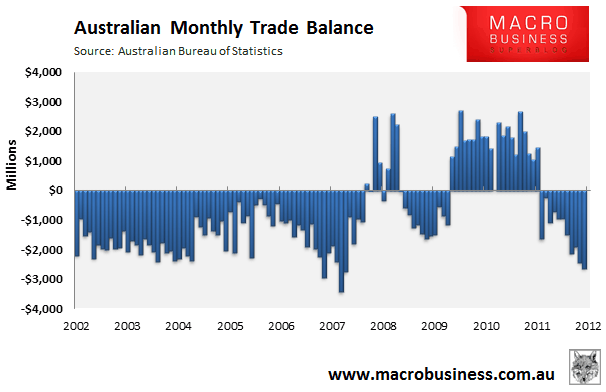
The Australian Bureau of Statistics (ABS) has just released trade data for the month of November, with Australia’s trade deficit increasing to a seasonally-adjusted $2,637 million, from $2,443 million in October (revised upwards from $2,088 million).
It was the eleventh consecutive month that Australia has recorded a monthly trade deficit and was also the largest deficit since March 2008 (see below chart).
In seasonally adjusted terms, exports rose $285 million (+1%) to $24,681 million. However, the increase in exports was more than offset by a $478 million (2%) increase in imports to $27,318 million, mostly on the back of intermediate and other merchandise goods (+$411 million) .
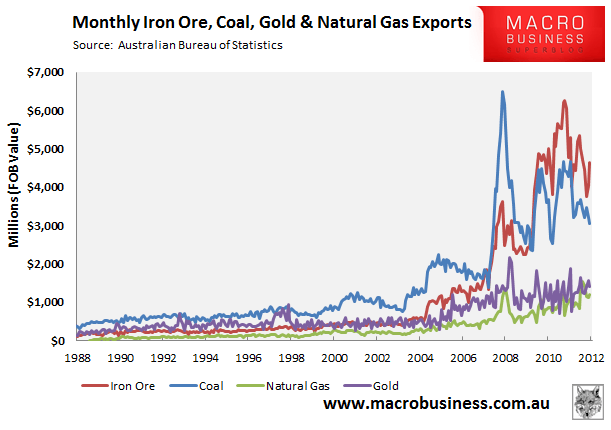
Australia’s major export – iron ore (23% share) – and fourth biggest export – gas (6% share) – rose by $621 million and $68 million respectively, whereas Australia’s second and third biggest exports – coal (15% share) and gold (7% share) – fell by -$154 million and -$140 million respectively over the month (see below chart).
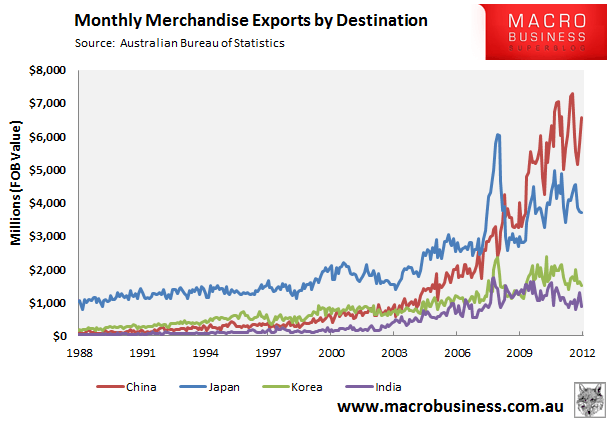
Exports to China continue to rebound, rising by $780 million (+13%) over the month, taking its share of total exports to 32% from 28% in October. By contrast, exports to the three other major markets – Japan (-25 million), Korea (-99 million) and India (-415 million) – all fell over the month of November (see below chart).
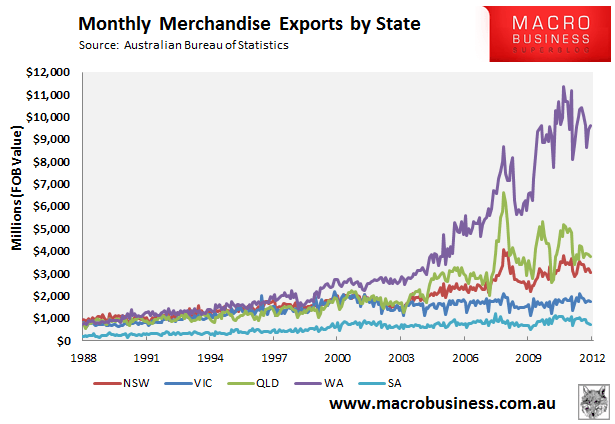
Given their status as Australia’s major producers of iron ore (Western Australia) and coal (Queensland), Western Australia and Queensland continued to dominate the nation’s exports. Western Australia alone accounted for 47% of Australia’s merchandise exports in November, much of which was iron ore (see below chart).
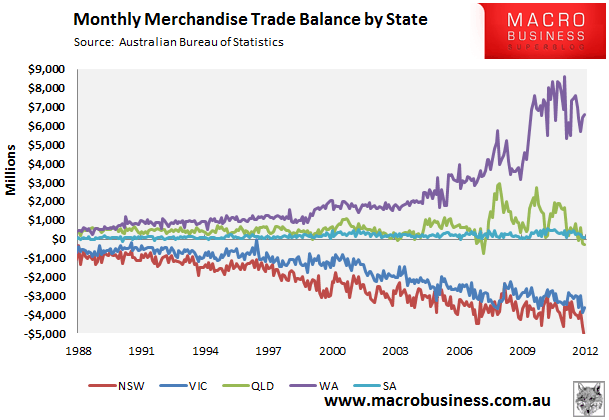
Western Australia also continues to hold-up Australia’s trade balance, recording a whopping surplus of $6,611 million (+3%) in November, again mostly on the back of iron ore exports (see below chart).
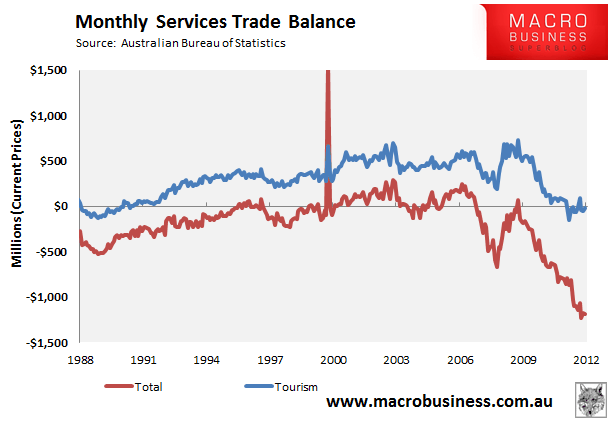
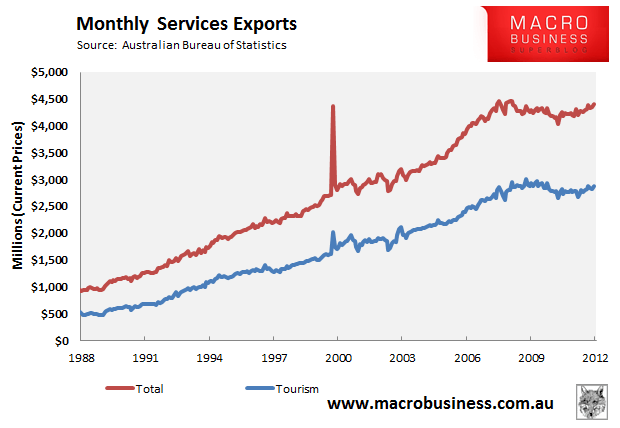
Finally, Australia’s services trade balance deteriorated slightly in November (-$20 million), but has essentially stabilised over the past six months after a horror run since late-2008 on account of the high Australian dollar (see below charts).
With the recent surge in iron ore prices, we are expecting a recovery in Australia’s trade balance over coming months.


This is a direct result of RBA interest rate cuts.
Since the currency hasn’t moved, any interest rate cut will spur consumer demand for imports (strong currency + lower debt servicing cost).
Once again the RBA has caused us to go deeper into debt and made our economy more unstable for the long-term.
It demonstrates clearly that lowering interest rates does not create free money as is so often portrayed by some bloggers here. The cost is paid somewhere in the economic loop……Unless of course you think the external account is a perpetual source of free money.
Flawse, I’ve seen you consistently stick with this opinion in your comments and want to commend you for that.
While I agree with some bloggers that austerity can bring about dangerous social unrest and implementation needs to be balanced, I have not seen anyone offer a viable alternative and certainly don’t see pumping more “money” into the economy as being the solution.
People say Europe is kicking the can down the road but boy, the Anglo-Saxon world is creating an incredible mess for themselves to be run into in the not too distant future…
Thanks Anon
I find our criticism, particularly of Europe, but also of the US et al so hypocritical. We think we are some sort of superior beings. In fact we’re a more profligate, earth and soul destroying lot, than all the rest put together.
It’s pretty simple. If you lower interest rates with the express aim of reducing savings and stimulating consumption, while at the same time maintaining a whole lot of production inhibiting policies, you must get increased imports and decreased exports.
The actual numbers illustrate the simple truth of it all.
Capitalist…EXACTLY!
But…but…whocoodanode?
I still think this Trade deficit bit is a con to delude people into thinking that things aren’t too bad. The CAD will come out later with a deficit of multi-billions for a month and it won’t get a mention in the MSM. Even in these pages it hardly rates a mention unless DE is around.
Never mind, we’ve still got a few assets to hawk for as long as our terms of trade stays high enough that hawking assets produces a sufficiently large capital account surplus to sustain the trade deficit and foreign debt servicing costs. Fortunately resource prices aren’t going to fall any time ever. And obviously once we’ve run out of productive assets to offload, we can just borrow all the money we need.
http://www.theaustralian.com.au/business/companies/treasury-wine-bidding-war-could-net-more-than-4bn/story-fn91v9q3-1226548505730
Treasury wine….Hells bloody bells!!!!
NOW I have a question…why is this framed in terms of ‘could NET more than $4bn’ Every story like this is framed in terms someone is giving us money for nothing.
Because they mean “net” as in the thing you go fishing with, not “net” as in the accounting calculation.
Maybe but it is all still phrased as if we get something for nothing and what a wonderful thing it is that foreigners want our assets!
I suppose it is or we would be really f….ed
“…an economy based not just on consumption of all net income but debt-based consumption is an economy devoid of savings, i.e. capital to invest in productive assets. An economy without capital is lacking a key component of Classic Capitalism. … the narcissistic consumption promoted by Neo-Liberal Capitalism erodes not just the work ethic that powers productive capitalism but also the ethic to save and invest that is the foundation of capitalism.”
http://www.oftwominds.com/blog.html
Mmmm. look at our gold exports. A hidden story here. I wonder who is the biggest buyer? India, Uk?
China I believe. I think in the Sept qtr was actually higher.
http://www.minerals.org.au/resources/gold/economic_trends_exports/
This chart is interesting. I wonder why neither the US nor Japan appeared in the list of major export markets.