

Regular readers will know that I’ve bet my shorts on the current rate cycle having further to fall. Today, the Kouk seeks to loosen my belt, coming out in support of Paul Bloxham’s pioneering call made late last year that the interest rate cycle has bottomed. From BS:
The interest rate cutting cycle in Australia is over.
There are three parts to the Kouk’s contention. The global economy is improving, commodity prices are up and the local economy is also strong. Let’s take each one at a time.
The global upturn is modest. The US is looking like having a better year in its slow, grinding recovery. With housing on the rebound (something I’ve been too bearish on), growth is likely to get close to its best since the GFC, around 2.8% on domestic demand and a slow revival in manufacturing that will be held back by pressure on exports.
Japan looks likely to rebound too as the falling Yen helps and its export exposure to the US increases demand. But I’m not expecting more than 2% given the tensions with China and ongoing European weakness.
China is having a decent first half but there is little in its figures to suggest anything more than a stimulus-led infrastructure build. The ramp up in growth has been slow since September and I continue to believe that the CCP will see that its interest lie in long term rebalancing. That means pressure on growth henceforth, with bouts of stimulus led euphoria tricking economists into thinking the worst is over. I had thought China would grow at a rate close to 9% annualised in the first half but the last GDP report is suggestive of lower.
Europe is not going anywhere fast (DE will provide his European forecasts tomorrow). Austerity and lousy credit demand across the zone will keep pressure on growth. Things may improve a little owing to better external demand, especially for Germany, but zero growth is my target for the year.
Having said that, the great success of 2012, the appointment of Mario Draghi and his lender of last resort initiatives, will keep markets buoyant with cheaper credit and higher stocks.
And so to Australia and the Kouk:
In terms of the things that matter domestically, the bank [RBA] will be looking at the recent lift in house prices with some trepidation. Since the end of 2012, house prices are up, according to RP Data, by a noticeable 1.3 per cent. While this rise follows two years of sluggish house price movements and is likely to have some seasonality to it, a massive improvement in affordability is likely to trigger further house price gains.
Here is the RP Data index:
Could be a bottom but beyond that it’s not so terrifying. I see no sign of The Kouk’s “massive improvement in affordability”. He goes on:
In addition to the global and house price news, house building approvals are trending higher, consumer sentiment is firm, share prices are strong, commodity prices have ticked higher, car sales are booming, and the mining sector still appears to be strong.
This is glass-half full stuff. New home sales are in the dunny (with a spark of hope in NSW’s investor focused stimulus):
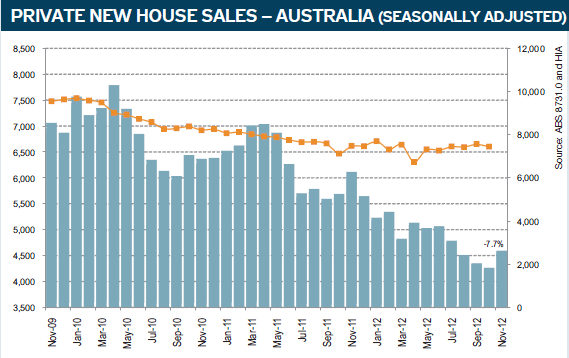
Yes, approvals are better, but they are in apartments:
And house approvals are hardly trending higher:

Sentiment remains soft, with a gentle uptrend:
Shares are going well and car sales are booming, yes.
But the big hole in this analysis is this: “the mining sector still appears to be strong”. Of course the mining sector is strong and will remain so for years to come. But that is irrelevant. What matters is is the mining sector getting stronger? The answer to that is an unambiguous “no” from mid year. And since that’s the case, the Kouk has not asked the only question that matters this year regarding interest rates. Given the RBA has spent the better part of two years squashing 95% of the economy so that the mining 5% can grow at astronomical rates, will it need to loosen further when mining begins to shrink?
On the balance of probabilities given the current data and trends, the answer for me is yes, although I do expect more economists to fall into the current bull trap in the first half.
It is also the reason why markets are still pricing two cuts for the year ahead:
Both in the second half, which I agree with unless iron ore falls earlier, unlike my trousers this year.


interest rates forecasts are a plausible range of possible outcomes, based on a plausble range of possible economic and political conditions all predicated on a massive range of reasonably forseeable, completely unforseeable and near certain events.
… why bother
Why, indeed.
Financial predictions are demonstrably worthless, though I can see some entertainment value in them as a sport.
A stopped clock is right twice a day. (Or so somebody said in the movie “Withnail and I”.)
You can say about any market. Why invest in this or that? Why read this site?
I dont bother investing in this or that, its index stocks all the way for me which I guess are the weighted average of everyone else’s best guess including the professionals (which stats show have less chance of getting it right after fees than an animal throwing things at a dart board).
Why read this site? To be informed about things that we can actually be sure of (eg housing is a crap investment at the moment)
An index is the wieghted average of what’s available for sale. In 1988 Japan equities were >40% of the MSCI developed market equity index with price earnings multiples >200x. An index guarantees that you will invest in every bubble.
Predictions are one thing; nuanced understanding of the odds of different outcomes is something else.
Only one of these is useful in investing.
The Kouk might be right but possibly for the wrong reasons.
What we may see in 2013 are some governments taking the logical next step in the adventure “Escape from Debt Mountain”.
Everyone is getting bored with the chapter entitled “The bankers and their debt ledgers are our only hope”.
If the Japanese really are planning to target inflation they may decide that to directly monetise government spending rather than the boring old techniques of fiscal expenditure funded by bond sales to the compliant household sector.
Sell bonds to the BoJ who will make the appropriate accounting entries. Use the accounting entries to cut taxes (a bit of concrete will sure to be part of the mix).
That will allow households, depending on their position, to cut their debts or spend.
When inflation hits 2% the govt can back off and raise taxes.
Apparently they did something like this in the 1930s and annoyed the international banking system no end.
Of course it does mean that we have to trust the pollies to turn of the tap when inflation responds but is that really a concern in the age of steely central bankers watching inflation like hawks?
So the Kouk could be right on interest rates but not because we are entering a new promised land of sound and sustainable growth.
I can’t see that being more broadly adopted. Not yet at least.
I agree, the RBA have shown little inclination to depart from the standard playbook.
When the economy lacks ‘animal spirits’
1. Cut interest rates
2. Stimulate debt
3. Keep an eye on inflation
4. Keep a lazy eye in the vague direction of asset prices.
Subject to 2 and 3 more interest rate cuts appear certain if the mining boom fades and the $AUS continues to damage the many dollar sensitive industries. (Tourism, education, making stuff)
Yeah I wonder about the Kouk’s call.
To be honest I dont think the 175Bp cut over 18 months has done anything significant demand wise – apart from maybe firm up what was there at the margins.
I do know the prospect of a serious climb in house prices will freak the RBA – so if the 1.3% increase in the first week of January is part of what they are looking at you would expect them to back off any more rate cuts.
With that same 175Bp cut not having done wonders in sparking housing construction any thought that monetary policy settings are feeding speculation (sans FHBers) and not underlying construction/the jobs associated with these then presumably the focus would at some point switch back to the fiscal side (in an election year with both sides of our one party state effectively wedded to surplus and responsible financial management – so not likely any time soon).
The RBA is effectively playing a waiting game – sure the macro hasnt turned to merde yet, but it is deteriorating.
I reckon the Kouk could be right as an implicit acknowledgement that monetary policy isnt actually working and that further rate cuts would be just fuelling housing speculation.
and the other thing I want to mention was that cutting rates is having stuff all effect on the AUD too
So far, the second main reason they’ll fall further. Unless we get some innovative policy…
I reckon they have to come off a long way before there is any AUD impact.
With the JPY moves there could be loads more stimulus looking for yield and I dont see the Australian government or RBA looking at damping speculative/yield hunting flows.
So presumably the AUD comes down only after the import competing sector has been utterly creamed.
innovative policy would be great. You can write your own ticket on the chances of getting some around here at the moment.
Yes I imagine 1-2% cash rate to see the interest rate differential removed. But as you say the demand for risk premium could be dropped in light of external pressures.
The AUD would be substantially higher sans rate cuts. 4.75% cash rate in a ZIRP world would get absolutely devoured.
It’s true but what else they got?
Yeah I know, yeah I know. They have got nothing. But if they have nothing and the alternative is to have nothing with a housing price jump they may opt to just have nothing
I wish that the RBA would stop with the rate cut crap, it does nothing more than move money from the productive economy and into housing.
If they really wanted to make a difference, then regulate the spread between the cash rate the the small business lending rates.
If you push down the cost of real estate, and drop the cost of lending to small business then you will provide the tools for the economy to grow.
Exactly
+1 one stone many birds
Hmmm. Your shorts are in danger in a similar way Steve Keen’s bet was: potential underestimation of countervailing measures from the powers that be. Faced with the dangers of dramatic collapse, the key players are likely to pull out all the stops. Chinese FAI will shoot through the roof again, if the economy is threatened by stalling. It will keep going until either the collapse couldnt be stopped or the economy reaches zombie state.
Rubbish. The Chinese have already decelerated their economy significantly. They know what’s going on. And if they push it further then I’ll just change my mind.
I’m not betting on a collapse of anything.
It is quite possible that what an amateur said is rubbish. Indeed, one would hope that this is the case.
But if the US can extend the debt bubble into the subprime, what is to stop China to extend its FAI bubble into the never-never? It all depends on the political-economic needs of the moment. One of the key failings in many economic theories is to ascribe superhuman capabilities to a government, wheras the truth is that its power is more likely to engineer a greater debacle. Unfortunately, a government is also populated by mere humans.
In the end, this whole thing has so many variables that it is next to being unpredictable. That’s why I think a scenario-based analysis (a list of if A then likely B with attached probability) is superior to the prediction of a single central outcome (I believe this will likely happen).
I agree with the point of the U.S likely ignoring its debt bubble’s both public and private until its too late.
However the Chinese don’t have this option in the long term, in the U.S if your government screws up and ruins the country you will be chastised but ultimately no harm will come to you in the long term. Likely before long you’d be making $40k a pop doing speaking tours around the country.
In China if the government fails the same way the U.S did they will be lined up against a wall and shot. That is of course if they don’t see it coming and don’t manage to flee to their palatial house and investment portfolio in Vancouver or Sydney.
By the way, my comments are meant to be complimentary. Steve Keen’s analysis of the nature and cause of the GFC was very insightful, but he lost the bet nonetheless.
Any reader who has read your analysis should have benefited handsomely by avoiding the risks in the mining stocks. I have recommended macrobusiness website to many friends on numerous occasions.
However, when excellent analysis is presented as a single outcome, i.e. as a bet, then by its own very nature, it has a decent probability of having results deviating greatly, if not sometimes wildly, from the prediction.
To be fair, your prediction has been pretty good. Thanks.
The earliest I think we’ll see another rate cut is May. This isn’t a prediction but I have 4 out of 4 in my predictions so far. Or it might be 3 out of 3.
UE up this time around
There will be no surplus this FY.
rates cut to 3% last year
there will be at least one rate cut in 2011
And I daresay any member of MB would have made the same predictions.