
Unintended consequences of childcare policy

With recent childcare reforms, and Labor’s maternity leave program in place, it is worth taking a moment to consider the economic and social effects of such policies.

Enabling access to the workforce for both parents through child care subsidies is admirable goal (for brevity I treat maternity leave as a form of subsidised home childcare). Yet the unintended consequence is to encourage women with young children to work rather than stay home with their children. Social equality for mothers, rather than bringing families together, may be tearing them apart.

We can look abroad to investigate the impact of generously subsidised childcare.  In Sweden, a country where twelve months maternity leave is the norm, more than 80% of children under 5 years of age attend formal day care. This figure must be closer to 100% of children aged 1-5, given that mothers (or fathers) are paid to stay home for the first year of their child’s life. In Australia, the number of children under 5 in formal day care is currently less than 40%, and much of that I would imagine is part time.

While the working mother gains all the benefits from subsidised childcare, it is the stay-at-home parent who bears a substantial cost (as well as taxpayers choosing not to have children):

…the popularity of parental leave brought higher taxes and lower benefits for home-caring parents. As more parents were trapped in dual-income lifestyles the burden on taxpayers increased to fund them, particularly threatening single-earner families, who were paying twice over, for their own and others’ parental leave.

Consider this comment (all quotes from here):

Policies such as childcare and parental leave have meant that the majority of Swedish women are employed in the labour market and remain there throughout their lives, with only minor interruptions after the birth of a child.

And:

From 1990-1998 the percentage of women engaged in part-time work fluctuated between 43 and 47 percent, while since then it has decreased to between 33 and 36 percent.

It appears more kids in full time, rather than part time, childcare is what you get.

The following graph is of the period following the introduction of 180 days parental leave, at 90% of previous salary, in 1974 in Sweden. This was extended to 9 months in 1978:
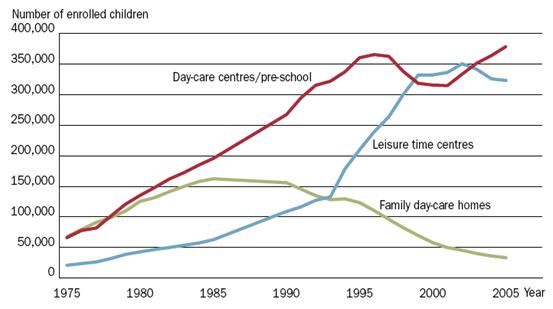
During the 1970s and 1980s, the state and the municipalities both covered approximately 45 per cent of the fees, leaving the remaining 10 per cent to be covered by parental fees.

Again, subsidising childcare works, in that it increases the uptake of childcare. Not subsidising it works too. Cost of childcare exploded in the 1990s, and:

…by 1998, 17 per cent of the costs of childcare were being covered by parental fees

The graph above clearly shows this impact. But what of the early 2000s boom? We have another policy change to explain that one.

In July 2001 the Swedish government expanded childcare to include children of parents who are unemployed and in January 2002 to include children of parents who are on parental leave looking after a sibling (Swedish National Agency for Education, 2003). In addition, in January 2003 all children aged 4-5 became entitled to 525 hours of free attendance in childcare per year.

It is time for the pro-maternity leave lobby to ask whether having almost all of our children aged 1-5 in full time childcare is a desirable social outcome. Like most social and economic policies, there is an inherent tradeoff, and we need a clear social purpose against which this tradeoff can be evaluated.

For example, the pro-childcare subsidy supporters appear to want to provide more equal work opportunities for mothers. Fair enough. But should such a policy favour working parents over stay-at-home parents?

An alternative, much broader, social purpose is to reduce the costs of child rearing.  This can also be achieved by granting similar subsidies to parents who choose to stay home with their children rather than put them in day care.  The current parenting payment scheme has this effect to some degree, although one can qualify for this payment in addition to child care subsidies.

Or even more broadly perhaps this is a population policy in disguise.  In which case there are no reasons to subsidise parents at all, since immigration policy can ensure a stable population.

Childcare and maternity leave policies may be unintentionally promoting a continued outsourcing of parental responsibility.  We have the power to create social policies for desirable ends, but a proper, honest evaluation of the tradeoffs is critical.

Tips, suggestions, comments and requests to rumplestatskin@gmail.com + follow me on Twitter @rumplestatskin


78 Responses to “ “Unintended consequences of childcare policy”

  1. Johnno says:

    When my wife decided to return to work – part time – the cost of child care nearly made the whole exercise pointless as these child care costs, additional fuel plus the drop off / pick up stress simply consumed nearly all of my wife’s wages. Would be in interesting to see if the number of women returning to work return to full or part time work. Me think that with all the new charges and changes coming in from next year, any additional costs will make returning to work a marginal decision.

  2. Rob Z says:

    Talk about unintended consequences. This is a snippet from our CC center, last week.
    “The ratio for staff to children has changed effective 1.1.12. We will now offer one educator to every four children less than 3 years. (Previous to 1.1.12 the ratio has been 1:5). This change has significant impact upon the wages and revenue of the centre.

    We will have four groups of children in our under 3 age bracket from 1.1.12, and each group will have a maximum of 12 children per day.

    What this means for our revenue is that we will reduce our income, by 3 places per day, per room. This gives us 12 places less per day or 60 places per week, and based on our current fee of $86.00 per day, our income will reduce by $5160.00 per week, or $268,320 annually, this is a huge cost for the centre to assume, and we have had to adjust the daily fee accordingly to offset this deficit.”

    • AB says:

      We’ve had a similar letter from our centre, though with fewer details on the increased costs to the centre.

      Although the cost increase may have been unintended, surely it can’t have been unexpected (it’s pretty obvious that costs will go up if you increase the ratio of staff to children!).

      I must confess that I have no idea of the arguments behind whether 1:4 or 1:5 (or whatever) is the right ratio.

  3. tonydd says:

    Perhaps a more efficient and cost effective means of populating Australia would be to import children from china or India.

    Less time wasted in the bedroom more time for the boardroom. Productivity and lowest possible prices.

    :)

    • jelmech@bigpond.com says:

      Take the board room to the bed room would be too honest??

    • Alex Heyworth says:

      Who needs a bedroom? Maybe you don’t remember John Brown, AKA the Minister for Having a Good Time. From his Wiki bio “Prior to his resignation, he was the subject of national headlines due to revelations that he and his then wife Jan Murray had celebrated a victory one night by having sex on his desk in his office at Parliament House.”

  4. AB says:

    Sweden has one of the most expensive housing markets in the world combined with very high living costs and taxes.

    I have many friends there where both parents are forced to work full-time in order to cover their living costs. Most would prefer to work less (but still work) but can’t afford to reduce their income.

    Our living costs (excluding housing) and taxes are much lower but unless house prices drop, I would expect to see an increase in childcare rates here in Australia.

    Personally I’d consider working part-time (my wife runs her own business and makes 3-4 times what I earn) if housing prices dropped significantly. We could afford for me to do so now, but we are in the process of saving hard to try to get to a ~50% house deposit in the next couple of years.

    Despite the cost of childcare (we pay ~$100 per day ($50 after the rebate) for three days a week), we’re far better off financially by working more.

  5. dam says:

    As French, I am astounded by the cost of having kids in OZ. I don’t know a people do with a mortgage to pay.

    Yes It is a population policy : compare the birth rate of France/Sweden to Germany ! That tell all

    Forcing women to stay at home is a waste of perfectly good brain for the community but of course allow men to fray/abuse at will since without financial independance, women have just to shut up.to be fair after few years of stay at home most women brain shrink to pinuts size and are not very attractive intellectually.

    • chodoboy says:

      I disagree with the women victim theory. For years, my wife has wanted to be a stay at home mother, only working part time. A loving and caring mother is one of the best gifts that a woman can give her children.

      My mother was a cold and emotionally distant person. Having a mother always available is a huge bonus for creating a productively efficient and stable next generation.

      Both my brother and me have subconsciously sought out women who can offer that to our children.

      • Velociraptor says:

        +1

        Great post.

        “A loving and caring mother is one of the best gifts that a woman can give her children.”

        Thats so true. As opposed to the female who drops the child off at an institution at 7 and picks them up at 6.

    • AnonNL says:

      Same here, in fact I don’t really see how we would do it. High cost of housing, expensive groceries and high cost of raising kids. Combine that with less flexibility at work and the fact that working part-time is not really an option considering the cost of living + the lack of rewarding part-time jobs.

      Being migrants we don’t have the opportunity to ask the grandparents to help out so I think we may find that as a lifestyle decision it may be better for us to go back to The Netherlands at some point. Shame because Oz is home to fantastic people.

    • Rusty Penny says:

      Yes It is a population policy : compare the birth rate of France/Sweden to Germany ! That tell all

      It says more about the qualitative value we place on happy children in comparison to branded consumer goods.

      Forcing women to stay at home is a waste of perfectly good brain for the community

      Well that is accurate in terms of bringing more product to market. If the role of these women is research and product development, telecommuting can overcome this.

      The failure of implementation has more to do with the lack of talent in bringing this to fruitition, or the ease a consumer society brings wealth to vested interests.

      but of course allow men to fray/abuse at will since without financial independance, women have just to shut up.

      Sounds straight out of the book of Andrea Dworkin. Women have a biological trait that enriches them more than any man can ever experience, conception.

      The biology of women also generally has them as better care givers, it alone is a rich experience.

      Sure the value is qualitative, and the role doesn’t lead to consumption of l’Oreal, Gucci and any number of colours of beneton that will satisfy. But any view their is a disparity in value says more about our culture.

      to be fair after few years of stay at home most women brain shrink to pinuts size and are not very attractive intellectually

      With virtually unlimited information now accessable via the internet, that says more about motive and support structures for women (which the provision for should focus more on other women) than the financial subjugation of women by men.

  6. Jumping jack flash says:

    Work/life balance is completely screwed.

    It is now required for both parents to work just to tread water.

    My wife does not work, we get by on one slightly above average income and a few benefits for our two children, but not much because the income is a bit high.

    But compared to average household income it is far less. This in itself makes no sense… why not start basing government policy and thresholds on average family incomes since two incomes are required to purchase even the most basic essentials? But that is an argument for another time.

    However, the way policy is geared it seems as if we should, in this era of globalisation of all things, outsource people production to the countries that are good at it.

    Then reap the payments!

    - They pay us to import the children to our country.
    - They pay us for keeping their children while they study
    - They pay is to educate their children.
    - Their children work (on the cheap) for us.

    An excellent system. I can’t see anything wrong with it at all, we get all the money with no effort. No bothersome, expensive children of our own to worry about sucking up all our money. Just endless consumption.

    oh, wait…

  7. Ronin8317 says:

    It is not an ‘unintended consequence’. The main purpose of the childcare rebate is to enable woman to return to the workforce with the least amount of interruption. The main social effect is to alter the power dynamic between the spouses, and a woman can leave a relationship whenever they want. Sweden have the highest divorce rate in the world after all.

    • dam says:

      “sweden have the highest divorce rate in the world after all” and OZ is just below, far higher than the French’one.

    • Jon says:

      Not sure that “main purpose of the childcare rebate (CCR) is to enable woman to return to the workforce”.
      Seems to me that perhaps the rebate rationale is similar to that behind the Medicare Levy Rebate (MLR).
      The ‘stick’ of an increase cost (extra Medicare Levy of 1.5%) effectively forces taxpayers into taking out Private Health Cover (PHC).
      Seems the ‘stick’ for CCR is that less income will flow to homes where there is only one earner. (leaving aside the whole social engineering argument here)
      The MLR is a de-facto carrot to donate monies to PHC funds. Similarly, perhaps the CCR is a de-facto carrot to donate monies to CC Centres.
      Perhaps by default, enabling “woman to return to the workforce” harnesses more work that can be taxed. As stay-at-home spouses are not generating as much taxes, better to ‘carrotise’ the desire to go to work – then tax that work, and slug the general tax-payer to subsidise it all.
      Neo-liberalism marches on?

  8. theponz says:

    ‘may contribute to creating a generation where parents and children become strangers’

    Seriously ? Can I suggest you leave the hyperbole to the commenters.

  9. First we disengaged children from their grandparents (and ended up with adults lacking ethics, morals and empathy)

    Then we disengaged children from their parents (who lack ethics, morals and empathy but at least have other attributes)

    and end up with what?

    maybe this?

    http://www.youtube.com/watch?feature=player_embedded&v=TdkNn3Ei-Lg

    or maybe none of it makes much difference

    pop

    • Phroneo says:

      Such results are the natural outcome of a world where progress and economic models ignore well-being, happiness and – above all – ethics. Hell, considering debt would help! Or equality? Even looking at GDP per capita and ignoring the aggregate would go a long way. But it seems we have it all backwards don’t we? He who dies with the most toys wins.

      • Velociraptor says:

        +2

        1 each for POP and Phroneo. Its quite sad really. Then they abrogate responsibility when the child is a dopey, feral shit at 15. “I don’t know why he/she is like this”

      • Rusty Penny says:

        He who dies with the most toys wins.

        And ultimately we all will, whether we want to or not, succumb to it, it’s a logical outcome in terms of game theory.

        The only thing that can stop it is regulation.

        • Aaron says:

          It’s funny you mention Game Theory as it assumes that all agents act rationally…I’ve not met more than a small handfull of people who would happily see the lives of the next generation made more difficult by the actions we undertake today, yet we’re still considered rational in pursuing courses of action which ensure this outcome in countless ways…

          The flaw with Game Theory is that unless one addresses philosophical differences in groups of agents/actors, we can easily see outcomes which are not “rational” at all.

          Unfortunately the only regulation that occurs these days is that which has been privately campaigned for by big business who see an opportunity to alter the landscape in order to extract benefit or advantage…

          • Rusty Penny says:

            ‘Assumes all agents act rationally?’

            I am of the beleif iit was agents act in their self interest, not rationally

            Thus the demonstration with prisoner’s dilemma. They do not act rationally.

            My call on ‘regulation’ is that one can act with pure moral principal, and only incur a one income family with a 38 hour week.

            Everyone other family structure will now price that person out of anything. Then it becomes two family, the 2 x 60 hour weeks, etc.

            Unless labour exertion is regulated.. OK.. I’ll restate that to ‘controlled’, either it by regulation, or societal pressure via peer pressure and shaming, then most of society will race to the bottom.

          • Aaron says:

            Strictly speaking it is “rationally” however the definition of rational in this case is limited to a consideration of cost vs benefit, which is, at least in part, comparable to self-interest, so you’re not actually wrong.

            The challenge is that benefits hinge upon the relative definitions of costs and benefits and the context within which they are applied. The Prisoner’s Dilemma is a really narrow context of personal punishment (prison time) versus reward (walks free) therefore the actions chosen are strictly self-interested.

            In this situation it’s a little complex because some of us are happy to stick our kids in childcare so that we can have a new car or overseas holiday, and others are happy to survive on one salary in order to give our partners and children some time together and hopefully some future advantage as a result of this. This is impacted by personal philosophy and motivation bases – both entire conversations in themselves.

            Suffice to say that I am happy to forego benefits now in order for my children to spend time with their mother and friends, on the assumption that this will help them in years to come. Perhaps there is an altruistic motivation in this, perhaps not, but it’s far from being a strictly “self”-interested decision.

            As regards regulation, I restate my point that the only regulation that occurs in modern times is that which creates advantage for large business. No regulation pertaining to the artificial constraining of labour supply would easily get through parliament as this would shift the fundamental controlling influence (critical success factor) and value of our economy from capital to labour which could easily and disrupt shareholder returns.

            I’d like to think that it could happen but we’ve lurched so far to the right on these issues that we don’t know any other way anymore. Yes it is a race to the bottom, and all for the love of “stuff” that we never really needed in the first place…

  10. Jono says:

    One of the many unintended consequences of subsidised and over-regulated childcare is that its gotten a lot more expensive in Australia.

    The government really ought to stop meddling in families personal situations and their decision to have children.

    Keep taxes and regulations low, and let families decide how many children they want, how they will manage their finances and how much they are willing to sacrifice (thats right, it can be a sacrifice, having children is not an entitlement)

  11. danna says:

    Studies in the US have shown that the soft skills learned at childcare / kindergarten (i.e. – when you are 3 and 4 in a formal social environment) are THe single most effective thing you can do to improve a child’s chances of getting a job, keeping a job and staying out of prison. The ROI is by far the greatest over everything else (employment courses, intervening at high school / primary school etc.)

    • 3d1k says:

      danna, these ‘studies’ are notoriously questionable. I think the one you may be referring to was the program in the US (Headstart?) where children from severely deprived backgrounds given early childhood full time care. At least initially, these children did perform better at a range of tasks comparative with their direct peers – not so with children from significantly different backgrounds.

      A whole of the flow-on research and half-baked ideas emerged from this scheme, the ‘earlier the better’ mentality driven by the educational/childcare industry. With almost no longterm longitudinal ‘proof’ – say twenty to thirty years later.

      Similarly there was a longitudinal study of gifted high achieving males in the US – kids that excelled from kinder all the way through to college. The surprising result was (from memory) some 80%+ ended up in ‘mid-range’ careers, not the glorious career path expected, the remainder pretty much split with those that elected to ‘drop out’ or pursue alternative lifestyles and those that did indeed achieve what society deems ‘great’ professional success.

      Finally, I’m sure there are many readers here at MB that were denied the opportunity of experiencing the delights of full time child care…and most have probably done OK, professionally and socially…

      My2c.

    • Mav says:

      +1. It makes intutive sense that kids are better off learning to interact with other kids at a very early stage.
      .
      NPR Planet Money has a podcast on the subject
      .
      http://www.npr.org/blogs/money/2011/08/12/139583385/preschool-the-best-job-training-program
      .
      http://www.npr.org/blogs/money/2011/06/13/137154537/preschool-makes-better-grownups-contd

      • 3d1k says:

        Mav – I detect a slight vested interest…

        The problem with the ideas in the links is what happened to the hundreds of generations before organised pre-school? Even school itself is a relatively ‘new’ concept, a by-product of mass industrialisation – mass ‘education’.

        • Mav says:

          Vested interest? Possible, since my spouse is a childcare worker.
          .
          In our personal situation, it does make a slight financial difference if our child went to childcare. But we would still prefer our child went to pre-school – not because of the financial implication – you could hardly expect us to put our financial interest before the interest of the child.
          .
          There is a lot of difference in the interactions between an adult and a child.. and between children themselves. This interaction is what will be missed if the child stays at home with the mother (or the father).

          • The BurbWatcher says:

            Sorry to pick you up, but isn’t the either/or scenario you have painted a bit simplistic?

            I don’t think it is a matter of interaction in an institution vs virtually none at home – there are many other options.

      • Velociraptor says:

        Sure, 1 to 2 days a week for a few hours not 5 days and 50hours in an institution.

      • danna says:

        indeed Mav – that’s where I got my info from initially too

        3d1k – there aren’t many longitudinal studies in it as you have noted – but the ones that have been done tend to back up this theory.

        Agreed that as a general rule we here at MB have done ok… also agree that compared to different backgrounds, the results may differ. I don’t really see that as relevant though. We can’t change the backgrounds of children without massive massive investment. We can’t change their parents without massive massive investment. The question is, what is the cheapest way to effect change (the ROI when trying to change a persons background would be minuscule compared to changing their early education). The point is, as a society, what is the most efficient way (best ROI) for our society to increase it’s citizens standards of living. Making sure they have a job is pretty essential to that. And learning soft skills when you are young is the cheapest and quickest way of boosting the possibility that you will get a job when older.

        • 3d1k says:

          danna, would love to see a couple of links to these studies.

          ‘And learning soft skills when you are young is the cheapest and quickest way of boosting the possibility that you will get a job when older.’

          Frankly I can’t see how anyone can say this and keep a straight face. Interacting with other 2 and 3 year olds boosts ‘employability’ in adulthood? The ability to attain these ‘soft skills’ is lost by 4 or 5 when formal schooling commences? Sorry, both notions are a fiction.

          Any range of factors determines employment prospects in adulthood: sharing a crayon, playing with large numbers of peer age companions or even fighting over a dump truck in the sandpit are unlikely to constitute any one of them!

          (Child care may or may not be enjoyable to the young child concerned, not all children are by nature extroverted; full time child care is a very long day – just ask the carers if not the children themselves!)

          • Mav says:

            full time child care is a very long day – just ask the carers
            .
            Umm..I asked. It isn’t what you think it is – it isn’t all fun, games and fighting over toys.
            .
            (Note to self: Insist on a “No Dump trucks rule” for my child’s centre. Don’t want the kid to start dreaming about a career in ffing mining :) )

    • Jono says:

      This early-intervention stuff is just the usual nonsense from the vested interests who want us to spend more resources on education.

      And besides, don’t parents play a role in early development ??

  12. ghandi says:

    You’re absolutely right. But “unintended” consequences? No, this effect is extremely obvious, and it is precisely what the government (and opposition) intend. They overtly praise the virtues of getting mothers back into the workforce. It is considered more valuable for the children to be cared for by an institution than a family.

  13. Rusty Penny says:

    You are a wonderful contributor Cameron. There is thorough analysis all round, but you are by far the most thought provoking.

    However, this article in particular, is the result primarily of a social dynamic, namely feminism, with the economic consequences an after-thought.

    Society was going to underwrite this feminist goal, and no appeal to sentiment.. such as…

    Yet the unintended consequence is to encourage women with young children to work rather than stay home with their children

    to reconsider the economic burden primarily will not work.

    Value, and it can ONLY be qualitative value, has to be assigned to motherhood and child-raising, and dare I say, aligning with conservative values. Trying to match it with dollars on a quantitative value will never be affordable.

    This will mean criticism of current mainstream feminist thought.

    • 3d1k says:

      ‘…criticism of current mainstream feminist thought.’

      I recall a few years back ACTU research revealed the shocking news that the majority of women with children who were in the workforce were there solely for economic reason, remove economic need and the overwhelming desire was to be home with children, part-time work OK. Female ACTU leadership at the time criticised their own internal report as flawed. Why?

      • Rusty Penny says:

        Because the dialogue of prevailing feminist thought is very narrow.

        One only has to look at what Sarah Palin endured.

        She is reasonably attractive, has 5 or so kids, became a successful politician for her state.

        You would think and role model for feminism. However she was against large scale welfare distribution, government jobs that populate large numbers of talking heads and her conservative slant was against many ‘progessive’ outcomes we see, such as their equivalent of the family court.

        I agree Palin is an idiot, but she was never attacked by feminists for her idiocy or lack of economic credentials. It was purely her ideology because it was deemed anti-feminist.

        • Alex Heyworth says:

          “Because the dialogue of prevailing feminist thought is very narrow.”

          I think maybe you meant the monologue, RP.

          • Aaron says:

            Well pointed out – criticism of feminism has joined the many words, concepts, topics and ideas which have effectively been banned from use in modern society because to do so would immediately earn a stinging rebuke as a result of the PC meme.

  14. km says:

    “it is the stay-at-home parent who bears a substantial cost (as well as taxpayers choosing not to have children)”

    The last part of that statement is incorrect over the medium/long-term.

    Anyway, an interesting post. These questions are complex and should be explored, but I fear you’ve missed some other important aspects of the issue.

    - Yes, it’s all about housing costs in the short-term. The cost is too damn high. Renting becomes extremely unattractive once you have children.

    - But it is also about retaining currency in the workforce:

    How many of you here would offer an important, well-paid job to a woman who had been out of the workforce for 7 years? (which would be the time required to raise 2 kids to school age).

    What about a man?

    What if said hypothetical parents weren’t lucky enough to conceive their second kid in the requisite 18 months timeframe, and so the stay-at-home parent had 2x 5-year gaps instead? How attractive would their work prospects be after that?

    Here is a good article (US, unfortunately) about the long-term financial costs of opting out of the workforce:
    http://www.salon.com/2011/01/06/wish_i_hadnt_opted_out/singleton/

    - Finally: I like the idea of paying the PARENT (father or mother) who stays at home to look after the child. We should recognise this work with financial reward.

    • The BurbWatcher says:

      ” Finally: I like the idea of paying the PARENT (father or mother) who stays at home to look after the child. We should recognise this work with financial reward.”

      +1 for the sentiment

      -1 for advocating yet more distorting and interferring govt policies

      ;)

  15. 3d1k says:

    Have to agree with the commenters above Cameron – you bring a wonderfully fresh eye to a range of real and interesting conundrums – thanks.

    • Rumplestatskin says:

      Thanks 3d1k and Rusty. If you appreciate my fresh views on a topic, I’d appreciate if you shared the articles widely. I do my best to get my ideas out into the debate, but to be honest, that process is more time consuming that actually writing them down! Any suggestions of other publications that would appreciate similar articles would also be appreciated. I find one problem is that there are very few non-academic outlets for analysis with any substantial detail or technical content.

  16. The BurbWatcher says:

    …having much smaller relative mortgages would also help, thus reducing and/or removing the “necessity” of both parents at work to pay for the exhorbitant mortgage.

    Also, I believe that it’s fair to state that the more money people earn, the more their expenditures will inflate – simply because the market moves to take what it can, as long as people stay able and willing to give/spend it. Again, mortgages are a case in point (loose credit and restrictive planning aside!).

    My 2c

    • The BurbWatcher says:

      …oh, and child care costs are another example of something that inflates because there is more willing money to absorb (such as an extra working parent, govt subsidies galore, increases in subsidies, etc).

      Why did Rudd’s housing stimulus cause vendors to push up prices? Because they could.

  17. monsieurbarso says:

    Touchy subject, Cameron, with answers completely unknowable I would suggest. But seeing as we are all generalizing, let me offer my own generalizations to hopefully balance out some of the nappy leakage here.

    When I compare my own children (who from age 1 have spent part of each week in childcare) to friends’ kids who have never been in childcare, there is a marked positive difference in my own children’s language ability, social skills such as sharing and negotiation, flexibility, and resilience. What to put this down to ? My own bias ? Possibly. But then maybe my friends are hopeless parents, maybe we’re great parents, maybe we got lucky with a good childcare centre, maybe our kids would have developed that way regardless. Impossible to truly know. Do we feel estranged from our children because we don’t see them for part of the week ? Initially – yes, it is a gut wrenching thing to do. Long-term – no, because with a bit of distance we recognize that the rest of our time with them is quality – they don’t want for parental attention or guidance.

    Whether government support for childcare is distorting prices is a separate issue. Enough with the moralizing dressed up as (pseudo) scientific analysis.

    • Junkyard says:

      My pseudo scientific analysis is that your children development and personality is largely genetic and less to do with going to child care.

      • 3d1k says:

        Absolutely. If nothing else, anyone who has read Angelas’s Ashes by Frank McCourt will at the most primary level be aware of this: drunkenness, poverty, religious extremism, severe catholic schooling, absent father – whilst each important in their own right, perhaps even made the man, who knows – child care, pre school not in the equation. What makes us human, what makes us what we are and who we become is so much more complex.

        And ‘early childhood development’ ala long days in childcare when that itself is used as an argument for LDC, does not cut it. Monsieurs’s child obviously returns to a communicative caring base, which one would hope all children have.

        My scientific theory: be relaxed, love them, be flexible, encourage friendship if that is their desire – the rest is pretty much beyond control.

        And at some level, to be something more than the ideal employee may be even more important.

        • Rumplestatskin says:

          I agree with you all. Child care can be very positive for kids, and genes play a greater role than we probably care to imagine.

          The question I try to raise is whether childcare subsides, with the intention of giving families ‘choice’ actually encourage the outsourcing of parenting from birth, degrading the value of family in society.

          The Swedish figure show almost 100% attendance at full-time care from 12 months of age onwards. That’s probably a little beyond the ‘beneficial’ dose of childcare.

          I have worked in after-school and holiday care, and there were many kids who attended 7am-5.30pm, five days, 48 weeks per year, and probably started at one year of age. Clearly there is a balance that benefits children and parents. And while individual family circumstances are very different, I don’t see why a policy that encourages this approach is not more heavily scrutinised.

          It also brings into question the responsibility of parents. Choosing to have children becomes a 1 year plus weekends commitment. Ask any teacher and they will assure you that they would rather teach kids, than parent them, and I am sure this situation puts of many intelligent potential teachers from choosing that career.

          Thanks for the intelligent debate.

  18. Aquarian says:

    As a stay at home mom with a toddler and an infant, I thought I might have a useful perspective. I have given up a six figure salary and the fast track at a large corporation to stay at home. We afford this by my husband working full time, renting and not saving as much as I’d like. Still, we don’t want for much and we are basically happy. Tired but happy.
    I can tell you I work much harder at this game for no pay than I did in corporate life.
    The only true thing I can say is that every situation is different for every single family. Few mothers I know ever went back to work and stayed there without huge discussion, and daily angst about whether they were doing the right thing for themselves and their family.
    I am thankful I am not in the US where I would be expected back to work after 6 weeks of giving birth.
    What I would like to say is that the Labor Government removing obstetrics from the medicare safety net has been one of the worst things they’ve done for any stay at home parent who wants to have more kids.
    Basically, you take your chances in a public hospital for free or pay 90% of the cost to have the baby privately, which can be anywhere from $5k upwards.
    Kind of sucks that baby bonus/parental leave right up!

    • Junkyard says:

      I always found it amusing how the cost of private obstetrics, seemed to track very closely with the increases in the baby bonus over the years.

      Almost like the specialists “priced it in”.

  19. ro says:

    I’m with you on the obstetrics change Aquarius. It is your own choice to go private, but the cost is starting to get excessive and I’m sure has meant a greater burden on the already strained public health system. Why pay private health insurance when you won’t use it due to increased cost!!!!
    My issue with the childcare subsidies is that there is a myth that it advocates greater choice. It doesnt!!! Have a mortgage in Sydney and a couple of kids and see how far 1 income goes. What choice.!!!! They (the govt) want all the mums and dads to be working so as to increase the tax base. Get them hooked to overpriced housing and SUVs and they are locked in for life.
    If you wanted to promote real choice the idea of income splitting for couples with children. This would make it a more level playing field with the working mums. Of course this does not match with govt policy.
    Btw I think childcare is good for kids but not full time. It works well with my 3 year old with 3 days per week. As aquarius says every family is different !!! Agreed so more choice would be welcome

  20. ro says:

    Thanks rumplestatskin
    I knew the idea had been bandied around before, Johnny Howard was an advocate of it according to the report, I suppose he brought in plenty of middle class welfare as it is!!!!! The report also essentially shot it down due to cost, by allowing income splitting tax rates would have to increase accordingly effectively wiping out any benefit
    It also had issues with a lower tax base making it unaffordable

  21. Jackson says:

    Interesting article and comments. Our experience is that, irrespective of childcare or not, the way the kids turn out is a function of the parental attitudes. Having our kids in childcare part-time has meant the other time we spend with the kids is far greater quality (they barely know anything about television). They’ve also breezed into school, and have great social skills. There’s downsides of course, like anything, but you’ve got to be balanced and realistic in your approach. No surprises that a 5-day a week, 7am-6pm stretch is going to mess up a kid, it would mess me up as an adult if I ever managed to work that much.

    One very significant difference to my childhood is that where I grew up, every single house on the street had young kids. Where we live now, it’s every 4th or 5th house. The street level interaction is far more limited, and that’s nothing to do with ‘helicopter’ parenting, simply less numbers! Less numbers means less likelihood of kids the same age, gender, interests etc.

  22. TBragg says:

    As a working mum who only recieves the non-means tested rebate of 50%, I hardly see how we are the burden on the welfare system. I see many of my unemployed friends place their children in daycare at heavily subsidised rates – much more than the CCR because they are entitled to CCB which sees some pay as little as $9 a day. These are stay at home mothers with 12 month old children (what is the benefit to a 1 year old being in child care when they have a parent at home capable of caring for them) who use the welfare system to fund their “time away” and “breaks from their children”. Now these are the people costing our system not the working parents who actually contribute back by way of taxes.

  23. yogiman says:

    I thought Family Tax Benefit Part B (introduced by the Howard Government) was effectively a form of income splitting, available to couples with children? Is that not the case? (I see it is now subject to an income threshold, but I’m not sure if that was always the case)

  24. ceteris paribus says:

    Wow- more articles like this on the social/economic interface.

    Sure gets the readers talking.

Leave a Reply

You must be logged in to post a comment.